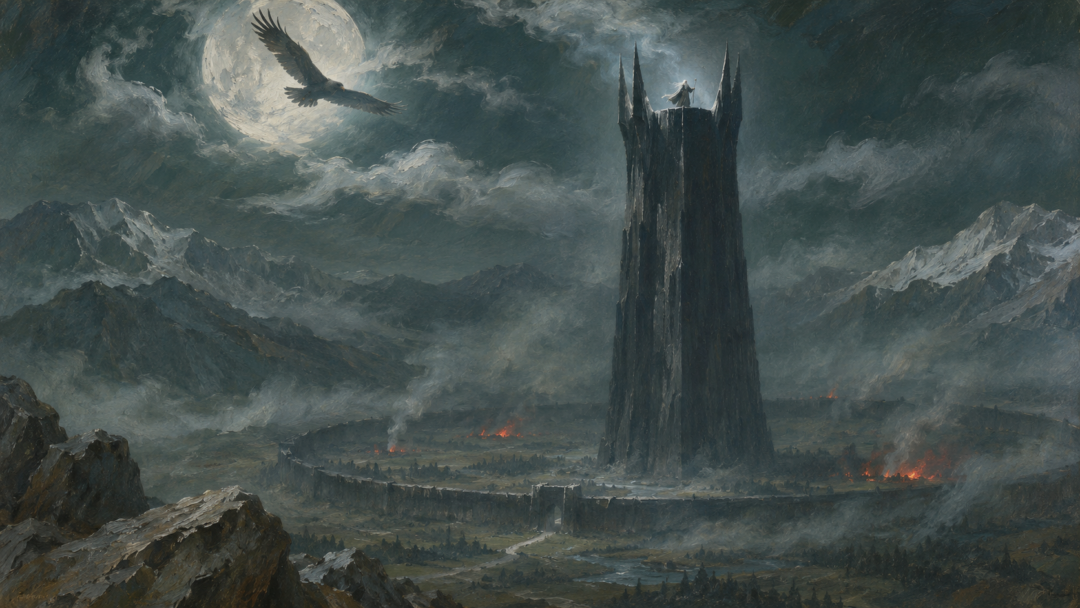
Above a ring of dark hills, a lonely tower rises in Frodo's sleep. A white-haired figure stands on its summit while wolves howl below. A winged shadow crosses the moon, a flash lights the darkness, and an Eagle swoops down to bear the figure away. Then come galloping hooves from the east. Frodo wakes thinking of the Black Riders, far from understanding what he has witnessed.
The scene, in “In the House of Tom Bombadil,” seems almost too accurate to be an ordinary dream. Could Gandalf have sent it to Frodo through ósanwe, the exchange of thought between minds? He might have possessed the capacity for such communication, but the story never says he sent this dream. More intriguingly, Frodo sees an escape that has already occurred. The strongest evidence concerns the dream's timing and Gandalf's reaction when he finally hears about it.
What Frodo actually sees in Tom Bombadil's house
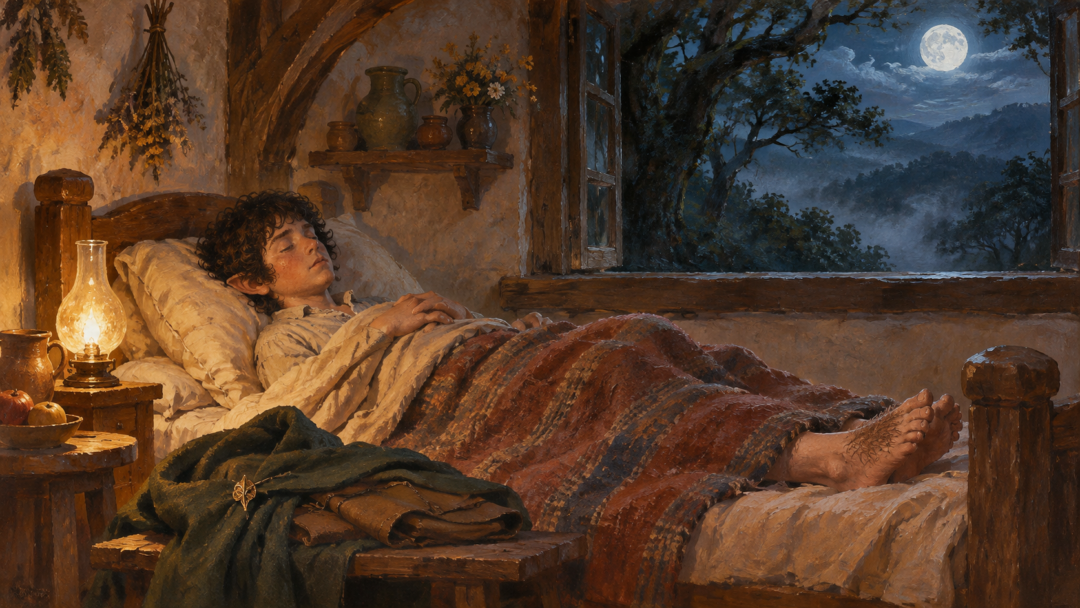
The hobbits reach Tom and Goldberry's home after their frightening encounter with Old Man Willow. Here, at last, are soft beds, a welcoming fire, and the assurance that the terrors of the Old Forest cannot follow them indoors. Yet their first night's sleep is far from ordinary. Frodo dreams of being lifted over a dark wall of rock, which resolves into a circle of hills surrounding a plain. At its center stands the towering stone pinnacle.
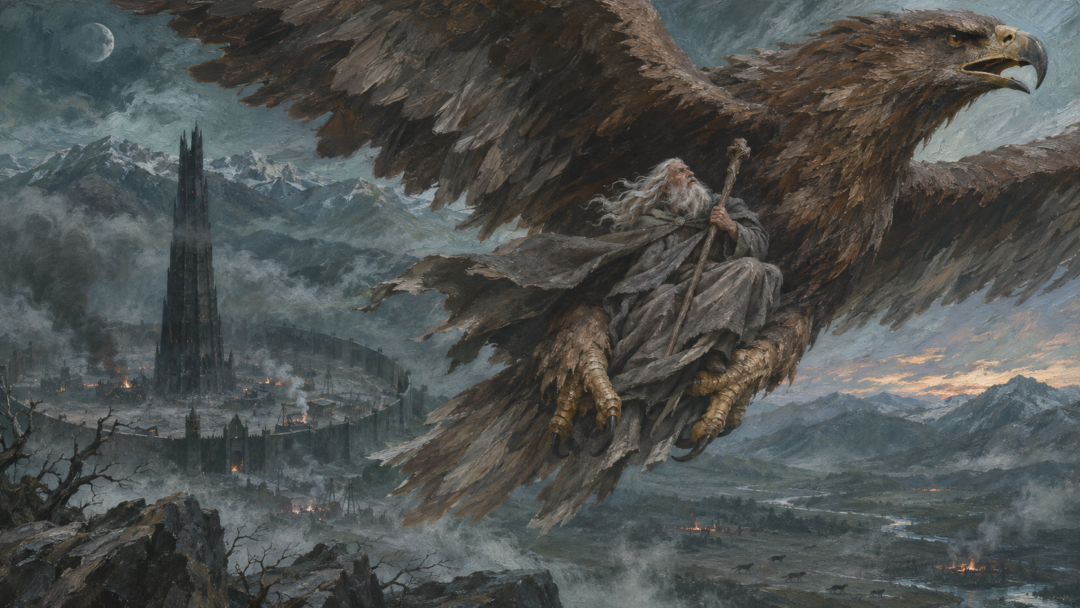
The dream supplies striking details without explaining them. Moonlight catches the standing figure's white hair. Voices and wolves rise from the plain; the figure raises a staff, and light flashes from it. The passing shadow becomes an Eagle carrying him away. Frodo is not shown Saruman, told the name Orthanc, or given an account of why the figure is imprisoned. He sees an event, not a spoken message addressed to him.
The hooves that follow belong to a different emotional world. Frodo thinks immediately of the Riders hunting him, and the sound remains in his mind as he wakes. It would be a mistake to treat everything in the dream as one perfectly recorded scene at Isengard. Its recognizable rescue is wrapped in fear and strange sensations that belong to Frodo's own dangerous journey. Nearby, Pippin and Merry also dream of the threats that have recently haunted them, while Sam sleeps peacefully. Tom's refuge does not make every sleeping vision a transmission.
The dates change the question
Appendix B, “The Tale of Years,” provides the essential anchor. Gandalf is imprisoned by Saruman in Orthanc on July 10, 3018. Gwaihir the Windlord rescues him in the early hours of September 18. The rescue is not merely the event that readers eventually learn to associate with Frodo's vision; it belongs to the story's already completed past by the time the hobbits arrive at Bombadil's door.
The hobbits enter the Old Forest on September 26. After Tom saves them from Old Man Willow, they reach his house that evening, and Frodo has the tower dream during their first night there. The following day is the rainy day of Tom's long stories, followed by another night's sleep. Placing the dream on that first night matters: it comes around eight days after Gwaihir lifted Gandalf away, not during the hours when the Eagle was approaching Orthanc.
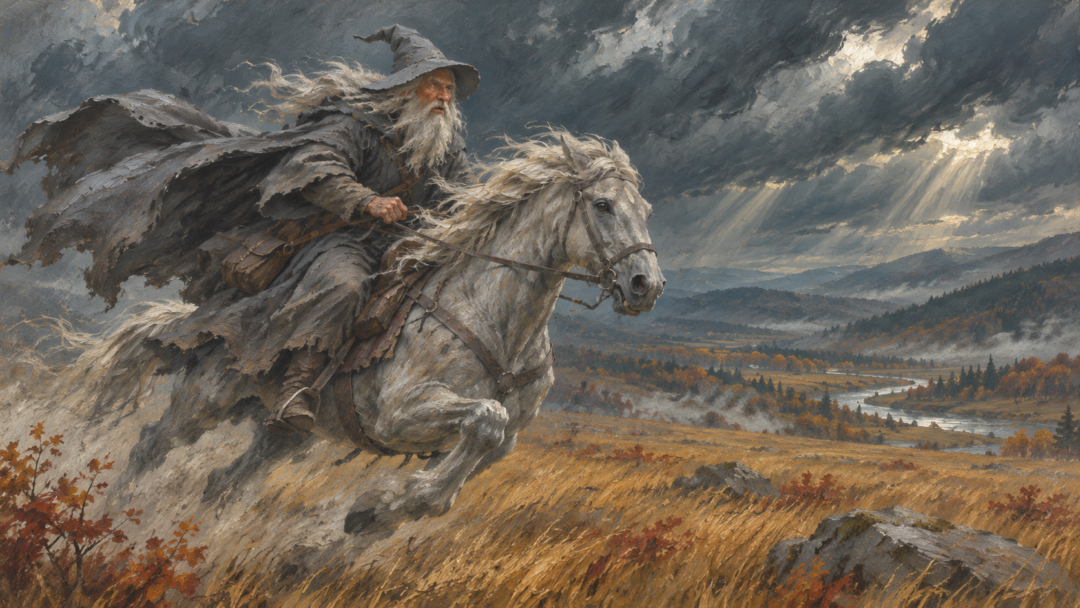
Gandalf, meanwhile, is not waiting atop the tower. Following his escape he has gone to Edoras and obtained Shadowfax, riding north and west in the effort to find news of Frodo. The chronology has him cross the Isen on September 24 and the Greyflood on September 27. Around the time Frodo sleeps under Tom's roof, Gandalf is a travelling rider, not a captive raising his staff beneath an Isengard moon. This also means Frodo's dream cannot straightforwardly be a live view of an ongoing rescue.
Gwaihir's appearance has its own explanation in Gandalf's later account. Before Saruman imprisoned him, Gandalf had asked Radagast to send news through birds and beasts. Radagast did so in good faith, and Gwaihir came bearing tidings, unexpectedly finding Gandalf stranded on Orthanc. The Eagle's intervention does not depend on Frodo dreaming, interpreting a plea, or arranging help. Of course, an event already over could still be remembered or somehow revealed later. The dates eliminate simultaneity, not every imaginable path by which knowledge of the past might reach a dreaming hobbit.
What Gandalf's astonishment tells us
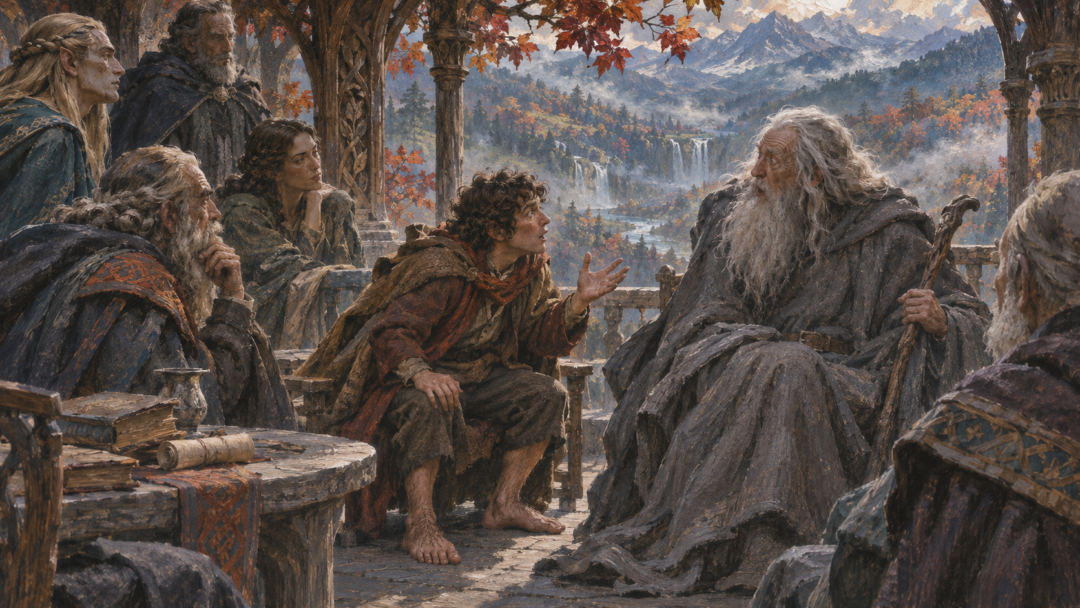
The story itself returns to the puzzle at the Council of Elrond, on October 25. Gandalf is recounting Saruman's betrayal and his confinement high above the circle of Isengard. When he describes his desperate situation, Frodo suddenly remembers the white-haired figure pacing on the tower. Only now does the dream acquire its meaning for him. In Tom's house it had been a disturbing vision; in Rivendell it becomes a recognizable piece of Gandalf's history.
The exchange is unusually revealing because neither character behaves as though they are completing a planned communication. Frodo breaks in with his recollection, having apparently forgotten the dream until Gandalf's story brings it back. Gandalf pauses, astonished, and looks at him. His response is brief: “Then it was late in coming,” before he continues his account. That sentence fits the gap between September 18 and Frodo's night in the Old Forest.
Gandalf's surprise is not absolute proof that he had nothing to do with the experience. A dream might have arisen through an influence he did not consciously direct, or through some process neither character explains. But surprise is awkward evidence for a confident claim that he deliberately composed and dispatched a message to Frodo. If the scene were intended to establish a successful act of thought-speech, it offers no acknowledgement of that act from its supposed sender.
There is a second restraint on the theory: what Frodo and Gandalf actually compare. Frodo recognizes the pacing figure and the moonlit hair, while Gandalf's account explains the captivity and the arrival of Gwaihir. The correspondence is remarkable, but the Council never identifies a channel of transmission. Gandalf does not say he reached across the miles to Frodo, and Frodo cannot report hearing his voice or receiving instructions. Recognition establishes a connection to a real event; it does not establish who placed the image in his sleep.
Could ósanwe carry such a vision?
The possibility is not invented out of thin air. Ósanwe is a Quenya term for the interchange of thought, developed in the essay “Ósanwe-kenta,” included in The Nature of Middle-earth. In this account, minds have a capacity for direct communication, although embodiment makes that capacity less immediately effective. Those living in bodies generally depend on ordinary speech and may neglect thought-communication. Gandalf's nature as a Maia makes the broader idea of mental contact particularly intelligible, even though he is acting in Middle-earth under the limitations of his incarnate mission.
The essay also makes thought-speech more demanding than unlimited mental broadcasting. A receiving mind must be open; openness is not the same as an invitation to read everything inside it. Affinity can strengthen contact, especially where friendship and sympathy join two people. Urgency and rightful authority can also lend strength. Frodo trusts Gandalf, and Gandalf's danger at Orthanc is genuine. Those circumstances make it reasonable to ask whether some kind of exchange was possible.
Still, conditions for communication are not evidence that communication occurred. The account of ósanwe does not specifically tell us that a sleeping hobbit must be receptive, that a sender can implant a detailed moving picture, or that another person's past experience arrives with the machinery of a dream. Nor does it establish a general rule by which thought travels backward or forward in time. If Gandalf intentionally sent anything after September 18, the dream would have to be understood as a later recollection or impression, not a live cry for rescue.
The distinction between communicating a thought and viewing a scene matters here. Frodo's dream includes an eagle, a flash, frightened voices, and finally hoofbeats that connect directly with his fears of the Black Riders. Some elements fit Gandalf's escape; others shape Frodo's experience of it. Even if one imagines a thought originating with Gandalf, the resulting dream need not be a photograph of his memory. But that is a possible reconstruction, not a mechanism the novel describes. The essay supplies vocabulary for asking the question, not a missing explanation of this particular night.
An accurate dream without a known sender
One tempting answer is to assign the vision to a greater power. Middle-earth contains meaningful dreams and guidance that characters do not fully understand, and the safety of Tom Bombadil's house makes this night feel especially enchanted. Yet neither Tom nor the Ring is identified as the dream's cause, and the text does not name Irmo, Ulmo, or any other Vala as its sender. Such proposals remain interpretations rather than discoveries hidden in a footnote.
Another possibility is that Frodo's own perception reaches something beyond his ordinary knowledge. That describes the experience without pretending to explain it. The telling feature is how little use Frodo can make of the dream at first. He does not recognize the place, go looking for Gandalf, or change his route because of it. The insight becomes intelligible only after the escape is safely behind Gandalf and the company has reached Rivendell. Knowledge arrives before understanding, but not in time to alter the rescue.
So the answer depends on the standard of proof. Could Gandalf have communicated by thought? Tolkien's account of ósanwe makes that plausible in principle. Does this dream show he did? No. The escape has already happened, Gandalf is astonished by Frodo's recollection, and the story names no sender or method. What remains is stranger than a secret distress call: a hobbit, safe beneath Tom's roof, dreaming of an Eagle lifting his old friend from the dark.
Sources & Notes
This article is based on close reading and interpretation of Tolkien's published works and related source material where relevant.