1. A Different Representative of Gondor
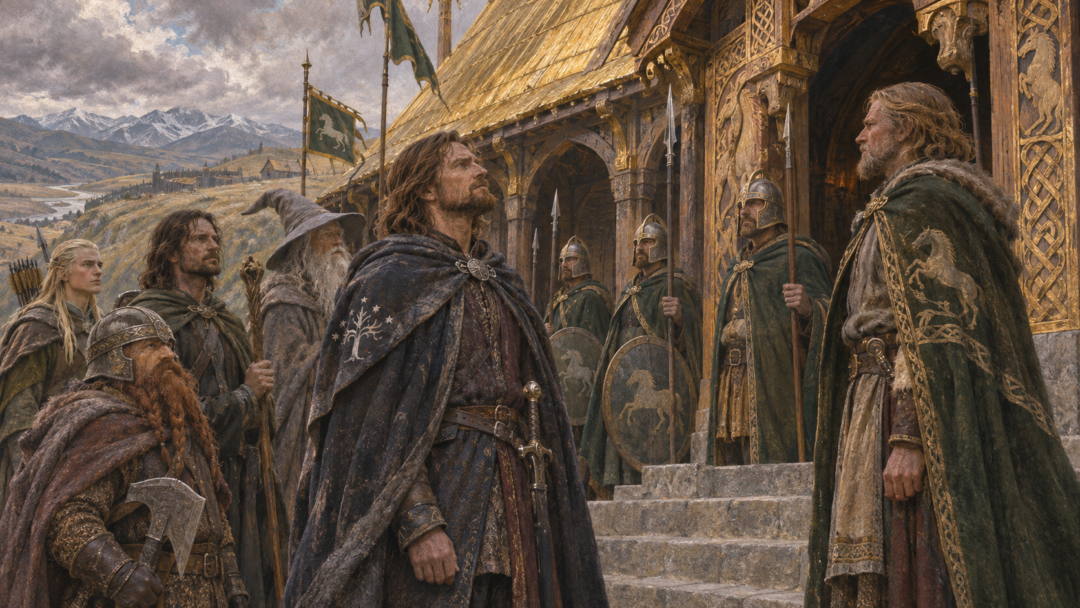
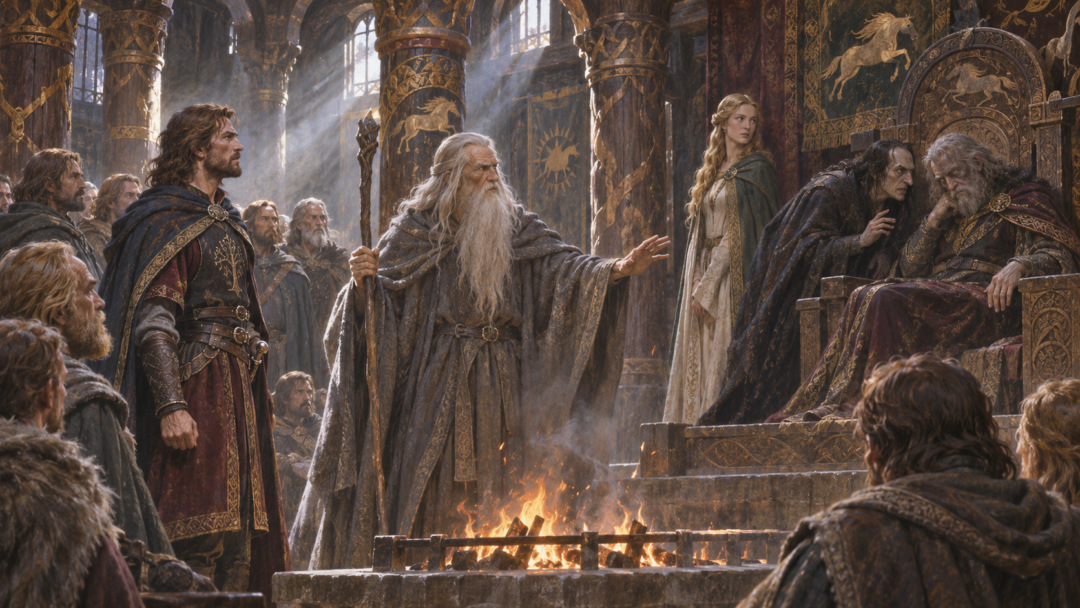
Had Boromir survived the breaking of the Fellowship and accompanied Aragorn into Rohan, his presence at Meduseld would have introduced a political dimension largely absent from the canonical encounter. Théoden would have received not merely a company of extraordinary travellers, but the eldest son of Gondor’s ruling Steward and one of the southern kingdom’s foremost military commanders. The distinction would have mattered both to the recovering king and to the interests Gríma had encouraged him to neglect.
Tolkien provides no canonical account of a meeting between Boromir and Théoden. Nor does he establish whether the two had encountered one another before the War of the Ring. Any reconstruction must therefore proceed from their established personalities, their political circumstances and the history of their respective peoples.
The most useful hypothetical assumes that Boromir survives Amon Hen, remains capable of travelling and accompanies the pursuit of Merry and Pippin. It also assumes that the essential circumstances of Théoden’s recovery remain unchanged. Neither development would necessarily follow from Boromir’s survival, but these conditions allow a meaningful comparison with the events of The Two Towers.
Under those assumptions, Boromir would probably become an effective advocate of renewed cooperation between Gondor and Rohan. His pride, however, could initially make that cooperation more difficult, particularly if he treated Rohan’s independent military emergency as subordinate to Gondor’s needs. His greatest diplomatic achievement would consist not in asserting Gondor’s importance, but in recognising that Théoden’s kingdom had to survive before it could come to Gondor’s assistance.
2. Boromir and the Historical Obligations of the Riddermark
Boromir would have approached Théoden with an understanding of the alliance fundamentally different from Aragorn’s. For Aragorn, the relationship between the kingdoms belonged to the inheritance of the realm he intended to restore. For Boromir, it belonged to the practical responsibilities of the government his family maintained.
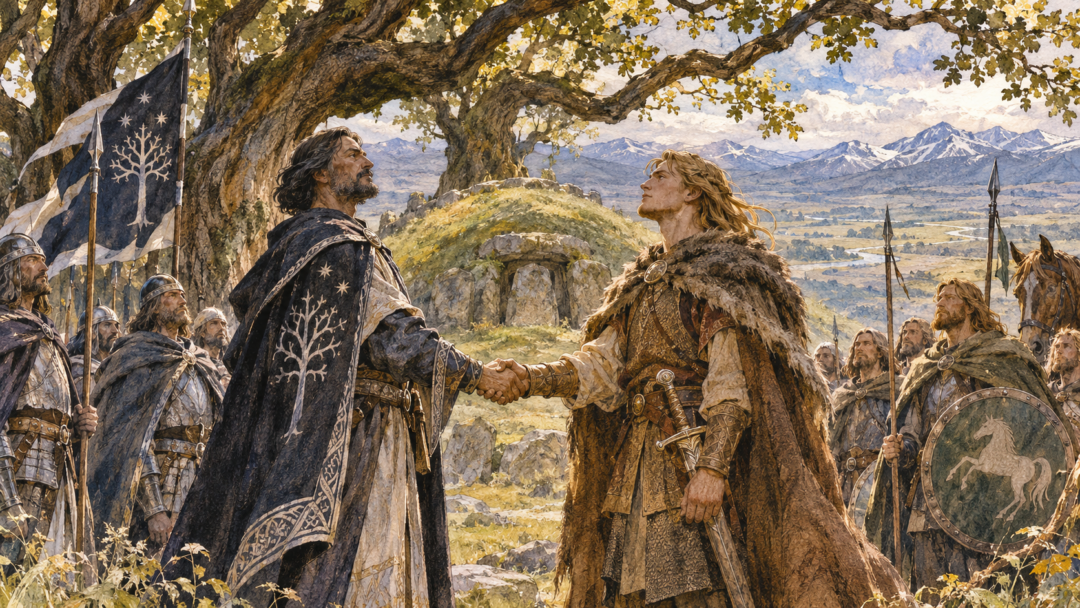
The origins of that relationship are described in Unfinished Tales, Part Three, ‘Cirion and Eorl and the Friendship of Gondor and Rohan’. Eorl’s intervention at the Battle of the Field of Celebrant saved Gondor from a grave military emergency. Cirion subsequently granted Calenardhon to Eorl’s people, and the two rulers established their enduring commitments through solemn oaths. Appendix A of The Lord of the Rings also records the establishment of the kingdom of Rohan under Cirion and Eorl.
The important political implication is that Rohan was an independent allied kingdom, not simply a reservoir of cavalry available to the Stewards. The relationship involved obligations on both sides, and its historical foundation was an act of mutual preservation.
Boromir’s knowledge of these traditions cannot be reconstructed in detail. Nevertheless, his position as Denethor’s heir and his demonstrated concern with Gondor’s security make it reasonable to suppose that he understood their practical significance.
His account of the defence of Gondor at the Council of Elrond reveals how strongly he identified with the burdens borne by his country. In The Fellowship of the Ring, Book II, Chapter 2, he stresses Gondor’s resistance to Mordor and the protective consequences of that resistance for other lands.
That conviction would give his appeals to Théoden considerable urgency. It would also expose a potential weakness: Boromir might be inclined to measure the value of the alliance primarily through what Rohan could contribute to Gondor’s defence. The historical oath offered a sounder basis for negotiation than such an exclusively Gondorian perspective.
3. The Steward’s Son at the Doors of Meduseld
There is good textual reason to expect that Boromir would have been less patient than Aragorn with the atmosphere surrounding Théoden’s court before Gandalf’s intervention.
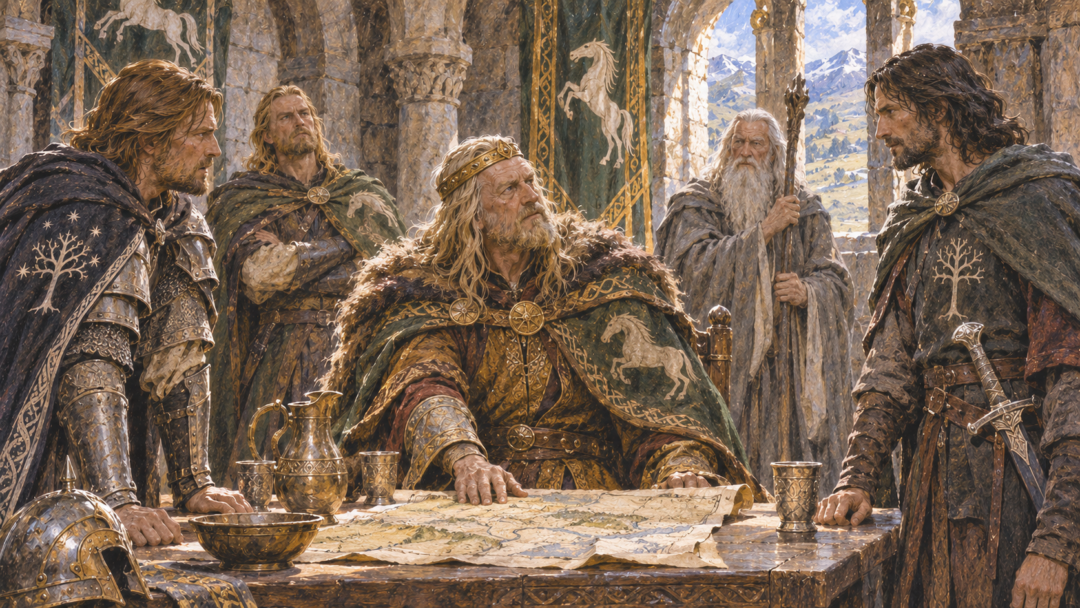
The encounter at Meduseld in The Two Towers, Book III, Chapter 6, ‘The King of the Golden Hall’, begins under conditions of suspicion. Háma requires the visitors to surrender their weapons, while Gríma subsequently attempts to discredit Gandalf and his companions before the king. Aragorn himself resists parting with Andúril, whose significance extends far beyond its practical military value.
Boromir’s attachment to the honour of Gondor might have produced a comparable reluctance, although Tolkien gives no basis for predicting a specific dispute over his sword. Unlike Aragorn, he would have possessed an immediately intelligible political identity: the son of the Steward of the allied southern kingdom.
His presence would therefore have complicated Gríma’s position. Hostility towards Gandalf could be presented as resistance to an unwelcome counsellor. Open contempt for Denethor’s heir would carry more obvious implications for relations with Gondor.
It would not, however, have rendered Gríma powerless. In ‘The King of the Golden Hall’, Gríma’s influence depends upon his ability to present distrust, caution and inactivity as prudent responses to danger. A Gondorian commander arriving during Rohan’s military crisis might have supplied him with an additional argument: that outsiders wished to draw Rohirric strength away from the defence of the Riddermark.
Whether Boromir would have recognised this manipulation is uncertain. His directness and military confidence suggest that he might have challenged Gríma openly. Yet an angry confrontation could have reinforced Gríma’s portrayal of foreign visitors as disruptive and demanding.
Gandalf would still have been the decisive figure. Boromir possessed neither Gandalf’s understanding of the forces surrounding Théoden nor his particular authority to challenge them. His political standing might have increased the pressure upon Gríma, but it could not substitute for the restoration of Théoden’s freedom of judgement.
4. The Respect Between Two Men of War
Once Théoden had rejected Gríma’s counsel, the relationship between the king and Boromir would probably have become substantially easier.
Boromir’s preferences are especially clear in The Two Towers, Book IV, Chapter 5, ‘The Window on the West’. Faramir remembers his brother as a man drawn strongly towards warfare, martial achievement and the distinctions of command. His account of their childhood also reveals Boromir’s dissatisfaction with the limitations of the Stewardship when measured against kingship.
These qualities might have made the restored Théoden particularly impressive to him. In ‘The King of the Golden Hall’, Théoden takes up his sword again, abandons his former inactivity and resolves to lead his people against their enemies. His recovery is expressed through renewed personal responsibility as well as renewed military action.
Boromir would likely have understood the importance of that transformation. His own account of the fighting at Osgiliath, given at the Council of Elrond, establishes his experience of desperate resistance against a superior enemy. He was accustomed to thinking about leadership under conditions in which defeat threatened the continued existence of a kingdom.
The two men would not necessarily have shared identical ideals. Théoden’s authority was hereditary and royal, whereas Boromir served within a Stewardship whose legitimacy explicitly preserved the distinction between governing Gondor and possessing its crown. Boromir’s ambition and Théoden’s kingship would thus have introduced an interesting inequality into their relationship.
Nevertheless, the most plausible foundation for personal respect would have been their shared willingness to expose themselves to the dangers faced by their soldiers. Théoden’s decision to ride into danger would have offered Boromir a persuasive answer to any initial doubts about the king’s strength or resolve.
5. Helm’s Deep as a Test of the Alliance
The immediate military situation would have prevented Boromir from treating Edoras merely as a diplomatic stopping point on the road to Minas Tirith.
In The Two Towers, Book III, Chapters 6 and 7, Théoden must respond to Saruman’s offensive against the Westfold. His movement towards Helm’s Deep arises from Rohan’s own desperate strategic circumstances. The kingdom cannot make a substantial contribution to Gondor while its western defences face destruction.
Boromir’s experience would have been relevant here. His description of the fighting at Osgiliath demonstrates familiarity with contested crossings, defensive resistance and withdrawal under pressure. It is reasonable to imagine him offering military assistance during the defence of the Hornburg, assuming that his wounds and the altered course of events permitted it.
The text does not establish what command Théoden would have entrusted to him. It would be unjustified to replace Aragorn, Éomer or another canonical defender with Boromir in a specific action, or to claim that his survival would have changed the outcome of the battle.
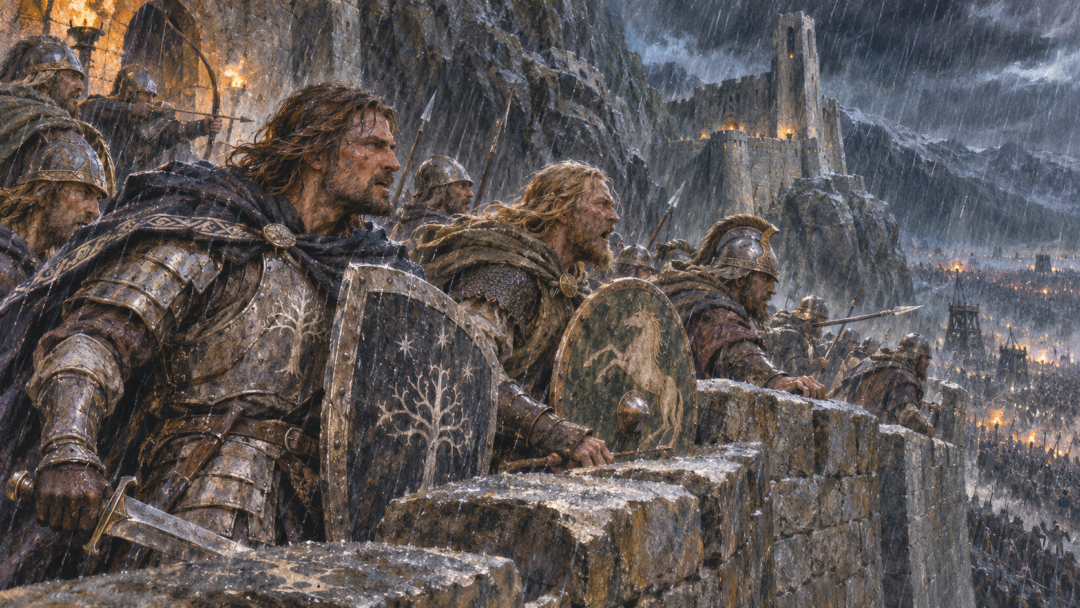
His more significant contribution might have been political. By fighting alongside the Rohirrim before requesting their assistance for Gondor, Boromir could have embodied the reciprocity underlying the Oath of Eorl. He would have demonstrated that Gondor’s heir regarded Rohan’s survival as a concern worthy of personal sacrifice.
Such an experience might also have modified his own understanding of the relationship. At the Council of Elrond, Boromir emphasises the burden Gondor bears in protecting others. At Helm’s Deep, he would have encountered another kingdom defending its people against an enemy whose victory would also have endangered Gondor.
The resulting solidarity would have been more persuasive than an appeal based solely upon inherited obligations. Boromir’s martial temperament, potentially troublesome in the hall of Meduseld, could have become his greatest diplomatic asset upon the walls of the Hornburg.
6. The Uncomfortable Question of Aragorn’s Authority
Boromir’s presence would also have introduced a complication into Aragorn’s developing relationship with Théoden. The king would have encountered both the claimant to Gondor’s ancient crown and the prospective successor to the man currently governing that kingdom.
At the Council of Elrond, Boromir questions Aragorn’s identity and the significance of the broken sword. In ‘The Window on the West’, Faramir’s recollections provide further evidence of his brother’s interest in the distinction between Steward and King. These passages do not prove that Boromir would have rejected Aragorn’s eventual accession, but they establish that Gondor’s political future was not an emotionally neutral matter for him.
The canonical death of Boromir also supplies important counterevidence to a simple interpretation of him as Aragorn’s rival. In The Two Towers, Book III, Chapter 1, ‘The Departure of Boromir’, he confesses his attempt to take the Ring and expresses his concern for the salvation of his people. Aragorn responds by affirming his honour.
A surviving Boromir who retained that repentance might have been more receptive to Aragorn’s leadership than the Boromir who first arrived at Rivendell. Survival alone, however, would not guarantee reconciliation or political submission.
At Meduseld, the two men would have represented different kinds of Gondorian authority. Boromir’s standing derived from his family, military office and existing government. Aragorn’s derived from his ancestry, personal leadership and claim to the restored kingship. Théoden could have respected both without being obliged to decide between them.
A publicly cooperative relationship would have strengthened their position considerably. Boromir’s support for Aragorn might have made the latter’s claims more persuasive to observers concerned with Gondor’s existing political order. Conversely, disagreement between them could have weakened the coherence of their appeals to Théoden.
It is particularly important not to turn the Rohirric king into an arbitrator of Gondor’s succession. Nothing in the established alliance required him to settle that question. His first responsibility remained the defence and government of his own people.
7. Would Gondor Have Received Rohan’s Aid Any Sooner?
The strongest argument against exaggerating Boromir’s diplomatic importance is that Théoden ultimately honours the alliance without him.
In The Return of the King, Book V, Chapter 3, ‘The Muster of Rohan’, Hirgon brings the Red Arrow from Gondor as a formal summons for assistance. Théoden’s preparations and subsequent ride demonstrate that the ancient relationship retains its force independently of Boromir’s presence.
A surviving Boromir might have provided earlier and more authoritative testimony concerning Gondor’s vulnerability. Yet his information would have been limited by the time he had spent away from Minas Tirith. His arrival in Rohan would not have supplied him with certain knowledge of Denethor’s latest intentions or the immediate circumstances of Mordor’s offensive.
Nor would his requests have eliminated the practical constraints upon Théoden: the defence of Rohan, the gathering of its forces and the movement of those forces towards Gondor. Boromir might have influenced discussions about priorities, but an earlier relief of Minas Tirith cannot be established from the published narrative.
His greatest potential contribution would instead have been the strengthening of confidence between the allies. He could have carried personal knowledge of Rohan’s sacrifices back to Gondor, while his participation in Théoden’s struggles might have given the Rohirrim greater confidence in the southern kingdom’s commitment to their welfare.
The irony of this alternate history is that Boromir would have served Gondor most effectively by resisting the temptation to demand that everything else yield to its immediate needs. His defining love for Minas Tirith need not have diminished. It would simply have acquired a broader political understanding.
The published story makes Théoden’s loyalty an independent expression of honour, rather than the achievement of a Gondorian negotiator. The most convincing surviving Boromir would therefore not be the man who persuaded an unwilling king to fulfil an ancient oath. He would be the man who helped make that oath a living relationship once more, discovering through shared danger that the survival of Gondor and the survival of Rohan were inseparable.
Sources & Notes
This article is based on close reading and interpretation of Tolkien's published works and related source material where relevant.