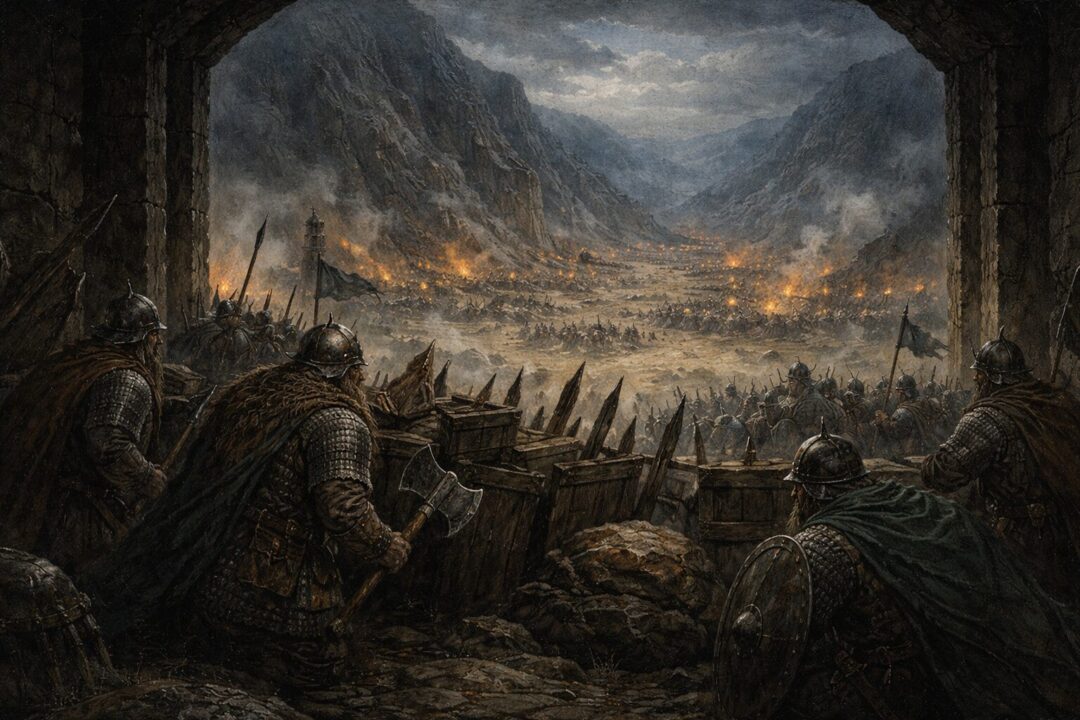
The War of the Ring is usually told like a road.
Mordor at one end, Minas Tirith at the other, with Rohan thundering in between.
But Middle-earth is not a road. It is a map.
And in 3019, the map is burning in more than one place.
The North is one of those places.
Not in the way that gets remembered—no white city, no black ships, no horns at dawn—but in a colder, harder way: an invasion meant to erase two kingdoms that had only recently returned to the world.
Dale and Erebor are not ancient powers in the Third Age. They are restorations. Hard-won, newly rebuilt, and—crucially—positioned in a region Sauron would be glad to turn into a wasteland again.
So it matters that when war comes north, it comes to their doorstep.
And it matters even more that the texts show a choice being made there: the Dwarves do not stand aside.
They aid Dale.
This article asks the counterfactual: what if they refused?
Not as fan-fiction, but as a careful “what if” constrained by what the texts actually establish—what pressures were present, what outcomes are explicitly recorded, and what consequences are at least implied by the narrative’s own hints.
What the texts say happened
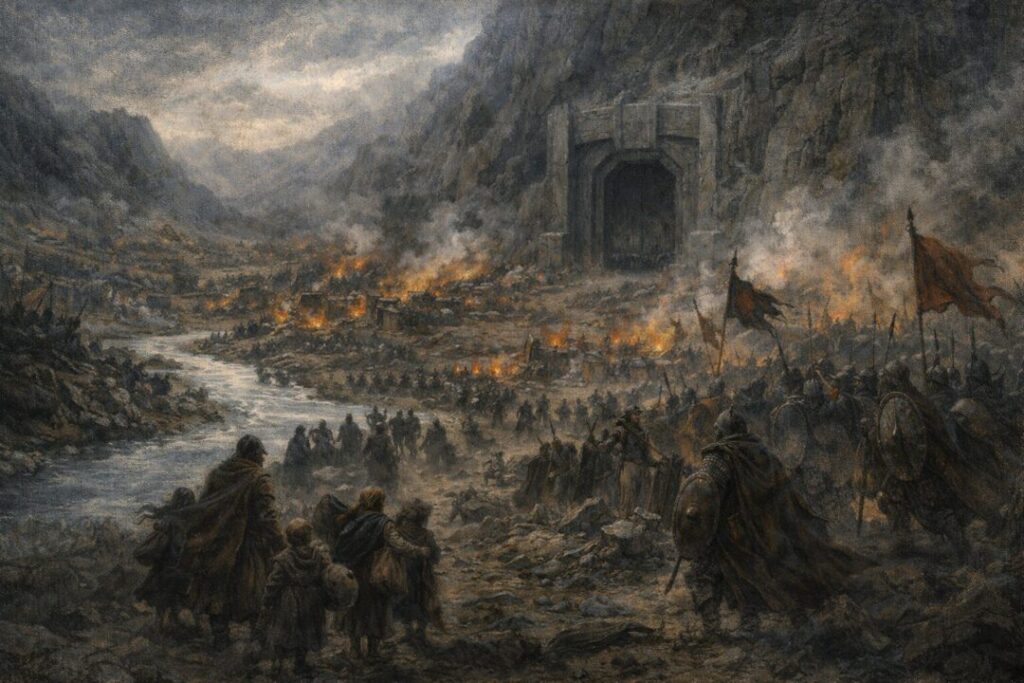
The Tale of Years in Appendix B records a northern invasion during the same March when the Pelennor Fields are fought.
Easterlings cross the Carnen.
King Brand is driven back to Dale.
And there, the text adds the pivotal line: “There he had the aid of the Dwarves of Erebor.”
That sentence is easy to skim.
But it’s the hinge.
Because what follows is not a minor skirmish. It is “a great battle at the Mountain’s feet,” lasting three days. Brand and Dáin both fall. The Easterlings win the field—but they do not take the Gate. Many Men and Dwarves take refuge inside Erebor and withstand a siege.
Then, after news of Sauron’s downfall spreads, the siege is lifted and the attackers are driven away.
So the canonical sequence is clear:
- Dale is attacked first.
- Erebor joins the defense.
- Both kings die.
- The defenders retreat into Erebor.
- The Gate holds through siege.
- The enemy is later driven off.
That is what happened.
Now we ask what changes if the Dwarves do not aid Dale.
What “refusing to aid” would actually mean
We have to be precise here, because “refusing to aid” can mean two different things:
- Refusing alliance with Sauron (i.e., refusing to cooperate with him)
- Refusing to help Dale (i.e., remaining neutral while Dale fights)
The first is not hypothetical. The Dwarves of Erebor do refuse Sauron’s overtures.
At the Council of Elrond, Glóin reports that a messenger from Mordor came to Dáin offering “friendship” and rings, while urgently asking about Hobbits and “Baggins.” Dáin does not accept; he withholds answer and refuses the pressure.
So the “what if” here is the second kind of refusal: not betraying the Free Peoples to Sauron, but refusing to spend Dwarven lives for Dale.
A closed-door policy.
A Mountain-first policy.
And it is not hard to imagine why it might tempt them.
Dwarves are not obligated—by any stated law in the texts—to defend a Mannish city. Erebor is a fortress. Dale is exposed. If you were thinking only in terms of survival, you might argue the rational move is to keep the Gate shut and let the storm pass outside.
But that is exactly where the dominoes begin.
Because Dale is not “outside.” Dale is the front yard of Erebor.
Domino One: Dale falls faster, and the battle moves to the Gate
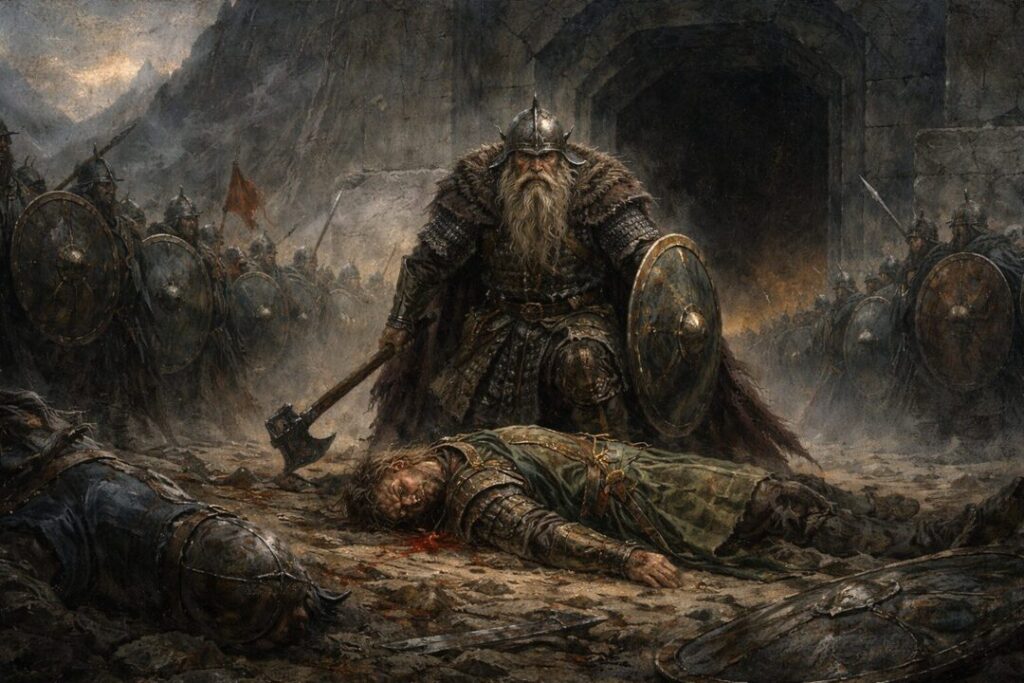
In the canonical account, Brand is pushed back to Dale and then has the aid of Erebor—and the decisive battle is fought at the Mountain’s feet.
If Erebor refuses, then Brand fights without that reinforcement.
What happens next cannot be stated as fact, because the text does not run the alternate scenario.
But the most conservative inference is also the simplest: Dale’s field army breaks sooner, and the attackers reach the Mountain in greater strength.
That does not guarantee the Gate falls. The Gate does not fall even in the real history.
But the siege becomes harsher, longer, and less contested.
And this matters because of what the canonical defense actually achieved: it fixed a large enemy host in place.
The battle and siege at Erebor keep an Easterling army occupied in the North during the critical days when the West marches to the Morannon.
A neutral Erebor may still be besieged—but it has surrendered initiative, sacrificed Dale, and lost the advantage of fighting the enemy before they fully consolidate.
Domino Two: The political bond breaks, and you lose what comes after
There is a detail the Tale of Years quietly preserves: after the war, Bard II and Thorin III become kings and later send ambassadors to the crowning of King Elessar.
That “perpetual friendship” between Dale and Erebor is not just sentiment. It is a stabilizing axis in the rebuilt North.
If Erebor had shut its doors while Dale burned, it is difficult to see how that friendship survives.
Even if Erebor endures the war, it endures as a fortress surrounded by the ashes of its closest ally.
That is a different North in the Fourth Age: colder, poorer, and more isolated.
This is interpretation, but it is tightly anchored in what the text shows: their alliance in war becomes their alliance in peace. Remove the first, and the second is no longer the default outcome.
Domino Three: The North becomes a vacuum
Now we come to the line that should keep the whole “what if” from feeling small.
On Tolkien Gateway’s Battle of Dale page, a quotation from Gandalf is preserved from Appendix A (Durin’s Folk):
When you think of the Pelennor, do not forget “the battles in Dale and the valour of Durin’s Folk.” Then he adds: “Think of what might have been.”
And the sting of that warning is what follows: the implication that without those northern battles, horrors might have spilled into Eriador—and the world that results might not include a Queen in Gondor.
We have to handle that carefully.
Gandalf does not lay out a step-by-step logistics plan. He does not name exact routes, exact commanders, or exact timetables.
But he does explicitly assert that the northern battles mattered enough that their loss could have reshaped the West.
So what does “refusing to aid Dale” change in this context?
It increases the odds that the northern theater collapses quickly—creating freedom of movement for Sauron’s allies and pressure on regions that, in the canonical story, survive long enough to take part in the post-war world.
We can’t go beyond that without inventing details.
But we also don’t need to.
Gandalf’s warning is already the text telling you: the North is not a side quest.
Domino Four: The psychological war turns
There’s also a quieter consequence.
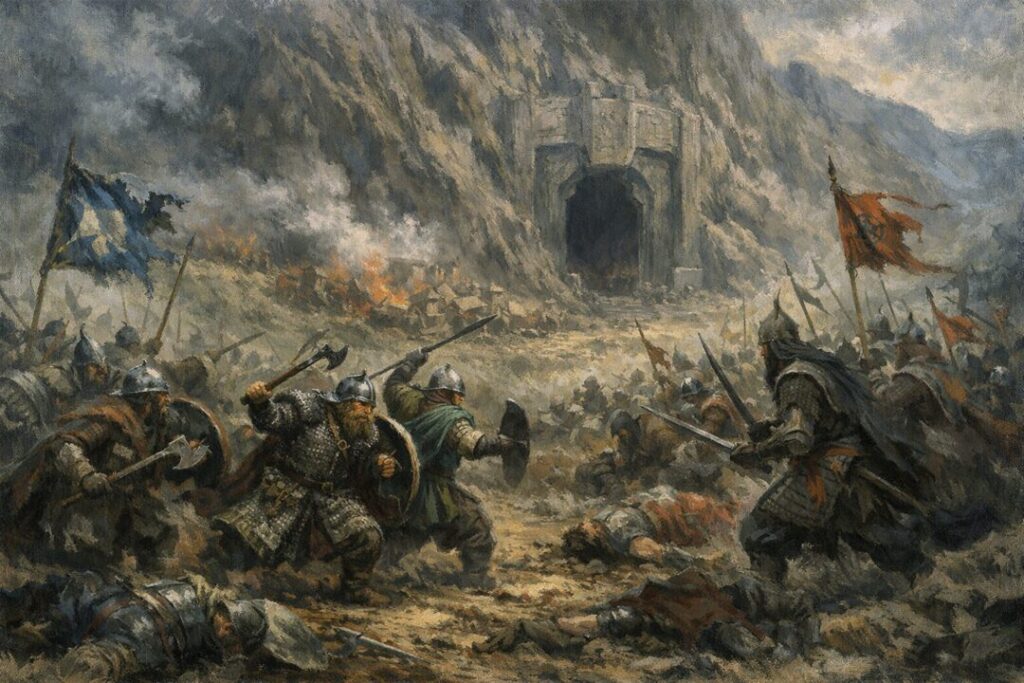
In the canonical story, Sauron’s war is fought on multiple fronts at once: Gondor, Rohan, the Ring-bearer’s road, and northern invasions (including the attacks out of Dol Guldur recorded in the Tale of Years).
Sauron’s strategy is pressure—overwhelm, divide, exhaust.
Erebor aiding Dale is not just military.
It is moral.
It says: we will not let the small kingdoms be swallowed one by one.
If Erebor refuses, the message to every border realm is the opposite: when the darkness comes, you may be left alone.
That kind of fracture is exactly what Sauron’s diplomacy at Erebor was trying to exploit in the first place—offering “friendship” and rings and special guarantees in exchange for compliance.
The Dwarves reject that offer in the texts.
But a refusal to aid Dale, even without any alliance with Mordor, still produces a similar outcome: division among the Free Peoples at the moment unity is most valuable.
So would refusing to aid Dale have saved Erebor?
Possibly—in the narrowest sense.
If you define “saved” as “kept the Gate shut and survived the siege,” then yes: Erebor might still endure for a time as a fortress.
But that is not the standard the texts encourage you to use.
The War of the Ring is repeatedly framed as a war of consequences, not walls.
You can survive behind stone and still lose the world outside it.
And the canonical narrative goes out of its way to show the alternative: Dáin does not stay behind the Gate.
He goes out.
He stands with Brand.
He dies defending him.
And the Gate holds anyway.
That last part is what makes the question sharp.
The Dwarves paid the price of alliance—and still did not lose their home.
In other words: the story suggests the brave choice was not only right, but effective.
And Gandalf’s warning suggests that if it had gone the other way, the victory in the South might not have been enough to preserve the kind of world that can crown a King and restore peace.
So if you want the most honest answer the texts allow, it is this:
Refusing to aid Dale might have preserved Dwarven lives in the short term—but it would have risked turning the North into a ruinous vacuum, with consequences the story itself tells you not to underestimate.
And that is why the northern war matters.
Not because it’s bigger than the Pelennor.
But because it’s the proof that the War of the Ring was never one battle.
It was a chain.
And Erebor was one of the links that did not break.
Sources & Notes
- J.R.R. Tolkien, The Lord of the Rings, Appendix B, “The Tale of Years” — the March 3019 entries record Brand driven back to Dale, the aid of the Dwarves of Erebor, the three-day battle at the Mountain, the siege, and its lifting after Sauron’s fall.
- J.R.R. Tolkien, The Lord of the Rings, Appendix A, “Durin’s Folk” — Gandalf’s warning not to forget the battles in Dale and the valour of Durin’s Folk supports the article’s claim that the northern war mattered to the fate of the West.
- J.R.R. Tolkien, The Lord of the Rings, Book II, Chapter 2, “The Council of Elrond” — Glóin reports Mordor’s messenger to Dáin, offering friendship and rings while pressing for news of Bilbo, Baggins, and the Shire.
- J.R.R. Tolkien, The Lord of the Rings, Appendix B, “The Tale of Years” — the assaults on Lórien and the fighting under the trees in Mirkwood show Sauron’s wider northern pressure during the War of the Ring.
- J.R.R. Tolkien, The Lord of the Rings, Appendix B, “The Tale of Years” — the post-war notices for Bard II and Thorin III Stonehelm support the article’s point that Dale and Erebor survive into the restored Fourth Age order.