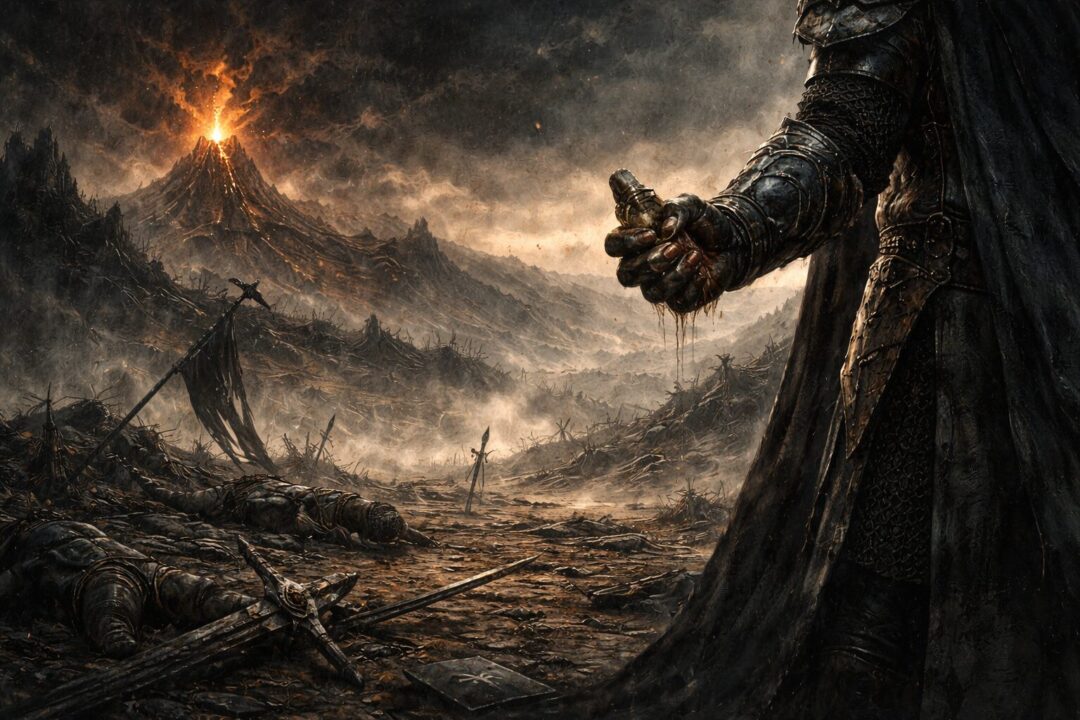
There is a particular kind of Middle-earth mystery that isn’t built from missing chapters.
It’s built from small words.
A verb.
A casual phrase.
A detail that seems too minor to carry weight—until you notice it solves a problem the story never spells out.
The question sounds simple:
Where did Sauron keep the Nine Rings while he was “disembodied”?
But the moment you ask it, you run into the real issue underneath:
Sauron loses a body twice in the long history of the Rings.
And yet the Nazgûl remain bound to him.
So whatever the Nine Rings are doing, they are doing it even when Sauron is not a visible king on a throne.
That means the Nine are not just symbols.
They are mechanisms.
And the texts—careful as they are—give you just enough to map what must be true, and what is never directly confirmed.
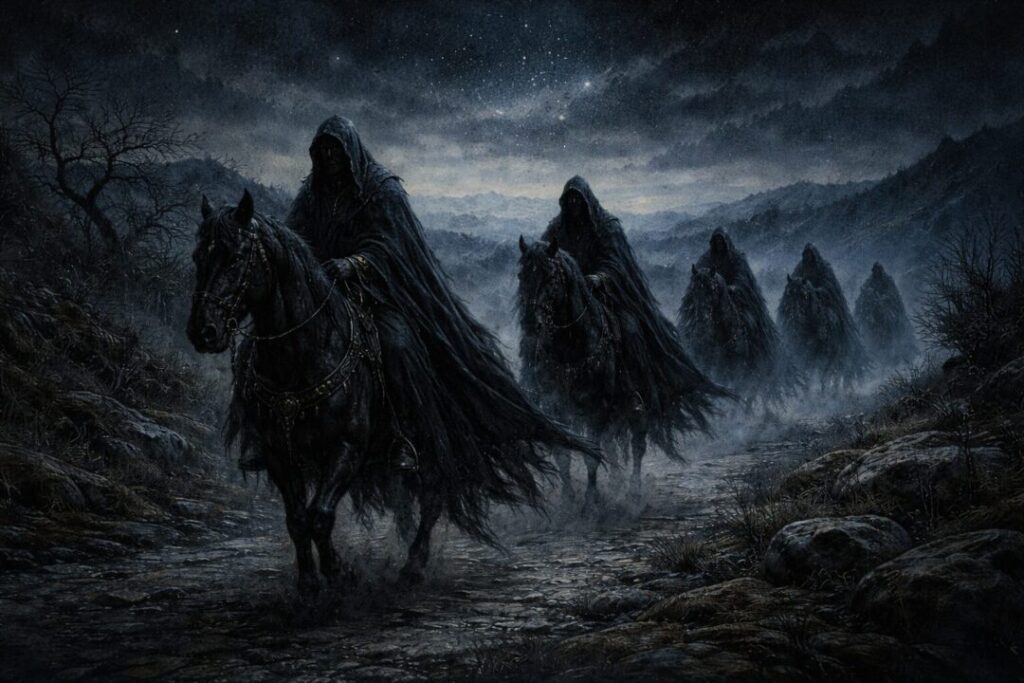
What the story states plainly: Sauron “has gathered” the Nine
The clearest line is Gandalf’s, spoken early, almost offhand, while the Shire still feels safe.
He tells Frodo that Sauron has been searching, rebuilding, recovering strength—and then says:
“So it is now: the Nine he has gathered to himself; the Seven also, or else they are destroyed.”
That sentence does not describe a vague spiritual influence.
It describes a collection.
The Nine are not merely “under his power.” They are “gathered to himself”—language that implies the Rings are in his possession, not distributed among their former bearers.
Galadriel later uses the same kind of concrete phrasing when Frodo looks into her Mirror and sees the Eye:
“You saw the Eye of him that holds the Seven and the Nine.”
Again: holds.
Not “once held.”
Not “made.”
Not “rules.”
Holds—as in custody, ownership, keeping.
By the late Third Age, at least, the simplest reading is that Sauron possesses the Nine Rings physically.
That already overturns the popular assumption that the Ringwraiths must still be wearing them.
A complication the text itself creates: “The Nine the Nazgûl keep”
Then we hit the line that causes confusion.
At the Council of Elrond, Gandalf says:
“The Nine the Nazgûl keep.”
If you take that sentence alone, it sounds like the case is closed: the Ringwraiths have their Rings.
But the surrounding evidence pushes back.
When Frodo is stabbed on Weathertop, the Nazgûl are terrifyingly present—but Frodo does not describe seeing Rings on them. And later, the narrative repeatedly frames the Nine as something Sauron has reclaimed.
One reasonable conclusion—held by many lore readers—is that this line reflects an earlier conception that was never fully revised, while later passages clarify the intended situation: that Sauron holds them.
Tolkien Gateway summarizes this tension directly and points to multiple passages indicating Sauron had reclaimed them by the end of the Third Age.
That doesn’t make the Council line meaningless. It simply means you have to read with Middle-earth’s usual rule: later, clearer statements outweigh a single ambiguous phrase.
And then there is a sharper piece of evidence—one that removes most of the doubt.

The strongest confirmation: Sauron held the Nine while commanding them
In Tolkien’s letters (and echoed in Unfinished Tales material about the Ringwraiths), the situation is described with unusual directness:
Sauron still had primary control of their wills through their nine rings (which he held).
That is the point where the popular image fully flips.
The Nazgûl are not independent agents empowered by Rings on their hands.
They are servants sustained and enslaved by Rings that are kept elsewhere—in the possession of the Dark Lord.
So if the Nine are being “held,” the next question becomes unavoidable:
Held where—especially during the years when Sauron had no body?
What “disembodied” actually means in this context
We need to be precise.
When people say “Sauron was disembodied,” they often imagine something like a ghost drifting helplessly, unable to affect the world.
But the texts present a will that endures—even when form is lost.
After the War of the Last Alliance, Sauron is “thrown down,” and the One Ring is cut from him. He does not cease to exist, but he is reduced. His return is slow. His shape is not immediately rebuilt.
The important part for our question is practical:
A Ring is a physical object.
A vault is a physical place.
A guard is a physical creature.
If Sauron lacks a body, he cannot personally carry Rings, lock doors, or stand over a chest.
So if the Nine remained in his possession across that long diminished period, they must have been kept through agents and strongholds.
The texts do not give a sentence like: “He hid them in this room.” They do not provide a map marker.
But they do allow you to narrow the possibilities—and to state what cannot be true.
The key negative: the Nine were not taken at the end of the Second Age
This is the simple but decisive observation:
When Isildur cuts the One Ring from Sauron, he takes it as a weregild. The narrative treats that moment as the great seizure.
If the Nine Rings had been on Sauron’s person—on his hands, or worn openly—there is no reason Isildur would leave them behind. It would contradict everything we see about the temptation and value of Rings of Power.
So the most conservative conclusion is:
At the moment of Sauron’s overthrow, the Nine were not on his body.
That aligns neatly with the later claim that Sauron held them. It implies that, even before his final defeat, the Nine were already stored and guarded rather than worn.
And that brings us to the most plausible kind of answer the texts permit.
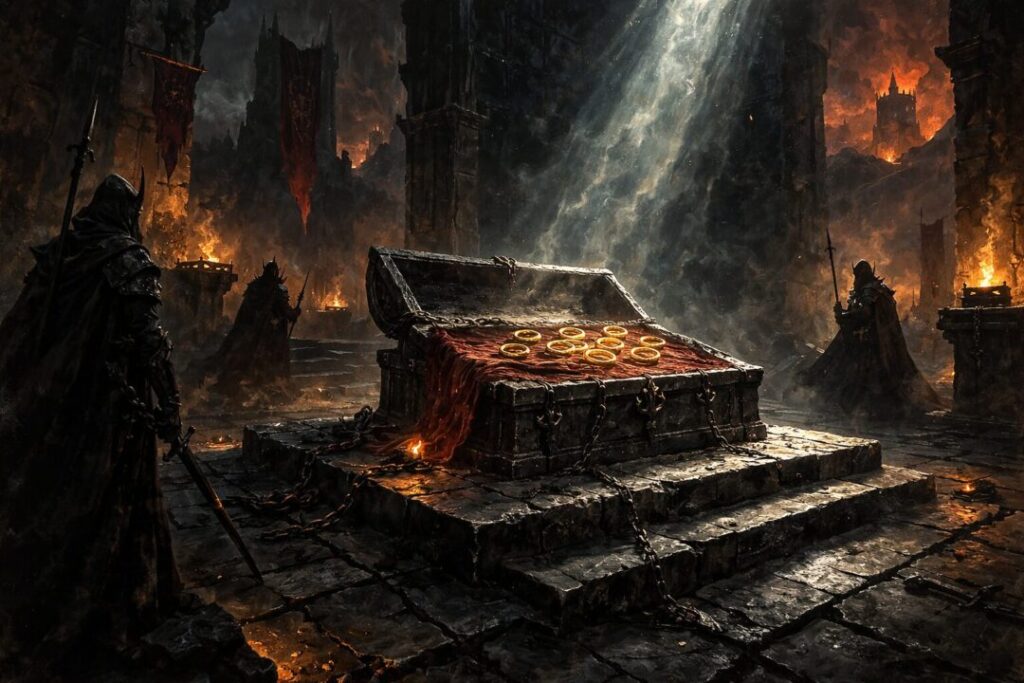
The most text-consistent picture: kept in Sauron’s guarded hoard, not on the wraiths
We can say with confidence:
- By the end of the Third Age, Sauron possesses the Nine (“gathered to himself,” “holds the Seven and the Nine”).
- The Ringwraiths remain enslaved through Rings that Sauron “held.”
- Therefore, the Nine do not need to be worn by the Nazgûl to bind them, and likely were not.
What we cannot say with certainty is the exact room, chest, or fortress during every phase of Sauron’s return.
But the logic the texts force on you is this:
If Sauron held them while lacking a body, then his servants held them for him—inside a secure stronghold under his dominion.
That could mean Barad-dûr when it stood.
It could mean another guarded place in Mordor during his diminished years.
It could even mean that the Rings were moved as his strength and location shifted.
Those location details are not explicitly stated in the primary narrative, so they must remain interpretation.
Yet the larger truth is not speculation at all:
The Nine are treated as property in Sauron’s keeping—tokens he can reclaim, store, and use as a leash.
Why it matters: the Nazgûl are not “Ring-bearers” in the way readers assume
This reframes the entire psychology of the Ringwraiths.
They are called Ringwraiths because Rings made them what they are.
But by the time of the War of the Ring, they are closer to something worse:
Wraiths whose existence depends on Rings that they do not possess.
Imagine what that means.
To be ancient.
To be emptied.
To be bound to a power you cannot touch—because the object that sustains you is locked away, held by another hand.
The Ring is not your weapon.
It is your chain.
This is why the question “Where were the Nine kept?” is more than a trivia puzzle.
It reveals what kind of domination Sauron preferred.
Not a partnership with powerful servants.
Not even the illusion of shared power.
A system where the servant cannot defect—because the source of their being is held elsewhere, in a place they cannot reach, guarded by a will they cannot escape.
And it leaves one last open loop, hanging over the whole history:
If the Nine were kept like that—gathered, held, locked away—then the true center of the Nazgûl’s existence was never their hands at all.
It was Sauron’s hoard.
And once you see that, you start to notice how often Middle-earth’s great evils work the same way:
Power is offered.
Dependence is created.
And then the real control is moved out of reach.
Sources & Notes
- J.R.R. Tolkien, The Lord of the Rings, Book I, Chapter 2, “The Shadow of the Past” — Gandalf says Sauron has “gathered” the Nine to himself, alongside the Seven or their destruction.
- J.R.R. Tolkien, The Lord of the Rings, Book II, Chapter 7, “The Mirror of Galadriel” — Galadriel describes the Eye as belonging to one who “holds the Seven and the Nine.”
- J.R.R. Tolkien, The Lord of the Rings, Book II, Chapter 2, “The Council of Elrond” — preserves the complicating phrase “The Nine the Nazgûl keep,” useful for the article’s ambiguity and textual tension.
- J.R.R. Tolkien, Letter 246 — states that Sauron retained primary control of the Nazgûl’s wills through their Nine Rings, “which he held.”
- J.R.R. Tolkien, The Silmarillion, “Of the Rings of Power and the Third Age” — gives the wider history of the Nine Rings, the making of the Ringwraiths, and Sauron’s overthrow when Isildur took the One Ring.