There is a quiet trick the story plays on first-time readers.
It trains you to think in headlines.
Moria.
Isengard.
Helm’s Deep.
Minas Tirith.
So Gondor’s danger feels like something that begins late—when the beacons flare and the City is walled about with fire.
But the texts put Gondor’s nearest brush with collapse earlier, and they do it almost casually: a date in a chronicle, a grim report at a council table, a few lines that sound like backstory until you realize they are the sound of a front line snapping.
And it happens while the Fellowship is not yet a Fellowship.
A date that should feel louder
Appendix B (the Tale of Years) gives the hinge plainly:
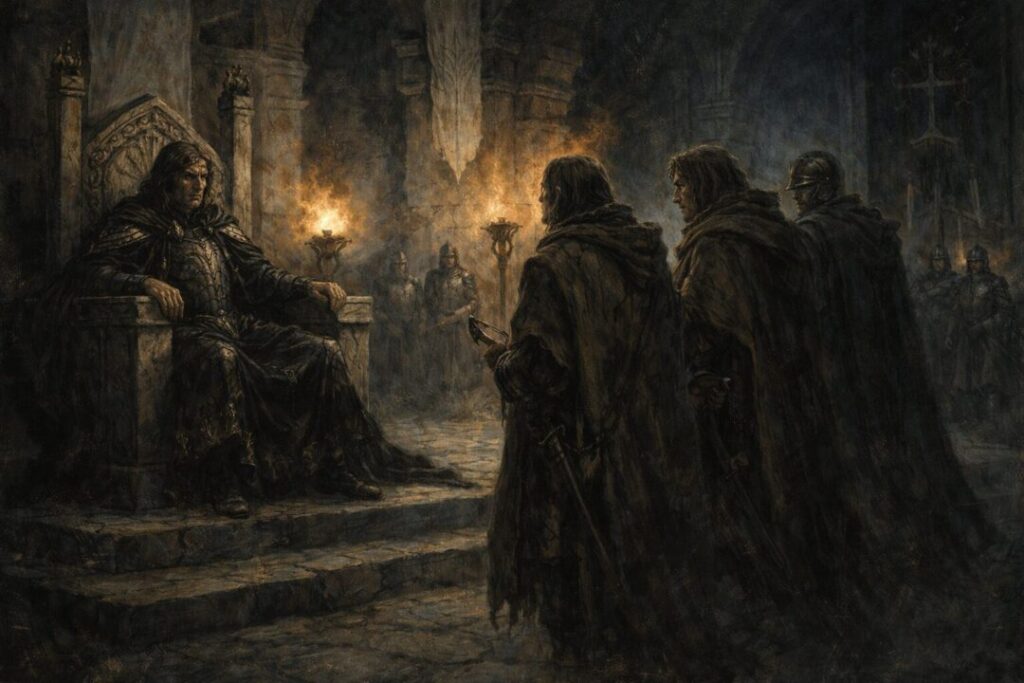
June 19, 3018: Boromir and Faramir receive the riddle in their sleep.
June 20, 3018: Sauron attacks Osgiliath.
Those two entries sit side by side like coincidence.
They are not framed as prophecy causing the assault. The texts never say that. But the proximity matters because it shows how abruptly the War’s pressure tightens around Gondor before the Council of Elrond ever meets.
Osgiliath is not just a ruined city with a famous name. In the late Third Age it is still Gondor’s forward position on the Anduin, guarding the approaches from Ithilien and the crossings that matter.
When the attack comes, it is not described as a mere skirmish on the border.
It is described—by the man who lived through it—as a near-annihilation.
Boromir’s report is not a victory speech
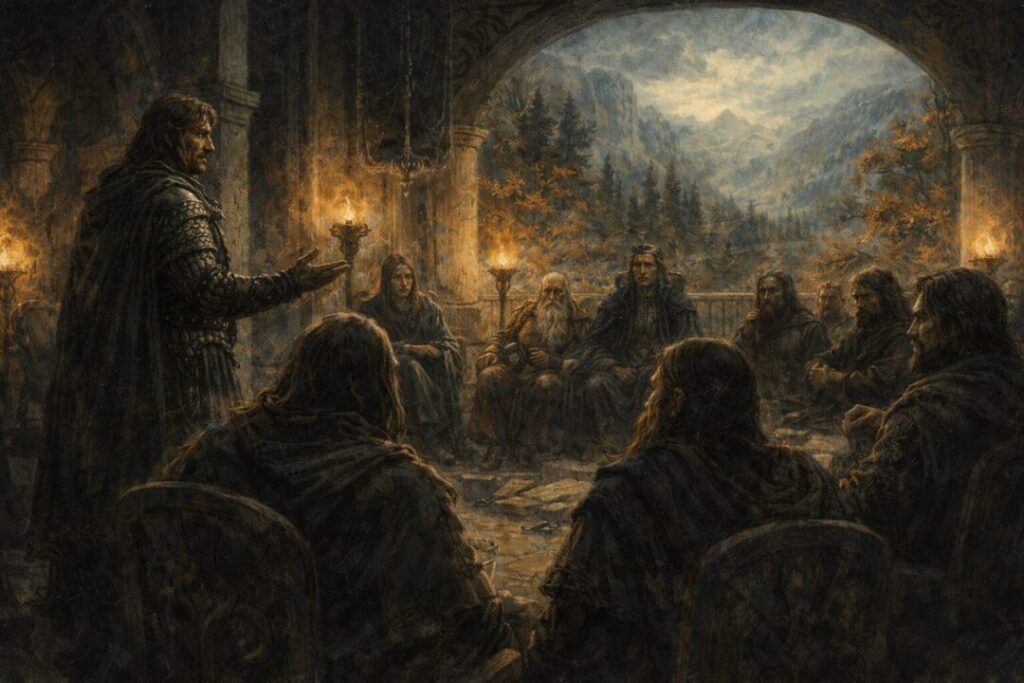
At the Council of Elrond, Boromir is often remembered for his pride and his urgency.
But when he speaks of Osgiliath, the tone is different. He is not boasting.
He is explaining why Gondor is desperate.
He tells them that the assault was sudden, that Gondor’s men were outnumbered, and that the enemy included not only Orcs but also Easterlings and Haradrim. He describes a terror in the attack that felt new—an overwhelming pressure that did not come only from steel.
And then he gives the detail that reveals how close the defense came to simply ending:
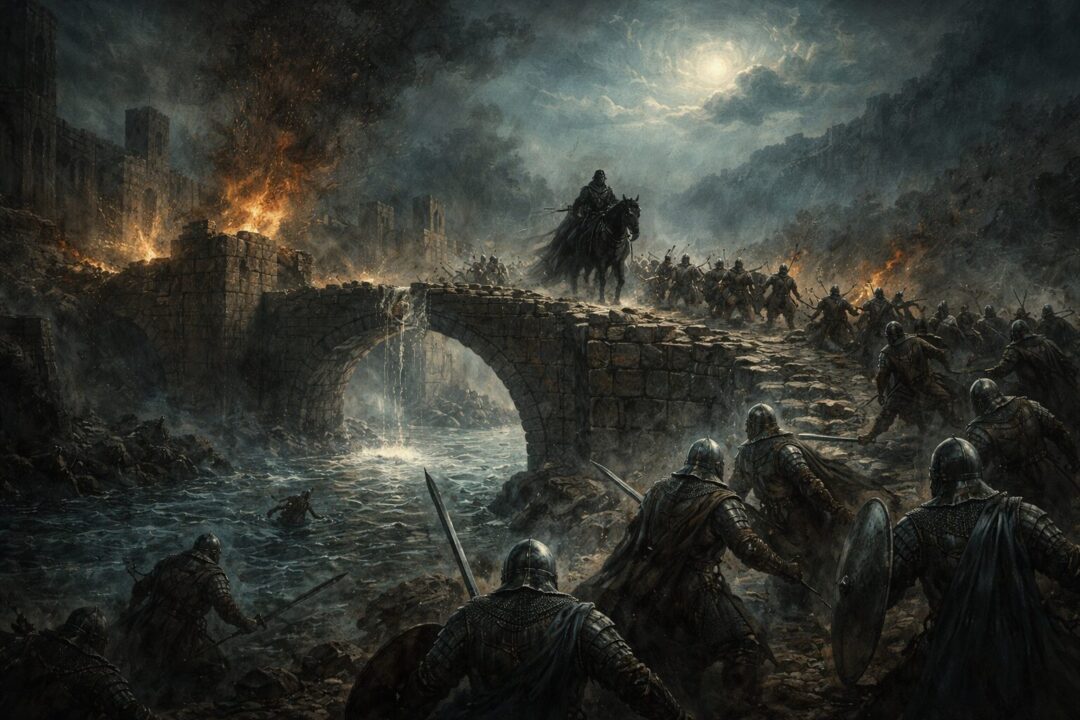
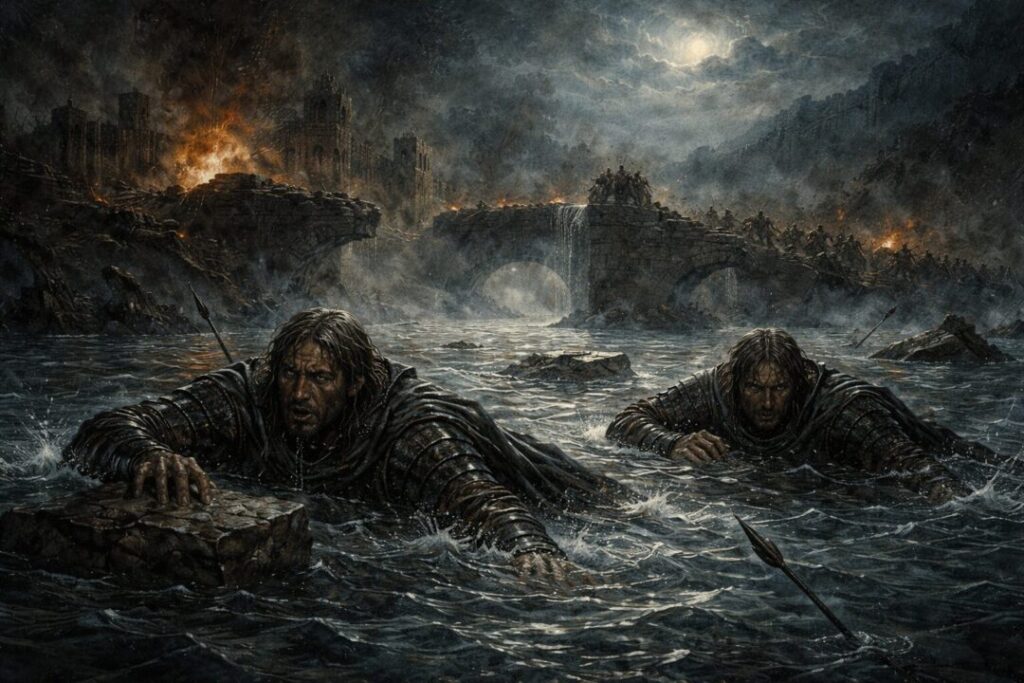
The last bridge of Osgiliath is held for a time by a company led by Boromir and Faramir—until the bridge is destroyed.
After that, only a very small remnant escapes, swimming the Anduin.
That is not “we were driven back.”
That is “our forward host was almost erased.”
If you want to understand how close Gondor came to losing before Rivendell, start there: not with a siege engine at the Rammas, but with a defense that ends in water, darkness, and a handful of survivors.
Why breaking the bridge matters
It is tempting to read “the bridge broke” as a clean tactical move—deny the crossing, retreat to safety.
The problem is that Osgiliath is not just a bridge. It is a position, and positions are made of more than stone.
When the eastern half falls and the defenders are nearly destroyed, Gondor loses three things at once:
- Men — the trained soldiers who can’t be replaced quickly.
- Confidence — the sense that the River-line will always hold.
- Time — because rebuilding a forward defense is slower than destroying it.
The texts do not give us precise numbers. They do not map out every company and captain. So we should be conservative.
But they do give the shape of the loss: it is severe enough that Boromir’s story becomes part of the case for why the Ring cannot be used as a weapon Gondor is waiting to claim.
Gondor is not in a position of leisurely strength.
Gondor is bleeding.
The attack isn’t only about Gondor
Here is where Unfinished Tales quietly deepens the picture.
In “The Hunt for the Ring,” the broader movement behind the year 3018 becomes clearer: the Nazgûl are not simply generals riding with an army. They are also hunters sent west with a specific purpose.
And the Osgiliath assault, seen in that light, begins to look like more than a push for territory.
One plausible reading—supported by the way “The Hunt for the Ring” frames Sauron’s priorities—is that the attack helps cover the Nazgûl’s true mission. A blow against Gondor looks like straightforward war. It distracts. It makes the appearance of the Ringwraiths feel like part of a military campaign rather than a search.
The texts do not say, “This was the plan, step by step.” We are not given Sauron’s private strategy in a neat outline.
But the alignment is hard to ignore:
- The assault happens the same summer the hunt begins to move west in earnest.
- The war-pressure against Gondor rises just as the Black Riders are about to enter the North.
- Boromir’s account includes a fear and a commander-shape that fits the presence of the Nazgûl.
So even if you treat motive cautiously, the effect is plain: Gondor is struck hard—and the Shadow is freed to reach outward.
The grim chain of consequences
Now place June 20 back into the larger timeline.
In late September, Frodo leaves Bag End.
On October 25, the Council of Elrond is held.
On December 25, the Fellowship departs from Rivendell.
Between the Osgiliath assault and the Fellowship’s departure, Gondor is living in the aftermath of a near-catastrophe.
And that casts Boromir’s journey in a different light.
Appendix B notes that Boromir sets out from Minas Tirith on July 4, 3018—shortly after the assault and after the riddle-dream that speaks of Imladris, the Sword that was Broken, and Isildur’s Bane.
It is easy to imagine this as a proud captain simply answering a call.
But in context, it looks like something sharper:
Gondor has just taken a blow that shows its forward defense can be shattered. The Steward’s realm is already stretched thin. If another such strike lands badly, Gondor’s ability to hold the line may simply fail.
So Boromir goes north not as a tourist of legend, but as a man sent from a frontier that is cracking.
And when he reaches Rivendell, the Fellowship has not even formed yet.
That means Gondor’s near-loss belongs to the “hidden” part of the story: the war already underway while the Ring-bearer is still learning what the Ring even is.
“How close” is close, in the texts?
We should not exaggerate.
The assault on Osgiliath in June 3018 is not the same event as the later capture of Osgiliath in 3019 during the Siege of Gondor. Minas Tirith does not fall in 3018. The Anduin still stands as a barrier, and Gondor still fights on.
But “close” does not have to mean “one more day and the City is taken.”
Sometimes “close” means something more fragile:
- One defense nearly wiped out.
- One bridge destroyed.
- One realm suddenly forced to play for time instead of for victory.
And it happens before the great company sets foot on the road south.
That is the unsettling point.
When people say the Quest of the Ring “saved Gondor,” they often picture the final hour—when the Ring is destroyed and the shadow collapses.
But the texts suggest Gondor needed saving earlier than that, in ways most readings slide past:
By June 3018, Gondor has already learned that the Enemy can strike hard, with allies, with fear, and with something that feels like a new weight in the world.
By July 3018, a captain is already traveling north on a mission born of that pressure.
By October 3018, that captain is sitting in Rivendell telling the Free Peoples, in effect:
“We are already fighting the first blows of the War.”
The part that changes how you read the Council
Here is the detail that shifts the whole scene in Rivendell:
Boromir’s argument is not the fantasy of a man imagining glory.
It is the logic of a realm that has already almost watched its front line disappear.
When he presses the idea that the Ring might be a weapon, he is not speaking from comfort. He is speaking from a city that has watched Osgiliath burn again, a river-line snap, and a handful of survivors claw their way back to the western bank.
That does not make his conclusion right.
But it makes it tragically understandable.
And it means the Fellowship forms in a world where Gondor is not “waiting to be attacked.”
Gondor is already absorbing blows—and hoping the next one won’t be the one it cannot answer.
That is how close it came.
Not in the drama of flaming walls, but in a broken bridge, a night swim, and a war that had started moving while the rest of Middle-earth still thought it had time.
Sources & Notes
- J.R.R. Tolkien, The Lord of the Rings, Book II, Chapter 2, “The Council of Elrond” — Boromir’s own account of the June assault on Osgiliath, the broken bridge, the overwhelming enemy, and the few survivors who escaped by swimming.
- J.R.R. Tolkien, The Lord of the Rings, Appendix B, “The Tale of Years” — gives the 3018 sequence: the riddle-dreams, Sauron’s attack on Osgiliath on June 20, Boromir’s departure from Minas Tirith, the Council, and the Fellowship’s later setting out.
- J.R.R. Tolkien, Unfinished Tales, “The Hunt for the Ring” — clarifies the wider 3018 movement of Sauron and the Nazgûl, including the strategic value of the Osgiliath attack as cover for the Ringwraiths’ westward mission.
- J.R.R. Tolkien, The Lord of the Rings, Book V, Chapter 4, “The Siege of Gondor” — useful contrast for the later 3019 fighting at Osgiliath and Minas Tirith, keeping the June 3018 crisis distinct from the final siege.