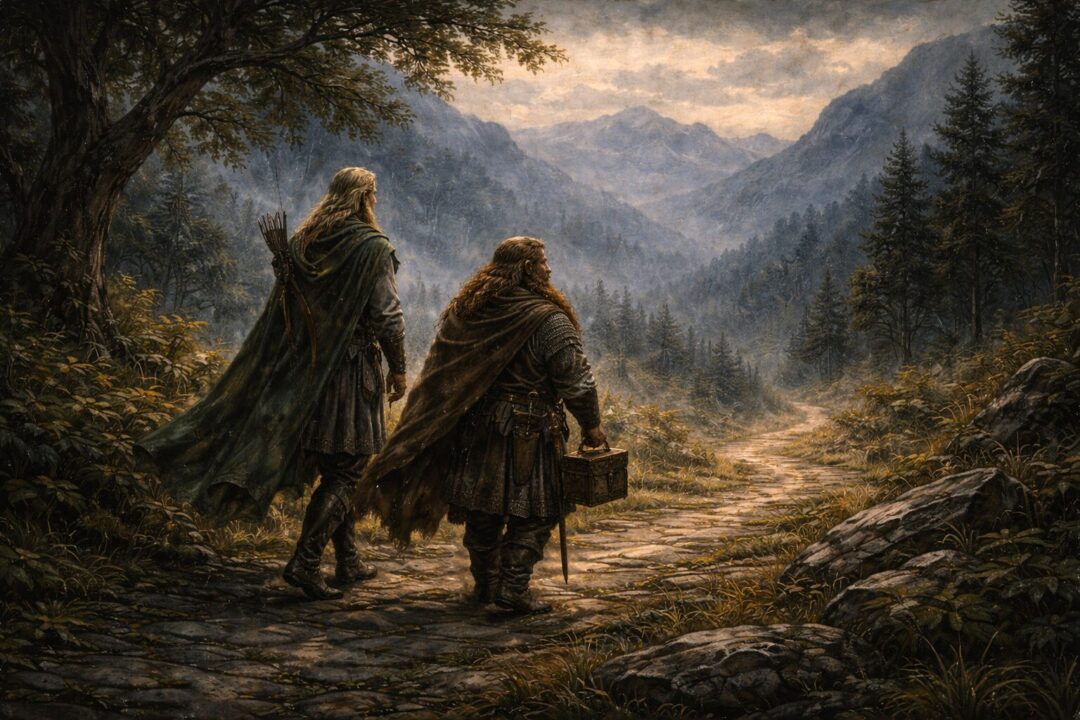
There is a sentence near the end of The Lord of the Rings that many readers only meet years later—tucked away in the appendices, placed among dates and quiet passings.
It does not arrive with trumpets. It is not a “final chapter.” It sits there like a closing of a ledger.
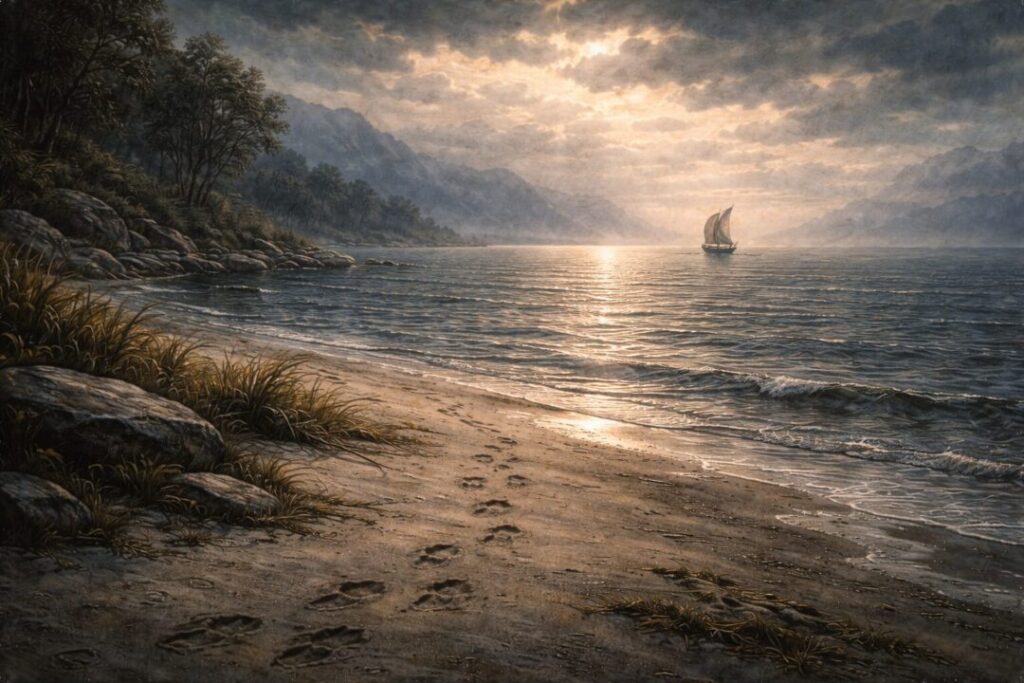
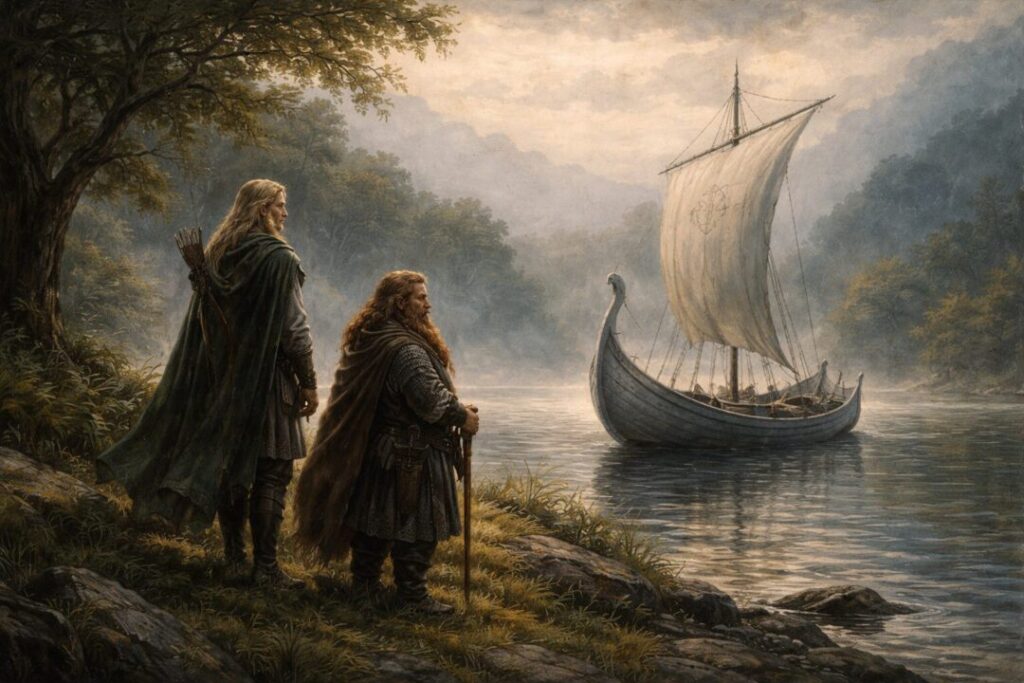
After the death of King Elessar, we are told, Legolas built a grey ship in Ithilien, sailed down Anduin and so over Sea—and with him, it is said, went Gimli the Dwarf.
If you stop there, it can sound like an indulgence: a sentimental tag-on for a beloved character. A last gift to readers who don’t want to say goodbye.
But the line is written too carefully for that.
Because it does not say, “and Gimli was granted entry.”
It does not name the Valar.
It does not declare what became of him afterward.
It says something narrower and stranger: “it is said.”
That framing matters. And it’s the first clue to why this moment belongs to the internal logic of the world, not outside it.
1) What the text actually claims (and what it avoids claiming)
The entry appears in the Tale of Years, where the great events of the Third Age and the early Fourth are set down with a historian’s restraint. In that same passage we are told of Aragorn’s passing, and the last days of those who remained from the War.
Then comes the ship.
Two details are doing more work than they seem:
- Legolas does not depart immediately after the War. He remains in Middle-earth for many years, long enough to see Aragorn’s reign run its course. (The timeline places this sailing after Aragorn’s death.)
- Gimli’s presence is reported, not proclaimed. “It is said” reads like a tradition preserved at the edge of certainty—exactly the kind of phrasing a chronicler uses when repeating something widely believed but not personally witnessed.
So the text is not trying to force a rule-change. It is leaving the moment slightly veiled.
That is not an accident. It’s how Middle-earth handles the rarest kinds of grace.
2) “Sailing West” is not the same thing as being immortal
One of the most persistent misunderstandings is that reaching the West makes a mortal—or a Dwarf—immortal.
The legendarium does not support that.
Even for mortals who are permitted to go (such as Ring-bearers), the West is not a place where death is escaped. It is a place where wounds may be healed, and where the end may be met in peace rather than in torment.
That distinction helps with Gimli, because it prevents the question from becoming: “How did a Dwarf become undying?”
Nothing suggests that happened.
The better question is simpler: how could a Dwarf be permitted to make the voyage at all?
And that is where the deeper story begins—because Gimli’s entire arc is about crossing boundaries that once seemed fixed.
3) Gimli is not “just a Dwarf” by the end
Gimli begins the journey carrying the full weight of inherited suspicion.
The hostility between Dwarves and Elves is not a minor cultural quirk; it is a long wound that reaches back through the ages. By the time of the Fellowship, it has become instinct: old grievances, old slights, old stories that have curdled into certainty.
And then something almost unheard-of happens.
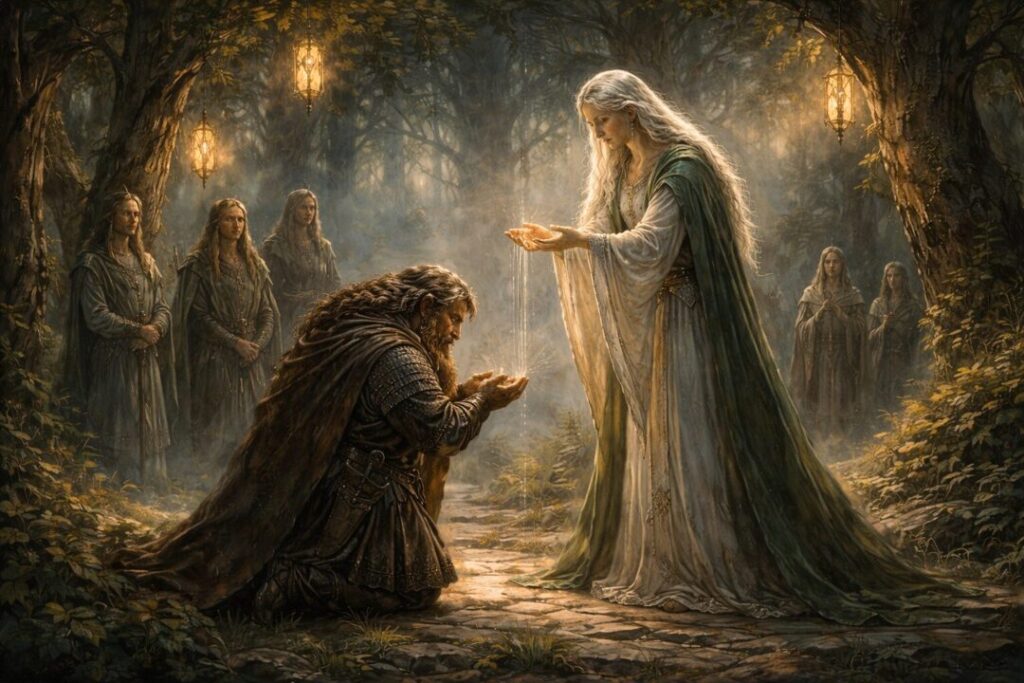
In Lothlórien, Gimli is brought into the presence of Galadriel—and instead of humiliation, the encounter becomes one of the most revealing moments in the entire book. When she offers gifts, he asks for one thing only: a single strand of her hair. She gives him not one, but three.
This is not romantic “fan lore” that the text endorses in explicit terms. The book does not turn it into a love story.
But it does treat the moment as extraordinary: the Elves are astonished; Gimli speaks with reverence; Galadriel answers with honor.
And later lore summaries preserve an important consequence: she names him in a way that marks a crossing—something like a Dwarf becoming, in spirit, an Elf-friend.
Whether you read that as deep admiration, humility, or a kind of sanctified devotion, it is clearly written as transformation.
Gimli does not cease being a Dwarf.
But he ceases being what the world expects a Dwarf to be.
And by the end, he is bound—openly and permanently—to an Elf.
4) Why Legolas matters as much as Galadriel
If Gimli sailed alone, the claim would feel far stranger.
But he does not.
The line pairs him with Legolas, and that pairing is the whole point.
The friendship between them is not a side gag. It is a deliberate reversal of history: two peoples long trained to distrust each other learning, slowly and stubbornly, to see truly.
By the end of the War, their bond has outlasted battles, horror, and distance. It remains when crowns have risen and fallen. It remains when the Shire’s heroes have passed away. It remains even when Aragorn—the mortal center of the Fellowship—dies.
Then Legolas, last of the Nine Walkers, builds a ship.
And the one companion still beside him is a Dwarf.
That is not “fan service.” That is theme, distilled to one quiet image: the Sea carrying what the world once refused to imagine could stand together.
5) So who “allowed” it?
Here we have to be disciplined, because the primary text does not give us a tribunal scene.
No messenger from the West appears. No herald announces a decree.
The appendices simply report the sailing, and even that with a careful “it is said.”
So any claim like “Galadriel demanded it” or “the Valar broke the rules” goes too far.
What we can say, conservatively, is this:
- The tradition of Gimli’s sailing is attached—by later summaries and by the shape of the narrative itself—to his devotion to Galadriel and his unique relationship with the Elves.
- If there was an “allowance,” it is presented as an exceptional grace, not a new norm for Dwarves.
In other words: the text does not treat Gimli as someone who found a loophole.
It treats him as someone who reached the far end of a road that almost no one else could walk: the road from inherited enmity to reverence, from suspicion to loyalty, from “Dwarf and Elf” to “companions until the end.”
That is exactly the kind of road Middle-earth rewards—quietly, rarely, and without explanation.
6) Why this ending belongs to Middle-earth’s logic
The most important thing about Gimli’s sailing is not the geography.
It is timing.
It happens only after Aragorn’s death—after the Age of the Ring has ended, after the world has turned toward Men, after the story’s great powers have withdrawn.
So the moment is not an interruption of the ending.
It is the ending, in miniature.
A world of fading wonders closes not with a battle, but with a vessel sliding down a river into the Sea—bearing an Elf who has lingered long, and a Dwarf who has changed enough to be remembered in the same breath.
And the chronicler, almost as if reluctant to look directly at something so rare, writes: “it is said.”
That phrase doesn’t weaken the moment.
It makes it feel like what it is: a final rumor of grace at the edge of history—one last sign that reconciliation in Middle-earth is not only possible, but worthy of being carried West.
And if you want the sharpest way to read it, it might be this:
Gimli did not sail because the story needed a sweet farewell.
He sailed because, by the end, he had become the proof that the oldest griefs in Middle-earth could—at least once—be healed.
Sources & Notes
- J.R.R. Tolkien, The Lord of the Rings, Appendix B, ‘The Tale of Years’ — the Fourth Age entry for Legolas building a grey ship after King Elessar’s death, with Gimli said to go with him.
- J.R.R. Tolkien, The Lord of the Rings, Appendix A, ‘Durin’s Folk’ — the note on Gimli’s westward voyage, Galadriel’s possible role, and the exceptional ‘grace’ involved.
- J.R.R. Tolkien, The Lord of the Rings, Book II, Chapter 8, ‘Farewell to Lórien’ — Galadriel’s gift of three hairs to Gimli and the Elves’ astonishment at the request.
- J.R.R. Tolkien, The Lord of the Rings, Appendix A, ‘The Tale of Aragorn and Arwen’ — Aragorn’s death in the Fourth Age, giving the timing for Legolas and Gimli’s final departure.
- J.R.R. Tolkien, The Letters of J.R.R. Tolkien, Letter 246 — Tolkien’s explanation that mortals permitted to sail West did not become immortal, but found healing before death.