There is a particular kind of frustration that Middle-earth creates on purpose.
You look at the map. You see the White Mountains. You see the Anduin. You see the old road running north-east from Minas Tirith—straight toward a fortress that used to be Gondor’s.
And you think: Why did they let that stand?
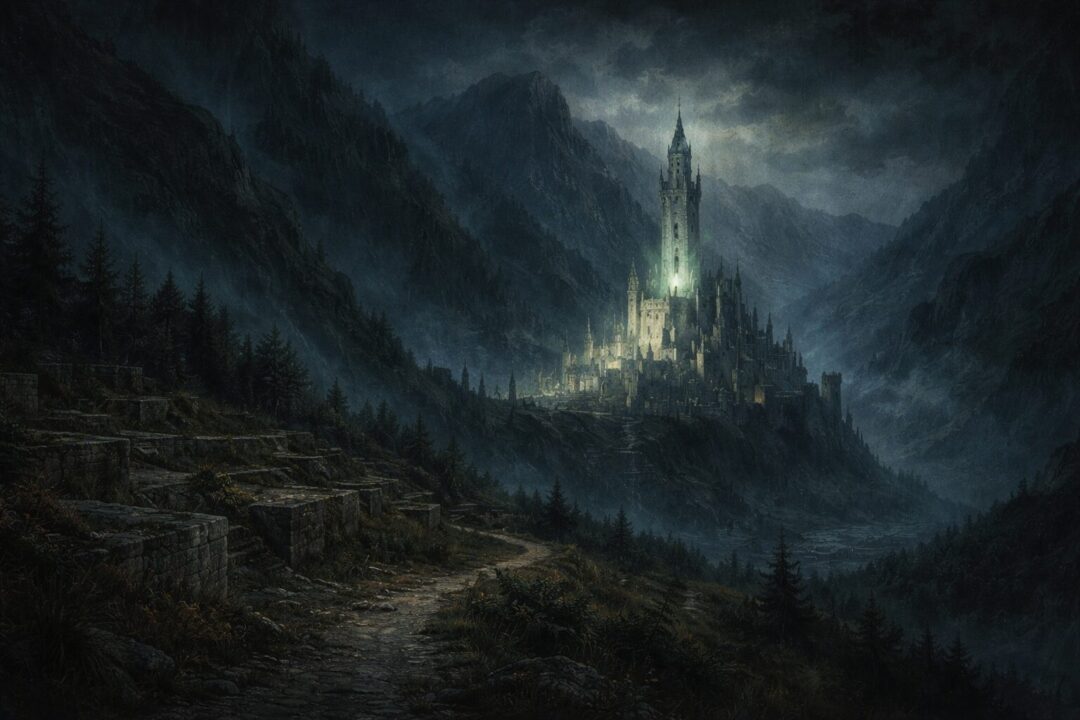
Minas Ithil was built as a twin to Minas Anor, a watchtower-city facing east, gleaming in the Mountains of Shadow. But in the Third Age it falls, becomes Minas Morgul, and remains a permanent threat crouched at the edge of Gondor’s heartland.
And the records are blunt about the turning point.
In T.A. 2000 the Nazgûl issue from Mordor and lay siege. In T.A. 2002, Minas Ithil falls. Its palantír is captured. And then comes the line that quietly closes the door on easy hopes:
“They were not expelled while the Third Age lasted.”
That is not a dramatic scene. It is a statement of grim reality.
But the question remains—especially because the timeline later contains something that sounds, at first glance, like an opening.
In T.A. 2063 the Watchful Peace begins, and the annals remark: “The Nazgûl remain quiet in Minas Morgul.”
Quiet. Not defeated. Not gone. Not replaced by something weaker. Quiet.
So why didn’t Gondor use that quiet to retake the tower?
Because the “chance” is largely an illusion—one created by looking backward from the War of the Ring, when everything finally breaks. In the long middle centuries, Gondor’s problem was not a lack of courage. It was that Minas Morgul was positioned to punish any overreach, and Gondor could not afford a war of that type anymore.
To see why, you have to look at three things the texts actually show: what Minas Morgul guards, what Gondor can spare, and what the Tower does to the borderlands.
Minas Morgul isn’t just a fortress—it’s a gate out of Mordor
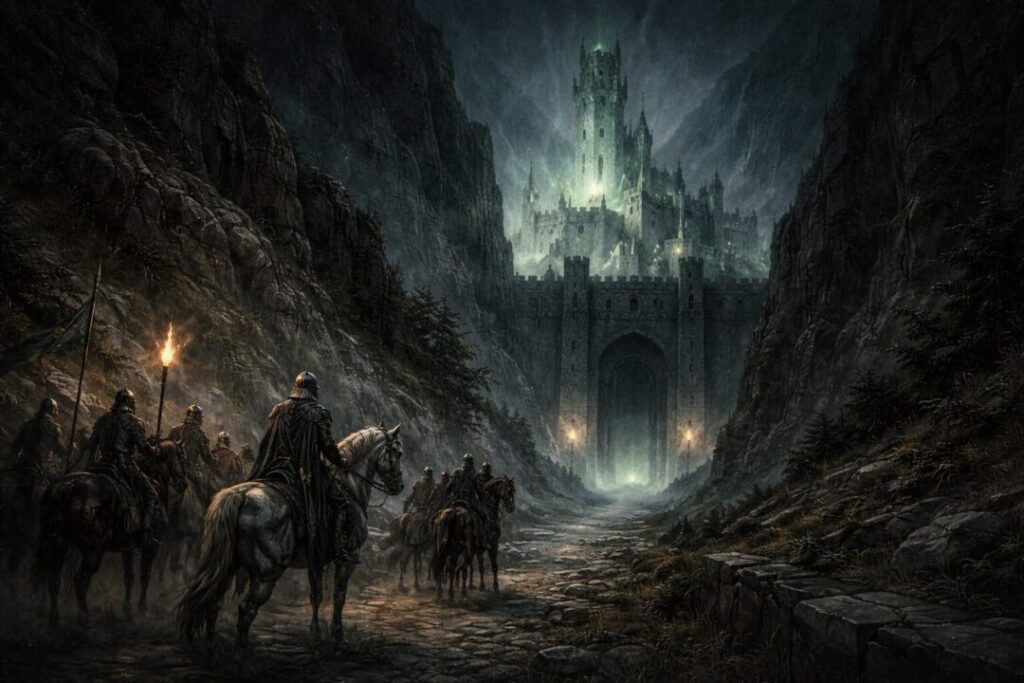
Minas Ithil was taken through a pass: the Nazgûl come “by the Pass of Cirith Ungol” and lay siege.
That matters. Minas Morgul sits where a road runs out of the Mountains of Shadow. It is not an isolated city that can be “ignored” while Gondor fights elsewhere. It is a doorway.
If Gondor tries to besiege the tower, Gondor must bring large forces into a narrow valley under hostile mountains—while Mordor retains the ability to strike through other exits, and to attack the besiegers from behind.
In other words: the act of “retaking” Minas Morgul would require Gondor to do the one thing it cannot safely do for most of the Third Age—commit a major field army east of the Anduin and keep it there long enough to reduce a stronghold.
The War of the Ring tempts readers to imagine that Gondor always had such an army available, just waiting for the right king or the right mood.
But the history embedded in the appendices and related writings points the other direction: Gondor is repeatedly forced into a defensive posture, because its strength is not infinite, and its dangers are not confined to one front.
Gondor’s strength is shrinking—so the “right moment” never comes
The appendices don’t treat Gondor’s decline as an aesthetic theme. They show it as a practical problem: fewer heirs, fewer people, fewer secure provinces, fewer safe decisions.
After Eärnur is lost, the annals explicitly note that the descendants of the kings had become few, and that their numbers had been greatly diminished, with political fear lingering after internal conflict.
This is not merely court drama. It is demographic pressure and institutional fragility.
And in Unfinished Tales, in a discussion of Gondor’s wider troubles, there is an even sharper observation: enemies in the East feared Gondor because they believed its realm was “more populous than it was in truth.”
That single phrase reframes the whole “Why didn’t Gondor just…?” instinct.
Gondor looks mighty. Gondor sounds mighty. Gondor has stone cities and ancient roads and a long memory of power.
But the texts are telling you that its enemies were misreading its numbers—and that misreading was one of Gondor’s protections.
When you are surviving partly on reputation, you do not gamble that reputation on a siege you cannot finish.

Minas Morgul actively empties Ithilien
Right after Minas Ithil becomes Minas Morgul, the annals add a consequence that is easy to overlook:
“Many of the people that still remained in Ithilien deserted it.”
That is a direct statement about Minas Morgul’s strategic effect. The Tower doesn’t need to conquer all of Ithilien to damage Gondor. It only needs to make living there too costly.
So even if Gondor “retakes” the tower in a hypothetical early war, what then?
The border must be repopulated. Roads must be secured. Garrison-lines must be rebuilt. The region must stop bleeding people.
And Minas Morgul is not simply occupying land. It is changing the cost of inhabiting land near it.
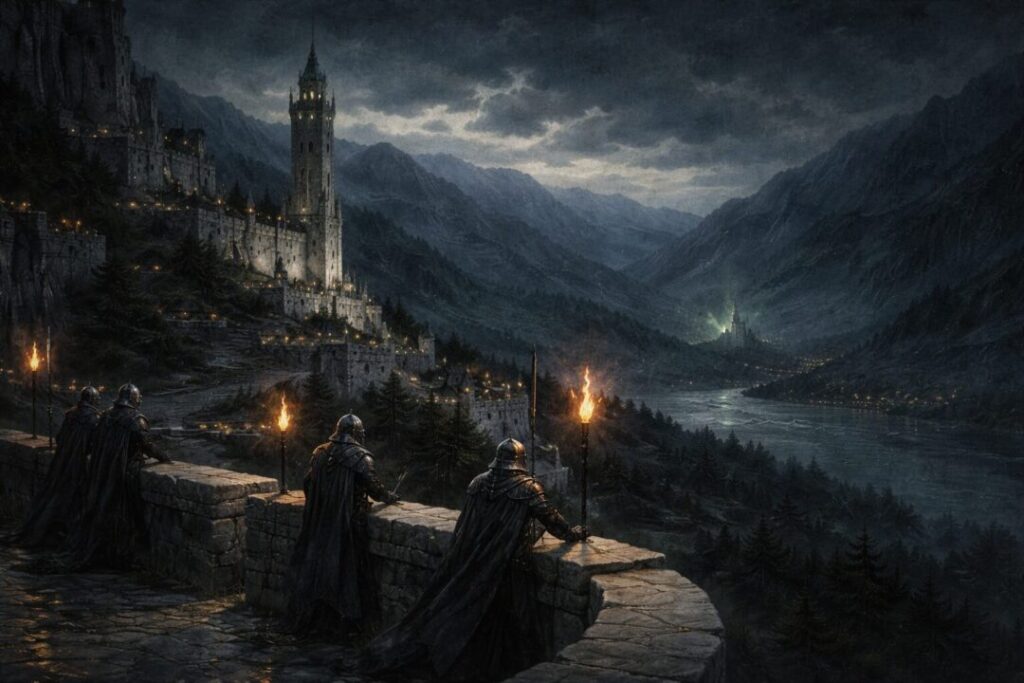
This is one reason Minas Anor’s renaming matters. The annals say it becomes Minas Tirith, “the city ever on guard against the evil of Morgul.”
That is not symbolic. It is an administrative truth: Minas Tirith becomes a fortress-city because Minas Morgul forces it to be one.
The Watchful Peace isn’t a lull—it’s a warning
So what about the “quiet years”?
The Watchful Peace begins in T.A. 2063, and the record says the Nazgûl remain quiet in Minas Morgul.
But “quiet” does not equal “weak.”
The Nazgûl being quiet can mean at least two conservative, text-consistent things:
- The threat remains present, because they are still in Minas Morgul and still unexpelled.
- Gondor still must keep Minas Tirith “ever on guard” against them, which implies the danger is not dismissed.
In other words, the Watchful Peace is not Gondor getting its strength back. It is Gondor enduring a tense stalemate while other powers shift—most notably in the wider shadow that is growing elsewhere.
And if you look later in the Tale of Years, the next big movement in the same eastern theater is not “Gondor advances.” It is attack renewed, with Osgiliath “finally ruined” and its bridge broken in T.A. 2475.
That date matters because it tells you something ruthless: even long after Minas Ithil fell, the war on Gondor’s eastern line still had the power to break its great river-city completely.
If you couldn’t hold Osgiliath in the long run—if its bridge is broken and it becomes a ruin—then the idea of safely committing your best forces to a siege inside the Mountains of Shadow becomes even more doubtful.
Minas Morgul isn’t just hard to take—it’s hard to cleanse
There is also a darker, quieter obstacle.
Minas Ithil does not merely change flags. The annals say it becomes “a place of fear,” renamed Minas Morgul.
And when Frodo and Sam approach the region, Faramir gives it a name that is not a military assessment but a survival warning: Imlad Morgul, the “Valley of Living Death.” (This phrasing is preserved in widely circulated text excerpts of The Two Towers.)
You don’t have to exaggerate what that means. You only have to accept the implication that the Morgul Vale is not a normal borderland.
If Gondor retakes Minas Morgul, it doesn’t regain a clean fortification ready to garrison. It inherits a corrupted stronghold whose surrounding land has become associated with dread and ruin, and which has already driven people out of Ithilien once.
So the victory condition is not “raise the banner.”
The victory condition is “hold it afterward”—and the texts repeatedly show Gondor struggling to hold even what lies outside that valley.
The Eärnur lesson: Minas Morgul punishes rash courage
If there is a single story-thread that shows Minas Morgul’s trap-like nature, it is what happens to King Eärnur.
The Witch-king (as “King of Minas Morgul”) challenges him. Once, the Steward restrains him. Then the challenge is renewed, and Eärnur rides with a small escort to the gate of Minas Morgul.
None are ever heard of again.
The annals even record what Gondor believes: that he died in torment in Minas Morgul.
This is not a siege. It is not a campaign. It is a single proud decision—answered by Minas Morgul swallowing a king.
After that, Gondor’s leadership becomes structurally cautious for generations, because the loss is not merely personal. It ends the line of kings in the South-kingdom and begins the long rule of the Stewards.
So when readers ask why Gondor didn’t strike when the Nazgûl were “quiet,” it’s worth remembering: Minas Morgul’s power is precisely that it can destroy boldness at a manageable cost.
It doesn’t need to win open battles every year. It only needs to make Gondor afraid of the price of overextension.
The real answer: Gondor never truly “had the chance”
If you read the chronology as a series of clean strategic windows, you will always come away frustrated.
But the texts don’t present Gondor as a nation choosing between easy options. They present it as a nation surviving a long narrowing—holding a line, losing ground, holding again, guarding constantly against the evil of Morgul, while its population and political stability are not what outsiders assume.
Minas Morgul is the eastern pressure that makes all of that sharper.
It drives people out of Ithilien.
It forces Minas Tirith into permanent vigilance.
It sits at a pass out of Mordor, so any siege invites a broader disaster.
And it proves—by swallowing Eärnur—that it can destroy Gondor’s leadership without meeting Gondor’s army in a fair field.
So yes: there is a moment on the page when the Nazgûl are “quiet.”
But quiet does not mean vulnerable.
Quiet means waiting—and Gondor, stretched thin, could not afford to be the one that blinked first.
Sources & Notes
- J.R.R. Tolkien, The Lord of the Rings, Appendix B, “The Tale of Years”: entries for T.A. 2000–2002, 2063, and 2475 on Minas Ithil/Morgul, the Watchful Peace, and Osgiliath.
- J.R.R. Tolkien, The Lord of the Rings, Appendix A, “Gondor and the Heirs of Anárion”: Eärnur’s challenge, loss at Minas Morgul, and the transition to the Stewards.
- J.R.R. Tolkien, The Lord of the Rings, Appendix A, “The Stewards”: the renaming of Minas Anor as Minas Tirith, set “ever on guard” against Morgul.
- J.R.R. Tolkien, The Lord of the Rings, Book IV, Chapter 5, “The Window on the West”: Faramir’s account of Ithilien, the Morgul Vale, and Gondor’s eastern border pressure.
- J.R.R. Tolkien, Unfinished Tales, “Cirion and Eorl and the Friendship of Gondor and Rohan”: context for Gondor’s overextended strength and enemies misjudging how populous it truly was.