
The One Ring often feels less like an object and more like a presence.
It slips from fingers at decisive moments. It clings to its bearer. It resists being surrendered. It seems to magnify exactly the desire a person is weakest against. Even before Sauron regains it, the Ring does not read as passive.
That impression is not accidental.
The text repeatedly describes the Ring in the language of action. Gandalf says that a Ring of Power “looks after itself.” He says it may slip off “treacherously.” He even says that it was the Ring itself that decided matters when it left Gollum. In the tale of Isildur, the Ring “betrayed” him and slipped from his finger in the Anduin. Read plainly, all of this makes the Ring seem alive.
And yet there is a limit to what the texts actually say.
The Ring is never presented as a separate speaking intelligence with its own independent history, motives, or consciousness. It is not a second Dark Lord. It does not become a character in the way Gollum, Saruman, or even Shelob are characters.
So why does it feel so personal?

The Text Gives the Ring Agency on Purpose
Part of the answer is simple: the narration encourages that feeling.
When readers hear that the Ring “left” Gollum, or “betrayed” Isildur, they instinctively read purpose into the object. Those are not neutral verbs. They make the Ring feel like something more than metal.
This matters because the Ring’s danger would feel smaller if it were treated as only a tool.
A sword can be evil because of the hand that wields it.
The Ring is more unsettling because it exerts pressure even when no one is deliberately using it.
It alters attachment.
It fosters secrecy.
It makes surrender feel unnatural.
It works upon the will before any grand act of domination ever happens.
That is why Gandalf’s explanation in the Shire is so striking. He does not merely warn Frodo that the Ring is powerful. He describes it as something that actively preserves itself and resists abandonment. The language is personal because the experience of possessing it is personal.
But “Alive” Is Not the Same as “Conscious”
This is the distinction that often gets blurred.
The Ring clearly behaves with purpose.
But the deeper lore points that purpose back toward Sauron, not toward an independent personality inside the Ring. In The Silmarillion, much of Sauron’s “strength and will” is said to have passed into the One Ring. In Letter 131, the Ring is described as imbued with a great part of Sauron’s own power. And in a later letter, Tolkien states even more plainly that the Ring was Sauron’s own and remained under his will, with Sauron exerting an effect upon it even from afar so that it worked for its return to himself.
That is an important boundary.
The Ring is not best understood as a separate evil mind living inside jewelry.
It is better understood as Sauron’s power and dominating intention made object.
That still allows it to act in ways that feel directed. But the direction is not proof of personhood. It is proof of what was built into it.
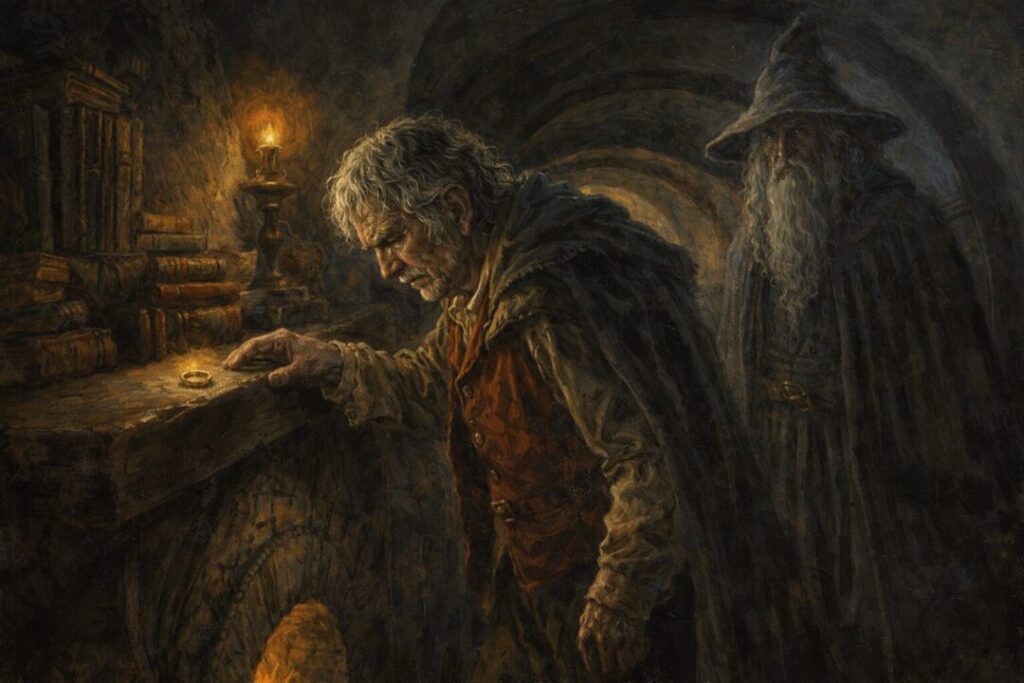
The Ring Carries Purpose Without Needing Personality
That may be the most disturbing part.
A conscious villain can be argued with, resisted, deceived, or at least imagined as making choices in the ordinary sense. The Ring works differently. It does not need a voice because its function is narrower and more intimate.
It was made to rule.
It was made to bind.
It was made to dominate wills other than its maker’s.
So when the Ring seems to “want” something, the texts allow a conservative reading: it is expressing the purpose placed into it by Sauron and the will still bound up with it, not displaying an independent consciousness of its own.
That helps explain why the Ring feels so uncannily alive without ever quite crossing into full personhood.
It is not merely cursed.
It is directed.
And because that direction is toward domination, possession, and return to Sauron, every bearer experiences it as a pressure on the self.
Why the Ring Feels Personal to Each Bearer
Another reason the Ring feels alive is that it does not affect everyone in exactly the same way.
It works through the desires already present.
With Bilbo, the corruption appears slowly, as possessiveness and unnatural attachment.
With Frodo, it becomes an increasing burden that isolates him and turns choice into strain.
With Boromir, it appears through visions of strength, victory, and the saving of Gondor.
With Sam, even his brief possession triggers an inflated image of heroic power and transformed landscapes under his command.
This variability can make the Ring seem almost conversational, as if it knows exactly what each person longs for.
But again, the text does not require us to conclude that it is consciously studying them like a scheming person. Another reading, and the safer one, is that the Ring is so perfectly ordered toward domination that it activates ambition in whatever form ambition already exists.
In other words, it does not need to invent temptation.
It only needs to seize what is already there.
That is why the Ring feels intimate. It is not generic evil. It takes shape against the bearer’s own mind.
Why It “Betrays” Without Becoming a Character
The strongest examples of apparent agency are the Ring’s betrayals.
It slips from Isildur in the river.
It leaves Gollum beneath the Misty Mountains.
It resists being discarded.
It works toward return.
These are not small details. They are central to the Ring’s atmosphere. But even here, the larger framework still points back to Sauron’s will and the Ring’s ruling purpose. The Ring does not betray at random. Its actions consistently align with preservation, domination, and eventual recovery by its maker.
That pattern is exactly why it feels so “alive.”
Random magic would not unsettle us in the same way.
A haunted object with a visible ghost inside it would actually be simpler.
The Ring is more unnerving because it acts with coherence while remaining impersonal.
It is like a will that survives in matter.
The Ring’s Presence Changes the Moral Atmosphere
The Ring also feels alive because it changes not just events, but the moral temperature of the scenes around it.
Conversations become tense around it.
Ownership becomes a loaded word.
Pity, secrecy, fear, and self-justification gather around whoever bears it.
Even when the Ring is still, the room around it is not.
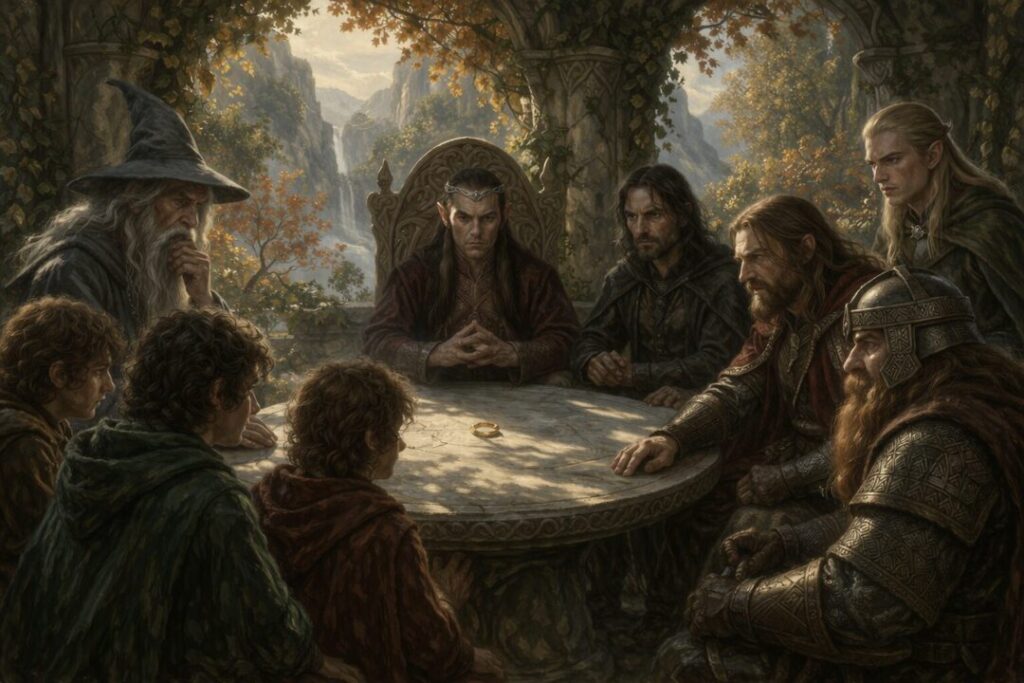
That is one of the reasons the Council of Elrond matters so much. The Ring is lying there, small and silent, yet nearly every serious proposal about it bends toward delusion: use it, hide it, guard it, trust it to strength. The object exerts no speech, but it distorts judgment simply by being what it is.
This is another way the Ring achieves presence without character.
It does not need dialogue.
It changes everyone else’s.
Why the “Alive” Feeling Matters
If the Ring were simply conscious in the ordinary literary sense, the mystery would actually shrink.
We would say: it is a malicious being in object form.
But the Ring is more troubling than that.
It feels alive while remaining, in a crucial sense, less than alive and more than inert. The texts support the idea that it is charged with Sauron’s own invested strength and will, and that it continues to work toward his domination and its own return to him. What they do not clearly support is the idea that it is a fully separate conscious character with an independent interior life.
That middle state is what makes it unforgettable.
The Ring stands at the point where object and will begin to blur.
It is a thing made so thoroughly for domination that readers experience it almost as a mind.
Not because it speaks.
Not because it thinks like a person.
But because it carries evil purpose so completely that everyone around it starts reacting as if something in the room were awake.
And in practical terms, something is.
Not a second character.
But Sauron’s will, still reaching through gold.
Sources & Notes
- J.R.R. Tolkien, The Lord of the Rings, Book I, Chapter 2, “The Shadow of the Past” — Gandalf says a Ring of Power “looks after itself,” may slip off treacherously, and had abandoned Gollum, grounding the article’s point that the Ring is narrated with agency.
- J.R.R. Tolkien, The Silmarillion, “Of the Rings of Power and the Third Age” — explains that Sauron made the One Ring to rule the others and that much of his own strength and will passed into it.
- J.R.R. Tolkien, The Letters of J.R.R. Tolkien, Letter 131 — describes the One Ring as containing a great part of Sauron’s own power and frames Sauron’s evil around domination and ordering other wills.
- J.R.R. Tolkien, The Lord of the Rings, Book II, Chapter 2, “The Council of Elrond” — shows the Ring silently distorting counsel around itself, as proposals to use, hide, or guard it are rejected because its power serves Sauron’s design.
- J.R.R. Tolkien, The Lord of the Rings, Book II, Chapter 10, “The Breaking of the Fellowship”; Book VI, Chapter 1, “The Tower of Cirith Ungol” — Boromir’s temptation and Sam’s brief vision of commanding power show how the Ring works through the bearer’s own desires rather than by becoming a speaking character.
- J.R.R. Tolkien, The Lord of the Rings, Book VI, Chapter 3, “Mount Doom” — Frodo’s final inability to cast the Ring away shows its pressure on will and possession at its strongest, while still keeping the Ring tied to Sauron’s power rather than to an independent personality.