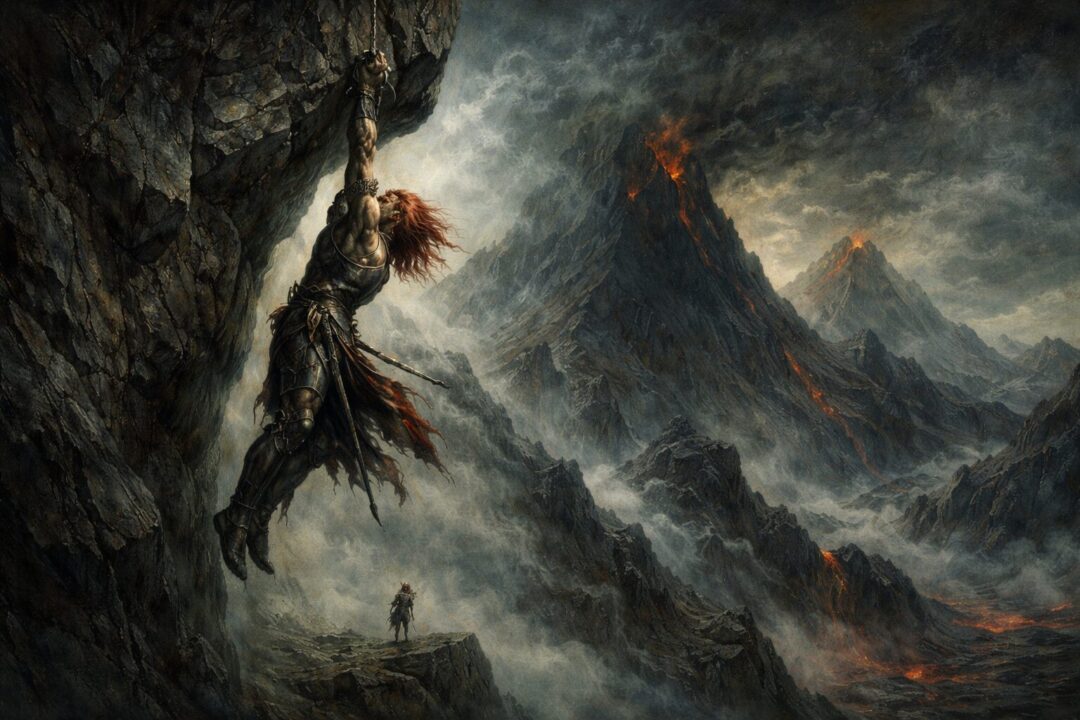
When people think of Maedhros on Thangorodrim, they usually focus on the image.
The cliff.
The iron bond.
The missing hand.
It is one of the harshest scenes in the Elder Days, and one of the clearest examples of endurance under torment.
But the deeper question is not how terrible it was.
It is why he survived it at all.
Because the story does not present Maedhros as someone who escaped a quick death by luck. Morgoth captured him, displayed him, and kept him alive long enough for his suffering to become part of the political and moral landscape of the war. That choice tells us something important about both Morgoth and Maedhros.
Morgoth Did Not Keep Maedhros Alive By Accident
After Fëanor’s death, Maedhros stood as the leading son of his house and the nearest claimant to the kingship in exile. Morgoth sent an embassy with a false show of negotiation, pretending even to treat over a Silmaril. Maedhros, driven by the oath, answered deceit with deceit and went to the parley as well. Morgoth’s side seized him.
That alone already frames the whole event.
This is not battlefield chaos.
This is deliberate capture.
And what follows is even more deliberate. Maedhros is not hidden in a dungeon and forgotten. He is hung by the wrist from a precipice of Thangorodrim. The placement matters. The torment is visible, prolonged, and symbolic. Morgoth is not merely punishing an enemy prince. He is turning the eldest son of Fëanor into a warning.
The texts strongly suggest that Maedhros survives because Morgoth wants him to survive.
A dead captive would have ended the matter quickly. A living captive, displayed in anguish, does more. He humiliates the House of Fëanor. He pressures the Noldor. He keeps a hostage whose death can be threatened at need. In the surrounding tradition of the story, Morgoth repeatedly prefers corruption, despair, division, and domination over simple killing when killing alone would serve less well. Maedhros on the mountain fits that pattern exactly. This is interpretation, but it is a very cautious one drawn from how the episode is staged.
The Rescue Was Real, But It Was Not Restoration
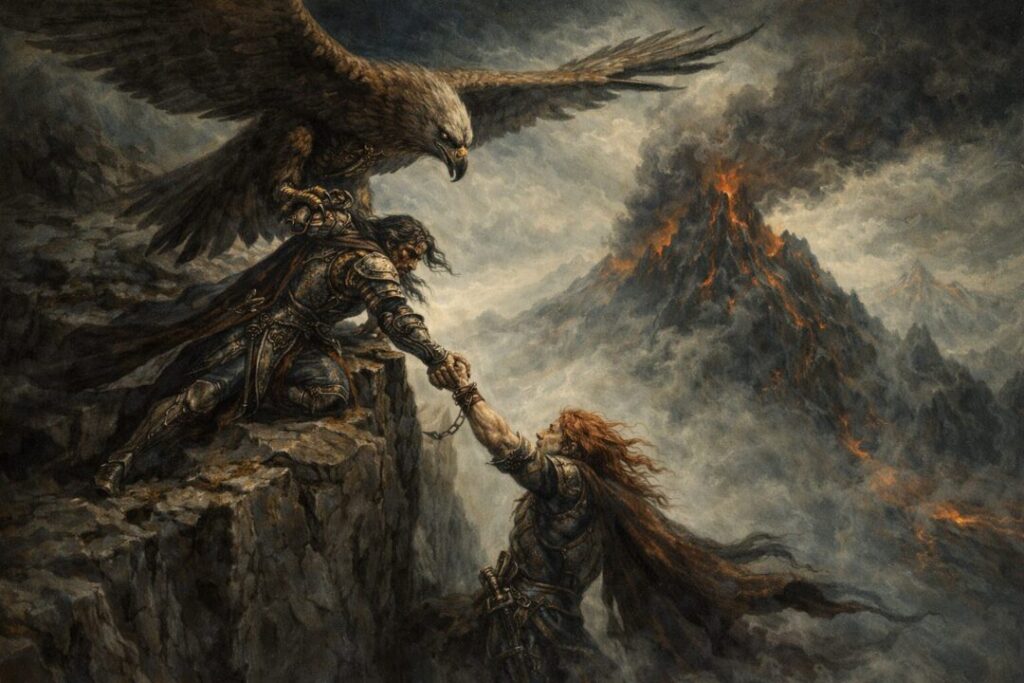
Fingon, who had been Maedhros’ friend even before the exile, goes alone in hope of healing the breach between the houses of Fëanor and Fingolfin. He climbs Thangorodrim and finds Maedhros near the pinnacle, but he cannot release the steel bond. At last he prepares to shoot him with an arrow in mercy and cries out for pity. Then help comes from above: the Eagles arrive, and Thorondor bears Fingon to Maedhros. Yet even then there is no painless deliverance. Fingon must cut off Maedhros’ right hand to free him. Afterward, Maedhros lives left-handed.
That detail matters because the story never treats survival as reversal.
Maedhros is not “saved” in the simple sense. He is recovered at great cost. The rescue preserves his life, but it confirms that the damage is permanent. His body bears it forever.
And the moral consequence appears immediately. The feud between the kindreds is eased by Fingon’s deed, and Maedhros yields the high kingship to Fingolfin. This is one of the most striking acts of humility in the legends of the Noldor. The eldest son of Fëanor does not insist on rank after his rescue. He steps back.
That is important because it shows what Thangorodrim did not do.
It did not reduce him to helplessness.
It did not make him petty.
It did not destroy his capacity for clear judgment.
If anything, the immediate aftermath shows Maedhros at his best.
What Thangorodrim Changed In Him
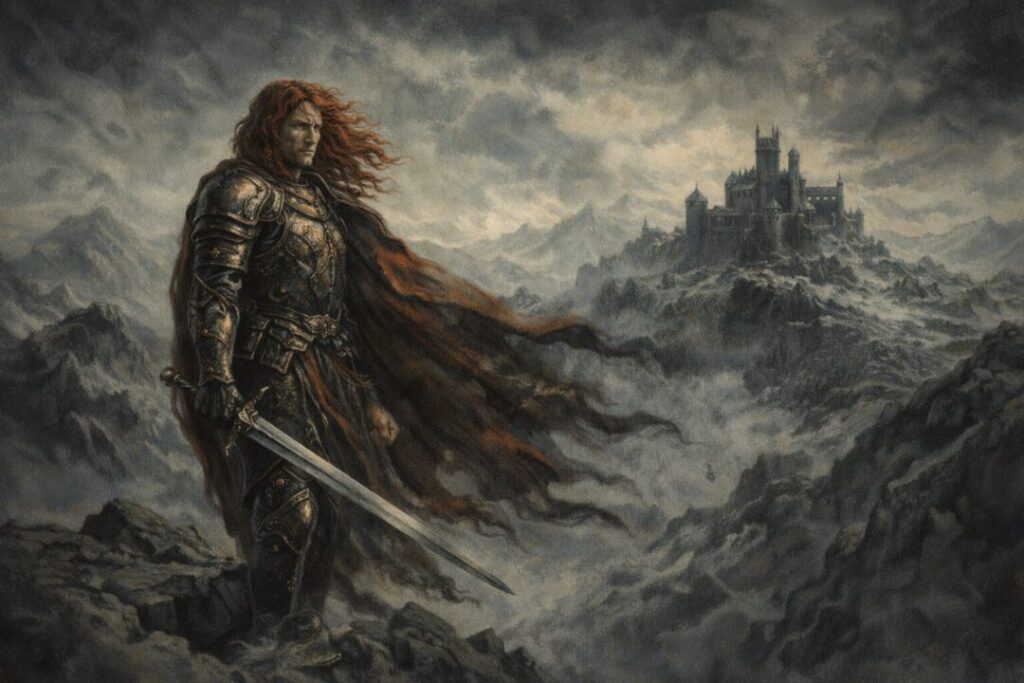
The text gives one of its most revealing descriptions later, after the Dagor Bragollach, when Maedhros is said to have done deeds of surpassing valor because “since his torment upon Thangorodrim his spirit burned like a white fire within, and he was as one that returns from the dead.”
That line is crucial.
It does not say that torture made him evil.
It does not say that torment broke his mind.
It says he came back altered.
His survival produces a kind of terrible intensity. He becomes harder, fiercer, and more formidable. He still leads. He still acts with courage. His stronghold on Himring becomes one of the eastern bulwarks against Morgoth, and when the Dagor Bragollach breaks much of the Siege of Angband, Himring still stands. Later he is able to gather hope enough to form the Union of Maedhros, trying to unite Elves, Men, and Dwarves against Angband.
So the survival has a paradoxical result.
Thangorodrim diminishes him physically, but seems to sharpen him spiritually into an instrument of endurance. He becomes one-handed, but not lesser in stature. He becomes maimed, but more dreadful to his enemies. The story gives us not recovery, but transfiguration through suffering.
And that is exactly why the scene remains so disturbing.
Because Maedhros does not come down from the mountain healed.
He comes down able to go on.
The Cost Was Not Only Physical
Losing his hand is the obvious cost, but it is not the deepest one.
The deeper cost is that survival leaves him in the world long enough to continue under the Oath of Fëanor.
This has to be said carefully. The texts do not explicitly claim that the torment on Thangorodrim caused the later kinslayings or all of Maedhros’ darker choices. The oath already existed. The doom around the house of Fëanor was already in motion. But the story does show that survival did not free him from any of that. It returned him to it.
That makes the rescue tragically double-edged.
It heals the breach with Fingolfin’s house.
It restores a great captain to the Noldor.
It allows Himring to stand and a great union to be attempted.
But it also preserves a man still chained, in another sense, to the vow that will help destroy what remains of his people.
After the recovery of the Silmaril from Morgoth by Beren and Lúthien, the old oath awakens again in force among the sons of Fëanor. Later come the assaults connected with Doriath and the Havens of Sirion, and though the traditions preserve moments that complicate Maedhros’ character, including his search for Dior’s lost sons, the overall shape is ruin. Survival has not undone the doom. It has prolonged his part in it.
Why His Survival Is Not A Victory Story
This is where Maedhros differs from a simpler heroic figure.
Ordinarily, surviving torment would mean returning to finish a triumphant arc. But that is not what happens here. Maedhros returns to courage, leadership, and renunciation, yes. Yet he also returns to a world in which endurance alone cannot save him from the moral consequences of his oath.
His survival is meaningful.
It is even noble in places.
But it is not victorious.
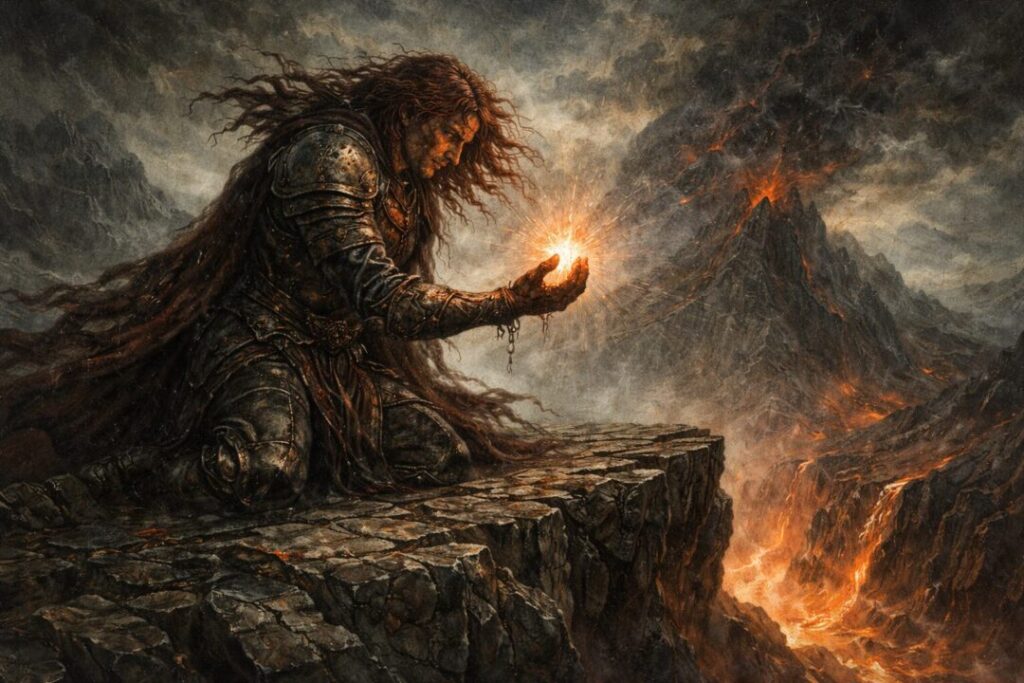
The end proves this. After the War of Wrath, Maedhros and Maglor seize the Silmarils that remain. Yet the jewels burn them. The point is devastatingly clear: possession is no longer the same as right. They can take what they swore to recover, but they cannot truly bear it. Maedhros, unable to endure the pain, casts himself with his Silmaril into a fiery chasm.
That ending throws light backward over Thangorodrim.
He survived the mountain.
He survived mutilation.
He survived the breaking of kingdoms.
But he did not survive the oath.
What Thangorodrim Really Reveals About Maedhros
The mountain does not simply show us that Maedhros is strong.
It shows us the kind of story he is in.
In Middle-earth, survival is not always rescue in the modern sense. Sometimes survival means being carried forward into a longer burden. Sometimes the person who comes back is greater in endurance, clearer in will, and still more tragic because of it.
Maedhros survives because Morgoth wants a living symbol of defeat, and because Fingon’s compassion, aided from above, reaches him before death does.
What it costs him is obvious in one sense and far deeper in another.
He loses his hand.
He loses any simple claim to an unbroken life.
He becomes, in the text’s own image, like one returned from the dead.
And in the end, he keeps going long enough to discover that surviving pain is not the same thing as escaping doom.
That is why the episode lingers.
Thangorodrim did not kill Maedhros.
It merely made the rest of his life impossible to read as anything but the survival of a man already marked for tragedy.
Sources & Notes
- J.R.R. Tolkien, The Silmarillion, “Of the Return of the Noldor” — tells of Morgoth’s treacherous capture of Maedhros, his torment on Thangorodrim, Fingon’s rescue with Thorondor, and the loss of Maedhros’ right hand.
- J.R.R. Tolkien, The Silmarillion, “Of the Return of the Noldor” — also records Maedhros yielding the high kingship to Fingolfin after his rescue, a key sign that survival did not make him small or spiteful.
- J.R.R. Tolkien, The Silmarillion, “Of the Ruin of Beleriand and the Fall of Fingolfin” — describes Maedhros after Thangorodrim as one whose spirit “burned like a white fire,” and shows Himring holding firm in the Dagor Bragollach.
- J.R.R. Tolkien, The Silmarillion, “Of the Fifth Battle: Nirnaeth Arnoediad” — gives the larger context for the Union of Maedhros and his continued attempt to gather resistance against Angband.
- J.R.R. Tolkien, The Silmarillion, “Of the Voyage of Eärendil and the War of Wrath” — completes the tragedy with Maedhros and Maglor taking the Silmarils, the jewels burning them, and Maedhros casting himself into a fiery chasm.