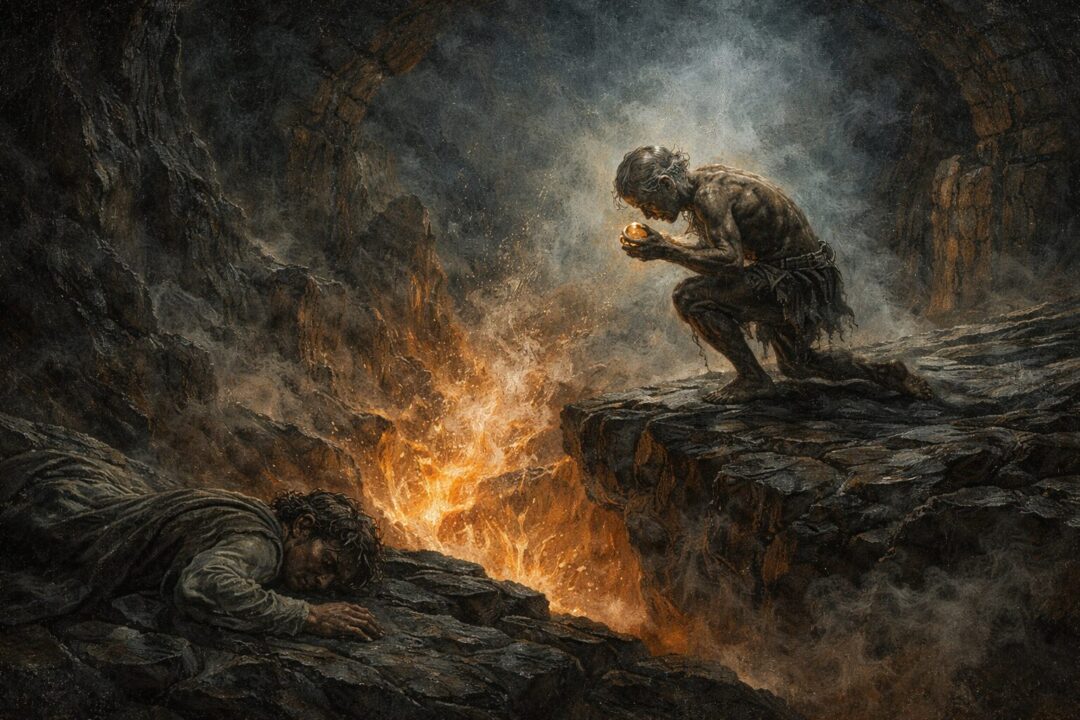
When people imagine alternate endings to the War of the Ring, they usually imagine something cleaner than what actually happens.
Frodo masters himself at the last moment and throws the Ring into the Fire.
Or Gandalf takes it and uses it rightly.
Or Galadriel accepts it and brings down Sauron by force.
Or Tom Bombadil simply keeps it, untouched and untroubled, until the danger passes.
These ideas feel natural because they sound more orderly than the ending in the book.
But Middle-earth does not support them nearly as much as people think.
The closer the Ring gets to its destruction, the fewer believable alternatives remain. And the alternatives the text does allow are not brighter versions of the same victory. They are usually darker, narrower, and more tragic.
By the time Frodo stands in Sammath Naur, the story has already stripped away most of the endings readers like to imagine.
The Ring Was Never Going to Be Solved by a Better Custodian
One of the most persistent assumptions is that the quest failed to consider some safer keeper.
Why not Bombadil?
Why not send the Ring into the West?
Why not entrust it to one of the Wise?
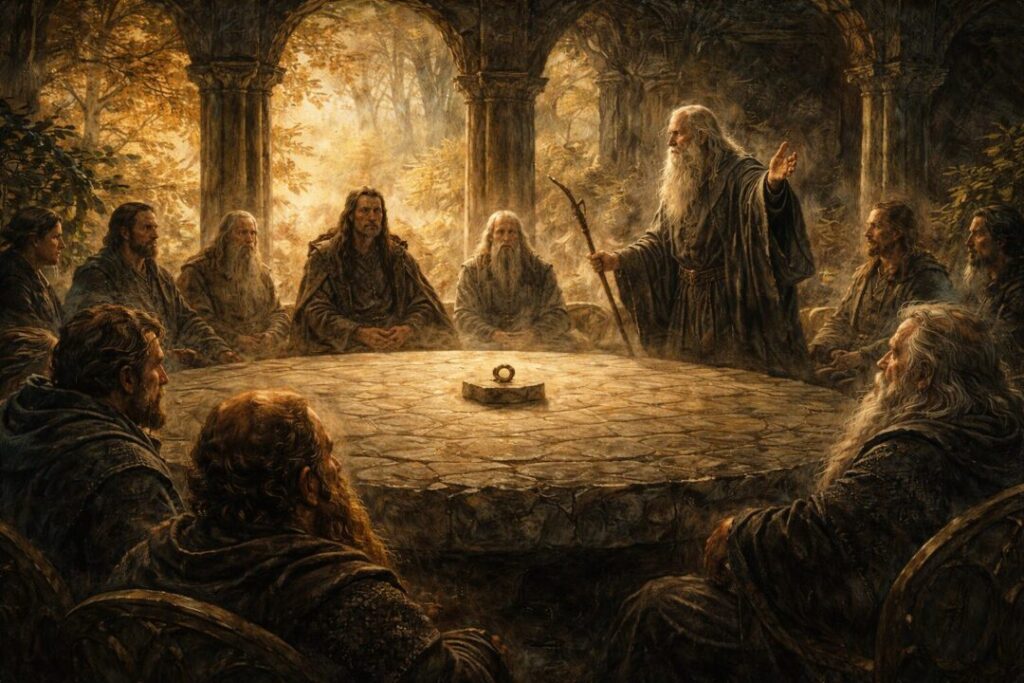
But the Council of Elrond shuts these paths down with surprising firmness.
Tom Bombadil is not presented as a hidden answer to the war. He is presented as someone outside the kind of struggle the Ring belongs to. That sounds promising at first. If the Ring has little or no hold on him, why not leave it there?
Because immunity is not the same thing as responsibility.
The problem is not merely that Bombadil would not be corrupted in the ordinary way. It is that he would not regard the Ring with the gravity the rest of Middle-earth must. He would not hold it as a strategic burden in an age-long war. The danger is not that he would turn evil, but that he would fail to guard the thing in the way such a weapon requires.
That is an important distinction.
Middle-earth does not reject Bombadil because he is too weak.
It rejects him because he is the wrong kind of being for the task.
The same pattern appears in the idea of sending the Ring away — whether to be hidden, buried, or removed from the immediate struggle. The Council treats this not as a permanent solution but as a postponement. As long as the Ring endures, Sauron’s power is not truly broken, and the danger remains for another age.
So before the final crisis at Mount Doom even begins, the story has already narrowed the field.
The Ring cannot simply be stored.
It cannot simply be transferred.
It cannot merely be kept out of reach.
It must be destroyed.
Why Frodo’s “Simple Heroic Ending” Was Never the Likeliest One
Many readers imagine one alternate ending above all others:
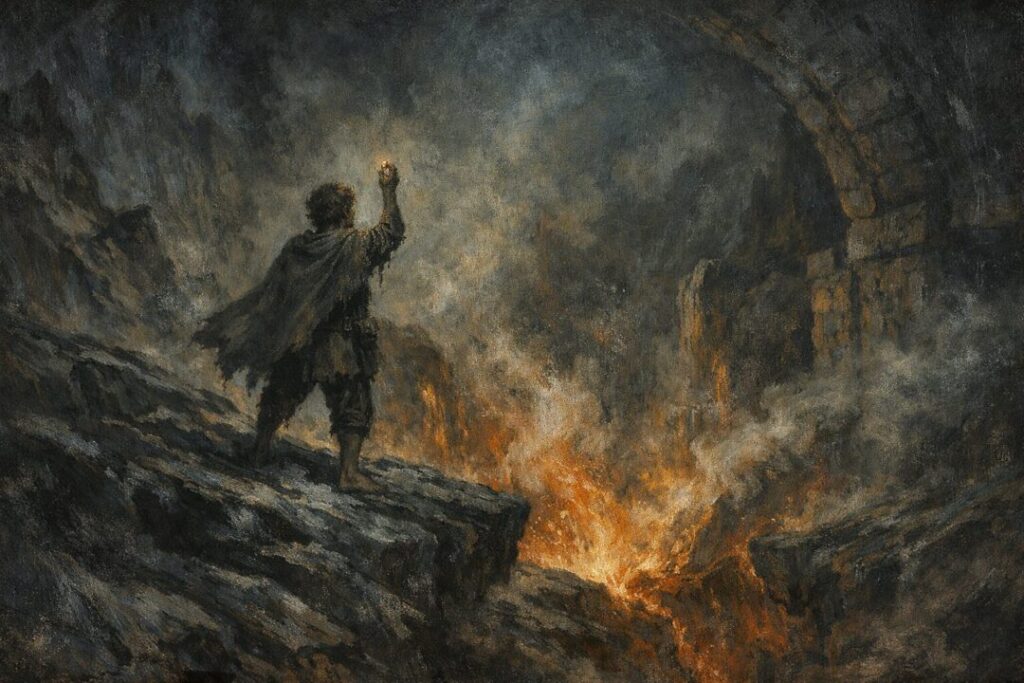
Frodo reaches the Crack of Doom, gathers the last of his strength, and willingly casts the Ring into the Fire.
It is easy to see why this version is attractive. It feels morally tidy. It preserves the image of complete heroic mastery. It gives the quest a direct and uncluttered ending.
But the text itself pushes hard against that reading.
At the crucial moment Frodo does not complete the task in that way. He claims the Ring.
And the later explanation matters enormously here.
The point is not that Frodo suddenly becomes wicked in some ordinary sense. The point is that he has been carrying, resisting, starving under, and being worn down by the Ring until he reaches the one place on earth where its power is strongest. The story is not staging a simple lapse of courage. It is showing the final limit of created endurance under an evil too great to be mastered by willpower alone.
That changes how alternate endings must be imagined.
If one wants a lore-grounded alternative, the clean version — Frodo simply throwing it away by unaffected choice — is not the most plausible.
In fact, it may be among the least plausible.
The text strongly suggests that by the time he stands there, that ordinary heroic option is gone.
The Most Hopeful Plausible Alternative Is Still Tragic
If Frodo could not simply choose to destroy the Ring, what alternative remains that is still consistent with the moral shape of the story?
The most hopeful one is not Frodo becoming stronger.
It is Gollum becoming different.
This is where many readers miss how severe the text really is. Gollum is not just a monster pursuing the Ring. He is also one of the last remaining variables in the quest. Mercy toward him is repeatedly preserved in the story even when it seems dangerous, irrational, or foolish. That mercy turns out not to be ornamental. It is structurally essential.
And there is a remarkable implication attached to that.
A textually grounded interpretation of the unwritten alternative is that if Gollum had truly turned back — if his attachment to Frodo had overcome his relapse into possessiveness — then the quest might still have ended with his own destruction and the Ring’s along with it.
That is not a cleaner ending than the one we have.
It is, in some ways, sadder.
Because it would mean that the final act of destruction still does not come from simple heroic self-command at the edge of the Fire. It comes through a broken creature’s last possible act of surrender.
Even in this more hopeful alternate ending, the Ring is not beaten by ordinary strength.
It is beaten through pity, long patience, and a final cost that still includes death.
So the most merciful plausible alternative is not triumphant.
It is redemptive and tragic at once.
The Darker Plausible Alternative Is Sauron Recovering the Ring
What if Gollum does not intervene at all?
That question leads to the grimmest plausible alternate ending the text allows.
If Frodo claims the Ring and no providential disruption follows, the story does not suddenly become a tale of Frodo the new Ring-lord successfully standing against Sauron. That fantasy is explicitly undercut by the logic of the Ring itself.
Frodo at that moment is not in command of a stable new kingdom.
He is a claimant at the center of enemy territory.
He has the Ring.
He does not yet have mastery.
That difference is fatal.
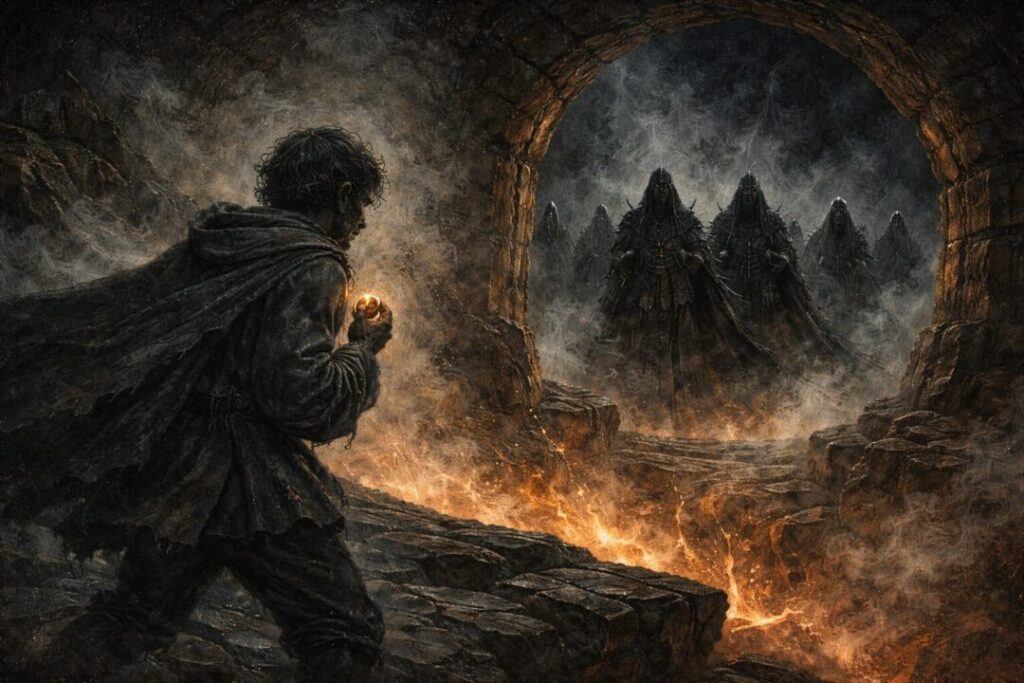
The most plausible consequence is not immediate conquest of Mordor, but exposure. Sauron becomes aware. The Nazgûl are drawn. And Frodo, however exalted or terrible he might seem in that instant, is still radically outmatched in experience, knowledge, and power.
This is one of the most important corrections to popular imagination.
Claiming the Ring is not the same as securing it.
A hobbit at the Crack of Doom with the Ring on his hand is still standing inside Sauron’s realm, under Sauron’s shadow, in the place where the Ring was made for Sauron’s own use. The likely end of that path is delay, deception, and recovery by the Dark Lord — not a sudden reversal in which Frodo rules from Barad-dûr.
So one of the truest alternate endings is also one of the bleakest:
The quest reaches its goal geographically, but fails in its purpose.
The Ring is claimed, not destroyed.
And Sauron gets it back.
Why “Use the Ring for Good” Is Not a Better Ending
Another common fantasy is that someone greater than Frodo should simply have used the Ring against Sauron.
Usually the imagined candidates are Gandalf or Galadriel. Sometimes Aragorn enters the discussion as well. The assumption is that a noble person with sufficient strength might wield the Ring effectively and then remain morally intact.
But Middle-earth does not support that hope.
The refusal of the Wise is not theatrical modesty. It is understanding.
They are dangerous candidates precisely because they are great enough to do something with it. A lesser person might be destroyed quickly. A greater one might actually build a new order under its power. That sounds, on the surface, more promising.
It is not.
Because domination does not become harmless when the ruler has good intentions.
That is the whole point.
The Ring does not merely tempt people to do evil openly. It tempts them to impose good by force, to arrange the world into obedience, to turn wisdom into control. In that sense, a victorious Ring-lord is not the opposite of Sauron. He is another version of the same deformity, perhaps even more seductive because his rule would first appear just.
This is why the “better ruler” ending is not a better ending at all.
It is simply a slower corruption wearing a nobler face.
The Real Alternate Endings Are Narrower Than Fans Expect
Once all the brighter fantasies are removed, the plausible alternate endings become surprisingly few.
Bombadil does not solve the war.
Hiding the Ring does not solve it.
Sending it away does not solve it.
Using it for good does not solve it.
Frodo’s simple voluntary throw at the very end is far less secure, textually, than many readers assume.
What remains?
Very little.
A redeemed Gollum, still ending in destruction.
Or a claimed Ring, ending in Sauron’s recovery of it.
That narrowness is not a flaw in the story.
It is one of the story’s deepest achievements.
The Ring is not a puzzle waiting for a cleverer plan.
It is a moral and spiritual burden designed to close off ordinary victories.
By the time the quest reaches its end, there is almost no room left for a clean solution.
Only mercy, failure, providence, and catastrophe remain in play.
Why This Matters
The ending of the Ring-quest often feels shocking because it refuses the kind of victory readers are trained to expect.
The hero does not simply prove stronger than temptation.
The wise do not seize power and use it properly.
The final success comes through pity shown long before, and through a chain of events no strategist could safely plan.
That is why the plausible alternate endings matter.
They reveal that the actual ending is not a strange accident interrupting a more heroic one.
It is the shape the story was driving toward all along.
Once you see that, the destruction of the Ring becomes even more unsettling than before.
Because the real question is not why the quest ended in such a painful, irregular way.
It is why readers ever imagined it could have ended cleanly at all.
Sources & Notes
- J.R.R. Tolkien, The Lord of the Rings, Book II, Chapter 2, “The Council of Elrond” — rejects Bombadil, hiding, sending the Ring away, and using it as answers; the Ring must be destroyed where it was made.
- J.R.R. Tolkien, The Lord of the Rings, Book VI, Chapter 3, “Mount Doom” — gives Frodo’s final claim of the Ring, Sauron’s sudden awareness, the Nazgûl’s rush to Orodruin, and Gollum’s fall with the Ring.
- J.R.R. Tolkien, Letter 246 — explains Frodo’s failure at the Crack of Doom, treats his endurance as having reached its limit, and discusses the possible outcome if Gollum had truly repented.
- J.R.R. Tolkien, The Lord of the Rings, Book I, Chapter 2, “The Shadow of the Past” — frames Bilbo’s pity for Gollum as a decisive mercy whose consequences Gandalf cannot fully foresee.
- J.R.R. Tolkien, The Lord of the Rings, Book II, Chapter 7, “The Mirror of Galadriel” — shows Galadriel refusing the Ring and links the temptation to ruling, ordering, and domination rather than simple villainy.
- J.R.R. Tolkien, Letter 131 — describes the Ring as Sauron’s instrument of domination and clarifies why using it against him would reproduce the same corrupting principle.