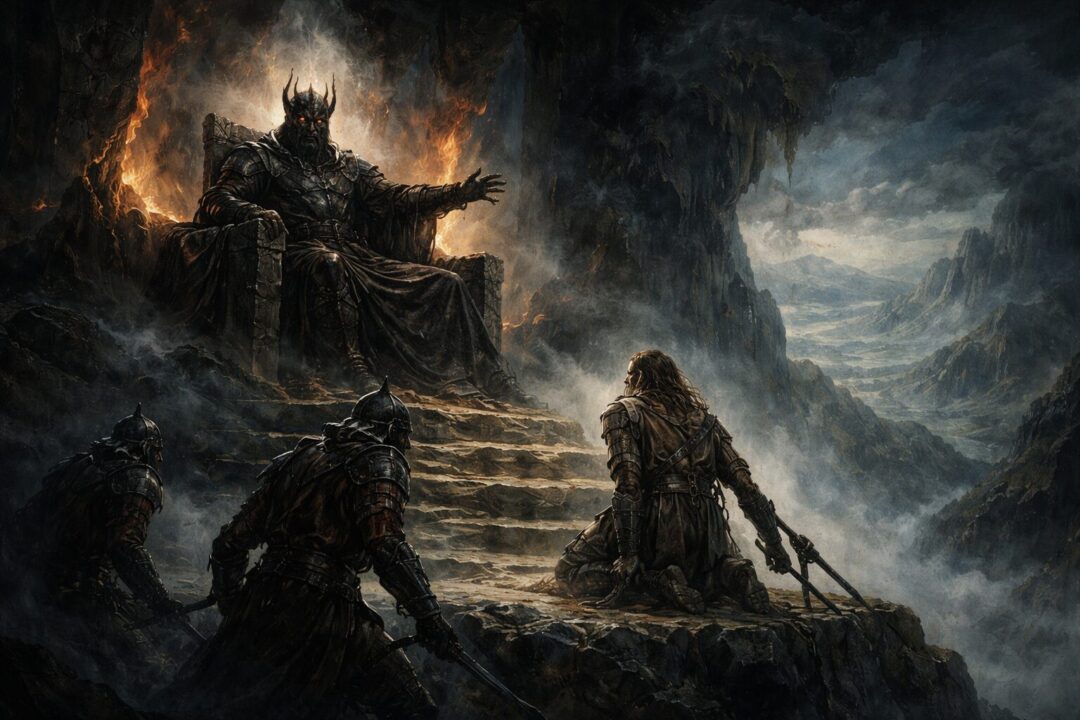
Most people remember Túrin Turambar as the man destroyed by a curse.
That is true.
It is also incomplete.
The story does not ask us to doubt that Morgoth’s doom over Húrin’s house is real. The curse is spoken plainly, and the pattern of Túrin’s life seems, at first glance, to confirm it line by line. Evil rises around him. His hopes turn bitter. His victories collapse into grief. Even his greatest acts seem to prepare the way for some worse disaster still.
But if that were the whole explanation, Túrin would not be tragic in the way he is.
He would be only unlucky.
Or worse, only controlled.
The deeper horror of his story is that the curse is real without cancelling his agency. The shadow lies over his life, but the man beneath that shadow still acts, chooses, loves, wounds, resists counsel, and helps bring about the very ruin he fears.
That is why the tale remains so devastating.
The Curse Is Real, and the Text Wants Us to Feel It
The first thing that has to be established is simple:
The curse is not a metaphor.
Morgoth does not merely threaten Húrin with ordinary suffering. He speaks of a dark pressure that will weigh upon all whom Húrin loves, driving them toward despair. Wherever they go, evil will arise. Whenever they speak, their words will bring ill counsel. What they do will turn against them.
That is not casual language.
The story is built to make those words echo.
Túrin’s life is marked from childhood by loss, exile, separation, and a strange pattern in which even strength becomes dangerous. He is not weak. He is not passive. In many ways he is one of the mightiest Men of the Elder Days. Yet over and over, his courage arrives inside conditions already poisoned.
This matters, because some readings swing too far in the other direction and act as though the curse explains nothing at all.
It clearly explains something.
The tale itself calls attention to it too often for that to be dismissed.
What the Curse Seems to Do
The curse does not behave like a simple spell that seizes Túrin’s hands and makes him act against his will.
Instead, it seems to work more like a cloud over events.
That image is close to Morgoth’s own words, and it fits the structure of the tale. The doom over Húrin’s line appears to darken circumstances, twist outcomes, and draw misfortune into moments that might otherwise have ended differently.
That helps explain why Túrin’s life feels so relentlessly burdened.
He enters places already strained.
He speaks in moments already dangerous.
He meets enemies who exploit exactly the wound he carries.
He reaches safety only for it to narrow into another trap.
The curse also seems connected to despair.
Again and again, hope is cut off at the moment it seems nearest. Reunion fails. rescue comes too late. Hidden identities remain hidden just long enough. Good intentions become openings for grief.
The result is not random bad luck.
It is the repeated frustration of healing.
What the Curse Does Not Do
And yet the curse does not erase Túrin’s character.
This is where many simplified readings fail.
If Morgoth’s doom explained everything completely, then Túrin’s own qualities would barely matter. But the entire force of the narrative depends on the fact that they matter constantly.
Túrin is proud.
He is quick to wrath.
He is deeply sensitive to insult.
He often resists counsel, especially when it asks him to endure shame, delay action, or accept limits.
He is also compassionate, brave, and capable of deep loyalty.
The story does not strip any of that away.
In fact, it makes his gifts and faults inseparable. The very intensity that makes him dangerous is also what makes him admirable. The same fierceness that drives him to defend others can drive him into rashness. The same refusal to bow can become refusal to listen.
That is not mind control.
That is tragedy.
Saeros, Doriath, and the Beginning of Exile
One of the clearest early examples comes in Doriath.
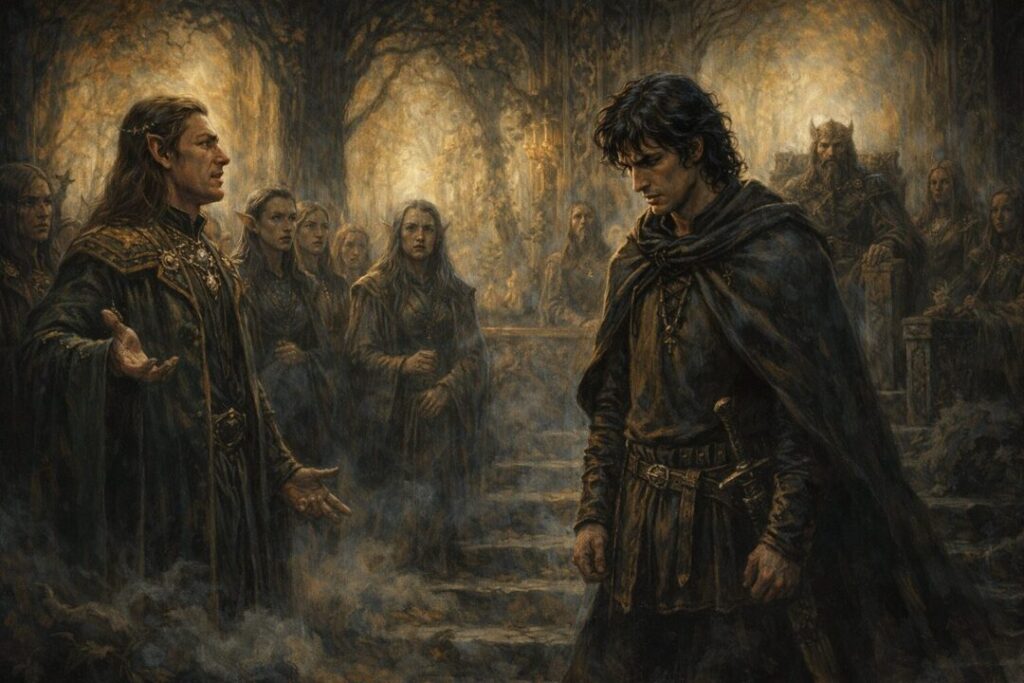
Saeros insults Túrin cruelly and publicly. The mockery is real, and Túrin is not wrong to feel wronged. But the outcome is shaped not only by external malice, but by Túrin’s own anger. He pursues Saeros in fury, and Saeros dies in terror while fleeing him.
This matters because it shows the pattern early.
Was evil present? Yes.
Was Túrin simply forced? No.
The curse may help explain why such malice and misunderstanding gather around him so quickly. It may even help explain why moments that could have been resolved instead become irreversible. But the text does not remove Túrin from the center of the act.
He responds.
He escalates.
He flees before Thingol’s judgment, assuming the worst and setting himself further outside the protection that might have preserved him.
That is exactly the kind of collision the story keeps staging: a dark pressure from without, answered by a destructive intensity from within.
Beleg’s Death Is Not Just “the Curse Did It”
The death of Beleg is often folded too easily into the curse, as if that were explanation enough.
But the scene is more exact than that.
Túrin has been captured by Orcs. Beleg comes to rescue him. In the confusion after his bonds are cut, Túrin wakes in terror and seizes Anglachel, killing the friend who came to save him.
The curse hangs over the scene, certainly. The whole chain of events feels marked by doom.
But the immediate cause is not mysterious.
It is fear, darkness, confusion, exhaustion, and the fatal nearness of a sword.
That does not make the scene less tragic. It makes it more tragic. The curse does not replace the human texture of the moment. It sharpens it.
Beleg does not die because Túrin becomes an empty instrument.
He dies because in a world already bent toward grief, one blinded instant is enough.
Nargothrond and the Cost of Túrin’s Counsel
The fall of Nargothrond is one of the strongest examples of what the curse does not excuse.
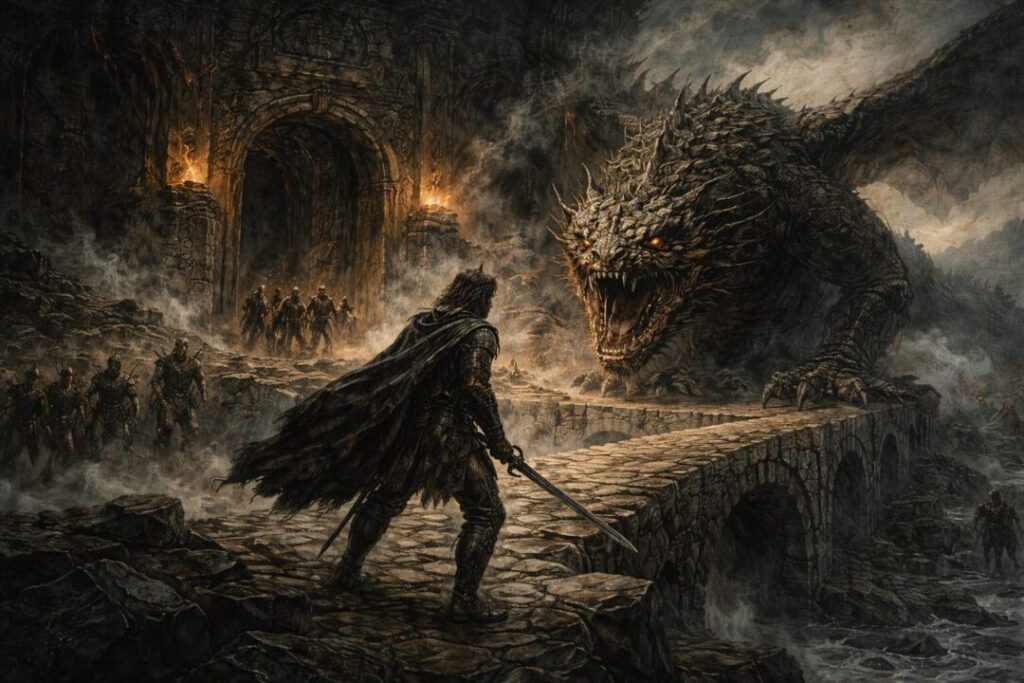
In Nargothrond, Túrin rises to power and renown. He becomes a great war-leader. He urges open action against Morgoth. He helps lead the realm away from secrecy and caution. Most famously, he counsels the building of the bridge that makes passage easier to the city.
This does not come out of nowhere.
It comes from Túrin’s temperament. He despises hidden waiting. He wants strength to answer strength. He wants fear broken openly.
These are understandable impulses. In another tale, they might look heroic.
Here they become disastrous.
When Glaurung comes, the bridge aids the ruin of Nargothrond. The city is exposed. The victory-loving policy that raised Túrin’s fame prepares the way for catastrophe.
This is crucial.
The curse may help explain why his counsels so often turn against him. Morgoth’s own words almost predict that pattern. But the counsels are still his.
The story never lets us say he bears no responsibility.
Glaurung Is Not the Same Thing as the Curse
Another detail often blurred in summary is the role of Glaurung.
The dragon is Morgoth’s servant, so his actions obviously belong within the Enemy’s larger malice. But the text still distinguishes between the general doom over Húrin’s house and the immediate, active deception worked by Glaurung himself.
This distinction matters.
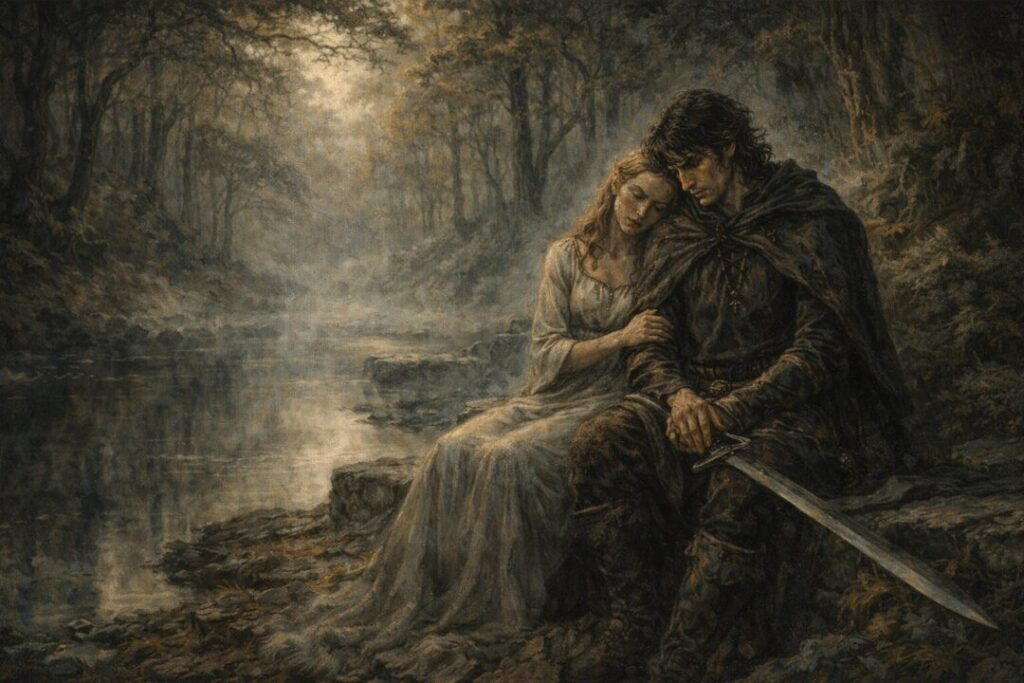
At Nargothrond, Túrin stands at a terrible crossroads. Finduilas is being carried away. Then Glaurung halts him, speaks to him, and fixes his will with dragon-spell, driving him toward Dor-lómin with false visions of Morwen and Nienor in torment.
That is not just “bad luck.”
It is direct manipulation.
Likewise, Nienor’s memory-loss comes through Glaurung’s power. The final horror between brother and sister is not explained by the curse alone, as though events merely drifted there. It is actively engineered through the dragon’s enchantment and lies.
The curse creates the atmosphere of doom.
Glaurung drives some of the most terrible particulars.
If those are blurred together, the story loses precision.
Why Túrin Still Matters Morally
If Morgoth’s curse is real, and if Glaurung actively deceives both Túrin and Nienor, why does the story still feel morally serious?
Because Túrin is never reduced to an object.
He is judged by others.
He is warned.
He ignores counsel.
He chooses names for himself.
He tries to master fate by renaming it.
That last point is especially important.
The name Turambar means “Master of Doom.”
It is one of the bleakest names in Middle-earth, because it reveals exactly what Túrin cannot do. He does not accept fate humbly. He answers it with defiance, almost as though will alone can break the shape of things.
There is grandeur in that.
There is also blindness.
The story does not mock his resistance. In some ways it honors it. But it also shows that defiance without wisdom can become another road into ruin.
That would have no force at all if Morgoth’s curse had already emptied Túrin of responsibility.
The Curse Explains the Pattern, Not Every Motion
This may be the clearest way to say it:
The curse explains the pattern of Túrin’s life more than it explains every individual act.
It explains why darkness gathers so persistently around Húrin’s children.
It explains why evil seems always near at hand.
It explains why even good intentions so often collapse into grief.
But it does not fully explain Túrin’s temper, his pride, his refusal of restraint, or his repeated inability to step back from wounded honor.
Those belong to him.
And that is exactly why the story hurts so much.
If all were curse, there would be pity.
Because it is curse and character together, there is something worse: recognition.
Why the Story Remains So Devastating
Túrin is not merely a doomed man.
He is a great man under doom.
That difference is everything.
The tale never asks us to deny the supernatural weight laid upon Húrin’s house. But neither does it allow us to dissolve Túrin into that weight and call the matter settled. Instead, it shows what happens when external malice finds exactly the kind of soul it can wound most deeply: proud enough to resist, fierce enough to strike back, noble enough to love, and wounded enough to misread the shape of danger again and again.
So what does the Curse of Morgoth explain?
It explains the darkness pressing on Túrin’s life.
It explains the terrible convergence of events.
It explains why despair seems to stalk his house almost as a living thing.
What does it not explain?
It does not explain Túrin away.
And that is why his story remains one of the hardest in all of Middle-earth to leave behind.
Because in the end, the most terrible part is not that doom came for him.
It is that when it did, it found a man still fully himself.
Sources & Notes
- J.R.R. Tolkien, The Children of Húrin, “The Words of Húrin and Morgoth” — gives Morgoth’s spoken doom over Húrin’s family and frames the curse as a real pressure, not just bad luck.
- J.R.R. Tolkien, The Children of Húrin, “Túrin in Doriath” — covers Saeros’s insult, Túrin’s furious pursuit, Saeros’s death, and Túrin’s flight before Thingol’s judgment.
- J.R.R. Tolkien, The Children of Húrin, “The Death of Beleg” — shows Beleg’s rescue attempt ending in Túrin’s fear-blinded killing of his friend, where doom and immediate circumstance meet.
- J.R.R. Tolkien, The Children of Húrin, “Túrin in Nargothrond” and “The Fall of Nargothrond” — support the article’s point that Túrin’s counsels, open-war policy, and the bridge help prepare Nargothrond’s disaster.
- J.R.R. Tolkien, The Children of Húrin, “The Fall of Nargothrond” and “Nienor in Brethil” — distinguish Morgoth’s broader curse from Glaurung’s direct dragon-spell, lies, and erasure of Nienor’s memory.
- J.R.R. Tolkien, The Silmarillion, “Of Túrin Turambar” — provides the compact canonical arc of Túrin’s pride, renaming as Turambar, slaying of Glaurung, and final tragic self-knowledge.