When readers think about the later history of Middle-earth, the same question keeps returning in different forms.
Why do some creatures seem to linger into the end of the Third Age and even beyond, while others fade out of the story almost entirely?
At first, the answer appears simple. Some survive because they are strong. Others disappear because they are defeated.
But the texts point toward something more subtle than that.
By the end of the Third Age, Middle-earth is already described as a fading world. The old powers are not merely being killed off one by one. They are being overtaken by time, by change, and by the coming Dominion of Men. That is why survival in the late ages rarely looks like triumph. More often, it looks like diminishment.
The Late Ages Are About Change, Not Simple Extinction
One of the easiest mistakes to make is assuming that every ancient being in Middle-earth follows the same rule.
They do not.
Some creatures are destroyed in war.
Some become fewer and weaker.
Some withdraw from the centers of history.
Some remain, but only as remnants of what they once were.
The Third Age itself is associated with that process. It is described as the “Fading Years,” marked by the waning of the Elves, and after the destruction of the One Ring the preserved beauty sustained by the Three Rings begins to fail. The world is not ending, but an older order is passing away.
That matters because it changes the whole question.
The issue is not simply, “Which creatures can stay alive the longest?”
It is, “Which creatures still belong in the kind of world Middle-earth is becoming?”
Once that shift is made, the pattern becomes much clearer.
The Elves Survive, but Only by Leaving or Fading
No people illustrate this more clearly than the Elves.
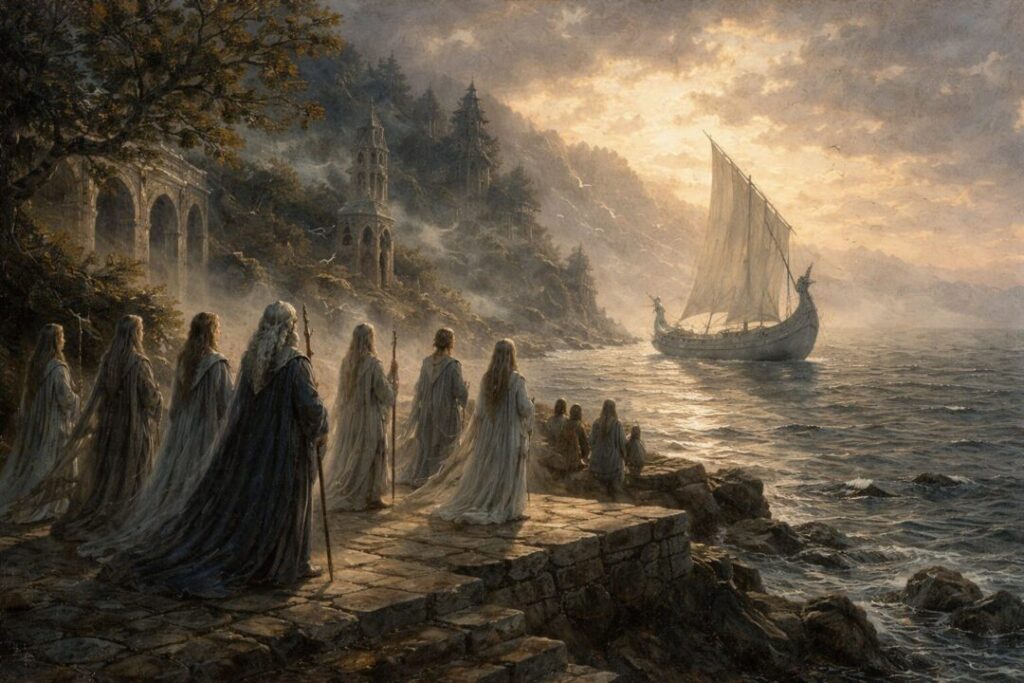
They are not wiped out at the end of the Third Age. In one sense, they survive better than almost anyone. They remain immortal within the life of Arda, and some still dwell in Middle-earth well into the Fourth Age. But that survival comes with a condition that makes it feel almost like disappearance anyway.
Their preserved realms cannot remain what they were once the One Ring is destroyed. The power of the Three wanes with it. Many of the Eldar depart over Sea, and those who remain are bound to a long decline. Tolkien Gateway’s summary of the textual tradition reflects this clearly: the remaining Elves eventually fade, becoming invisible to mortal eyes in the long course of the world.
This is why Elven survival in the late ages is so strange.
They endure.
But they do not continue in open splendor.
Their future is either departure into the West or fading within Middle-earth until they are no longer present in the way they once were. Galadriel’s warning that her people must depart or dwindle into a “rustic folk of dell and cave” captures exactly that mood: not sudden annihilation, but slow diminishment into memory.
So the Elves do survive.
They simply do not survive as a ruling presence in the visible, historical world.
The Ents Remain, but Without Renewal
The Ents present a different version of the same principle.
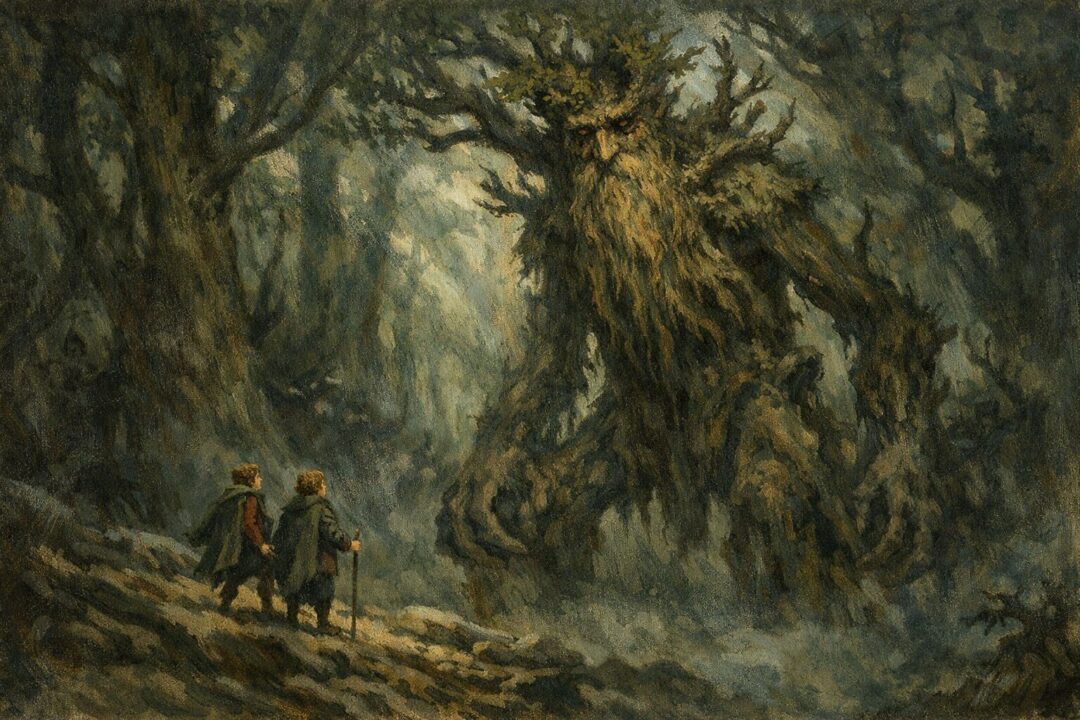
They are described as the most ancient living creatures surviving in Middle-earth during the Third Age. That alone makes them seem like the perfect example of endurance. Treebeard feels older than kingdoms. Older than wars. Older, almost, than history itself.
And yet the texts go out of their way to show that Entish survival is fragile.
By the Third Age, Fangorn appears to be the only place where Ents still dwell. There are no Entings because the Entwives are lost. Some Ents have become increasingly “treeish,” slowing toward a state that is less like active life and more like a long settling into silence. Their race survives by longevity, not by renewal.
That distinction matters.
The Ents are not presented as a thriving ancient people who outlast everyone else.
They are presented as a people who have almost come to the end of their story without quite ending. Their survival is real, but it has the melancholy of something that cannot truly begin again. Even Treebeard’s lingering hope concerning the Entwives is hope, not resolution. The canon does not confirm reunion. It leaves the question open.
So why do Ents survive into the late age?
Because their nature is slow, ancient, and bound to the deep life of the world.
Why do they still feel like they are disappearing?
Because survival without renewal is only one step away from loss.
Dragons Do Not Entirely Vanish, but They Do Become Lesser
Dragons are where this pattern becomes especially revealing.
Many readers instinctively treat Smaug as the end of the dragons. He feels final. The last great terror. The final flame of an elder age.
But that is not quite what the texts support.
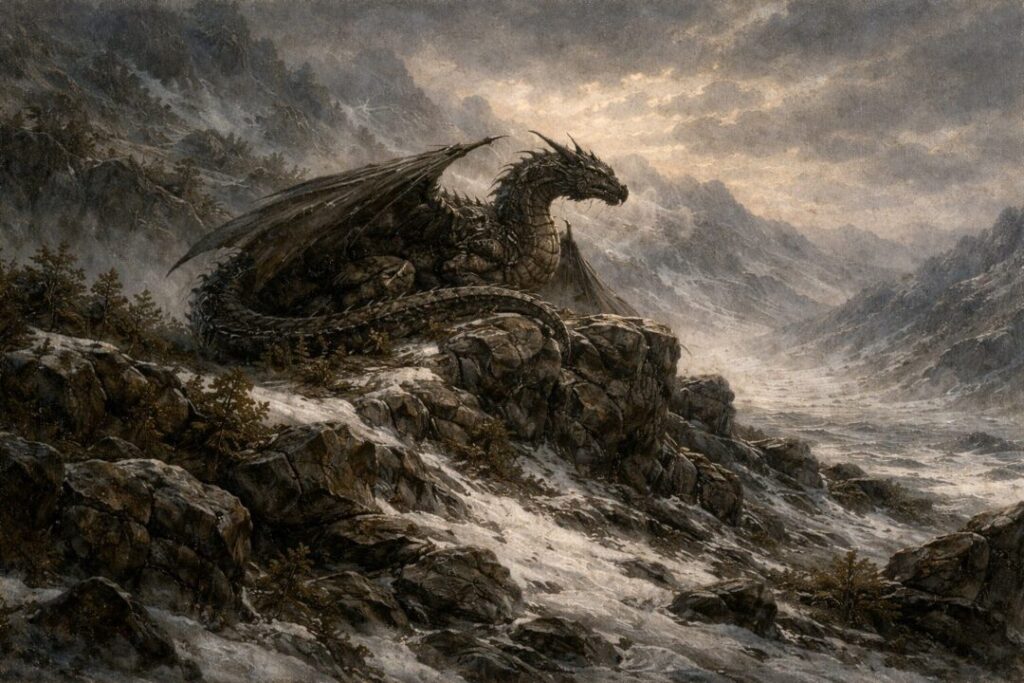
In The Fellowship of the Ring, Gandalf says that no dragon then living had fire hot enough to melt and consume the Rings of Power. The wording matters, because it does not say there are no dragons at all. It says none remained with that old strength. Tolkien later clarified the point even more directly in Letter 144, explaining that dragons had “not stopped” and that the phrase itself implies that there were still dragons, though no longer “of full primeval stature.”
That is one of the clearest statements anywhere in the legendarium about late-age survival.
Dragons may persist.
But they persist in diminished form.
This fits the larger pattern perfectly. The ancient monsters of Morgoth’s world do not necessarily vanish overnight. Some remain into later times, but as weakened descendants rather than as world-breaking powers on the scale of the First Age. The age can still contain dragons, just not dragons that belong to the old height of terror.
So dragons survive not by escaping decline, but by sharing in it.
Hobbits Endure Because They Fit the Coming World
Hobbits reveal the opposite side of the pattern.
They are not ancient in the same sense as Ents. They do not possess the grandeur of the Elves or the fearsome power of dragons. Yet in some ways they are the best suited of all to the late ages.
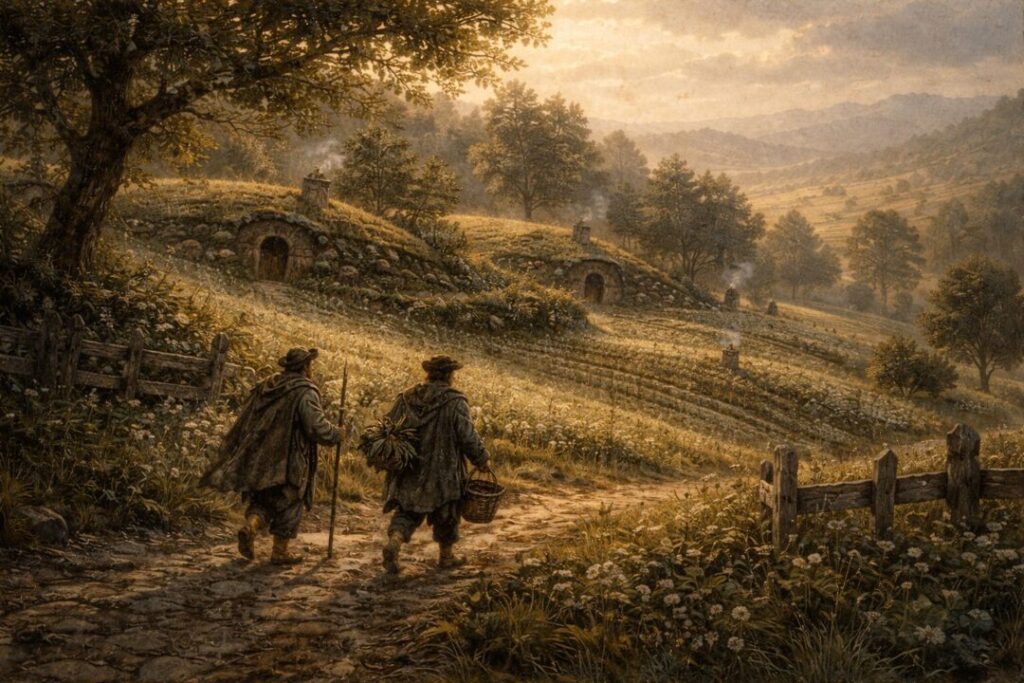
The opening of The Lord of the Rings already frames them this way. Hobbits are “an unobtrusive but very ancient people,” once more numerous than they are now, increasingly shy of Big Folk and hard to find. In other words, they survive by smallness, concealment, and adaptability.
This is crucial.
The world after the War of the Ring is moving toward the Dominion of Men. Hobbits are generally understood within the legendarium to be related to Men rather than a wholly separate order like Elves or Dwarves. That gives them a different future from the great elder peoples. They are not passing out of the world in the same way. They are becoming obscure within it.
That is why Hobbits can feel both surviving and disappearing at once.
They do not leave.
They do not fade into invisibility.
They simply slip out of the main roads of history.
The late ages have less room for wonder, but plenty of room for small hidden lives.
And that makes Hobbits strangely well matched to what Middle-earth is becoming.
Some Creatures Depend on a Dark Power and Do Not Last the Same Way
There is another category too: creatures whose continued presence seems bound to a specific evil order.
This is where caution matters, because the canon is not equally explicit in every case.
Barrow-wights, for example, are not treated as a natural enduring people with their own long future. They are evil spirits sent into the Barrow-downs by the Witch-king of Angmar, and during the War of the Ring he is said to have roused them again. Their survival is less like the endurance of a people and more like the lingering of a curse in a specific place.
The Olog-hai are even more telling. Tolkien Gateway summarizes the textual basis by noting that they may have existed only because Sauron’s evil will empowered them. They appear very late, at the end of the Third Age, and most who fought at the Morannon were killed when Sauron fell. That does not prove every Troll vanished at once. But it strongly suggests that this particular heightened form was bound to Sauron’s power in a way older Troll-kind was not.
So some creatures disappear not because age overtakes them, but because the will sustaining or organizing them collapses.
They do not belong to the world that follows.
Survival in Middle-earth Usually Comes at a Cost
That may be the deepest rule behind all of this.
The late ages do not reward creatures for being older, grander, or more terrible.
They test whether a being can continue under diminished conditions.
The Elves can survive, but only by leaving or fading.
The Ents can survive, but only without renewal.
Dragons can survive, but not in the old greatness.
Hobbits can survive because they were never built for domination in the first place.
Creatures bound to dark tyrannies may linger for a while, but often do not outlast the order that made them dangerous.
That is why the later history of Middle-earth feels so bittersweet.
Survival is possible.
But it is rarely unchanged survival.
The world goes on by becoming narrower, quieter, and more human.
Why This Pattern Matters
Once this pattern is seen, many scattered details in Tolkien’s world begin to lock together.
The old creatures do not simply vanish because the plot forgets them.
They vanish, fade, withdraw, or diminish because Middle-earth itself is moving away from the age in which such beings stood openly at the center of things.
That is why the late ages are filled with remnants.
A last dragon, but perhaps not the last dragon-kind.
An ancient Ent still walking, though his people cannot renew themselves.
Elves still present, but already on the edge of being memory.
Hobbits still alive, though becoming hard to find.
The deeper question was never just who lives and who dies.
It was always which beings can still remain once the world no longer belongs to wonder in the same way.
And in Middle-earth, that answer is almost never simple survival.
It is survival altered by time.
Sources & Notes
This article is based on close reading and interpretation of Tolkien's published works and related source material where relevant.