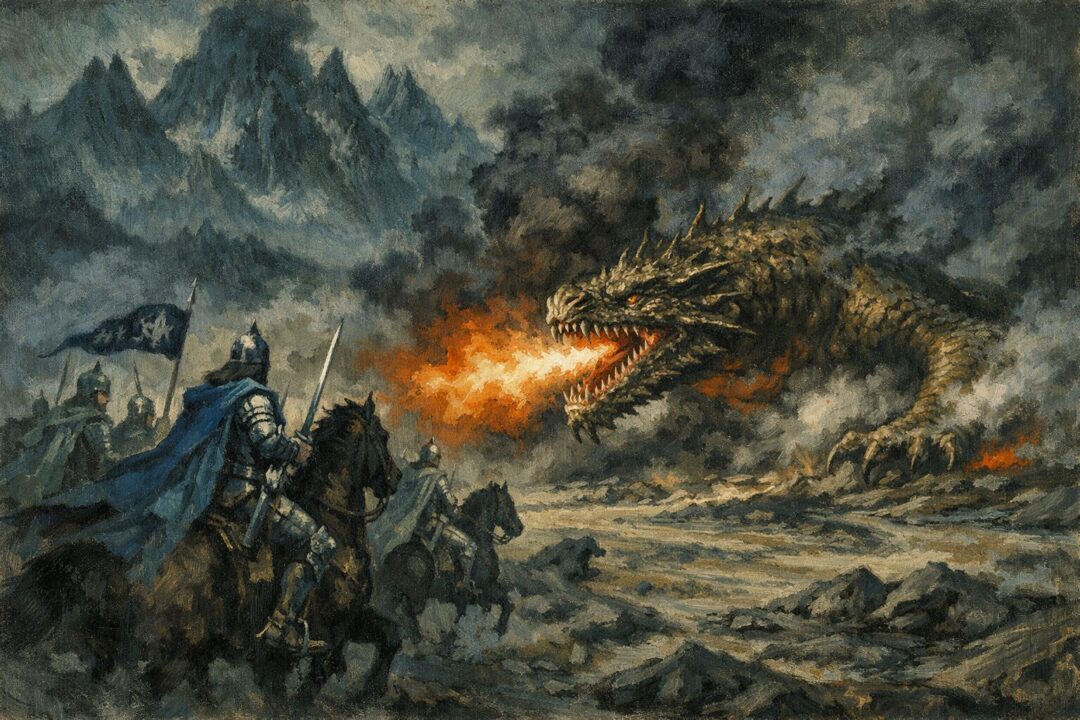
When people think of the most frightening servants of Morgoth, Balrogs usually come first.
That makes sense.
Balrogs arrive wrapped in fire and shadow. They are ancient corrupted spirits, terrible in battle, and when one appears the entire scene narrows around raw dread. In Middle-earth, few things announce themselves with such immediate force.
And yet Glaurung often leaves a darker impression.
Not because the texts clearly rank him above every Balrog in sheer power.
Not because dragons are automatically worse than fallen spirits.
And not because he is the largest or most destructive creature Morgoth ever bred.
He feels worse for another reason.
Glaurung does not only attack fortresses, armies, and bodies.
He attacks the inner life.
That is what makes him feel like a new kind of evil in the legendarium. With Balrogs, terror comes at you from outside. With Glaurung, terror moves inward—into thought, memory, shame, and choice.
That difference matters more than it first appears.
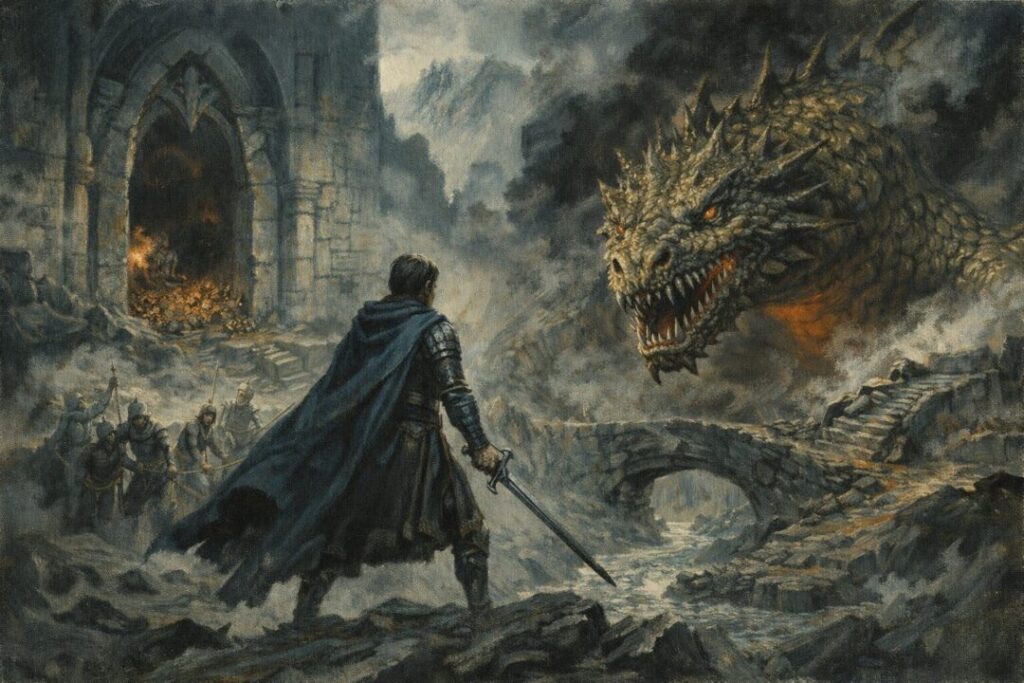
Balrogs Are Catastrophic, But Their Evil Is Usually Direct
The Balrogs are among Morgoth’s most dreadful servants. They are corrupted Maiar, spirits of fire and darkness, described as “demons of terror.” Their very presence carries force. In battle, they break lines, strike panic, and embody the old violence of Morgoth’s wars.
When a Balrog appears, the danger is immediate.
You do not wonder what it wants.
You do not need to decode its methods.
Its evil is manifest.
Even Durin’s Bane, encountered late in the Third Age, works this way. It is hidden for long ages, but once revealed, it does not begin by seducing, arguing, or rearranging the minds of its enemies. It advances as a being of shadow, flame, and overwhelming threat.
That kind of evil is terrible.
But it is also legible.
A Balrog is a nightmare of force. It is a destroyer. It overwhelms courage and endurance. It belongs to the old world of open war, where evil often comes crowned in fire.
Glaurung can do that too.
But he is not limited to that.
Glaurung Is Not Just a Beast
Glaurung is the first of the dragons, and from the beginning he is more than an animal weapon.
He is sentient.
He speaks.
He understands his enemies.
He acts with patience.
That alone sets him apart.
His earliest appearances already show that he is a war-power. He drives the defenders of Ard-galen in dismay. Later, at the Nirnaeth Arnoediad, his strength and terror are so great that Elves and Men wither before him. He helps sweep apart the hosts of Maedhros and Fingon.
So the dragon is not merely psychological.
He is fully destructive in the ordinary sense.
But when his story reaches Túrin, the shape of his evil becomes more personal and far more disturbing.
Glaurung does not merely serve Morgoth by burning what is good.
He serves him by bending human lives toward ruin from within.
The Fall of Nargothrond Shows What Kind of Monster He Really Is
The sack of Nargothrond is where Glaurung becomes truly unforgettable.
He comes as conqueror, yes. He defeats the forces of the city, passes over the bridge, and destroys the Doors of Felagund. On the surface, this looks like the kind of devastation readers expect from a dragon.
Then the deeper horror begins.
As the city is being sacked, Túrin cuts his way toward the captives. Glaurung emerges and fixes him with the spell of his gaze. Túrin is held helpless while Finduilas is led away.
That scene already feels cruel in a way different from ordinary battlefield slaughter.
But Glaurung is not finished.
He speaks.
And what he says is not empty mockery. He studies Túrin’s weaknesses and turns them against him. He invokes Morwen and Niënor. He presses on guilt, family loyalty, shame, and the fear of having failed those nearest to him. He redirects Túrin away from Finduilas and back toward Dor-lómin.
This is one of the most revealing moments in all of Middle-earth.
Glaurung does not only overpower the body.
He engineers the decision.
That is a subtler and more invasive evil than open violence.
Glaurung Lies Best When He Uses Truth
Part of what makes Glaurung so frightening is that he does not rely on simple falsehood.
He lies through distortion.
He tells Túrin things that touch reality closely enough to wound. The emotional pressure works because the dragon does not invent a random fear. He reaches for what already lives inside Túrin: guilt, divided duty, uncertainty, grief, and the sense that every choice comes too late.
That is why Glaurung’s speech hits so hard.
He is not a crude tempter offering obvious evil.
He is a manipulator who weaponizes conscience.
The result is more tragic than a straightforward deception would have been. Túrin is not tricked because he is foolish in any shallow sense. He is caught because the dragon speaks into the deepest fractures already present in his life.
That kind of evil feels modern, intimate, and psychologically exact.
A Balrog may kill you.
Glaurung can make your own heart help him do it.
Niënor Reveals the Full Depth of His Malice
If the Nargothrond episode shows Glaurung’s cunning, Niënor’s story shows his cruelty at its most chilling.
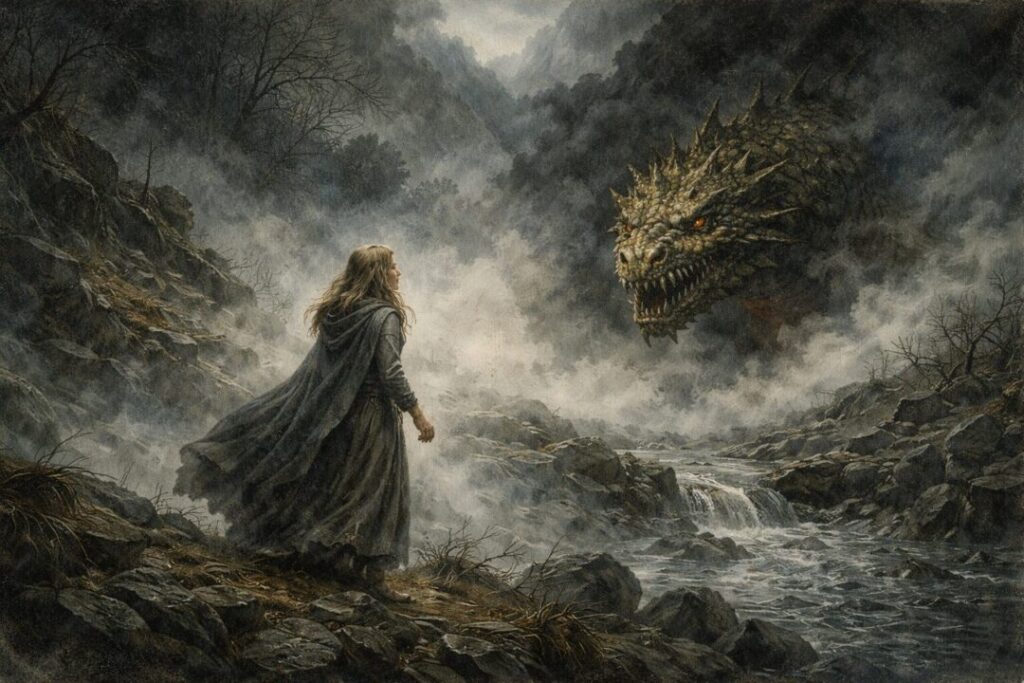
When Morwen and Niënor come seeking news, Glaurung detects them quickly. He creates confusion, separates them, and then meets Niënor alone. There he places her under a spell so severe that her memory is wiped away. She knows nothing, remembers nothing, and wanders lost.
This is not merely intimidation.
It is the destruction of identity.
And the consequences are catastrophic.
Niënor becomes Níniel. Túrin, not knowing who she is, later finds her. The two marry in ignorance. The dragon’s intervention hangs over the entire tragedy. What follows is not presented as random fate falling from the sky. It is the result of Morgoth’s curse moving through one of his most intelligent servants.
Even then, Glaurung’s part is not complete.
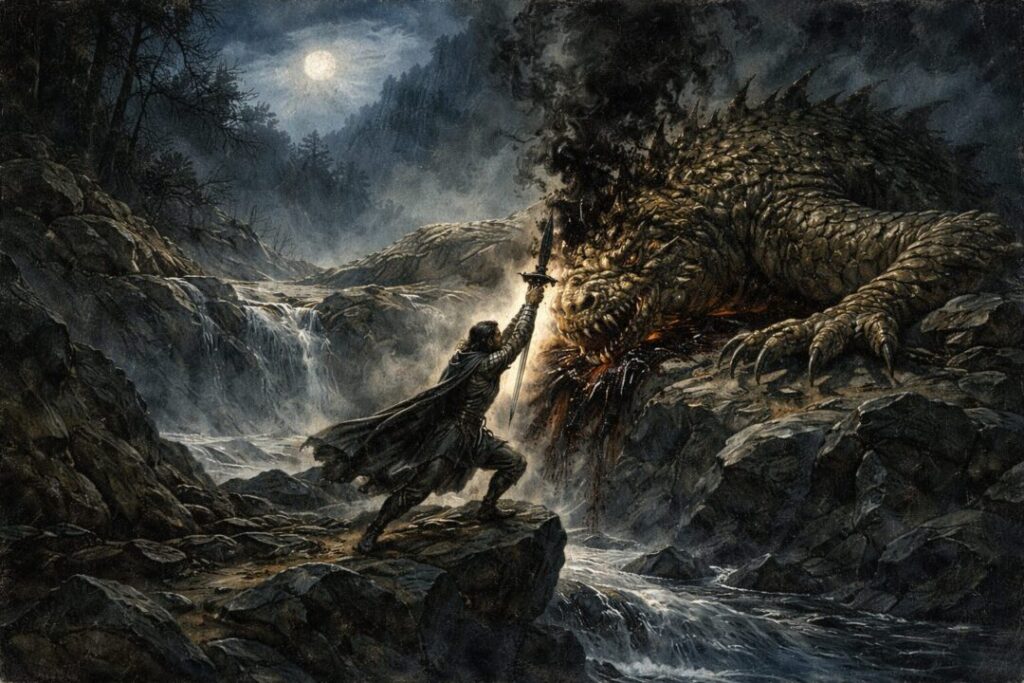
When Túrin finally mortally wounds him, the dragon uses his last breath not for repentance, not for rage alone, but for one final revelation designed to destroy. He names the truth to Niënor at the precise moment it will do the greatest damage. As his spells break, memory returns, and the whole ruin falls into place.
That is almost unbearable in its precision.
The dragon does not merely kill.
He arranges the moment of recognition.
Why This Feels Worse Than Balrog Terror
This is where the comparison sharpens.
Balrogs are terrifying because they embody concentrated dread. They are ancient, overwhelming, and apocalyptic in battle. When one appears, the world seems to darken around it.
But Glaurung introduces a different register of horror.
He is articulate.
He is patient.
He is mocking.
He is strategic in a deeply personal way.
He makes victims participate in their own undoing.
That does not mean Balrogs are lesser beings in any absolute sense. In origin, they are of a higher order than dragons. They are corrupted spirits, not creatures bred later in the history of Arda. But origin is not the same thing as narrative terror.
What Glaurung does to readers is different from what Balrogs do.
Balrogs terrify as manifestations of force.
Glaurung terrifies as a mind.
He is closer to a corrupter than a beast.
Closer to a destroyer of meaning than merely a destroyer of walls.
Glaurung Makes Evil Feel Intimate
There is another reason Glaurung lingers so strongly.
His evil is scaled to persons, not only to nations.
He certainly affects wars. He appears in major battles, scatters hosts, and helps break realms. But the story remembers him most vividly through what he does to a family. Through Túrin. Through Morwen. Through Niënor. Through the slow, suffocating fulfillment of Morgoth’s curse.
That narrowing is crucial.
Many dark powers in the legendarium operate at a grand distance. They move armies, alter kingdoms, or cast shadows over whole ages. Glaurung can do that—but his most unforgettable work happens in conversation, in gaze, in false guidance, in memory stolen and truth timed for maximum ruin.
He turns tragedy into something almost claustrophobic.
You cannot just flee him physically.
By the time he has spoken, part of the damage is already inside you.
He Is One of Morgoth’s Purest Instruments
Morgoth’s evil often works by marring what already exists. He corrupts, twists, distorts, and turns strength against itself. Glaurung reflects that pattern almost perfectly.
He does not create a new destiny for Túrin.
He twists Túrin’s own noble impulses.
He does not replace love with nothing.
He turns love, loyalty, and urgency into the road toward disaster.
He does not merely silence truth.
He withholds it, delays it, and reveals it at the deadliest possible moment.
In that sense, Glaurung feels like one of Morgoth’s most fitting servants.
Not just because he is powerful.
Because he is spiritually congruent with the kind of evil Morgoth represents.
Why Glaurung Stays With Readers
Glaurung remains terrifying because he crosses a boundary many monsters do not.
He is not only dangerous.
He is invasive.
He does not just burn the world.
He interprets it for his victims until they can no longer trust their own judgment.
That is why he can feel worse than a Balrog, even to readers who fully understand how dreadful Balrogs are.
Balrogs are terror advancing.
Glaurung is terror persuading.
Balrogs make you fear death.
Glaurung makes you fear deception, memory, guilt, and the possibility that your best motives can be turned against you.
And in the story of Túrin, that is exactly what happens.
So when people remember Glaurung as more disturbing than Morgoth’s fiery demons, they are usually noticing something real.
He is not simply a dragon with greater dramatic flair.
He is one of the clearest examples in Middle-earth of evil becoming articulate, personal, and psychologically exact.
That is why he lingers.
And that is why, for many readers, the Great Worm is harder to forget than any creature of shadow and flame.
Sources & Notes
- J.R.R. Tolkien, The Silmarillion, “Of Túrin Turambar” — gives the central evidence for Glaurung’s psychological evil: the dragon’s gaze halts Túrin, his words redirect Túrin from Finduilas, and his final revelation destroys Niënor.
- J.R.R. Tolkien, The Children of Húrin, Chapter 12, “The Fall of Nargothrond” — expands Glaurung’s manipulation of Túrin after the sack, showing how he uses guilt, family duty, and half-truths rather than mere force.
- J.R.R. Tolkien, The Children of Húrin, Chapter 14, “The Journey of Morwen and Niënor to Nargothrond” — details Glaurung’s spell on Niënor, the loss of memory, and the personal cruelty behind the later tragedy.
- J.R.R. Tolkien, The Silmarillion, “Of the Fifth Battle: Nirnaeth Arnoediad” — places Glaurung among Morgoth’s war-powers, scattering Elves and Men by terror and destruction before his later, more intimate role in Túrin’s story.
- J.R.R. Tolkien, The Silmarillion, “Valaquenta: Of the Enemies” — identifies Balrogs as corrupted Maiar, “scourges of fire” and “demons of terror,” supporting the article’s contrast between Balrog force and Glaurung’s articulate malice.