Most people think Gondor’s decline is mainly a story of bad rulers, lost kings, and the growing pressure of Mordor.
Those things matter.
But they are not the whole story.
A quieter pattern runs beneath them, and once you notice it, Gondor begins to look very different. Its tragedy is not only that it is attacked from outside. It is that over many centuries, it becomes harder and harder for the realm to fill the space it still claims.
The roads remain.
The fortresses remain.
The old capitals remain.
But the people do not remain in the same numbers.
By the late Third Age, Gondor is not merely a kingdom under threat. It is a kingdom that has been thinning out for generations. That is why so many of its greatest places feel haunted even before the War of the Ring begins. Tolkien’s own summary of the Age is strikingly restrained: Gondor “rises to power… and then fades slowly.”
That slow fading is the key.
Gondor does not collapse all at once
One of the most important things about Gondor’s decline is that it is gradual.
There is no single moment when the realm simply breaks.
Instead, the texts give a long sequence of losses: civil strife, plague, repeated war on the eastern frontier, the abandonment of whole districts, and finally the survival of the kingdom in a narrower and more defensive form.
This matters because Gondor at the end of the Third Age is still impressive. Minas Tirith stands. The Stewards still rule. The southern fiefs still answer the call. The realm can still field armies, hold ceremonies, preserve archives, and remember its ancient dignity.
Yet the grandeur sits beside unmistakable signs of demographic exhaustion.
The kingdom is still there, but not in the fullness it once possessed.
That is a very different kind of decline from a dramatic fall. It is the difference between a city destroyed overnight and a city whose outer quarters slowly empty, whose traffic lessens, whose outposts grow difficult to maintain, and whose people begin living inside the remains of a larger past.
Osgiliath shows the pattern most clearly
If one city reveals this process most sharply, it is Osgiliath.
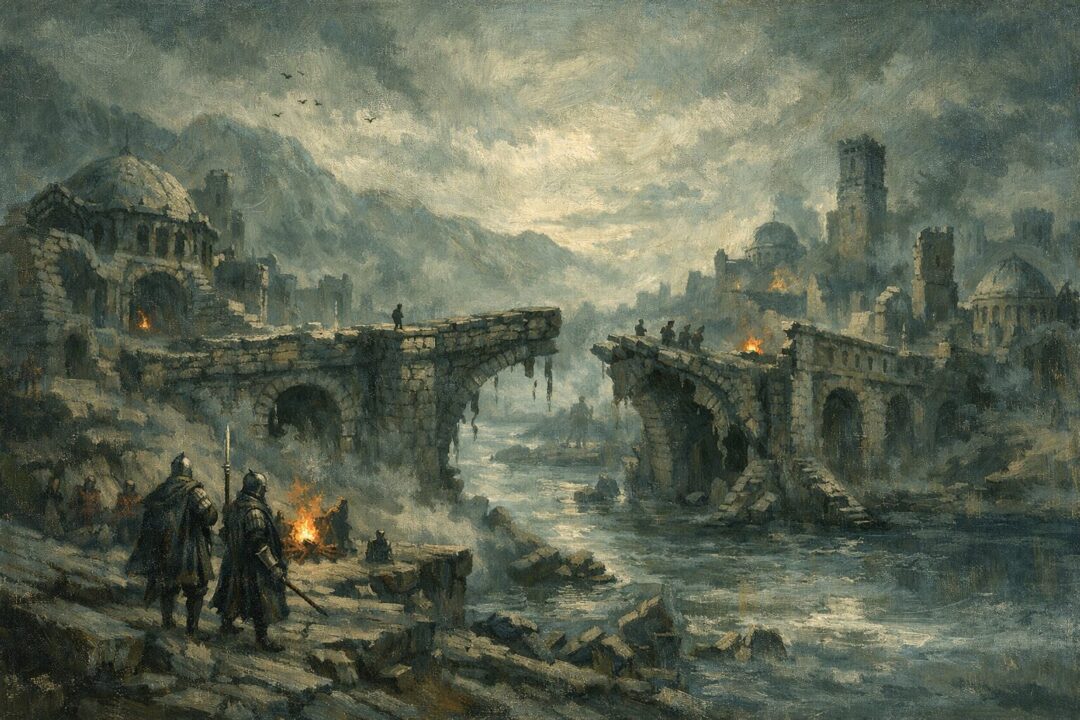
Osgiliath was once the capital of Gondor, the great city on the Anduin where the thrones of Isildur and Anárion stood side by side. But its decline begins long before Sauron’s final war. It is damaged in the Kin-strife, struck again by the Great Plague, and gradually left more vulnerable as Gondor loses strength east of the river.
The crucial phrase comes in The Silmarillion: Osgiliath had long been deserted “in the waning of the people.”
That wording is extraordinary.
The city is not described as deserted only because it was conquered. It is tied directly to the waning of the people themselves. In other words, Osgiliath becomes a ruin not merely because enemies break it, but because Gondor no longer has the human strength to sustain what it once built.
That same thought lingers over the city’s later history. After the plague, many flee and few return. The King’s House is moved to Minas Anor. The population keeps shrinking. By the time Osgiliath is finally abandoned by its remaining civilians, the process is already centuries old.
Osgiliath is therefore more than a battlefield ruin.
It is the clearest sign that Gondor’s geography has become too large for its remaining population.
The Great Plague changes everything
If one event most visibly accelerates this process, it is the Great Plague of T.A. 1636.
The plague devastates Gondor. Osgiliath suffers terribly. Minas Ithil is emptied of its people. Calenardhon is hit so hard that later tradition remembers it as nearly abandoned. The losses among the Dúnedain are severe, and the damage comes only about two centuries after the Kin-strife had already weakened the realm.
This is one of the most important facts in understanding late Gondor.
The kingdom that faces Mordor in the War of the Ring is not the Gondor of uninterrupted strength. It is a kingdom already hollowed by catastrophe long before the final crisis. The plague does not erase Gondor, but it leaves behind a realm less able to repopulate frontier lands, less able to man old defenses, and less able to recover what it loses.
In that sense, plague matters in Middle-earth much as war does.
It reshapes maps without always moving borders immediately.
A land may still belong to a kingdom on parchment while becoming far harder to inhabit, govern, or defend in practice.
Empty provinces matter as much as empty cities
The same pattern appears outside the major capitals.
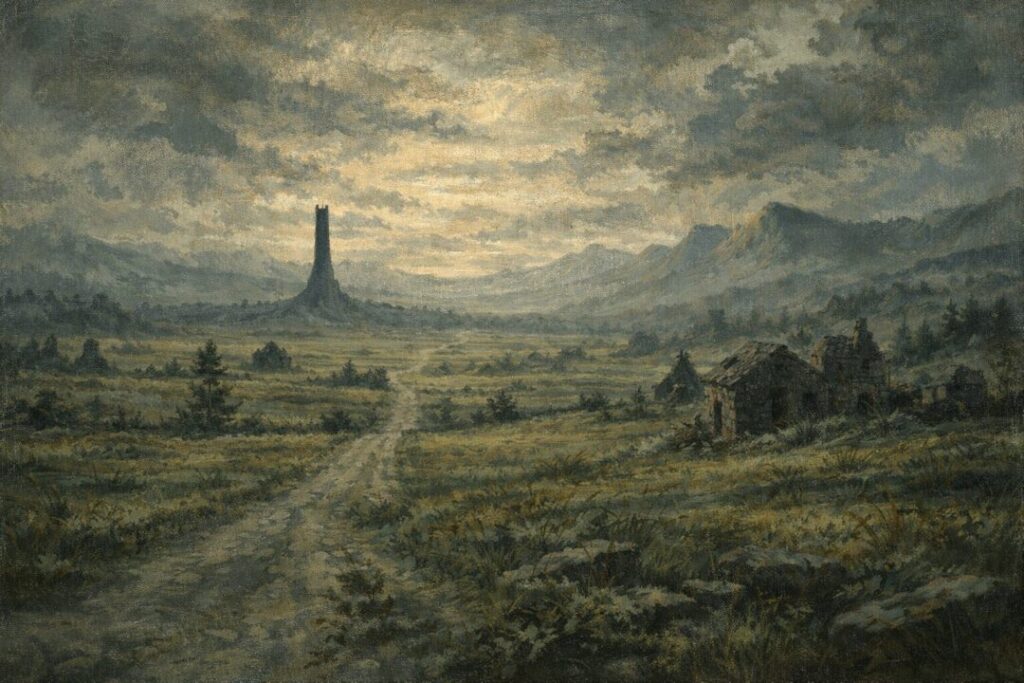
Calenardhon was never densely populated, and after the plague it loses still more people. The tradition preserved in later texts is stark: the region gradually lost most of its inhabitants, and even Orthanc stood deserted for a time, its keys removed to Minas Tirith.
That image should not be rushed past.
Orthanc is one of the great works of Númenórean stonecraft. Yet the issue is not that enemies have shattered it. The issue is that Gondor can no longer keep the surrounding province meaningfully occupied and integrated as before. The tower remains, but the life around it has thinned away.
Something similar happens in Ithilien. The plague drives many there from Osgiliath, but later defeats east of Anduin make the region increasingly exposed. After major losses to the Wainriders, territories north of Ithilien and east of the river are abandoned by Gondor. Ithilien itself becomes a marcher land rather than a secure heartland. By Frodo’s time it is beautiful, but dangerous, held only by stealth and vigilance.
This is how demographic decline appears on the ground.
Not always as a dramatic empty map.
More often as a chain of half-held places.
A kingdom first loses ease, then density, then depth.
Minas Tirith survives — but survival is not fullness
Because Minas Tirith still stands at the end, it is easy to think Gondor remains fundamentally intact.
But Minas Tirith should not be mistaken for proof that nothing essential has been lost.
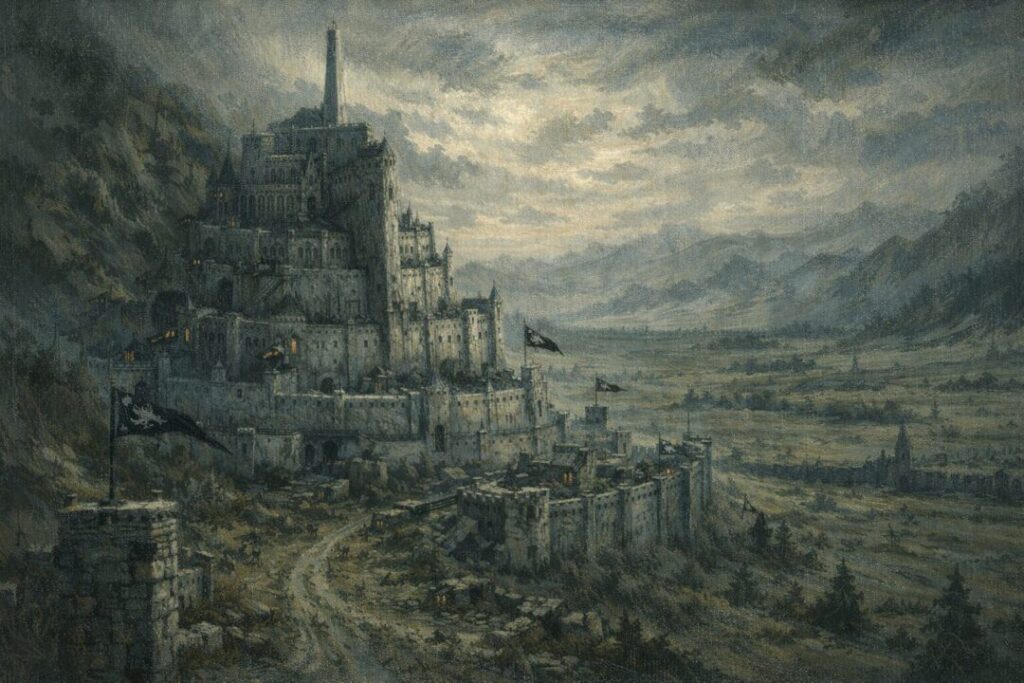
In the late Third Age, the city is the surviving seat of a realm that has already withdrawn from earlier centers. Osgiliath is a ruin. Minas Ithil is long lost. Ithilien is perilous. Calenardhon has been ceded to the Rohirrim generations earlier, in part because Gondor no longer has the strength to hold that northern expanse by itself.
This is why Minas Tirith feels so charged in the narrative.
It is not merely a capital under siege.
It is the last great concentration of a people that once occupied a far broader and deeper realm.
That does not make Gondor weak in some simple sense. In fact, it makes its endurance more remarkable. The kingdom survives repeated shocks that might have ended lesser states entirely. But the cost of survival is contraction. Gondor keeps its core while losing the ability to fill and secure all its former spaces.
The city of the Stewards thus carries a double meaning. It is a sign of continuity, but also a sign of narrowing.
The loss is not only political. It is civilizational.
This is where Gondor becomes especially moving.
When people think of decline in Middle-earth, they often think first in political terms: who rules, who inherits, who attacks whom. But Gondor’s fading is also civilizational. It affects settlement, memory, roads, garrisons, agriculture, and the simple ability of a realm to inhabit itself fully.
A kingdom can still have noble lineage and be running low on people.
A city can still have archives, tombs, and ceremonies while old neighborhoods fall quiet.
A frontier can still be claimed while becoming impossible to repopulate in lasting strength.
That seems to be exactly the atmosphere Tolkien wanted. Gondor at its end is not dead. It is living among survivals. The realm carries the scale of an older age, but not always the numbers that scale once assumed.
That is why its ruins are so often not remote curiosities. They are woven into current life. Osgiliath is not ancient myth; it is part of Gondor’s still-visible wound. Ithilien is not merely a borderland on a map; it is a former province now held only in fragments. Even Isengard’s earlier history preserves the memory of a Gondorian reach that had become too thin to maintain.
Why this makes Gondor’s resistance more impressive
Once this pattern becomes clear, Gondor’s final stand looks different.
The realm is not simply a proud power facing one overwhelming enemy in a single climactic war. It is a long-enduring kingdom that has already absorbed centuries of attrition and is still capable of order, courage, memory, and sacrifice.
That is one reason Denethor’s Gondor is so tragic. He is not stewarding an untouched inheritance. He is trying to hold together a realm that has been reduced and pressured for generations. His failure is his own, but the burden he bears belongs to a much longer history.
And it is one reason Aragorn’s restoration matters so much.
The return of the king is not only a symbolic correction.
It comes to a people who have endured diminishment without wholly losing themselves.
The old framework still exists.
The memory still exists.
Enough people remain for renewal to matter.
But the poignancy of that renewal depends on recognizing what came before: Gondor had not merely been threatened. It had been thinning out, emptying in stages, becoming a smaller inhabitant of its own inheritance.
Gondor’s saddest feature may be its scale
In the end, what makes Gondor so haunting is not simply ruin.
It is disproportion.
The kingdom still possesses the monuments, names, roads, lineages, and defensive works of a greater age. Yet again and again the texts imply that the people left to occupy that inheritance are fewer than before. The result is a realm that feels vast even where it still lives.
That is why Gondor can seem so solemn.
Its beauty is real.
Its dignity is real.
Its strength is real.
But all of those things are set inside the visible traces of a larger world that has already receded.
So how does a realm quietly run out of people in Middle-earth?
Not all at once.
Not with one battle.
Not even with one plague.
It happens by accumulation.
A civil war here.
A pestilence there.
A frontier lost.
A city half-abandoned.
A province too thinly settled to keep.
A capital moved.
A defense line shortened.
A people forced inward while memory remains outward.
And when the final war comes, what stands against the darkness is not a realm at full height.
It is Gondor after the waning of its people.
That may be the saddest thing about it.
And also the reason its endurance feels so great.
Sources & Notes
- J.R.R. Tolkien, The Silmarillion, “Of the Rings of Power and the Third Age” — summarizes Gondor as a realm that rose to power and then “faded slowly,” and links deserted Osgiliath to the waning of its people.
- J.R.R. Tolkien, The Lord of the Rings, Appendix A, “Annals of the Kings and Rulers: Gondor and the Heirs of Anárion” — gives the Kin-strife, Great Plague, Wainrider wars, abandonment of Osgiliath, and loss of population as a long chain rather than one sudden fall.
- J.R.R. Tolkien, Unfinished Tales, “Cirion and Eorl and the Friendship of Gondor and Rohan” — describes Calenardhon as thinly peopled and strategically exposed before its grant to the Rohirrim, supporting the article’s “too much land, too few people” reading.
- J.R.R. Tolkien, The Lord of the Rings, Book IV, Chapter 4, “Of Herbs and Stewed Rabbit” — shows Ithilien as a beautiful but perilous former garden-land, now held by Rangers instead of normal settled life.
- J.R.R. Tolkien, The Lord of the Rings, Appendix B, “The Tale of Years” — anchors the chronology of the Great Plague, Osgiliath’s abandonment, the Wainrider pressure, and the shrinking defensive history of Gondor.