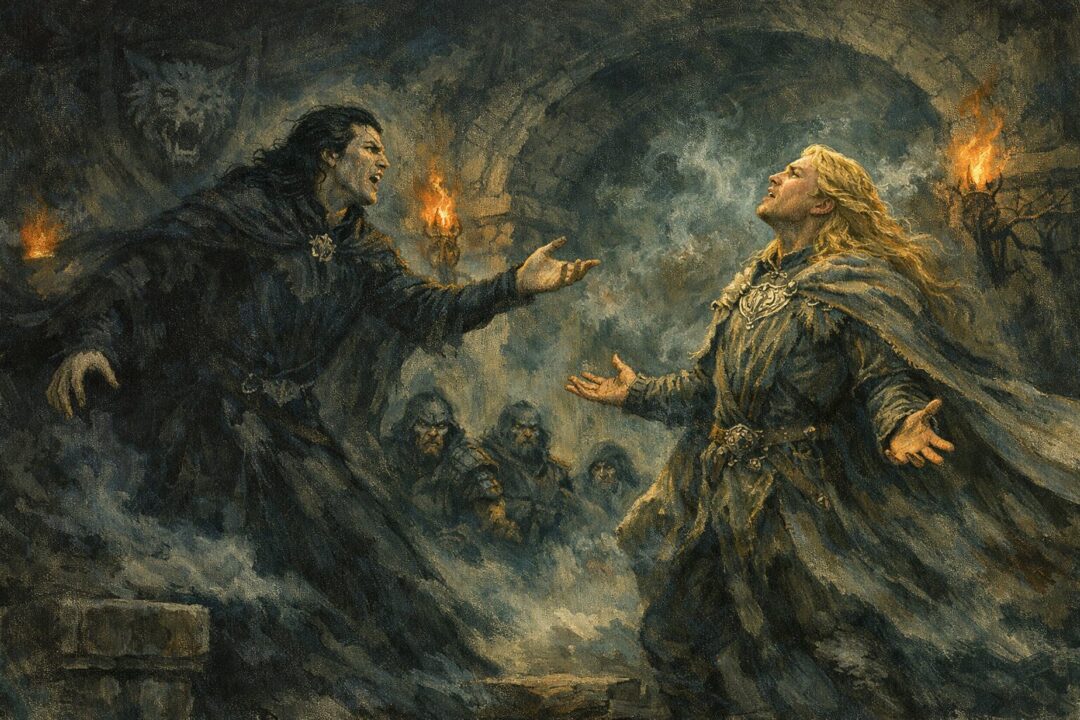
Most people first hear about this scene in a slightly distorted form.
Somebody mentions that Sauron once had a “rap battle” with Finrod Felagund, and the detail sounds so odd that it begins to drift away from the text almost at once.
It starts to feel like one of those Middle-earth facts that is technically true but not really serious.
Except this one is serious.
The texts do not present it as a joke, and they do not leave much doubt about what kind of confrontation took place. In the account of Beren’s quest, Finrod and Sauron are said to strive against one another in “songs of power,” and the poetic version of the episode expands that into one of the most unusual and revealing battles in the legendarium.
So yes, in the plainest sense, Sauron and Finrod really do engage in a contest through song.
But that answer can still be misunderstood.
Because the important question is not whether they sang.
It is what singing means in that moment.
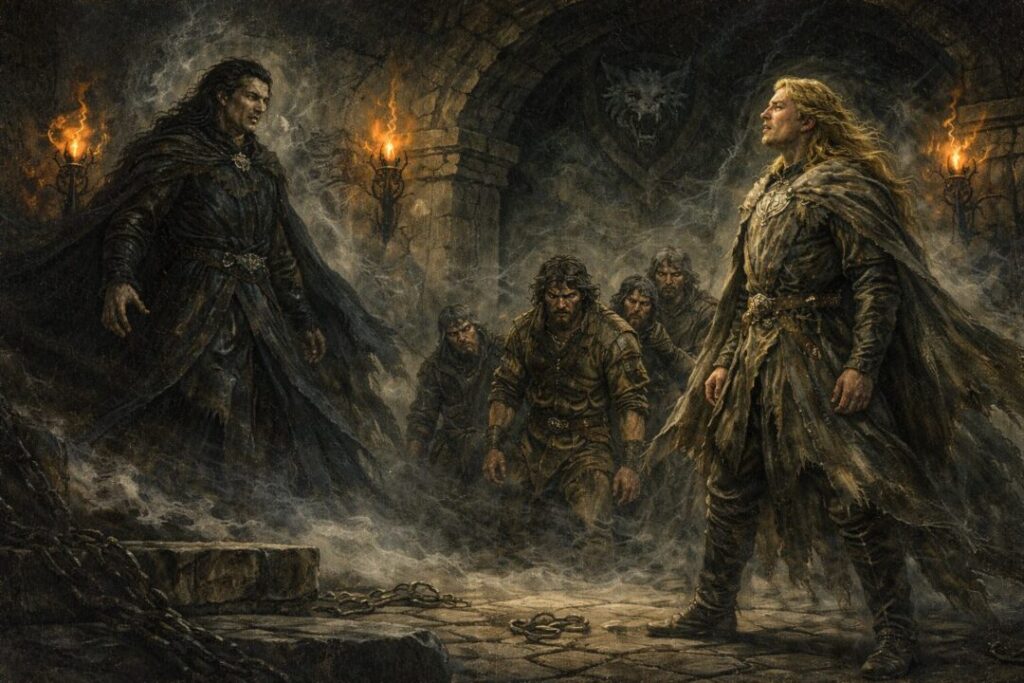
The Scene Really Happens
The encounter takes place during Beren’s quest for the Silmaril.
Finrod joins Beren out of an old oath to Barahir, Beren’s father. He leads a small company from Nargothrond, and by his own art he disguises them in the likeness of Orcs so they can pass north in secrecy. But as they move between Ered Wethrin and Taur-nu-Fuin, Sauron becomes suspicious, captures them, and brings them to Tol-in-Gaurhoth, the Isle of Werewolves.
At that point, the prose account becomes very precise.
It says: “Thus befell the contest of Finrod and Sauron. Finrod strove with Sauron in songs of power, and the power of the Elven King was very great. But in the end, Sauron had the mastery.” That is not later fandom language. It is the story’s own description of the event.
The longer poetic passage from the Lay of Leithian shows what that means.
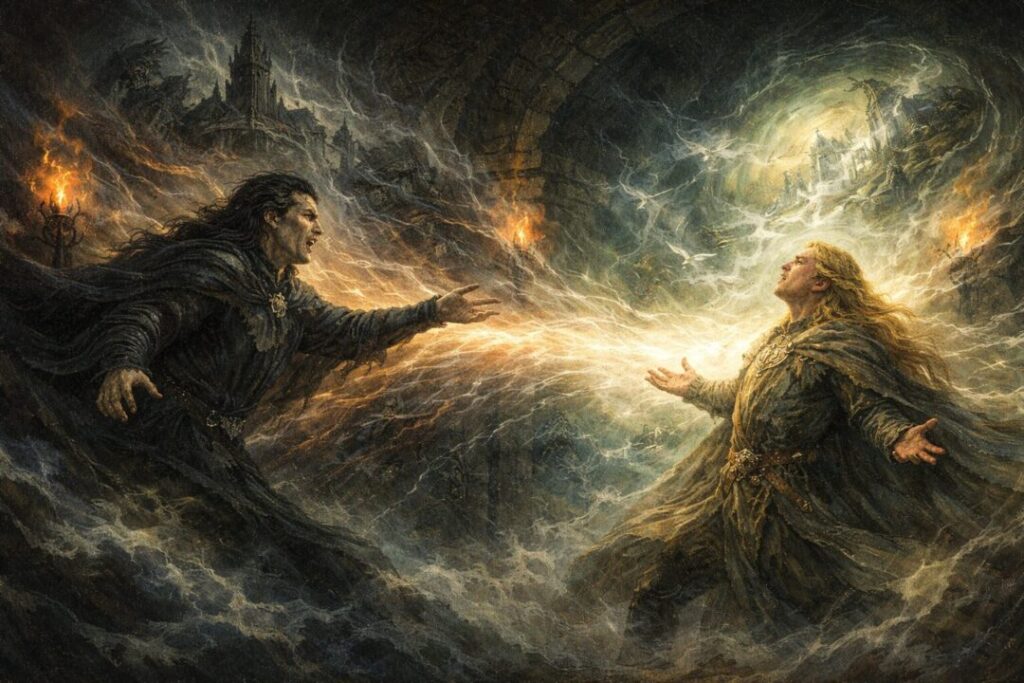
Sauron begins with “a song of wizardry,” a chant aimed at piercing disguise and uncovering truth. Finrod responds with “a song of staying,” resisting exposure and holding fast to secrecy, freedom, and escape. The two songs move backward and forward as a real struggle, and the poem explicitly says that “Felagund fought” and brought “all the magic and might” of Elvenesse into his words.
So the answer is not merely that there is singing in the scene.
The answer is that the scene itself is structured as a battle fought through song.
This Is Not a Joke Version of a Duel
What often gets lost is the tone.
Modern readers hear “singing contest” and imagine something theatrical, performative, or almost comic. But that is not the atmosphere of Tol-in-Gaurhoth.
This is an interrogation under mortal danger.
Sauron is trying to break concealment and force revelation.
Finrod is trying to preserve hidden identity and protect his companions.
The song is not ornamental. It is the weapon.
That is why the poem uses verbs of struggle rather than entertainment. Sauron chants to reveal, uncover, and betray. Finrod answers with resistance, secrecy, and strength. The exchange is a pressure of will against will, expressed in voice and shaped in words.
In other words, readers are not supposed to picture two figures politely taking turns singing at one another.
They are supposed to picture a contest in which spoken or sung utterance carries force.
The text does not reduce the confrontation to metaphor. It presents song as the medium through which power is being exercised.
Why Song Can Be Power in Middle-earth
This scene feels less strange once it is set inside the larger logic of the legendarium.
Arda itself begins in music.
The world is first shaped through the Music of the Ainur, and even in that primal account, opposing themes are not decorative. They are expressions of will, discord, resistance, sorrow, beauty, and domination. The great Music is not a concert in the ordinary sense. It is a mode through which deeper realities are brought into form.
That does not mean every song in Middle-earth is magical in the same direct way.
But it does mean that music and voice can carry unusual force in this world, especially among beings of great spiritual stature. Tolkien Gateway’s synthesis of the texts notes this carefully: Elven figures such as Finrod and Lúthien exercise power through song, and the Sauron-Finrod encounter is one of the clearest examples.
Lúthien later provides another explicit parallel.
She uses song in enchantment, in disguise, and in her confrontation with Morgoth and Sauron. That does not make every such scene identical, but it confirms that song in the Elder Days can be a vehicle of real power rather than mere performance.
So the contest at Tol-in-Gaurhoth is unusual, but it is not out of place.
It belongs to a world where art, language, memory, and spiritual force are more closely joined than they are in ordinary modern fantasy.
What Sauron and Finrod Are Actually Doing
The poem is especially revealing because it shows the direction of each will.
Sauron’s song is a song of exposure.
It presses toward piercing, opening, and betrayal. He is trying to strip away false appearance and force hidden truth into the open. That fits the immediate situation exactly, because Finrod’s company is traveling under disguise.
Finrod’s answer is defensive, but not weak.
His song is one of staying, resistance, secrecy, trust, escape, broken snares, opened prisons, and chains snapping. He is not simply matching sound for sound. He is trying to hold together identity under hostile pressure.
Then the imagery deepens.
As Finrod fights, the poem evokes Nargothrond, birds in the dark, the sighing of the sea, and the light and beauty of the West. Then the mood turns, and darker memories enter: blood by the Sea and the guilt of the Noldor. The passage does not pause to explain every implication, but the contrast matters. Finrod’s power is bound up not only with skill, but with memory, inheritance, and the whole burdened history of his people.
That is part of what makes the scene feel larger than a magical duel.
Each song seems to draw on a different order of reality.
Sauron presses with domination and unveiling.
Finrod answers with fidelity, memory, and hidden strength.

Why Finrod Still Loses
The prose account is clear that Finrod’s power is “very great.”
This matters, because the story does not treat his defeat as easy or inevitable in a casual sense. Finrod is one of the great Elven kings of the First Age, and the poem makes his resistance formidable.
But Sauron has the mastery.
That result also fits the broader hierarchy of the world. Sauron is not merely a clever sorcerer. He is a Maia, one of the Ainur who entered the world before the awakening of Elves and Men, and in the First Age he is already Morgoth’s most feared lieutenant after his master.
Even so, the result is narrower than readers sometimes remember.
Sauron wins the contest and strips away the disguises, but he still cannot discover their names or purposes. So his victory is real, yet not total. He breaks the outer concealment, but he does not wholly penetrate the inner truth he is seeking.
That detail is important.
It shows that the contest is not simply about who is “stronger” in a flat sense.
It is about what kind of truth can be forced, and what kind remains protected even after defeat.
Why This Moment Feels So Strange
Part of the reason readers remember this episode so vividly is that it shows Middle-earth working by laws that are older and deeper than ordinary fantasy combat.
This is not primarily a world of spell lists and visible energy bolts.
It is a world where oath, name, memory, craftsmanship, lineage, language, and song can all carry real weight.
The Finrod-Sauron confrontation reveals that with unusual clarity. A song here is not just sound. It is shaped will. It is thought made active. It is pressure exerted through form, meaning, and voice.
That is why the scene sounds bizarre when reduced to one sentence, but haunting when read in full.
“Did they really get into a singing fight?” sounds silly.
“Did they engage in a deadly contest of revelation and resistance through songs of power?” is much closer to what the text is doing.
And once that is clear, the strangeness becomes one of the scene’s greatest strengths.
So Did Sauron and Finrod Really Have a Singing Fight?
Yes.
But not in the trivial sense people often mean.
The canon does not merely imply it. It states it. Finrod and Sauron strive in songs of power, and the poetic account shows those songs acting as a real field of conflict.
What readers should resist is not the fact itself.
It is the temptation to flatten it into a joke.
This is one of the clearest places where Middle-earth reminds us that power is not always expressed through blade, fire, or physical force. Sometimes it moves through voice. Sometimes through memory. Sometimes through the attempt to uncover what another will die to keep hidden.
And that may be the real reason this scene lingers in the mind.
Not because it is absurd.
But because it reveals, for a moment, how old and strange the world of the Elder Days really is.
Sources & Notes
- J.R.R. Tolkien, The Silmarillion, “Of Beren and Lúthien” — states directly that Finrod and Sauron strove in “songs of power,” that Finrod’s power was great, and that Sauron ultimately had the mastery.
- J.R.R. Tolkien, The Lays of Beleriand, “The Lay of Leithian” — expands the duel into Sauron’s “song of wizardry” against Felagund’s “song of staying,” showing the exchange as a contest of will, disguise, and revelation.
- J.R.R. Tolkien, The Silmarillion, “Ainulindalë” — sets the deeper background for music as more than ornament in Arda: the world is first shaped through the Music of the Ainur, with discord and counter-theme carrying real force.
- J.R.R. Tolkien, The Silmarillion, “Valaquenta: Of the Enemies” — identifies Sauron as one of the Maiar and Morgoth’s chief servant, supporting why his power can overcome even a great Elven king.
- J.R.R. Tolkien, The Silmarillion, “Of Beren and Lúthien” — also gives the surrounding context: Finrod’s oath to Barahir, the Orc-disguise of Beren’s company, their capture at Tol-in-Gaurhoth, and Lúthien’s later use of song against Sauron and Morgoth.