At first glance, the answer seems simple.
Bilbo puts on the Ring and disappears. Frodo does the same. Gollum used it for years as a tool of secrecy and survival. For many readers, that makes invisibility feel like the Ring’s defining power.
It is the first effect that can be seen clearly in the story.
And yet the deeper logic of Middle-earth points elsewhere.
The One Ring was not made as a device for stealth. It was forged as the ruling Ring: the one meant to govern, dominate, and ultimately enslave the bearers of the lesser Rings. Its central purpose was mastery, not concealment.
So why, then, does invisibility appear so consistently around it?
Because invisibility is not really the Ring’s highest power.
It is what happens when a mortal bearer is drawn into the Unseen.

The Ring’s True Purpose Was Never Simple Disappearance
The first correction matters most.
The Ring does not exist to make people vanish. The broad tradition of the Rings of Power is tied to preservation, enhancement of native power, and, in corrupted form, domination. In the case of the One, those powers are concentrated toward rule over others.
That means invisibility should not be treated as the Ring’s chief design.
It is better understood as a visible symptom of a deeper spiritual action.
This helps explain why the effect is not distributed evenly across all beings. The texts connect invisibility most strongly with mortals who bear Great Rings. Gandalf explicitly explains that a mortal using such a Ring does not simply prolong life unnaturally, but begins to fade. The end of that process is not just repeated vanishing. It is permanent movement into a twilight condition under the power that rules the Rings.
That changes the question.
The Ring is not granting a harmless magical convenience.
It is beginning a transformation.
Invisibility Is the Sign of Being Drawn into the Unseen
The clearest way to understand the effect is through the distinction between the seen world and the unseen one.
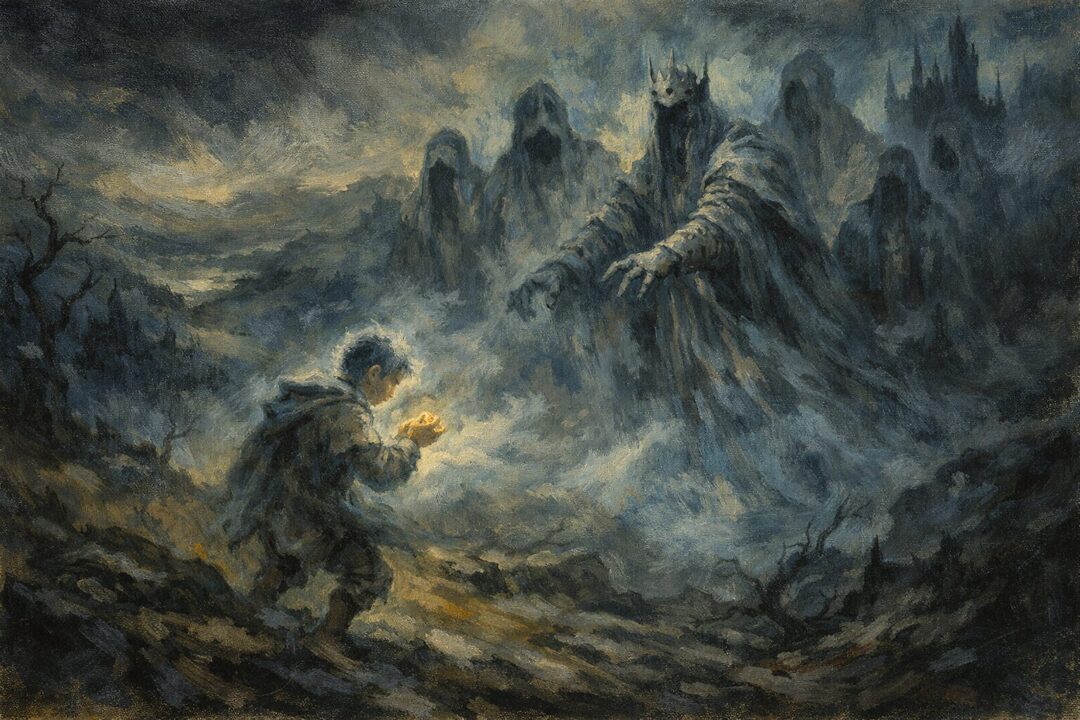
When Frodo wears the Ring, ordinary sight is altered. He is hidden from many physical eyes, but he also perceives things differently. On Weathertop, when he puts on the Ring in the presence of the Nazgûl, he sees them with terrible clarity. Their hidden reality becomes more visible to him at the very moment he becomes less visible to others.
That is not an accident.
The Ring is shifting the bearer’s relation to the world.
Reputable lore summaries built from the text describe this as movement into the Unseen or wraith-world. That language fits what the narrative repeatedly shows: the Ring does not merely cloak a body. It relocates the bearer toward another mode of existence.
This is why invisibility is especially dangerous in Middle-earth.
To vanish from ordinary sight sounds like power. In practice, it is often exposure.
A mortal bearer becomes less present in the common world and more present in a realm where Sauron’s structures of domination are stronger.
Why Mortals Become Invisible
This is where the pattern becomes sharpest.
The effect is tied to mortality.
Gandalf’s explanation to Frodo does not describe invisibility as a universal outcome for every possible bearer. He specifically speaks of a mortal who keeps and uses one of the Great Rings. Such a bearer fades. The invisibility is part of that fading.
That matters because it prevents a common oversimplification.
The One Ring does not just have a fixed “invisibility spell” built into it as its main purpose. Rather, invisibility is what a mortal experiences when the Ring begins to pull that person out of the normal conditions of bodily life and into the twilight realm bound up with the power of Sauron.
That is also why the fate of the Nazgûl is so important to this question.
They are the completed version of the process.
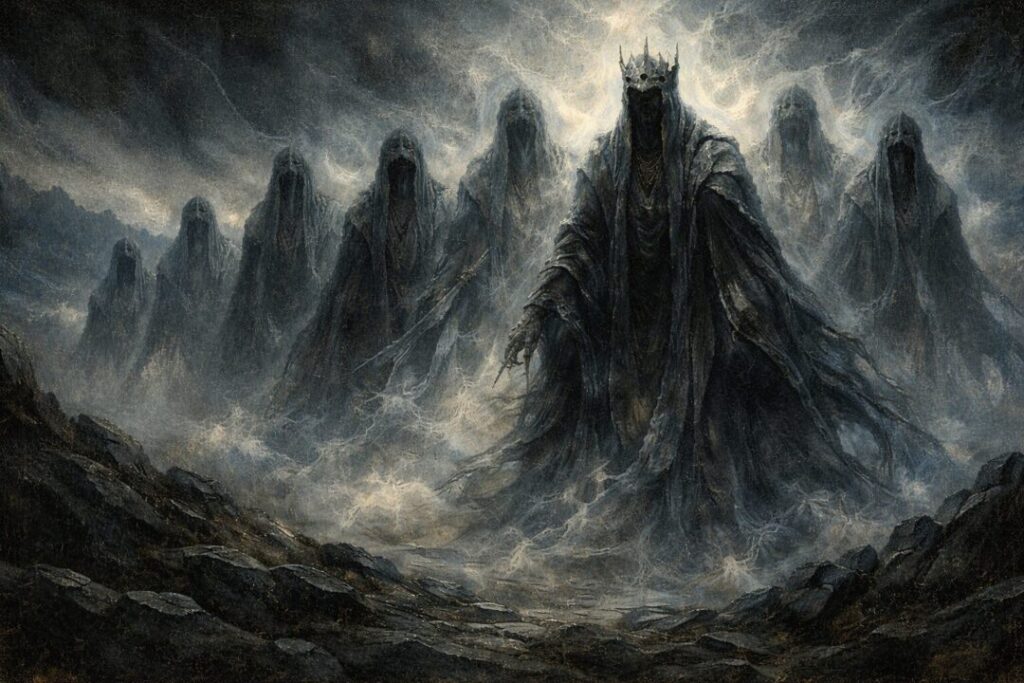
The Nine received Rings of Power, gained unnatural extension of life, and in time faded until their existence belonged more fully to the Unseen. They did not become mighty because invisibility itself was the goal. They became wraiths because domination had consumed them.
In that light, Bilbo and Frodo are not using a fun magical ability.
They are touching the same road, only briefly and without reaching its end.
The Ring Does Not Truly Hide Its Bearer from the Greatest Threats
This may be the most unsettling part.
If invisibility were simply concealment, the Ring would make Frodo safer.
But that is not what happens.
At Weathertop, putting on the Ring does not protect him from the Nazgûl. It exposes him more fully to them. Later material tied to Letter 246 makes the point even more directly: beings fully instructed in the Ring’s lordship are not deceived by that kind of invisibility. In fact, the wearer becomes more vulnerable in relation to them.
That means the Ring’s invisibility is limited in exactly the way one would expect if it is a side effect of entering the Unseen.
It works mainly against ordinary embodied sight.
It does not free the bearer from the order of power that the Ring itself belongs to.
So the wearer gains concealment from common enemies while moving closer to the notice of the most dangerous ones.
That is not a gift.
It is entrapment disguised as usefulness.

Why Bilbo Thinks It Is a Useful Power
Bilbo’s story can make the Ring seem smaller than it is.
In The Hobbit, invisibility is practical. It helps him escape goblins, evade danger, and move through the world with a burglar’s advantage. That surface usefulness matters because Bilbo does not yet know what the Ring really is. For him, the effect appears almost like luck joined to magic.
But the later framework of The Lord of the Rings recontextualizes that entirely.
Bilbo was not discovering the Ring’s true purpose.
He was experiencing the most immediately noticeable effect available to a small mortal bearer with no ambition to dominate kingdoms.
This fits the wider logic that the Rings enhance native powers and desires. A humble hobbit is not going to use the One Ring the way Sauron would, or even the way Galadriel imagines she might if she accepted it. The Ring meets each bearer at the level of what they are capable of desiring and expressing.
So Bilbo receives concealment because concealment is within the scale of his situation.
That does not mean concealment is the Ring’s deepest nature.
It means that is the form its corruption can first take in the hands of someone like him.
The Ring Gives Power According to the Bearer
This helps solve another tension.
If the Ring’s real purpose is domination, why do Bilbo and Frodo not immediately begin ruling minds?
Because the texts suggest that the Ring works in proportion to the stature, native power, and will of its bearer. The general powers of the Rings include enhancement of what the possessor already is. The One then bends that enhancement toward domination.
That is why Sam, while briefly bearing the Ring, has a vision not of world empire in an abstract sense but of transforming Mordor into an enormous garden under his command. The temptation is grander than Bilbo’s, but still recognizably Sam’s. Galadriel’s imagined temptation is larger still: beauty, dread, and overwhelming rule.
So invisibility is not “the” power in isolation.
It is the entry-level manifestation of the Ring’s effect on small mortal bearers who are not yet capable of wielding its fuller force.
That is why it is so memorable.
And that is also why it is misleading.
Invisibility Is a Warning, Not a Reward
Once the larger structure is visible, the meaning of invisibility changes.
It no longer looks like a clever magical bonus.
It looks like the earliest outward sign that the Ring is unmaking the proper relation between body, soul, and world.
A mortal who uses it does not become more complete.
He becomes less anchored.
He steps out of ordinary sight because he is beginning, however slightly, to pass into a condition that belongs to wraiths. The Ring’s usefulness in the short term masks the fact that its long-term movement is toward erasure of ordinary life and subjection to Sauron.
That is why the power feels so fitting and so wrong at the same time.
It feels fitting because disappearance is exactly what domination by the Ring does to a mortal self. It hollows, isolates, and removes. The bearer seems to gain an ability, but is actually surrendering substance.
And that is why the One Ring grants invisibility.
Not because invisibility was its true purpose.
But because when a mortal touches a power made for domination, one of the first visible consequences is that he begins to slip out of the seen world.
The Ring does not really teach its bearer how to disappear.
It teaches him how to fade.
Sources & Notes
- J.R.R. Tolkien, The Silmarillion, “Of the Rings of Power and the Third Age” — states the One Ring’s purpose plainly: to rule the other Rings and bind their wearers to Sauron’s will, not merely to hide its bearer.
- J.R.R. Tolkien, The Lord of the Rings, Book I, Chapter 2, “The Shadow of the Past” — Gandalf explains that mortals who keep a Great Ring do not truly die, but “fade” and become permanently invisible under the Ring’s power.
- J.R.R. Tolkien, The Lord of the Rings, Book I, Chapter 11, “A Knife in the Dark” — Frodo’s use of the Ring on Weathertop makes the Nazgûl more clearly visible to him and leaves him exposed in the wraith-world.
- J.R.R. Tolkien, The Hobbit, Chapter 5, “Riddles in the Dark” — Bilbo first experiences the Ring as practical invisibility, the small-scale effect that later lore reinterprets through the Ring’s darker nature.
- J.R.R. Tolkien, The Letters of J.R.R. Tolkien, Letter 246 — clarifies that claiming and using the Ring would draw the bearer into Sauron’s order of power rather than provide safe concealment from him.