Most people hear this question and immediately assume there must be a hidden answer.
Tom Bombadil lives beside the Old Forest.
The Dúnedain of Cardolan, after the great disaster of 1409, are said to have held out in Tyrn Gorthad or taken refuge in the forest behind.
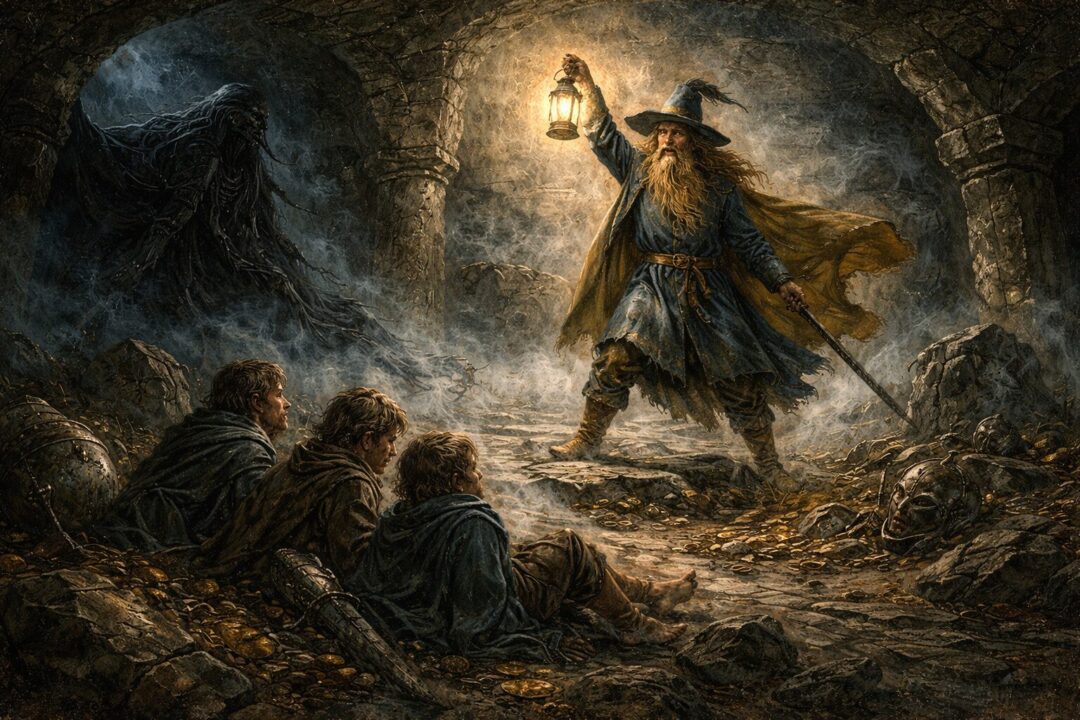
Later, Tom moves through that same region with effortless authority, drives off a barrow-wight, and handles the treasures of the tombs as if they belong to a remembered world.
It is easy to turn that into a theory.
Perhaps Tom sheltered the survivors.
Perhaps he fought Angmar in some unseen way.
Perhaps the Dúnedain knew him as a guardian lingering outside their histories.
But the texts do not say any of that directly.
And that is where the real answer begins.
The Year 1409 Was a Catastrophe for Cardolan
To understand the question, the date has to be taken seriously.
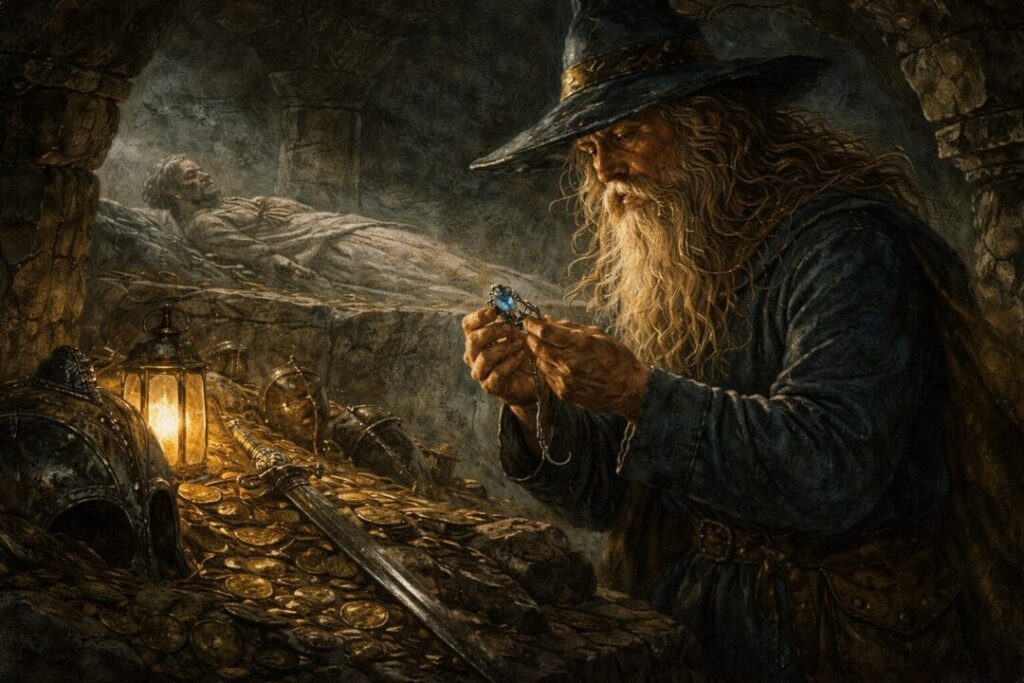
In Third Age 1409, Angmar launched a devastating assault against the North-kingdom. Amon Sûl was besieged and burned. King Arveleg I of Arthedain was slain. Cardolan was ravaged, and its last prince fell in that war. A remnant of the faithful among the Dúnedain of Cardolan then held out in Tyrn Gorthad, the Barrow-downs, or took refuge in the forest behind.
That last detail is the key.
The survivors of Cardolan were not merely defeated somewhere far away from Tom’s country. They ended up precisely in the region associated with him: the Barrow-downs and the forest behind them, generally understood to be the Old Forest. Tom’s house lies in that borderland between remembered burial-ground and ancient wood.
So there is certainly a connection.
The question is what kind.
The Text Gives Geography, Not an Alliance
This is the point where many readings go beyond what the story actually supports.
The canon does not state that Tom aided the Dúnedain militarily.
It does not state that they sought him out by name.
It does not state that he led them, protected their settlements, or had any formal tie to Cardolan’s rulers.
That absence matters.
When Middle-earth wants us to know that one people aided another, it usually says so. The same passage that tells us Cardolan was ravaged also tells us that help came through Círdan and through resistance in the north. By contrast, Tom is not named in the account of the war at all.
So any claim that Tom was an active ally in the war of 1409 has to remain speculation.
Interesting speculation, perhaps.
But still speculation.
Tom Clearly Belongs to That Landscape
Even if the texts do not give him a political role, they do something else.
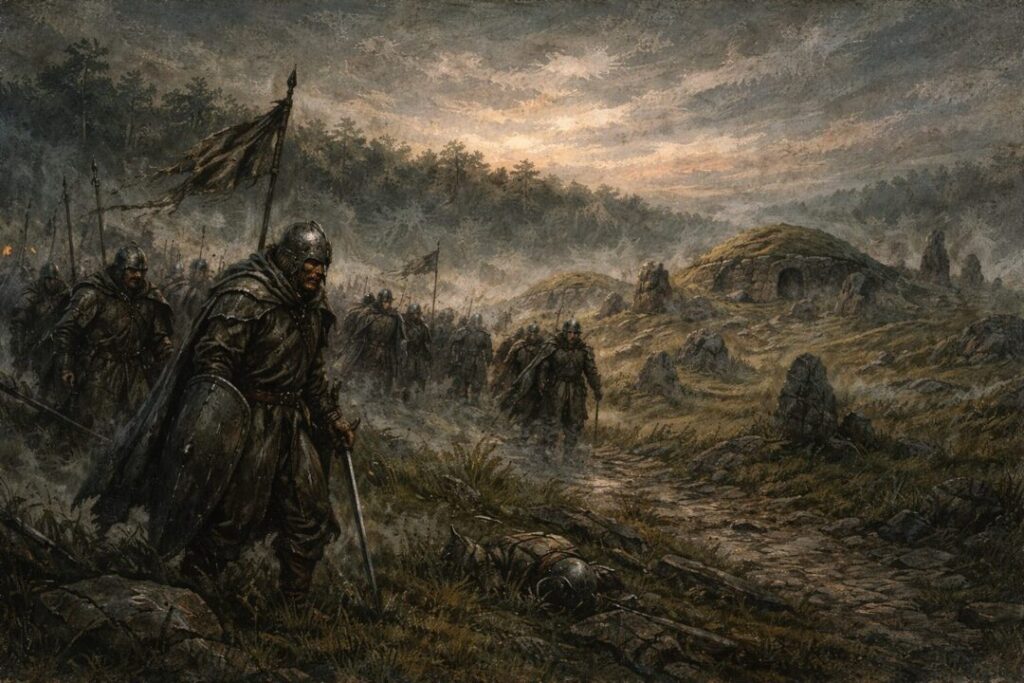
They make it unmistakable that Tom belongs to that land on a level deeper than ordinary history.
When Frodo asks who he is, Tom answers in one of the most extraordinary self-descriptions in the legendarium. He says he was there before the river and the trees, before the kings and the graves and the barrow-wights. Elrond later recalls him by the name Iarwain Ben-adar, “oldest and fatherless,” and says he was older than old even long ago.
This does not solve Tom’s nature.
It does not tell us what order of being he belongs to.
But it does establish something important for this question:
Tom did not arrive after the Dúnedain.
He did not move into their ruins later.
Their kingdom rose and fell inside a world he already knew.
That changes the whole emotional shape of the question.
Instead of asking whether Tom became connected to Cardolan in 1409, it may be more accurate to ask how the tragedy of 1409 entered a country that was already his.
The Barrow-downs Were Not Strange to Him
Tom’s rescue of the hobbits is often treated as one more strange Bombadil moment.
But in the context of Cardolan, it becomes more specific.
He enters the barrow-wight’s domain without hesitation.
He breaks its power.
He calls the hobbits out.
Then he handles the grave-treasure with calm familiarity, as though he knows exactly what sort of place this is and what has gone wrong there.
This is important because the evil in the Downs is not original to the place.
The mounds were ancient burial-sites, and in the age of Cardolan they were used again by the Dúnedain, including the burial of the last prince who fell in the war of 1409. Only later, after the Great Plague ended the Dúnedain of Cardolan, did evil spirits from Angmar and Rhudaur enter the deserted mounds and dwell there.
So when Tom masters the barrow-wight, he is not simply proving power over some timeless local hazard.
He is confronting a corruption that invaded old graves after the fall of Cardolan.
That does not prove he defended the Dúnedain when they were alive.
But it does show that he stands, in his own way, against what was done to their dead.
The Brooch Is the Most Personal Clue
The most intimate detail comes after the rescue.
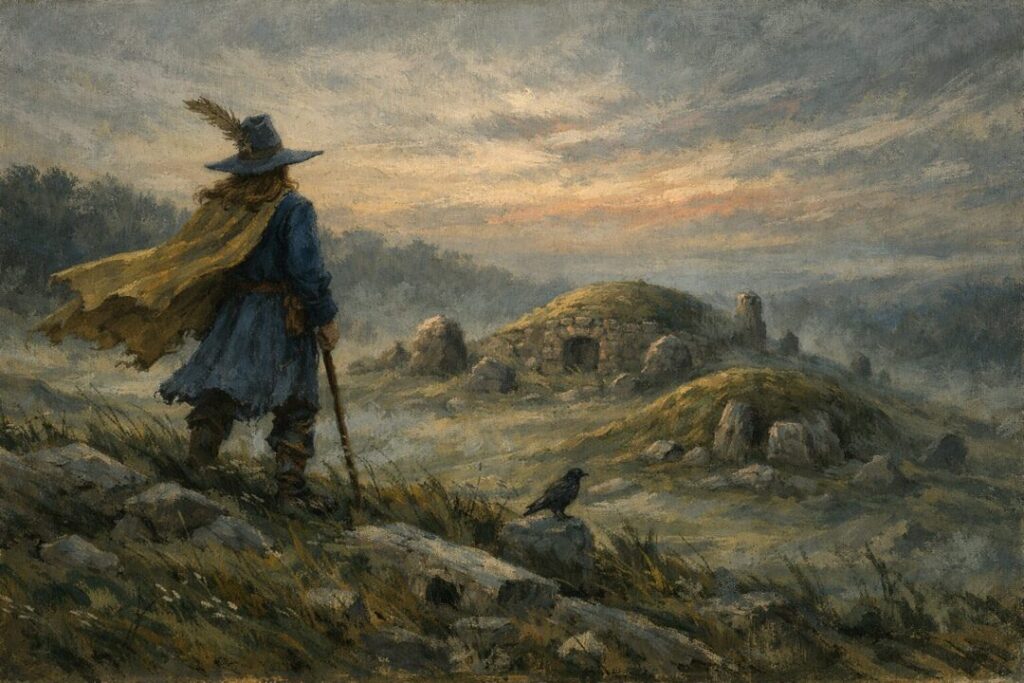
Among the treasures in the barrow, Tom chooses a brooch set with blue stones. He looks at it for a long time, as if stirred by memory, and says: “Fair was she who long ago wore this on her shoulder. Goldberry shall wear it now, and we will not forget her!”
That small moment is easy to overlook.
But it is probably the strongest hint of all.
Tom does not speak like an archaeologist.
He does not react like someone finding an anonymous ornament in a forgotten tomb.
He reacts like someone who remembers that the object once belonged to a real person.
The texts never identify the woman.
Appendix A only says that some say the mound in which the Ring-bearer was trapped had been the grave of the last prince of Cardolan, who fell in 1409. So it is reasonable to connect the brooch with the world of Cardolan, but not safe to insist on a precise identity beyond that.
This is exactly where careful reading matters.
We may say the texts imply that Tom remembered at least one person associated with the buried world of Cardolan.
We may not say the canon proves he personally knew the prince, his wife, or the whole remnant of 1409.
The distinction is small, but it matters.
So What Was Tom’s Connection?
If the question is asked strictly, the best answer is this:
Tom Bombadil’s connection to the Dúnedain of 1409 is real, but limited in what the texts actually confirm.
The confirmed connection is geographical and memorial.
The surviving Dúnedain of Cardolan ended up in the Barrow-downs and the forest behind, the very region of Tom’s dwelling. Tom later shows deep familiarity with that landscape, mastery over the evil that corrupted its tombs, and a memory that seems to reach back to at least one of the people buried there.
What the texts do not confirm is an official role, a military intervention, or an explicit friendship with the remnant of Cardolan.
That does not make the connection less interesting.
In some ways, it makes it more moving.
Why the Silence Matters
If Tom had been a hidden war-lord, the story could have said so.
Instead, what remains is quieter.
A kingdom falls near him.
Its people retreat into the edges of his land.
Its princes are buried in the Downs.
Dark spirits later defile those graves.
And centuries afterward, Tom is still there, remembering enough to say that the dead will not be forgotten.
That may be the truest answer the text gives.
Tom’s connection to the Dúnedain of 1409 was not that of a king, captain, or counselor.
It was something older than that.
He was the one who remained.
He was there before their realm rose.
He was there when its last remnant fled into the Downs and the forest.
And he was still there after their memory had nearly been swallowed by barrows, wights, and time.
That is a different kind of bond.
Not a political one.
Not a solved mystery.
But a haunting nearness between the oldest dweller in that land and one of the last ruined houses of the North.
And once you see that, Tom Bombadil becomes stranger than a secret ally ever could.
He is not the lost answer to Cardolan.
He is the witness that outlasted it.
Sources & Notes
- J.R.R. Tolkien, The Lord of the Rings, Appendix A, “The North-kingdom and the Dúnedain” — Angmar’s assault in T.A. 1409, the fall of Cardolan’s last prince, and the remnant in Tyrn Gorthad or the forest behind.
- J.R.R. Tolkien, The Lord of the Rings, Appendix A, “The North-kingdom and the Dúnedain” — the Barrow-downs as Dúnedain burial-mounds and the later coming of evil spirits after Cardolan was deserted.
- J.R.R. Tolkien, The Lord of the Rings, Book I, Chapter 7, “In the House of Tom Bombadil” — Tom says he was there before kings, graves, and barrow-wights.
- J.R.R. Tolkien, The Lord of the Rings, Book I, Chapter 8, “Fog on the Barrow-downs” — Tom rescues the hobbits, breaks the wight’s power, and remembers the woman who wore the blue-stoned brooch.