One of the most easily overlooked lines in The Hobbit comes very early, before the company has even left Bag End.
Gandalf has just revealed that he found Thráin, Thorin’s father, in the dungeons of the Necromancer. Thráin was broken, wandering, and barely able to remember anything beyond the map and the key.
Then Thorin answers:
“We have long ago paid the goblins of Moria.”
At first glance, it is easy to misread that sentence.
It can sound as though he is talking about money.
Or tribute.
Or some older political arrangement between Dwarves and goblins.
But that is not what the line means.
In context, Thorin is speaking about vengeance already taken. He means that the goblins of Moria have already been repaid for what they did to his house, and that the company should be thinking instead about the greater and more immediate shadow: the Necromancer.
That single sentence quietly reaches back into one of the grimmest episodes in the history of Durin’s Folk.
And once that history is brought into view, the line becomes much sharper than it first appears.
It Does Not Mean Tribute or Payment in Gold
The first thing to clear away is the most common misunderstanding.
Thorin is not saying that the Dwarves used to pay off the goblins of Moria.
He is not referring to tolls, ransom, or protection money.
And there is nothing in the text suggesting some long-running arrangement of that kind.
The wording is older in tone.
To “pay” an enemy in this sense is to repay them, to requite them, to answer what they have done with a reckoning of your own.
The line comes immediately after Gandalf speaks of Thráin’s captivity, and Thorin’s reply only makes sense if he is distinguishing between two separate wrongs.
The first wrong was already answered: the evil done by the goblins of Moria.
The second wrong still stands in front of them: the power of the Necromancer, who had imprisoned Thráin in Dol Guldur.
So Thorin is not saying, “we owed Moria something.”
He is saying, “that score was settled long ago.”
The Blood-Debt Behind the Line
To understand why Thorin speaks that way, we have to go back to Thrór.
After the loss of Erebor, Thrór became restless in old age and wandering in mind. At last he went with Nár toward Moria, the ancient house of Durin’s line. He seems to have been driven by memory, pride, and the pull of the ancestral kingdom.
What he found there was Azog.
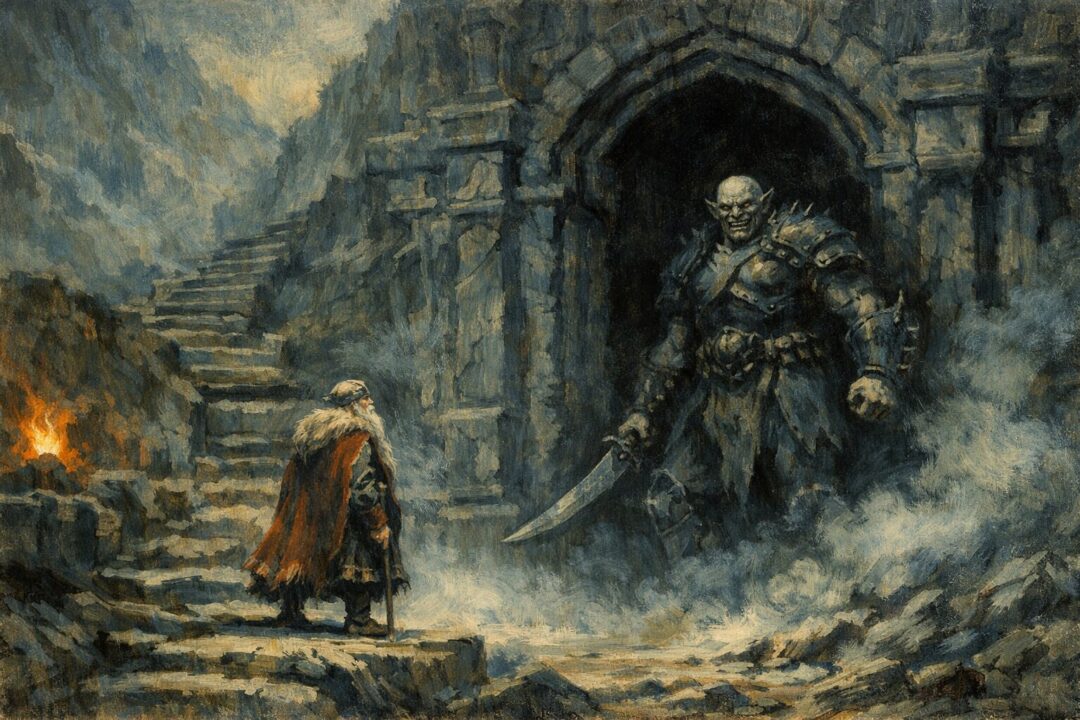
Azog, the Orc-chieftain of Moria, killed Thrór at the gate and branded his own name on the dead king’s forehead. Nár was spared only so that he could carry the insult back.
That moment matters enormously.
This is not just the killing of a Dwarf lord in battle.
It is the humiliation and murder of the head of Durin’s House at the doors of Khazad-dûm itself.
The response was immediate in moral force, even if it took time in practice.
When Nár brought the news, Thráin called for war.
The Seven Houses of the Dwarves gathered.
And what followed was not a single act of revenge, but a brutal campaign across the Misty Mountains.
This is the background Thorin assumes.
When he says “we have long ago paid the goblins of Moria,” he is speaking out of memory inherited from that war and from the cost his people already exacted.
The War of the Dwarves and Orcs Was the Payment
The reckoning Thorin refers to is the War of the Dwarves and Orcs.
It lasted for years.
It was savage.
And it seems to have been fought with the kind of relentless purpose that only an insult like Thrór’s murder could provoke.
The Dwarves hunted Orcs through the mountain strongholds.
The war did not remain confined to one gate or one valley.
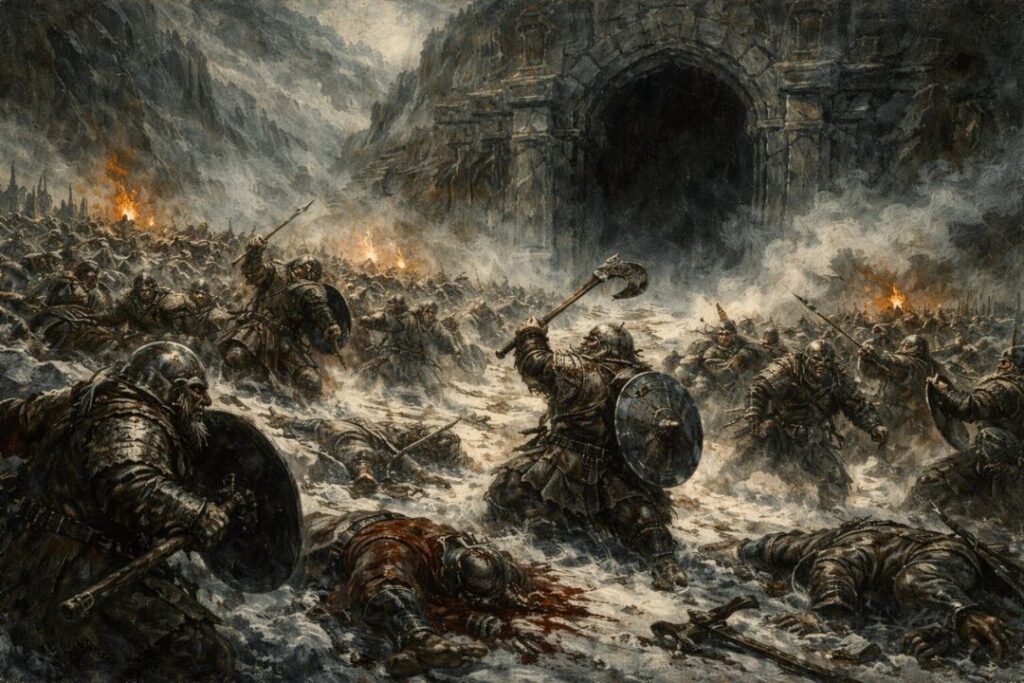
It spread through the northern Misty Mountains until at last it came to its climax before Moria itself, in the Battle of Azanulbizar.
There, before the East-gate, the Dwarves won.
But it was a terrible victory.
Their dead were beyond easy counting.
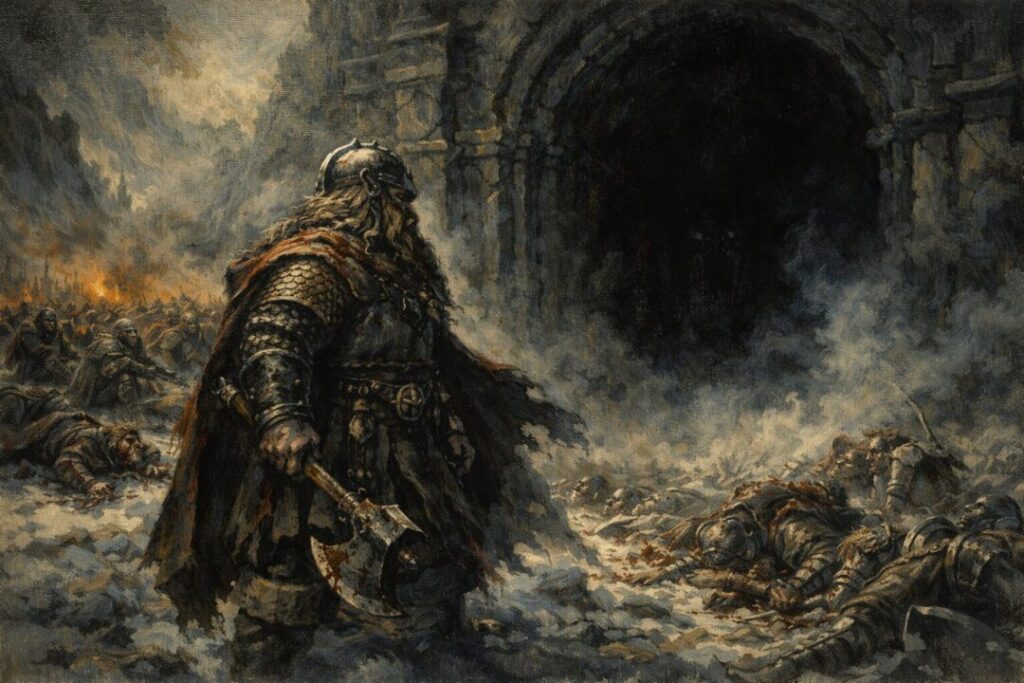
The field had to be stripped and the bodies burned.
Even in victory, the cost was almost too great to bear.
Azog himself was finally slain by Dáin Ironfoot.
That is the point.
This is the “payment.”
Not coins.
Not diplomacy.
Not some forgotten arrangement of tribute.
Blood for blood.
War for murder.
A reckoning carried to the very threshold of Moria.
From Thorin’s perspective, the goblins had already been answered.
Why Thorin Says This in The Hobbit
The line becomes even more revealing when we notice why Thorin says it at that exact moment.
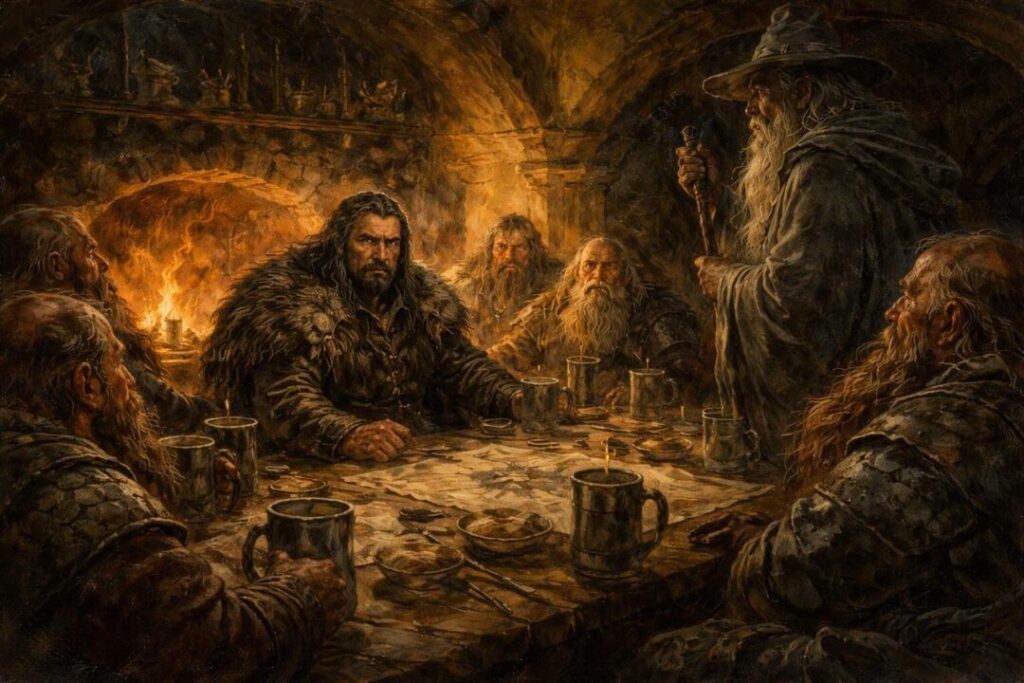
Gandalf has just told him about Thráin’s captivity in Dol Guldur.
That changes the shape of the conversation.
Thorin’s mind could easily turn back toward Moria, because Moria is where the older grief began. It is the wound behind so much of Durin’s later history: the loss of Khazad-dûm, the murder of Thrór, the rise of Azog, the war that followed.
But Thorin does not follow that path.
Instead, he cuts it off.
“We have long ago paid the goblins of Moria,” he says, “we must give a thought to the Necromancer.”
That tells us something important about his priorities in that moment.
He is not denying the importance of Moria.
He is not forgetting what happened there.
He is saying the goblin-score is old, and already settled as far as vengeance goes.
The unresolved evil now lies elsewhere.
This is one of those subtle moments where Thorin sounds more politically serious than readers sometimes remember him to be. He is not daydreaming about reclaiming every lost grievance at once. He knows that the enemy behind Dol Guldur is of another order entirely.
And Gandalf’s answer confirms it.
The wizard does not treat the Necromancer as some local problem.
He treats him as a power beyond all the Dwarves together.
So Thorin’s line is not casual.
It is a judgment about which shadow is still unfinished.
But the Line Is Also Deeply Ironic
And this is where the sentence becomes more interesting than its surface meaning.
Thorin is right.
But he is not right enough.
Yes, the goblins of Moria had been “paid” in the sense he means.
Azog was dead.
The war had been fought.
The insult to Thrór had been answered with enormous force.
But Moria itself was not settled.
After Azanulbizar, Thráin wished to enter Khazad-dûm and reclaim it.
The Dwarves refused.
And Dáin, who had killed Azog and looked toward the gate, spoke the decisive warning: something still waited there. Durin’s Bane remained.
That changes everything.
Because it means Thorin’s line is about one layer of the problem, not the whole of it.
The goblins had paid.
But the deeper power in Moria had not been overthrown.
Khazad-dûm was still shut, not because the Dwarves lacked courage, but because another terror remained beyond the reach of Dwarf vengeance.
In other words, Thorin is speaking about a settled blood-feud, not about a fully healed inheritance.
That distinction matters.
The house of Durin had avenged a murder.
It had not reclaimed its deepest loss.
Why This Small Line Carries So Much Weight
This is why the sentence feels heavier the longer one sits with it.
It reveals how the Dwarves remember history.
Not abstractly.
Not sentimentally.
But in debts, wounds, and reckonings.
Thorin is speaking from within a culture that remembers ancestral wrongs with extraordinary force. The murder of Thrór was not merely one death among many. It was a dishonour laid upon the line of Durin at the gates of its own ancient house.
The answer to that insult came in war.
So when Thorin says the goblins of Moria have long ago been paid, the line is cold with memory. It assumes a history of grief that needed no explanation among his own people.
At the same time, the sentence also shows one of the recurring truths of Middle-earth:
vengeance can settle a debt without restoring what was lost.
Azog dies.
The Orcs are broken.
Yet Moria remains dark.
That is the deeper tragedy.
The Dwarves can answer the insult.
They cannot simply force history backward.
Khazad-dûm does not become Khazad-dûm again because blood was shed before its gate.
So What Does the Line Mean?
In the most direct sense, it means this:
the goblins of Moria had already been repaid through the War of the Dwarves and Orcs, above all in the destruction brought upon them and in Azog’s death at Azanulbizar.
That is the clearest and most textually grounded reading.
But the line matters because it does more than explain an old phrase.
It shows Thorin trying to distinguish between an old vengeance already taken and a greater darkness not yet confronted.
And it carries an irony the reader can only fully appreciate later.
The blood-debt was paid.
The deeper shadow was not.
That is why the sentence feels so final at first, and so incomplete once the larger history comes into view.
Thorin is closing one account.
Middle-earth, quietly, is telling us that the oldest losses are not always closed so easily.
Sources & Notes
- J.R.R. Tolkien, The Hobbit, Chapter 1, “An Unexpected Party” — gives Thorin’s line after Gandalf recounts finding Thráin in the Necromancer’s dungeons, setting up the contrast between old Moria vengeance and Dol Guldur.
- J.R.R. Tolkien, The Lord of the Rings, Appendix A, “Durin’s Folk” — tells of Thrór’s murder by Azog at Moria and Nár carrying the insult back to Thráin.
- J.R.R. Tolkien, The Lord of the Rings, Appendix A, “Durin’s Folk” — describes the War of the Dwarves and Orcs and the Battle of Azanulbizar as the Dwarves’ grim reckoning at Moria’s gate.
- J.R.R. Tolkien, Unfinished Tales, “The Quest of Erebor” — shows Gandalf’s concern over Smaug and the Necromancer, useful context for why Thorin’s remark turns attention away from Moria toward the larger shadow.