When people remember Gandalf and the Balrog, they usually remember the bridge.
They remember the staff.
They remember the command to flee.
They remember the narrow stone span over blackness, and Gandalf standing alone against shadow and flame.
And because that moment is so overwhelming, it is easy to assume the whole story is contained there.
It is not.
The bridge is only where Gandalf makes his stand.
It is not where the full meaning of his choice becomes clear.
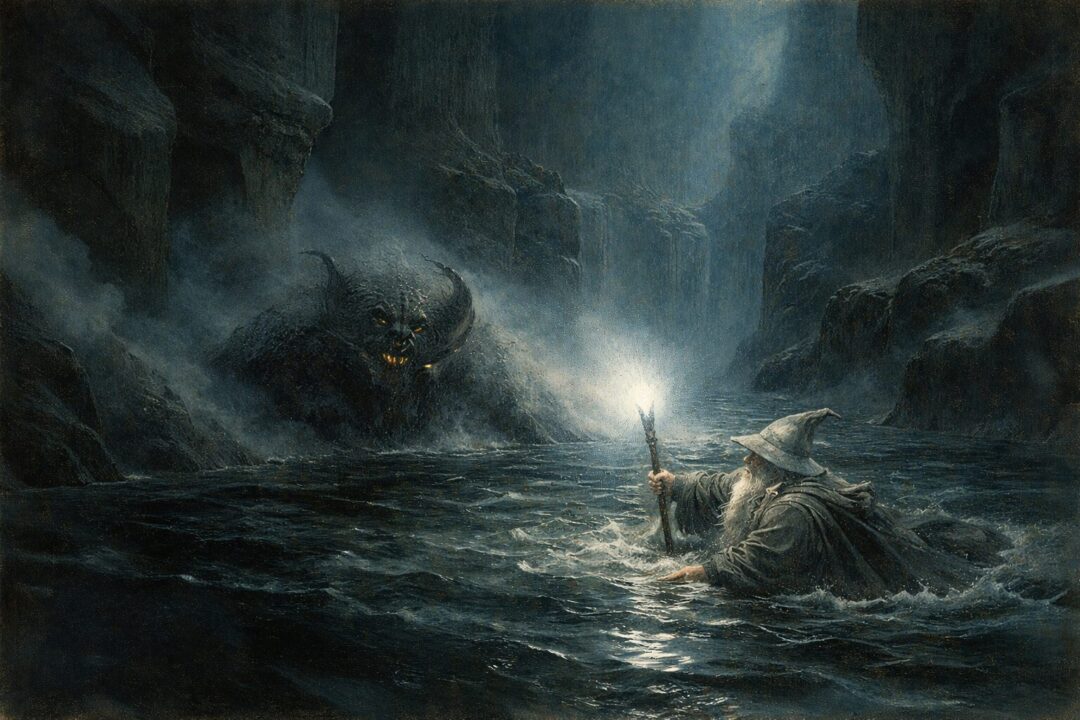
Because after the bridge breaks, after both wizard and Balrog vanish into the abyss, the story takes a turn many readers do not dwell on enough. Later, Gandalf explains that deep below Moria, in darkness beyond the Dwarves’ deepest delvings, he did not merely survive the fall.
He kept going.
More than that, he says he pursued the Balrog.
That single detail changes the whole scene.
It means Gandalf’s confrontation with Durin’s Bane was not just a final defensive gesture on the bridge. At some point after the fall, it became something else: a decision to continue the struggle rather than let that ancient terror escape him in the dark. The books do not present this as triumph or recklessness. They present it as necessity.
The Bridge Was About Holding, Not Hunting
The first thing to make clear is what Gandalf is doing at the bridge itself.
He is not charging the Balrog.
He is not seeking out a duel for its own sake.
He is not acting like a warrior hungry for one last test of strength.
His own words frame the moment differently.
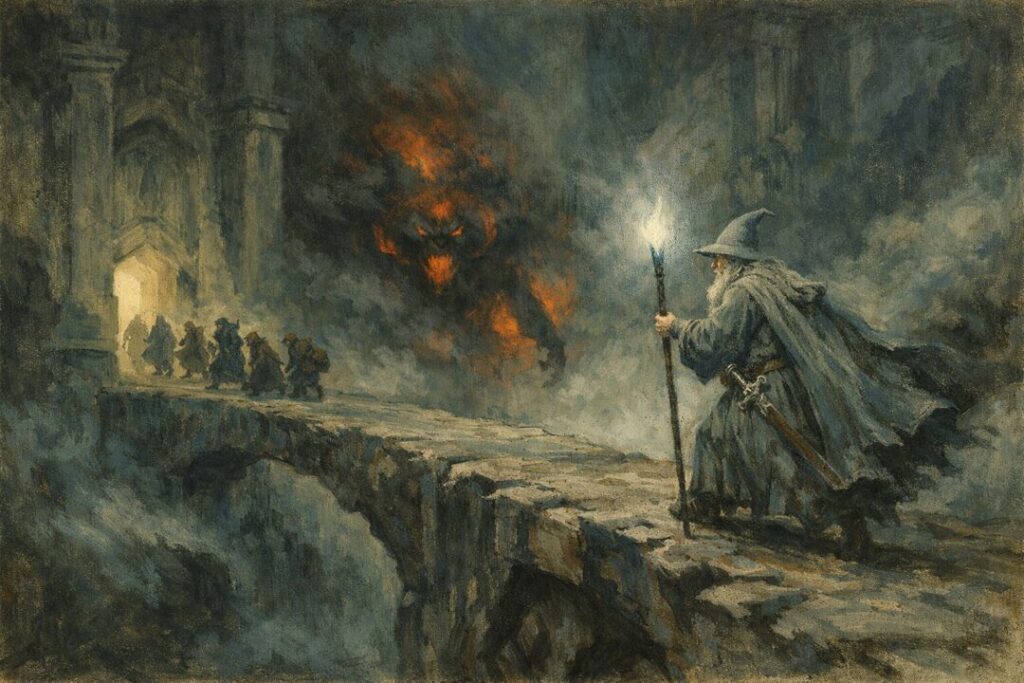
He orders the Company across and says, “This foe is beyond any of you. I must hold the narrow way.” That is not the language of pursuit. It is the language of containment. The Company must get away, and Gandalf understands immediately that none of the others—not Aragorn, not Boromir, not Legolas, not Gimli—are meant to face such a being there.
This matters because it tells us how Gandalf reads the danger.
The Balrog is not simply another monster in Moria.
It is a catastrophe if it reaches the Company intact.
So on the bridge, Gandalf does what his whole mission in Middle-earth often requires: he stands between the weak and something they cannot endure. That is the first layer of the answer. Gandalf confronts the Balrog because someone has to, and among those present, only he can even attempt it.
The Fall Did Not End the Problem
A common way of imagining the scene is that Gandalf breaks the bridge, the Balrog falls, and then Gandalf is simply dragged down with it.
But the later account in The White Rider makes the aftermath much stranger and more important.
Gandalf says he fell long with the Balrog, plunged into deep water, and came at last to the uttermost foundations of stone. There the Balrog’s fire was quenched, and the fight continued in another form. Then comes one of the key lines: “In that despair my enemy was my only hope, and I pursued him, clutching at his heel.”
That line is crucial.
It tells us two things at once.
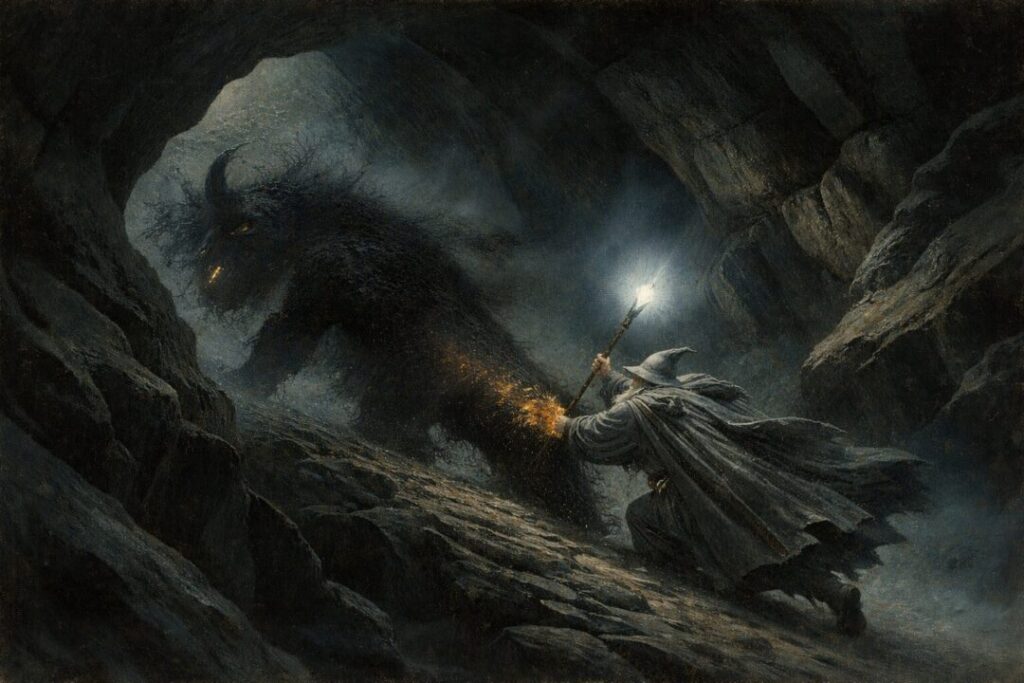
First, Gandalf is no longer merely being carried along by events. He is making a choice to continue after the Balrog. Second, the choice is bound up with survival and direction. In the abyss beneath Moria, the Balrog knows the hidden ways out. Gandalf does not. So pursuit becomes both combat and escape. The enemy becomes the only guide back toward any road at all.
This is why the idea that Gandalf ran the Balrog down out of vengeance or pure aggression does not fit the text.
The books present the pursuit as desperate, practical, and burdened. He follows because the fight is not over and because letting the creature go free is not a tolerable outcome.
Why Gandalf Could Not Simply Let It Go
The text never gives us a sentence where Gandalf says, plainly, “I chased it because it would have endangered the Fellowship.”
So that specific wording would be an interpretation.
But it is a strong one, and it fits what the narrative shows.
Durin’s Bane is not some half-defeated thing stumbling away harmlessly. It is a Balrog: an ancient servant of Morgoth, terrible enough that its coming is recognized with horror by Legolas and Gimli alike, and grave enough that Gandalf immediately orders the others to flee. Even before the fall, the Company’s survival depends on holding it back. Nothing in the later account suggests it had become less dangerous below.
So once both have fallen into the abyss, the problem has changed shape but not disappeared.
If Gandalf had somehow broken contact and allowed the Balrog to move where it would through the deep ways of Khazad-dûm, the danger would still exist. The creature would remain a terror loose beneath the mountains, with the Fellowship somewhere ahead and Moria still full of enemies.
The text does not explicitly map out Gandalf’s reasoning step by step.
But it strongly implies that this is not a fight he believes he can leave unfinished.
This Was Still in Character for Gandalf
At first glance, Gandalf’s pursuit can seem almost out of character.
Is this not the wizard who guides, warns, encourages, and restrains rather than dominating by force?
Yes.
And that is exactly why this moment stands out.
The traditions surrounding the Istari say they were sent to contest Sauron by strengthening resistance, uniting the Free Peoples, and giving counsel, but they were forbidden to match Sauron’s power with power or to dominate Elves and Men by force and fear. Gandalf, more than Saruman, remains faithful to that mission throughout the story.
But none of that means he must refuse every direct confrontation.
The restriction is against domination and open seizure of power, not against defending others when no one else can stand. At the bridge, Gandalf is not trying to become a rival dark lord. He is acting as a shield. In the abyss, that same logic continues. The Balrog is not a political enemy to outmaneuver. It is an immediate ancient threat that has to be stopped.
So this is not Gandalf stepping outside his mission.
It is Gandalf carrying that mission to its most dangerous edge.
A Burden He Believed Was His Alone
There is another layer here that deepens the moment.
Long before Moria, Gandalf was chosen for this work precisely because he was humble enough to fear it. In the tradition preserved in Unfinished Tales, Olórin says he is too weak for such a task and that he fears Sauron; the answer given is that this is all the more reason he should go. Círdan later entrusts him with Narya, saying his labours will be heavy and that the Ring of Fire may support him in weariness and help him rekindle hearts in a world that grows chill.
That background matters in Moria.
Gandalf is not reckless by temperament.
He does not seek contests with dark powers because they are glorious.
He is the one who takes the burden because he knows what it costs.
That makes his pursuit of the Balrog feel even more severe.
He is not swept up in battle-madness.
He is doing what he has been doing all along in Middle-earth: taking on what others should not have to bear. The difference is that here the burden becomes literal. He falls into darkness with it and keeps fighting long after anyone else could have followed.
From the Deepest Dungeon to the Highest Peak
The pursuit does not end in the abyss.
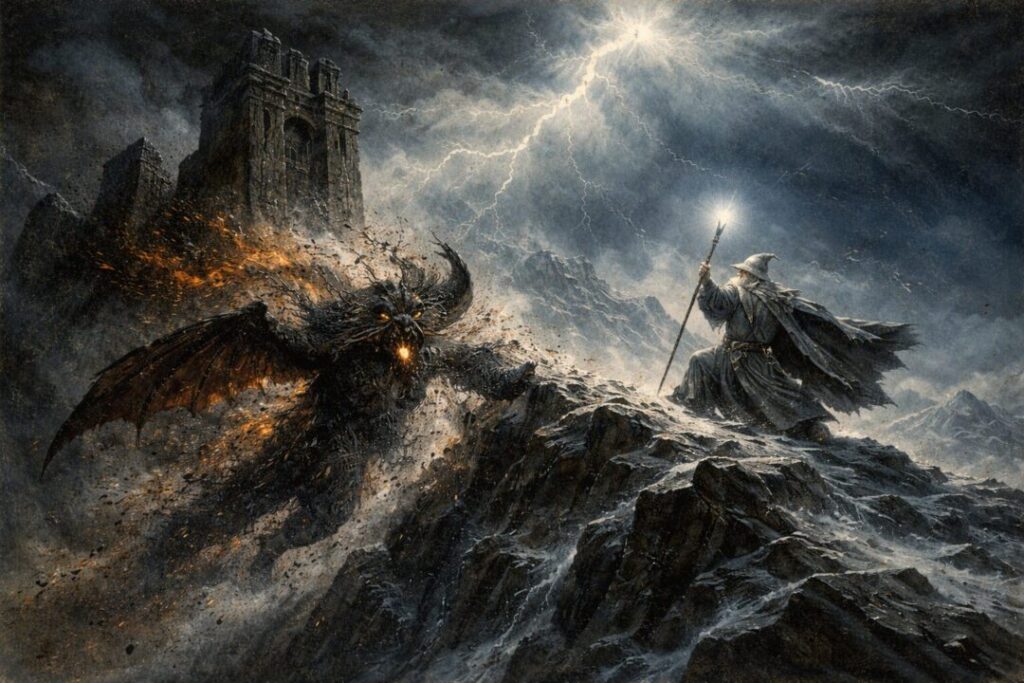
Gandalf says the Balrog fled through tunnels below the living earth, and he pursued it until it brought him back to the secret ways of Khazad-dûm. Then they climbed the Endless Stair to Durin’s Tower on Zirakzigil, where they fought under the sky for days. In other words, Gandalf does not merely survive the fall. He drives the conflict all the way from the roots of the mountain to its summit.
That upward movement matters symbolically, but even before symbolism, it matters practically.
It means Gandalf never lets the Balrog break away cleanly.
The thing is harried, opposed, and forced onward until the final confrontation on the peak.
Again, the text never says, “Gandalf decided the world could not risk this creature’s escape.”
But the shape of the whole struggle points that way.
This is not a chase of pride.
It is a relentless denial of release.
Why This Scene Feels Bigger Once You Notice It
Most people remember Gandalf’s line on the bridge.
Fewer pause over the line in Fangorn where he says he pursued the Balrog.
But that later line reveals the true weight of the episode.
The bridge shows Gandalf’s courage.
The pursuit shows his responsibility.
On the bridge, he chooses to stand.
In the deep, he chooses not to stop.
And that second choice may be the more revealing one.
Because it tells us that for Gandalf, some evils cannot merely be checked for a moment and left behind in the dark. They must be followed through danger, weariness, and near death until they are ended. Not because victory is grand. Not because battle is noble in itself. But because abandoning the task would leave the burden to fall on others less able to bear it.
That is why he ran the Balrog down.
Not to prove strength.
Not to seize power.
Not because the bridge was the climax.
Because the bridge was only where the duty began.
And once both had fallen, Gandalf seems to understand that he cannot simply survive.
He has to finish what followed him out of the ancient dark.
Sources & Notes
- J.R.R. Tolkien, The Lord of the Rings, Book II, Chapter 5, “The Bridge of Khazad-dûm” — frames Gandalf’s stand as holding the narrow way so the Company can escape a foe beyond them.
- J.R.R. Tolkien, The Lord of the Rings, Book III, Chapter 5, “The White Rider” — Gandalf recounts the fall, the deep water, and his pursuit of the Balrog through the hidden ways beneath Moria.
- J.R.R. Tolkien, The Silmarillion, “Valaquenta” — identifies the Balrogs as Maiar corrupted into Morgoth’s service, supporting the article’s stress on Durin’s Bane as an ancient terror rather than an ordinary monster.
- J.R.R. Tolkien, Unfinished Tales, “The Istari” — gives the Wizards’ mission as counsel and resistance rather than domination, useful context for why Gandalf’s direct combat remains defensive and exceptional.