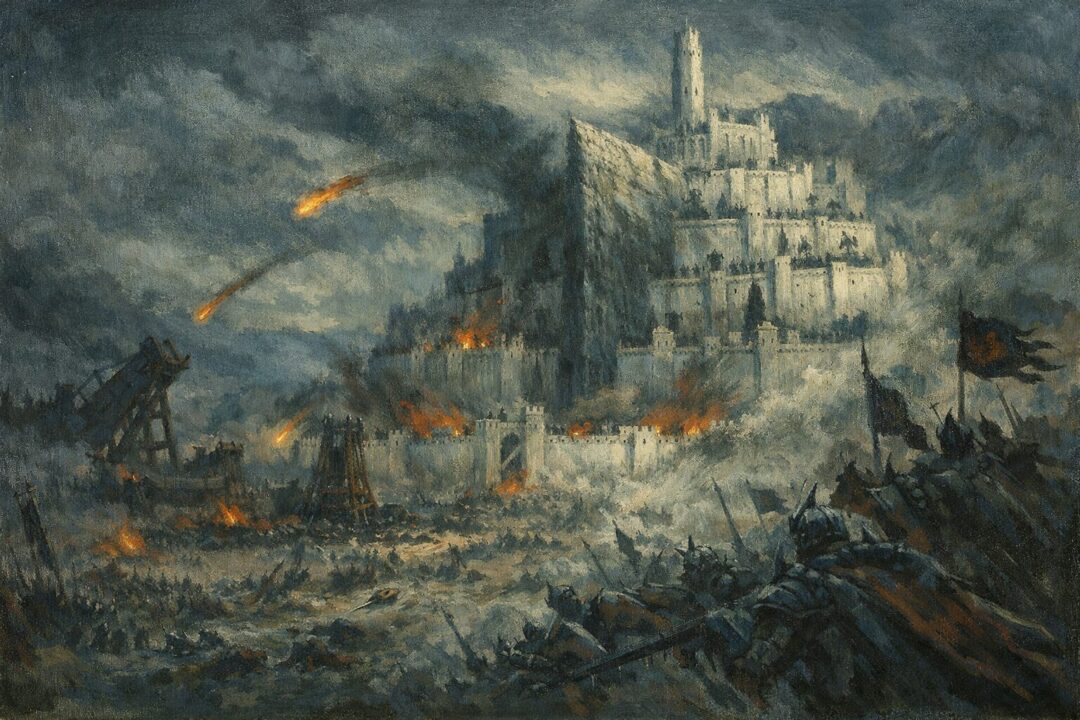
At first glance, the question sounds reasonable.
Why aren’t there any sieges in The Lord of the Rings?
After all, this is a story full of fortresses.
There is the Hornburg at Helm’s Deep.
There is Minas Tirith with its great walls and gates.
There is Erebor in The Hobbit and again in the War of the Ring.
And behind all of them stands a much older world in which some of the greatest wars in Middle-earth were defined by siege warfare.
So the real puzzle is not that sieges are absent.
It is that they often do not feel like the center of the story.
Even when a fortress is surrounded, the action rarely settles into the slow, grinding kind of war people usually associate with a classic siege. The pressure becomes intense, the walls are tested, the defenders are driven to the edge—and then something changes. Reinforcements arrive. A sortie breaks out. A wider battle overtakes the siege. The pattern repeats so often that it shapes how the whole war is remembered.
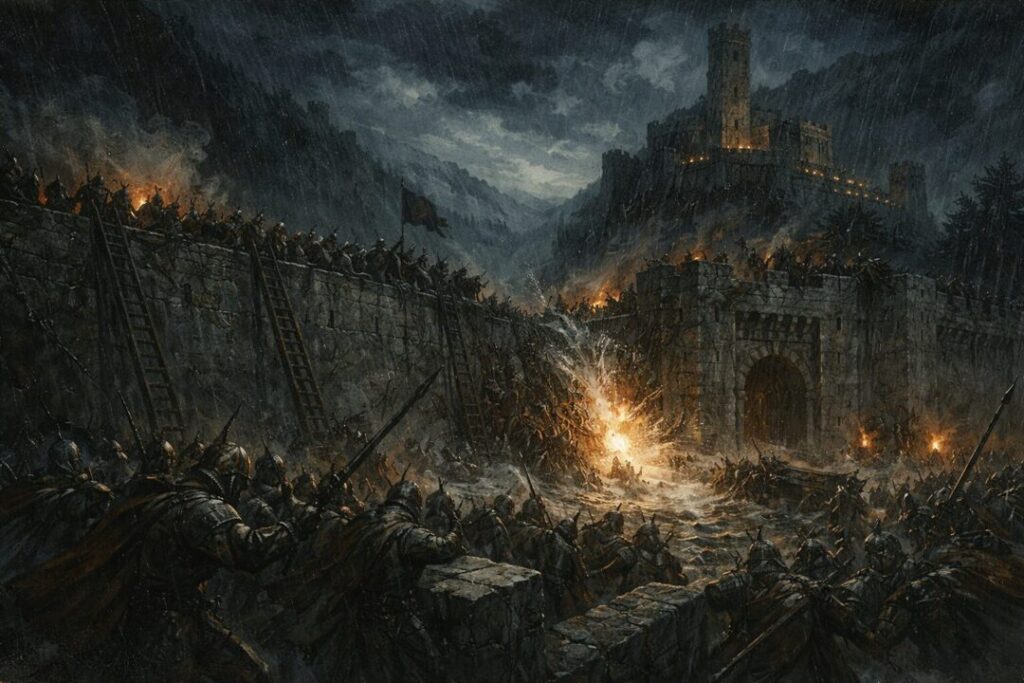
Middle-earth Actually Has Several Important Sieges
The first thing to clear away is the false premise.
Middle-earth absolutely has sieges.
In the deep history of the legendarium, the Siege of Angband and the Siege of Barad-dûr are among the great examples. The latter lasts seven years at the end of the Second Age before Sauron finally comes forth. These are not marginal details. They are major parts of the military history of the world.
In the main narrative of The Lord of the Rings, the Siege of Gondor is explicit. Mordor overruns the Pelennor, sets engines in place, batters the city, and drives the defenders upward through the levels of Minas Tirith. This is not merely a battle near a city. It is a true siege.
Helm’s Deep also falls under siege, even if readers often remember it mainly as a night battle. Saruman’s host surrounds the Hornburg, attacks the gate, scales the wall, penetrates the defences, and breaches the Deeping Wall. The siege is simply compressed into a single desperate night rather than stretched into weeks.
Even Erebor belongs in this discussion twice.
In The Hobbit, after Smaug’s death, Bard and Thranduil besiege the mountain when Thorin refuses terms. Later, during the War of the Ring, after the Battle of Dale, the survivors retreat into Erebor and are besieged there by Easterlings until news of Sauron’s fall breaks the enemy’s resolve.
So the question cannot really be: why are there no sieges?
The real question is: why do the most memorable sieges in the story not remain long, static, attritional wars?
The War of the Ring Is Built on Haste
One answer lies in the nature of the war itself.
The War of the Ring is short, compressed, and driven by urgency. Events in March 3019 move with startling speed: Helm’s Deep, the Siege of Gondor, the Battle of Dale, the assaults from Dol Guldur, the march on the Morannon, and the destruction of the Ring all fall within a remarkably tight span.
That pace is not accidental.
Sauron is not fighting a comfortable war of patience. He is trying to crush his enemies before the Ring can be turned against him. Tolkien Gateway’s summary of the palantír episode reflects the point made in the text: after Aragorn reveals himself, Sauron is driven to launch his assault on Gondor immediately, rather than wait for all preparations to be complete, because he fears one of his enemies may have the Ring and may soon use it.
That matters enormously.
A patient Dark Lord might have preferred to isolate, starve, and reduce strongholds one by one.
But the Sauron we meet at the end of the Third Age is under pressure from his own misunderstanding. He reads events through the assumption that others would use the Ring as he would. That pushes him toward speed and overwhelming assault. It is one reason the war feels like a chain of crises rather than a sequence of slow sieges. This is partly textual and partly interpretive, but the pattern is strongly supported by the timeline and by Sauron’s hasty move after Aragorn’s challenge.
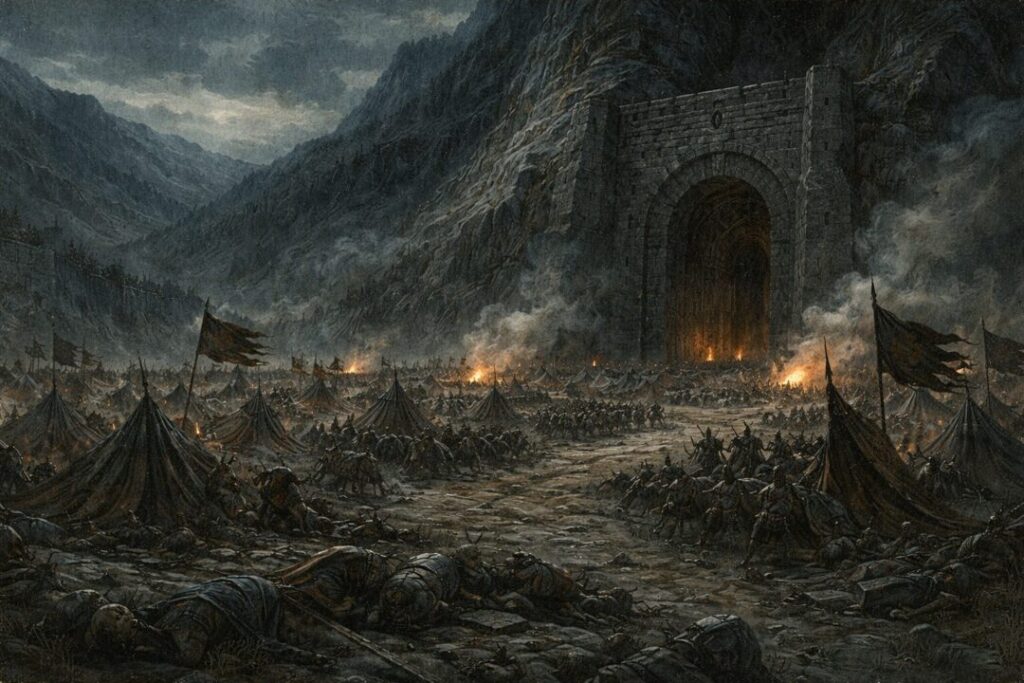
The Great Fortresses Are Delay Points, Not Final Answers
Another reason is that fortresses in The Lord of the Rings are rarely presented as places that can win the war by merely enduring.
They matter.
They buy time.
They preserve peoples long enough for something else to happen.
Helm’s Deep is exactly that kind of place. It is strong, ancient, and hard to take. But the defenders do not simply wait out the enemy. The wall is breached, the keep is endangered, and the battle is only reversed when Théoden rides out and Gandalf arrives with reinforcements. The fortress delays destruction; it does not solve the strategic problem by itself.
Minas Tirith is similar.
Its walls are formidable, but the city is not written as an impregnable answer to Mordor. The defenders are already under immense strain before the siege closes. Once the assault begins, the city is pounded, terrorized, and partially overrun. The siege is broken not because the walls alone are enough, but because outside help arrives at the critical moment and transforms the struggle into the Battle of the Pelennor Fields.
Erebor during the northern war fits the same pattern.
It preserves the survivors of Dale, but the siege there ends because the entire war changes when Sauron falls. The fortress holds long enough for the larger turn of history to catch up with it.
This is one of the clearest military patterns in the story.
Fortresses are not where the final answer lies.
They are where hope is kept alive long enough for the true answer to arrive.
Tolkien Prefers the Moment of Reversal
There is also a narrative reason, and this is interpretation rather than a direct statement from the text.
Tolkien is usually more interested in the moment when despair is about to become final—and is suddenly interrupted—than in the slow mechanics of blockade, famine, and engineering. That is why his sieges tend to crest into relief, sortie, or catastrophe.
At Helm’s Deep, the key image is not prolonged starvation behind walls, but the black night, the breached wall, the king riding out, and dawn with Gandalf on the height.
At Minas Tirith, the key image is not months of encirclement, but the battering ram at the gate, the city under shadow, and then the horns of the Rohirrim at sunrise.
Even the northern siege of Erebor is remembered not for the daily grind of confinement, but for the larger reversal: Sauron falls, and the besieged come forth.
That does not make the sieges unreal.
It makes them transitional.
They are written as points of maximum pressure where the moral and strategic shape of the war becomes visible.
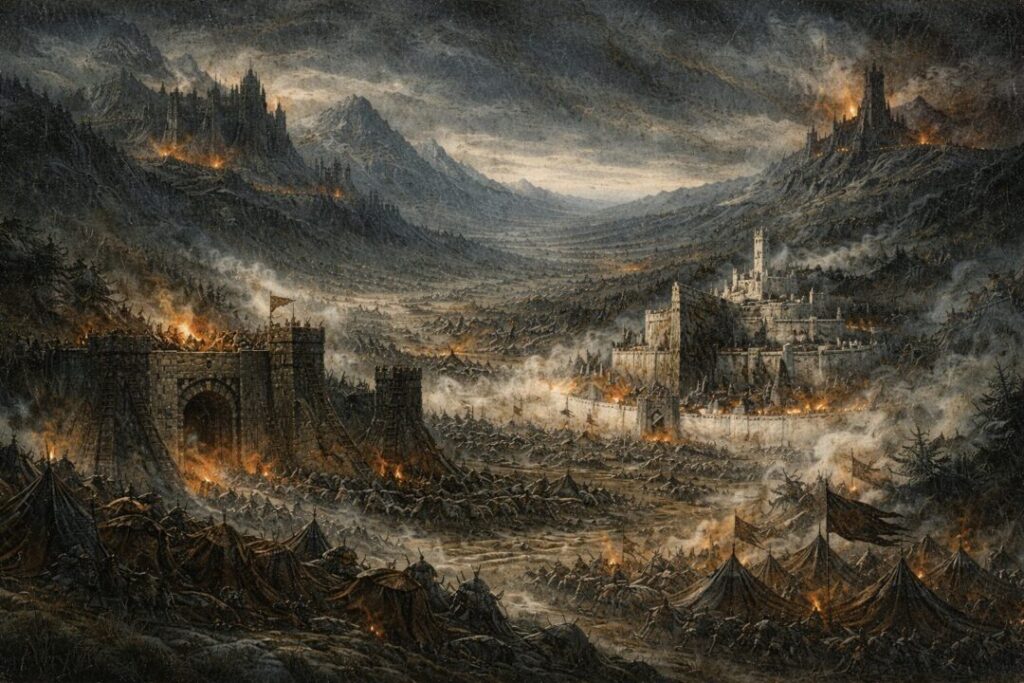
Why It Feels Like There Are No Sieges
So why do many readers come away with the impression that The Lord of the Rings has no sieges?
Because the most famous conflicts are remembered as moving stories.
Helm’s Deep is remembered as a last stand and a breakout.
Minas Tirith is remembered as the coming of Rohan and the fall of the Witch-king.
The northern war is remembered through scattered reports rather than extended siege chapters.
And the greatest military question in the whole book is never whether a city can endure indefinitely, but whether the Ring can be destroyed before military defeat becomes inevitable.
That last point is essential.
The war is not finally decided at a wall.
It is decided because Sauron’s attention is fixed on armies and strongholds while the Ring-bearer moves elsewhere. The armies of the West even march on the Morannon to hold that gaze in place. In that sense, every siege in the story is secondary to the deeper contest that Sauron never truly understands.
The Stranger Truth
There are sieges in Middle-earth.
Some of them are immense.
Some are central.
Some are among the most important military events in the whole legendarium.
But in the War of the Ring especially, sieges rarely remain static for long.
They are cut short by haste.
Broken by relief.
Overtaken by a wider turn in the war.
Or rendered strategically incomplete because the real struggle is happening somewhere else entirely.
So the answer is not that Tolkien forgot siege warfare.
It is that he kept placing sieges inside a story where walls could delay evil, but could never be the final cure for it.
And once you see that, the wars of Middle-earth begin to look less like a series of fortress contests and more like a race to interrupt them before the darkness can settle in for good.
Sources & Notes
- J.R.R. Tolkien, The Lord of the Rings, The Two Towers, Book III, Chapter 7, “Helm’s Deep” — Saruman’s army surrounds the Hornburg, breaks the Deeping Wall, and is defeated by Théoden’s sortie and Gandalf’s arrival.
- J.R.R. Tolkien, The Lord of the Rings, The Return of the King, Book V, Chapter 4, “The Siege of Gondor” — Mordor encircles Minas Tirith, uses engines and Grond against the Gate, and drives the city to the brink before relief arrives.
- J.R.R. Tolkien, The Lord of the Rings, The Return of the King, Book V, Chapter 2, “The Passing of the Grey Company” — Aragorn’s use of the palantír helps explain why Sauron moves in haste rather than conducting a slower war of reduction.
- J.R.R. Tolkien, The Lord of the Rings, Appendix B, “The Tale of Years” — the War of the Ring chronology places Helm’s Deep, the Siege of Gondor, Dale/Erebor, and the Morannon in a compressed March 3019 sequence.
- J.R.R. Tolkien, The Lord of the Rings, Appendix B, “The Tale of Years” — after the Battle of Dale, King Brand and Dáin fall and the survivors are besieged in Erebor until Sauron’s fall changes the northern war.
- J.R.R. Tolkien, The Silmarillion, “Of the Rings of Power and the Third Age” — the Last Alliance’s seven-year siege of Barad-dûr gives the wider legendarium a clear example of prolonged siege warfare.