It is one of the most tempting “what if” questions in The Lord of the Rings.
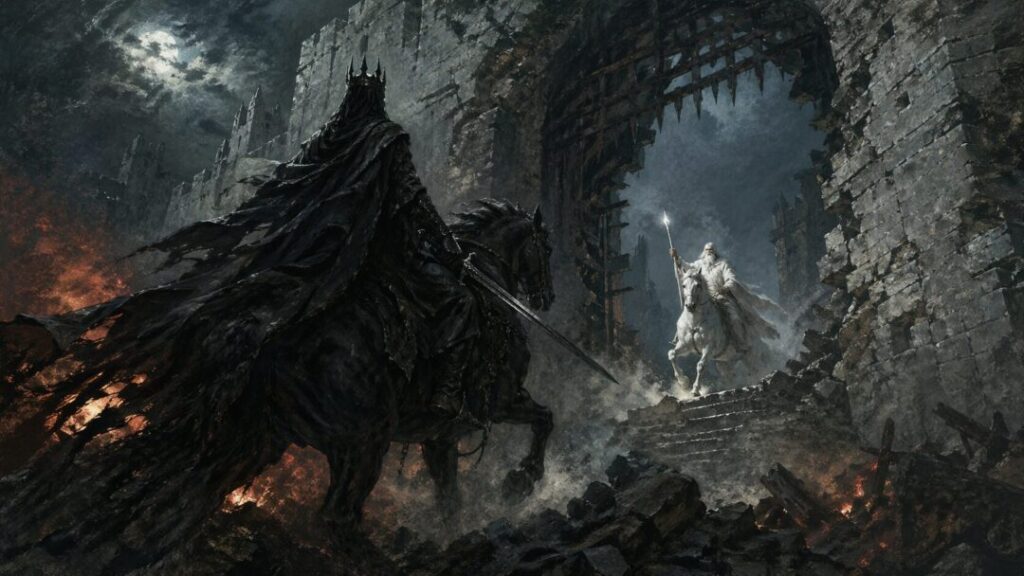
The Witch-king of Angmar rides through the shattered Gate of Minas Tirith. Gandalf the White is waiting for him. The city is breaking. The hour feels final.
And then the story stops the duel before it truly begins.
That interruption has left readers debating the scene ever since.
Could Gandalf actually have killed the Witch-king?
The short answer is that the text never says so directly.
But it also does not say the opposite.
What the books give us instead is more careful, and more interesting. They show that Gandalf is one of the very few beings in Middle-earth who can openly withstand the Witch-king at all. They also show that the Witch-king’s end is tied not merely to strength, but to a doom that the story has already prepared long before the siege of Gondor.
To understand the question, we have to separate three things that are often blurred together: power, prophecy, and narrative purpose.
The Confrontation at the Gate Is Deliberately Left Unfinished
When the great ram Grond breaks the Gate of Minas Tirith, the Witch-king enters the city alone. He is not presented as merely another captain in battle.
He is the point of collapse.
His coming is meant to embody the terror of Sauron’s assault in concentrated form. The defenders have been driven to the edge of despair. Even before this, Gandalf has warned that the Dark Lord has not yet revealed his deadliest servant.
So when the Witch-king rides in, the moment carries enormous weight.
Then Gandalf meets him.
This is crucial. Gandalf does not stand aside. He does not speak like someone already beaten. He commands the Witch-king to halt and forbids him entry. The Nazgûl-lord answers with mockery and threat, calling it his hour.
And yet no blow settles the issue.
Before the confrontation can resolve, the horns of the Rohirrim sound across the fields. The Witch-king abandons the encounter and turns away toward the larger battle.
That means the books never show Gandalf defeated by the Witch-king.
They also never show Gandalf destroying him.
The scene is left open on purpose.
Gandalf Is Not Powerless Before the Nazgûl
That matters because some later adaptations have encouraged the idea that Gandalf is plainly overmatched by the Witch-king.
The book does not support that reading.
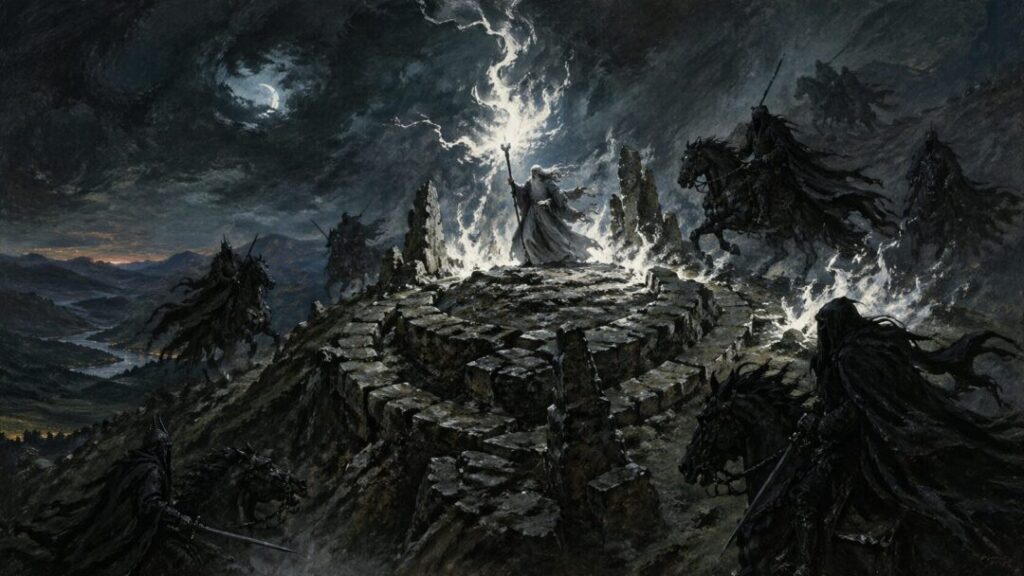
Long before Minas Tirith, Gandalf has already faced the Nazgûl directly. At Weathertop he is attacked at night and besieged on the hill. He later describes the struggle as fierce enough that “such light and flame” had not been seen there since the ancient war-beacons. He was “hard put to it indeed,” which means the danger was real.
But he survives.
More than that, the Nazgûl do not simply sweep him away. He escapes them.
Later, during the retreat from Osgiliath, Gandalf rides out to rescue Faramir and his men while Nazgûl descend upon them. A shaft of white light goes up from Gandalf’s raised hand, and the attackers wheel away.
These moments do not prove that Gandalf could effortlessly destroy the Lord of the Nazgûl in single combat.
They do prove something important: the Nazgûl are not beyond him.
Their terror, sorcery, and battlefield dominance are terrible against ordinary people. Gandalf is not ordinary. He is one of the few figures in the story who can meet that darkness without collapsing under it.
Gandalf the White Is Not the Same Figure He Was Before Moria
Another detail matters here.
The Gandalf who confronts the Witch-king at Minas Tirith is Gandalf the White, not Gandalf the Grey.
After his fall in Moria and return, he is explicitly changed. He speaks with greater authority, takes Saruman’s place as head of the order, and acts with an enlarged stature throughout the rest of the war.
This does not mean he is suddenly unrestricted or free to use limitless force. Gandalf still operates within the mission given to the Istari. He is not sent into Middle-earth simply to dominate through raw power.
But it does mean the confrontation at the Gate is not between the Witch-king and a weary old traveler whose strength is mostly hidden.
It is between the chief of the Nazgûl and the White Rider at the height of his revealed authority.
That is one reason the scene feels so charged. These are not equal figures in exactly the same sense, but they are beings of such weight that the rest of the battlefield seems to pause around them.
The Witch-king’s Doom Was Never Just About Strength
At this point, it is easy to turn the question into a simple ranking contest.
Who was stronger?
That is not quite how the text frames the Witch-king’s fall.
Long before the War of the Ring, after the defeat of Angmar, Glorfindel speaks the words that shadow the Witch-king ever after: his doom is still far off, and he will not fall by the hand of man.
This is often misunderstood.
It does not necessarily mean the Witch-king is physically impossible for a man to injure in every circumstance. The wording is prophetic, not mechanical. It tells us how his end will come, not that no human blow could ever touch him under any imaginable condition.
That distinction matters.
By the time of the Pelennor Fields, the Witch-king himself speaks with arrogant certainty: “No living man may hinder me.” But prophecy in Tolkien is often most dangerous when characters turn it into a form of false security.
The point is not that he has discovered an absolute loophole in the structure of reality.
The point is that his doom has been appointed elsewhere.
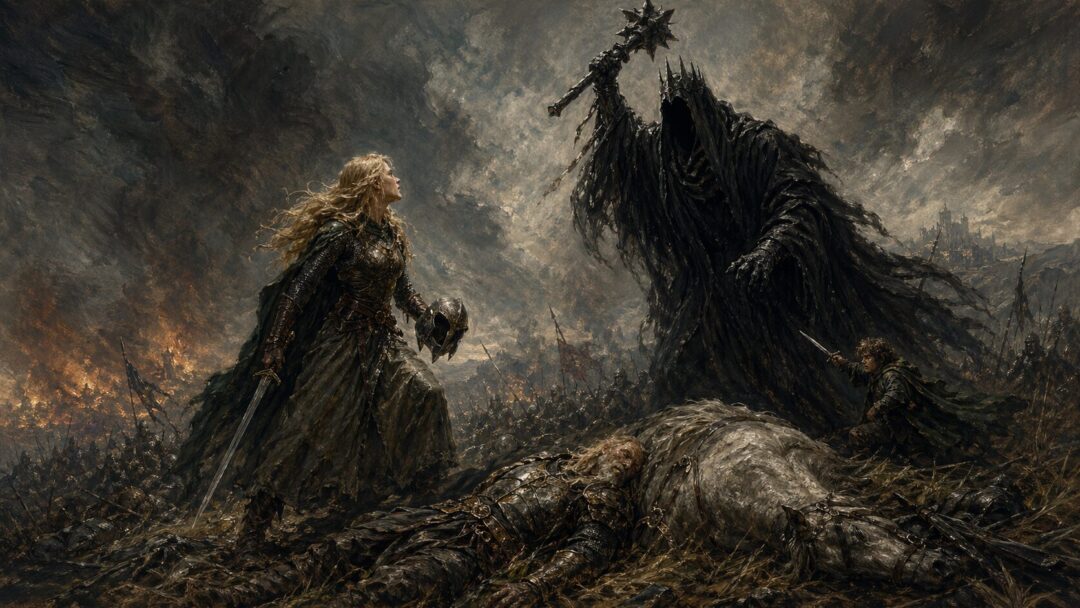
That is why the decisive moment is reserved for Éowyn and Merry.
Why Merry Matters More Than People Sometimes Notice
The destruction of the Witch-king is not accomplished by Éowyn alone in a simple duel.
Merry’s blow matters.
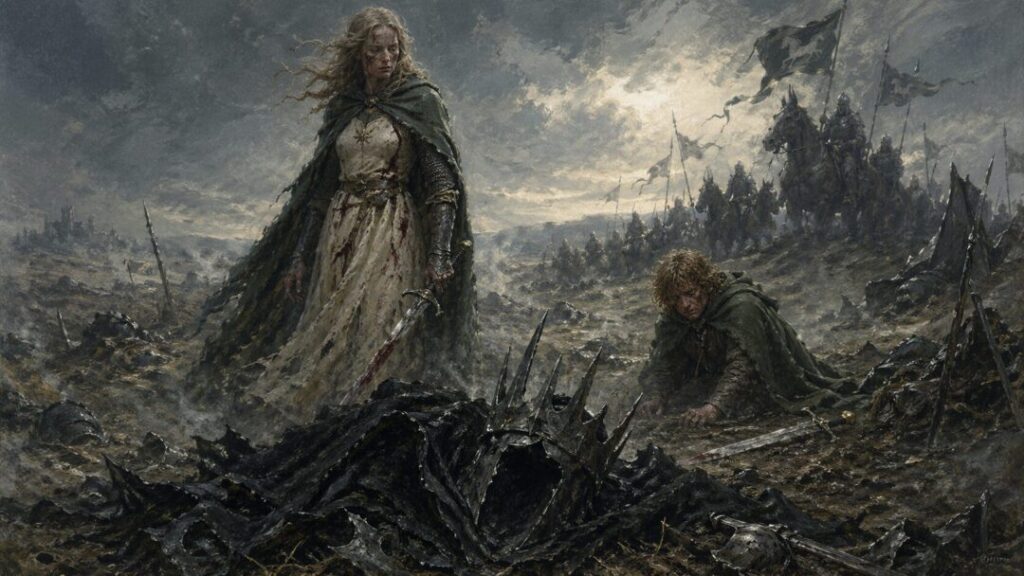
And the text draws unusual attention to the blade he uses. It is one of the blades taken from the Barrow-downs, weapons forged long ago in wars against the servants of Angmar. When Merry strikes from behind, the effect is not described as ordinary wounding. The blade undoes the sorcery that knit the Witch-king’s unseen sinews to his will.
Only after that does Éowyn drive her sword into him.
This is essential because it shows that the Witch-king’s destruction is not presented as something any hero with enough courage and steel could have accomplished.
Specific conditions matter.
Specific timing matters.
Specific persons matter.
That does not mean Gandalf lacked the power to contend with him.
It means the story has arranged the Witch-king’s end through a different pattern.
So Could Gandalf Have Killed Him?
With all that in view, the most careful answer is this:
Possibly, but not certainly in any way the text states outright.
There is good reason to think Gandalf had the stature to seriously oppose the Witch-king. The Nazgûl had already failed to master him outright. Gandalf had driven them back before. At Minas Tirith he stands firm before their lord without any sign that the encounter is hopeless.
At the same time, the book withholds the actual outcome. That matters too much to ignore.
If Tolkien had wanted to tell us plainly that Gandalf could have slain the Witch-king at the Gate, he could have done so.
He did not.
Instead, he shifted the battle away from that meeting and toward the fulfillment of the Witch-king’s appointed doom on the Pelennor.
So the safest conclusion is not that Gandalf definitely would have killed him.
It is that Gandalf was one of the very few beings in Middle-earth who could have met him in open contest without immediate ruin, while the story itself reserves the Witch-king’s actual end for another moment.
Why the Story Refuses to Give Gandalf That Victory
This may be the most important part.
The Witch-king is one of the greatest visible terrors in the war. If Gandalf had simply struck him down at the Gate, the moment would have become a straightforward triumph of the greater power over the lesser.
But Tolkien is doing something more pointed than that.
The fall of the Witch-king comes instead through a woman overlooked by her own side and a Hobbit whom almost no great lord of Middle-earth would count as a decisive warrior. It is courage, pity, overlooked strength, and providential timing converging at once.
That pattern fits the larger moral structure of the story far better than a direct magical victory between two mighty figures.
Gandalf’s role is different.
He holds the line.
He resists despair.
He protects others.
He buys time.
Again and again, that is what Gandalf does throughout the war. He is not there merely to win the most spectacular duel. He is there to help make possible the kind of victory Middle-earth actually needs.
And that victory almost never comes in the form people expect.
The Better Answer
So could Gandalf have killed the Witch-king?
The books do not let us say yes with certainty.
But they also do not support the idea that Gandalf was helpless before him.
What they show is subtler than either extreme.
Gandalf can face him.
Gandalf can defy him.
Gandalf can withstand the terror that breaks others.
And Gandalf may well be powerful enough to threaten him seriously.
Yet the Witch-king’s actual destruction is not given to Gandalf, because the story is aiming at something more meaningful than a contest of rank.
The real point is not that Gandalf was too weak.
It is that the doom of the Witch-king was always going to reveal one of Middle-earth’s deepest truths:
that the proud often fall where they feel safest, and that evil is not always broken by the greatest visible power, but by the hands it has learned not to fear.
Sources & Notes
- J.R.R. Tolkien, The Lord of the Rings, Book V, Chapter 4, “The Siege of Gondor” — gives Gandalf’s warning about the Lord of the Nazgûl, his rescue of Faramir’s company, and the unfinished confrontation at the broken Gate.
- J.R.R. Tolkien, The Lord of the Rings, Book II, Chapter 2, “The Council of Elrond” — includes Gandalf’s account of being besieged by the Nine at Weathertop and surviving a severe struggle of flame and light.
- J.R.R. Tolkien, The Lord of the Rings, Book III, Chapter 5, “The White Rider” — establishes Gandalf’s return in greater authority as the White, not merely as the same figure who fell in Moria.
- J.R.R. Tolkien, The Lord of the Rings, Appendix A, “The North-kingdom and the Dúnedain” — records Glorfindel’s prophecy that the Witch-king would not fall by the hand of man.
- J.R.R. Tolkien, The Lord of the Rings, Book V, Chapter 6, “The Battle of the Pelennor Fields” — shows the Witch-king’s actual fall through Merry’s Barrow-blade and Éowyn’s final stroke, rather than through Gandalf.