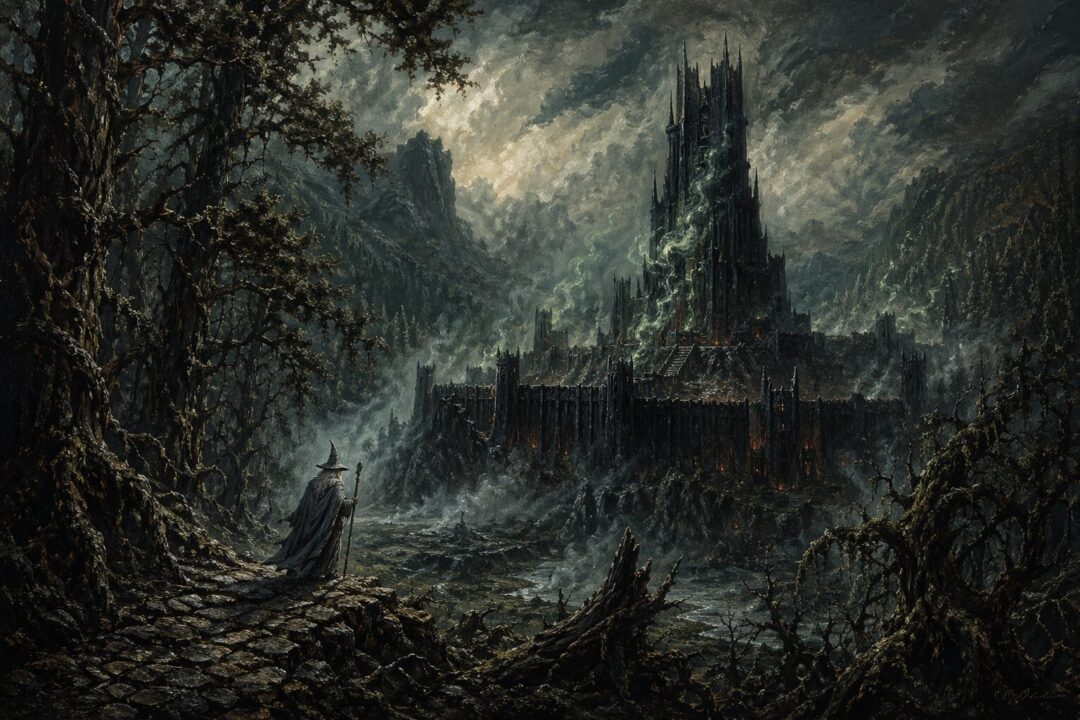
At first, the question sounds easy.
Of course Sauron speaks.
He is the Dark Lord. He commands Mordor. He sends threats, bargains, lies, and armies across nearly every page of the late Third Age. The whole War of the Ring turns around his will. It feels almost impossible that a figure so central could be nearly voiceless.
But once you start looking carefully, the answer becomes stranger.
In The Hobbit and The Lord of the Rings, Sauron is present almost everywhere and heard almost nowhere.
That is not an accident. It is one of the most effective choices in the way Middle-earth handles evil. The closer Sauron comes to total power, the less often the narrative gives him to us as an ordinary speaking character. We see his pressure, his symbols, his commands, his servants, and the ruin spreading out from his will. But his own voice is withheld so often that readers can come away feeling they know it, when in fact they have mostly felt its effects.
The Short Answer Is Yes — But Barely in the Main Story
If the question is simply whether Sauron ever has dialogue anywhere in the books, the answer is yes.
If the question is whether he speaks much in The Hobbit and The Lord of the Rings, the answer is almost no.
That distinction matters.
Across the wider legendarium, especially in First and Second Age material, Sauron is not mute at all. He appears in scenes where he argues, deceives, threatens, and manipulates. But in the two most famous narratives — The Hobbit and The Lord of the Rings — the texts keep him at a great narrative distance.
That is why the question feels slippery. People often remember Sauron as a speaking presence because his power is so overwhelming. But when you separate his direct words from the words spoken about him, for him, or in fear of him, there is much less actual dialogue than memory suggests.
In The Hobbit, Sauron Is There Without Really Speaking
In The Hobbit, Sauron does not appear as the open Dark Lord of Mordor.
He is the Necromancer of Dol Guldur, a threatening power on the edge of the story rather than a fully dramatized speaker within it. Gandalf investigates him. The White Council acts against him. His shadow matters to the larger history. But the book does not stage him as a character with developed on-page dialogue.
This is important because many readers carry over images from adaptations and assume the book does the same.
It does not.
The Hobbit gives Sauron importance without giving him a conversational presence. He is more rumor, threat, and background force than speaking antagonist. Even when the wider stakes begin to emerge, the book does not pause to let the Necromancer become a voice in the room.
So if someone asks whether Sauron has dialogue in The Hobbit itself, the careful answer is that the book does not meaningfully present him that way.
He matters enormously.
But he is not given to us through direct speech.
The Lord of the Rings Gets Closer — But Still Keeps His Voice Distant
The Lord of the Rings brings Sauron much nearer.
Now he is no longer a distant suspicion in southern Mirkwood. He is the declared enemy. His power has returned openly in Mordor. The Ring is revealed as his. The war against him becomes the central struggle of the age.
And yet even here, something surprising remains true:
Sauron almost never becomes a normal speaking character on the page.
We hear of his plans. We see the fear he causes. We encounter his emissaries. We feel the reach of his mind through the palantíri and through the Ring. But the narrative still resists bringing him forward in the ordinary dramatic way. It is as though the story prefers his absence to his presence, because absence lets him spread wider.
That is why the few places where his words do appear matter so much.
The Clearest Direct Words: The Ring Inscription
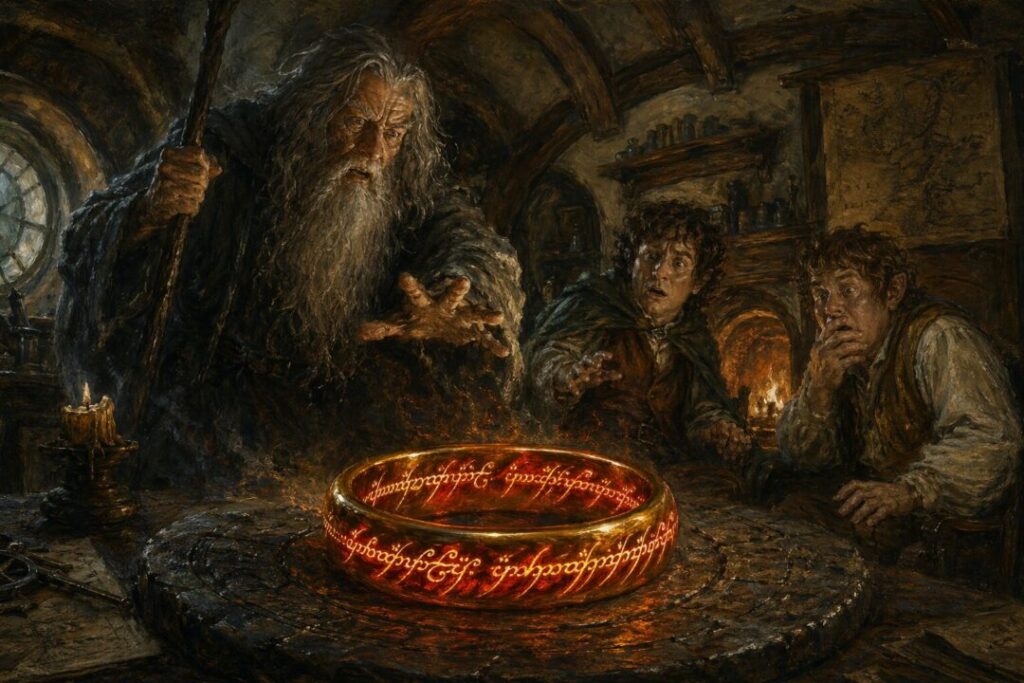
The strongest case for Sauron speaking directly in the core story is the Black Speech inscription of the One Ring.
Those lines are not just associated with him in a vague symbolic way. They are bound to the Ring he forged, and Tolkien Gateway’s summary notes that the Black Speech wording on the Ring consists of words of the Ring-verse linked directly to Sauron and his making of the Ring. In practical terms, this is the clearest moment in the main narrative where readers encounter words that are his.
That matters more than it may seem.
Because the Ring is not merely his weapon. It is the vessel into which he put so much of his own power. The inscription is the closest thing in The Lord of the Rings to Sauron’s voice surviving in a permanent form. The story does not often let him step forward and speak at length. Instead, it gives us a sentence of domination burned into the object that carries his will.
That is a different kind of dialogue.
Not conversation.
Declaration.
The Messenger to Erebor: Sauron Speaking by Report
Another important case comes through reported speech.
At the Council of Elrond, Gloin recounts the message brought to Dáin from Mordor. The wording explicitly frames the demand as something Sauron “asks,” and the messenger offers terms in his name. This is not Sauron standing before us in person, but it is still presented as Sauron’s will expressed in words.
This distinction is worth keeping.
It is not direct dialogue in the dramatic sense. We do not watch Sauron speak the line.
But it is closer than mere rumor. The text is giving us a statement attributed to Sauron, passed through a messenger and repeated in council. That is already very revealing. Even here, Sauron does not simply threaten. He bargains. He requests the return of “this thief” and the “little ring,” trying to use greed and fear together.
So yes, Sauron does have words in The Lord of the Rings.
But they come filtered.
Even his speech arrives through someone else’s mouth.
The Palantír Scene: He Speaks, But We Are Not Allowed to Hear Much
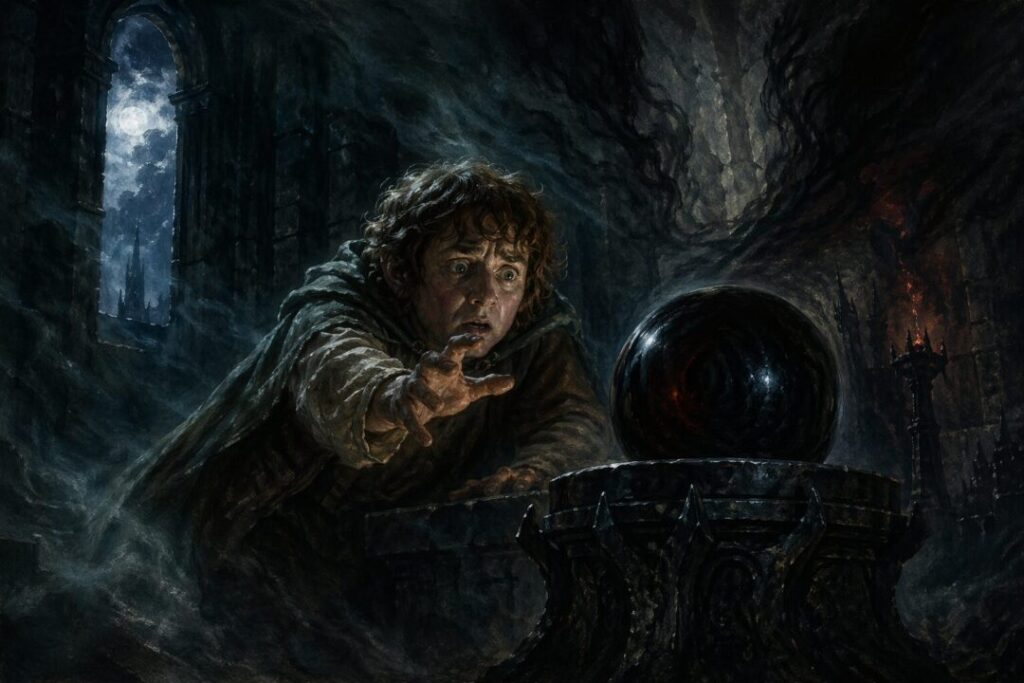
The encounter with Pippin through the palantír is one of the most fascinating examples.
The text makes clear that Sauron questioned Pippin through the stone. Tolkien Gateway’s summaries note that Pippin was seen by Sauron, questioned, and that Sauron misunderstood him to be the captured hobbit at Isengard; Gandalf later reconstructs some of what Sauron wanted conveyed to Saruman.
This is crucial.
Sauron is clearly speaking here.
But the narrative still refuses to give us the full exchange in a straightforward dramatic format. We see terror. We see aftermath. We hear Gandalf explain what probably happened and what Sauron concluded. Yet the Dark Lord’s actual words remain mostly veiled behind the experience.
That choice does something powerful.
It turns Sauron’s speech into an intrusion rather than a scene.
We do not sit with him as with Saruman in Orthanc, where persuasion itself becomes the danger. With Sauron, the danger is more immediate and less human. His voice is not allowed to become familiar.
The Mouth of Sauron Is the Point
Nowhere is this strategy clearer than at the Black Gate.
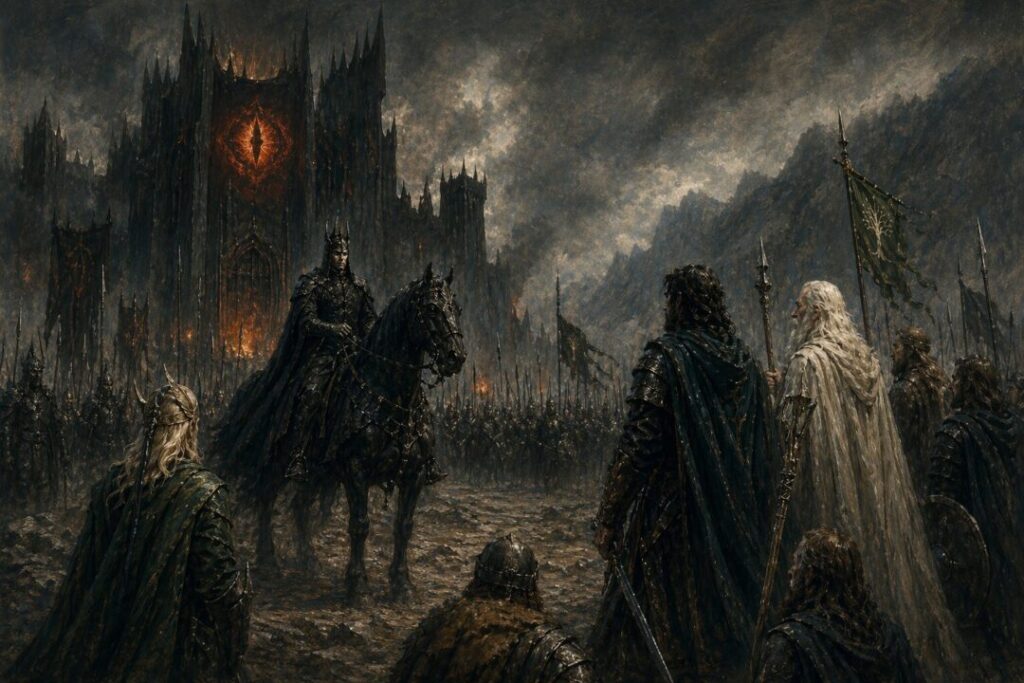
When the West rides out to challenge Mordor, Sauron does not appear in person. Instead, the gate opens and a spokesman comes forth: the Mouth of Sauron, the Lieutenant of the Tower of Barad-dûr. The very title tells the story.
This figure is not Sauron.
That needs to be said plainly, because readers sometimes blur the scene in memory.
The taunts, threats, and cruel terms offered before the Morannon are spoken by the Mouth of Sauron, not by the Dark Lord himself. He is a herald and emissary, terrifying precisely because he has become almost nothing except a function of his master’s will.
And that is the deeper point.
At the moment when many stories would bring the villain out for a grand confrontation, this story sends a mouth instead.
Sauron is present as command, but absent as body.
Present as will, but absent as speaker.
Present as power, but displaced into heraldry and symbol.
The result is somehow more unsettling than a speech would have been.
In the Wider Legendarium, Sauron Does Speak More Openly
If we widen the question beyond The Hobbit and The Lord of the Rings, the answer becomes much less ambiguous.
Yes — Sauron has actual dialogue elsewhere in the legendarium.
In First Age material connected with Beren and Lúthien, he is a far more dramatized figure. In Second Age material, especially the Númenórean story preserved in Akallabêth, he is not a distant eye or a shadow over a battlefield. He is a corrupter, counselor, captive-turned-master, and manipulator who works through speech as much as force. The tradition preserved in reference material on those episodes makes clear that Sauron is active as a speaking deceiver in those ages.
That contrast helps explain the late Third Age presentation.
By the time of The Lord of the Rings, Sauron has become less a character encountered face to face and more a ruling pressure over the whole field of history.
The earlier ages can stage him.
The later age feels him.
Why the Silence Matters
Sauron’s relative lack of direct dialogue is not a gap in the story.
It is part of the story’s design.
Other villains in Middle-earth seduce through presence. Saruman talks. Wormtongue talks. Even Gollum draws us into his mind through constant speech. They come close. They can be overheard. They can be answered.
Sauron is different.
He is too large in the structure of the tale to be improved by ordinary access. If he spoke often, he would become more local, more manageable, more like an opponent in a chamber. Instead, the books keep him distributed across symbols, armies, fear, rumor, command, and corrupted intermediaries. His speech is not missing because the story forgot to give it to him. It is missing because the story has already made his will audible in everything else.
That is why the Ring inscription matters so much.
Those few words do not humanize him.
They condense him.
So Does Sauron Have Dialogue?
Yes.
But not in the way most people mean when they ask.
In The Hobbit, he is present without becoming a real speaking character.
In The Lord of the Rings, he does speak in limited and indirect ways: most clearly through the Ring inscription, through reported commands, and through the questioning of Pippin that the narrative largely withholds from us. But he is still kept at a distance so consistently that the Mouth of Sauron ends up telling us something essential about the Dark Lord himself: even his speech is often delegated.
And across the wider Middle-earth books, yes, he has fuller dialogue.
But by the time we reach the War of the Ring, the more unnerving truth is this:
Sauron does not need many lines.
By then, the whole world is already answering to his voice.
Sources & Notes
- J.R.R. Tolkien, The Hobbit, Chapter 19, “The Last Stage” — identifies the Necromancer as a power driven from southern Mirkwood, without staging him as a speaking character in the story.
- J.R.R. Tolkien, The Lord of the Rings, Book I, Chapter 2, “The Shadow of the Past” — gives the Ring-inscription and Gandalf’s explanation that it is Sauron’s Black Speech verse of rule.
- J.R.R. Tolkien, The Lord of the Rings, Book II, Chapter 2, “The Council of Elrond” — reports the messenger from Mordor asking Dáin for news of “a little ring” on Sauron’s behalf.
- J.R.R. Tolkien, The Lord of the Rings, Book III, Chapter 11, “The Palantír” — shows Pippin’s encounter with Sauron through the Orthanc-stone and Gandalf’s reconstruction of the questioning.
- J.R.R. Tolkien, The Lord of the Rings, Book V, Chapter 10, “The Black Gate Opens” — makes clear that the threats at the Morannon are spoken by the Mouth of Sauron, not by Sauron in person.
- J.R.R. Tolkien, The Silmarillion, “Of Beren and Lúthien” and “Akallabêth” — gives wider-legendarium episodes where Sauron appears more openly as a deceiver, captor, and counsellor.