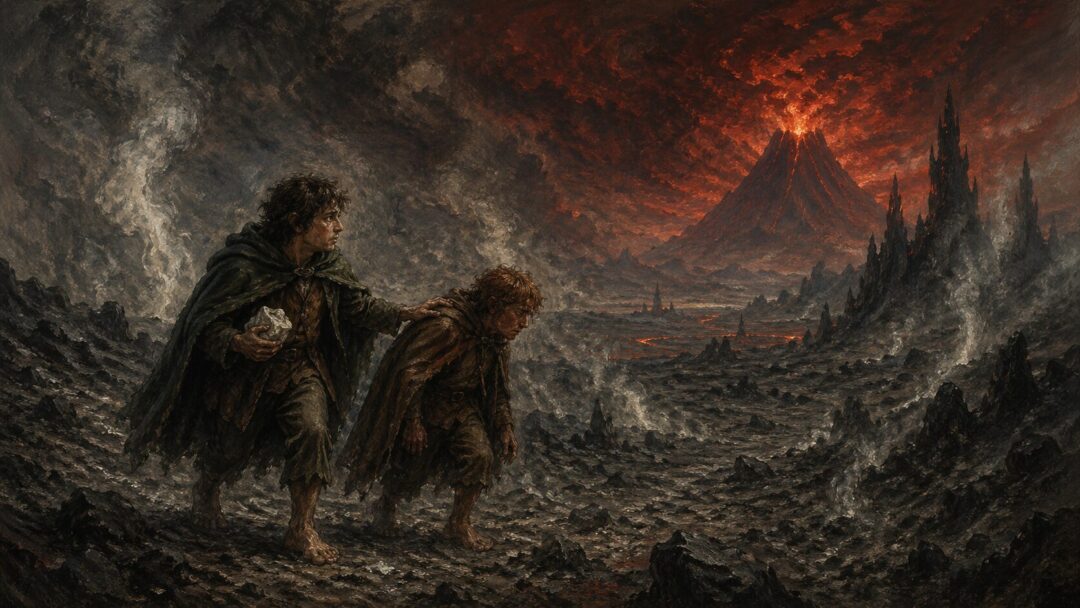
When Frodo and Sam entered Mordor, the Quest became almost impossibly small.
There were no armies around them. No banners. No songs. No clear road to victory. Just two Hobbits, a terrible burden, a little food, a little water, and a land designed to break the will of anything living.
It is easy to remember their final journey as a kind of heroic starvation.
And that is partly true.
They were hungry. They were thirsty. They were exhausted beyond ordinary endurance. Sam watched Frodo weaken step by step, and Frodo’s body and mind were both being crushed by the Ring as they drew nearer to Mount Doom.
But the question of what they ate in Mordor is more important than it first appears.
Because Frodo and Sam did not survive on courage alone.
They survived, for as long as they could, on lembas.
And by the time they were crawling through the ash of Mordor, that small store of Elven waybread had become one of the most meaningful things left in the story.
The Food They Carried Into Mordor
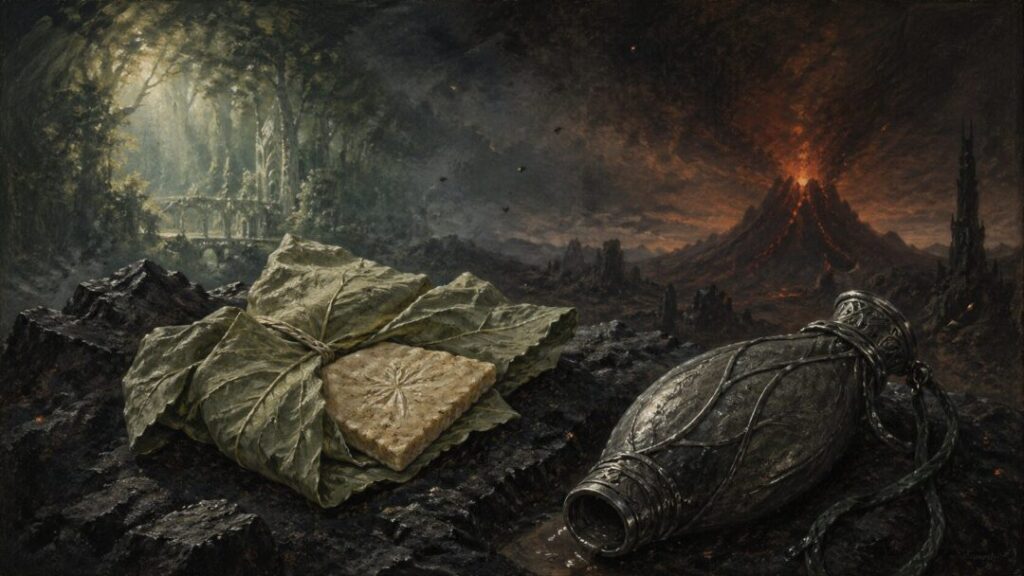
The clearest answer is simple: Frodo and Sam mainly ate lembas, the waybread given to the Fellowship in Lórien.
This was not ordinary bread. It was Elven travel-food, meant to sustain those on long journeys. It was wrapped in leaves, and a little of it could strengthen a traveler far beyond what normal food could do.
But it should not be exaggerated into magic that removed hunger completely.
The text treats lembas as deeply nourishing, not as a spell that makes bodies invincible. Frodo and Sam still grow weaker. They still thirst. They still suffer. They still reach the edge of collapse.
That matters.
Lembas does not make Mordor easy.
It makes Mordor barely possible.
Before Mordor, their food situation had already been narrowing. In Ithilien, Sam cooked the famous rabbit stew after Gollum brought him rabbits. Faramir’s men also gave the Hobbits provisions before sending them on. But after the Stairs of Cirith Ungol, Shelob’s Lair, Frodo’s capture, and Sam’s rescue of him from the Tower, the journey changed completely.
There was no more hunting.
No more cooking.
No more chance of a proper meal.
Once they escaped from the Tower of Cirith Ungol and set out across Mordor, the road to Mount Doom became a struggle of rationing, thirst, and endurance.
Why Lembas Matters So Much
At first, lembas can seem like a convenient survival detail.
The Hobbits need food. The Elves gave them food. The story continues.
But in Mordor, lembas becomes much more than that.
It is food from Lórien, a place of memory, beauty, preservation, and resistance against the Shadow. Mordor, by contrast, is a land of ash, fumes, slag, dust, fear, and domination. Everything there feels reduced. Burned down. Used up.
So when Frodo and Sam eat lembas in Mordor, they are not merely taking in calories.
They are carrying a remnant of an unruined world into the heart of ruin.
That contrast is important because Mordor is not simply dangerous. It is spiritually hostile. It wears down hope. It narrows thought. It makes the future feel impossible.
The lembas does not defeat that darkness by force.
It simply remains what it is.
Clean.
Sustaining.
Given freely.
Untouched by Sauron.
And in a land where almost everything has been bent toward domination, that is quietly powerful.
Could They Have Eaten Orc Food?
This is where the question becomes more complicated.
Frodo himself understands something important about Mordor: Orcs must eat and drink. The Shadow can ruin and twist living things, but it does not create real new life out of nothing. If Orcs live, they need food and water like other creatures.
So yes, somewhere in Mordor there had to be food.
There had to be stores, supplies, foul water, and some kind of meat or provisions for Sauron’s servants. Frodo even reasons along these lines. Mordor is not a land where nothing physical can survive. It is a military realm, and armies require supplies.
But that does not mean Frodo and Sam could safely or realistically rely on Orc food.
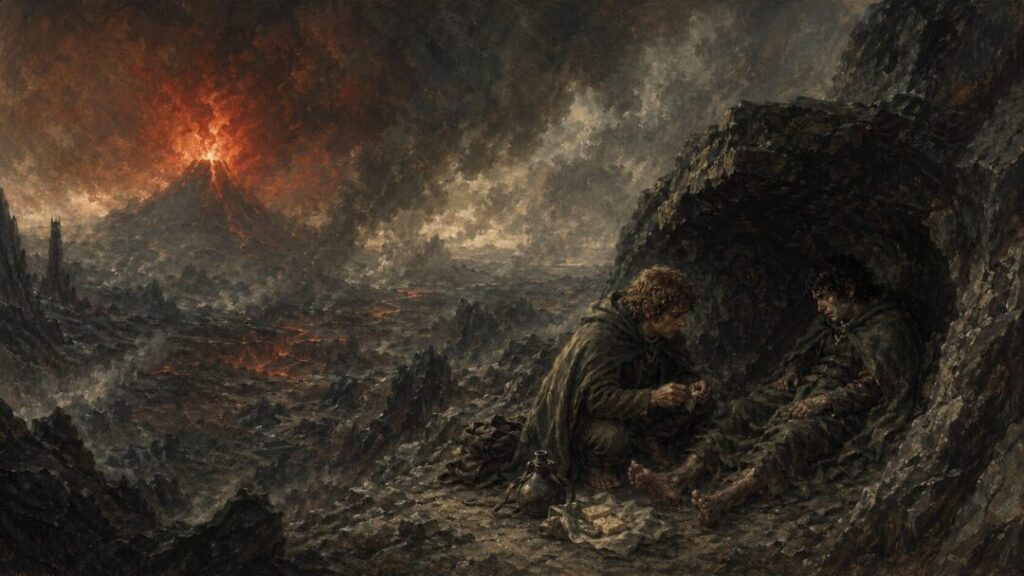
They were fugitives. They were moving in hiding. They had no secure access to enemy stores. Any attempt to search for food among Orcs would have risked capture. And even if they found something, the text gives no reason to imagine that it would be wholesome or fit for Hobbits.
There is a difference between “food exists somewhere in Mordor” and “Frodo and Sam could use it.”
The first is true.
The second is doubtful.
So the conservative answer is this: the texts imply that Mordor contained food and water for its inhabitants, especially Orcs and soldiers, but Frodo and Sam’s own survival depended mainly on what they already carried.
And what they carried was lembas.
The Problem Was Not Only Hunger
Hunger was terrible, but thirst may have been even more urgent.
Again and again in Mordor, the story emphasizes dryness, dust, fumes, and the difficulty of finding water. The land itself seems to resist life. Frodo and Sam do drink when they can, and Sam is careful about their supply, but water becomes part of the same grim arithmetic as food.
How much can they spare?
How far can they go?
Is there any need to save something for the return journey?
That last question is one of the most heartbreaking parts of the Mordor march.
For much of the Quest, Sam thinks practically. He worries about food, watches their supplies, and keeps some hope of going home. This is not foolishness. It is one of Sam’s strengths. He keeps the ordinary world alive in his mind: meals, gardens, roads, inns, the Shire.
But Mordor forces him toward a terrible realization.
There may be no journey back.
This changes the meaning of their supplies. Food is no longer something to ration for a return. It is something to spend on reaching the Fire. Their remaining lembas and water become not provisions for an adventure, but the last measurable pieces of hope.
Sam’s practicality does not disappear.
It becomes sacrifice.
Why Gollum Could Not Share It
There is another detail that reveals what lembas represents.
Gollum cannot bear it.
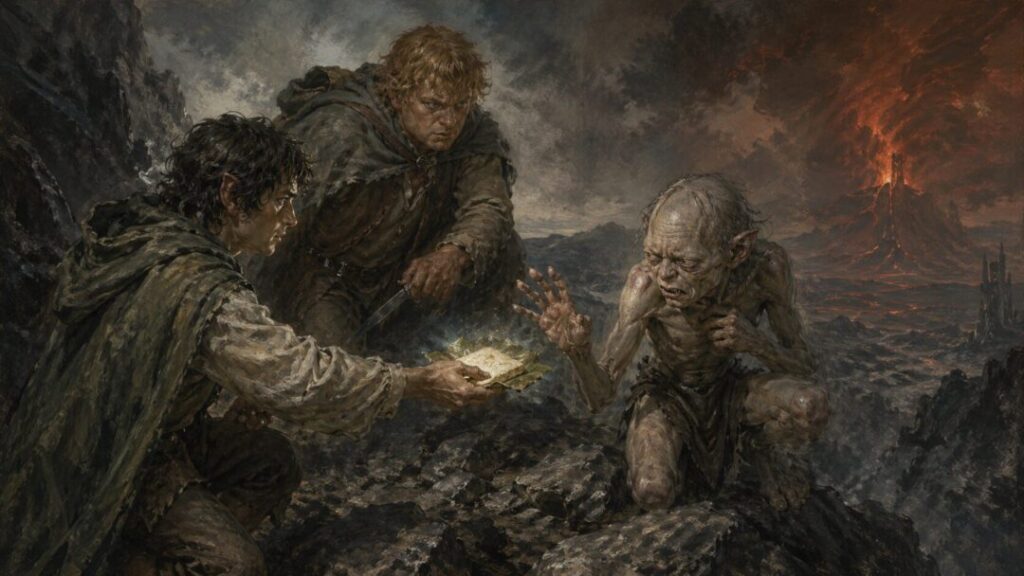
Earlier in the journey, Frodo offers him some lembas, but Gollum rejects it with disgust. He calls it dust and ashes. This is not because the bread is actually worthless. Frodo and Sam can eat it. It strengthens them. But Gollum, long corrupted by the Ring and by his own choices, finds Elven things unbearable.
This should be phrased carefully. The text does not give a scientific rule explaining exactly how lembas affects corrupted beings. It does, however, clearly shows Gollum’s revulsion toward it.
And dramatically, that matters.
Frodo and Sam are being sustained by something Gollum cannot receive.
The same food that helps preserve them exposes how far Gollum has been estranged from the clean and healing things of the world. It is not that Gollum is denied food by cruelty. Frodo offers it. But Gollum cannot accept it.
That moment quietly separates the paths of the three travelers.
Frodo is being consumed by the Ring, but he can still receive what is given.
Sam is weary and suspicious, but he can still preserve and share.
Gollum is hungry, but the food of the Elves is hateful to him.
In that small rejection, the whole tragedy of Gollum is visible.
Sam’s Rationing Is a Form of Love
Sam is often remembered for carrying Frodo.
But before he carries Frodo bodily, he carries him in smaller ways.
He watches the food.
He thinks about water.
He measures what is left.
He pushes Frodo to eat.
He gives more than he keeps.
These are not dramatic acts in the usual heroic sense. No sword is drawn. No enemy falls. No speech is made before an army.
But in Mordor, this is what heroism looks like.
Sam’s care for Frodo becomes practical, stubborn, and almost domestic. That is exactly why it matters. Mordor is a place where everything ordinary has been stripped away, and Sam keeps trying to preserve the ordinary things: eating, drinking, resting, waking, taking one more step.
The lembas in Sam’s hands becomes part of that love.
He cannot remove the Ring.
He cannot heal Frodo’s wound.
He cannot defeat Sauron by strength.
But he can make Frodo eat a little.
He can save a mouthful of water.
He can refuse to abandon him.
This is one reason the food question is so moving. It is not just about survival mechanics. It is about how goodness continues when almost every grand form of hope has disappeared.
In Mordor, love looks like rationing bread.
The Moment Supplies Stop Meaning What They Used To
As they approach Mount Doom, Sam begins to understand that old calculations no longer apply.
The idea of saving enough for the road back becomes increasingly unreal. Not because Sam wants to die, but because the Quest has narrowed to one purpose: reach the Fire.
This is where food becomes symbolic in the deepest sense.
At the beginning of a journey, provisions represent planning. They belong to a future that can be imagined. You pack because you believe there will be another meal, another camp, another morning.
But near the end of the Quest, Frodo and Sam’s remaining food represents something else.
It represents the vanishing distance between life and mission.
Every bite brings them closer to Mount Doom.
Every sip makes the next step possible.
Every ration spent is an admission that there may be no ordinary future left to preserve.
And still they go on.
That is what makes their endurance so different from simple toughness. They are not confident. They are not well supplied. They are not secretly protected from suffering. They continue with almost nothing, and the “almost” matters.
That little store of lembas is the difference between collapse and one more step.
Mordor Could Not Make What Saved Them
One of the most important ideas in the story is that evil can corrupt, twist, mock, and destroy, but it cannot create in the same way goodness creates.
That idea appears directly in Frodo’s reasoning about Orcs. The Shadow can ruin living things, but it cannot make true new things of its own.
This casts the food question in a sharper light.
Mordor can feed armies in a brutal, degraded way. It can organize supply lines. It can keep Orcs marching. It can sustain war.
But it cannot produce lembas.
It cannot make the kind of food that carries Frodo and Sam through the last stage of the Quest. That food comes from outside its logic entirely. It is not a weapon. It is not a command. It is not a device of mastery.
It is a gift.
And that is why it belongs so naturally at the center of the final journey.
The Ring is all about possession.
Lembas is received.
The Ring isolates.
Lembas sustains fellowship.
The Ring grows heavier as they near the Fire.
Lembas becomes one of the few things still helping them move.
Mordor understands force.
It does not understand grace.
What They Ate, and What It Means
So what did Frodo and Sam eat when they crossed Mordor on foot?
Mostly lembas.
They also drank what water they could find or carry, and the text implies that Mordor contained food and water for Orcs and other servants of Sauron. But for Frodo and Sam themselves, there is no evidence of proper meals during the final crossing. Their survival rests on Elven waybread, careful rationing, and Sam’s fierce refusal to let Frodo fail while he can still help him.
That simple answer opens into something much larger.
They crossed Mordor on the last gifts of Lórien.
They crossed it on food Gollum could not bear to eat.
They crossed it on the ordinary care of one Hobbit for another.
They crossed it on supplies that slowly stopped meaning “we will get home” and began to mean “we may reach the Fire.”
And in the end, that is why this detail matters.
The Quest is not carried only by kings, councils, swords, or prophecies.
It is carried by bread wrapped in leaves.
By a water bottle guarded carefully.
By Sam looking at Frodo and choosing, again and again, to spend what little remains on the next step.
Mordor is vast.
The Ring is terrible.
The road is almost impossible.
But for a while, against all reason, two Hobbits keep going because they still have a little food from a better world.
And because Samwise Gamgee will not stop sharing it.
Sources & Notes
- J.R.R. Tolkien, The Lord of the Rings, Book II, Chapter 8, “Farewell to Lórien” — describes lembas, the Elven waybread wrapped in leaves, and explains how a small amount can sustain travellers on a long road.
- J.R.R. Tolkien, The Lord of the Rings, Book IV, Chapter 2, “The Passage of the Marshes” — Frodo offers Gollum lembas, but Gollum rejects the Elven bread as hateful “dust and ashes.”
- J.R.R. Tolkien, The Lord of the Rings, Book IV, Chapter 4, “Of Herbs and Stewed Rabbit” — shows the last more ordinary food on the road before Mordor: Sam cooking rabbit in Ithilien, with Gollum’s help.
- J.R.R. Tolkien, The Lord of the Rings, Book VI, Chapter 1, “The Tower of Cirith Ungol” — Frodo notes that Orcs must eat and drink like other living creatures, even though the Shadow only ruins and twists what already exists.
- J.R.R. Tolkien, The Lord of the Rings, Book VI, Chapter 3, “Mount Doom” — follows Frodo and Sam’s final crossing of Mordor, with Sam rationing the remaining lembas and water as the hope of a return journey disappears.