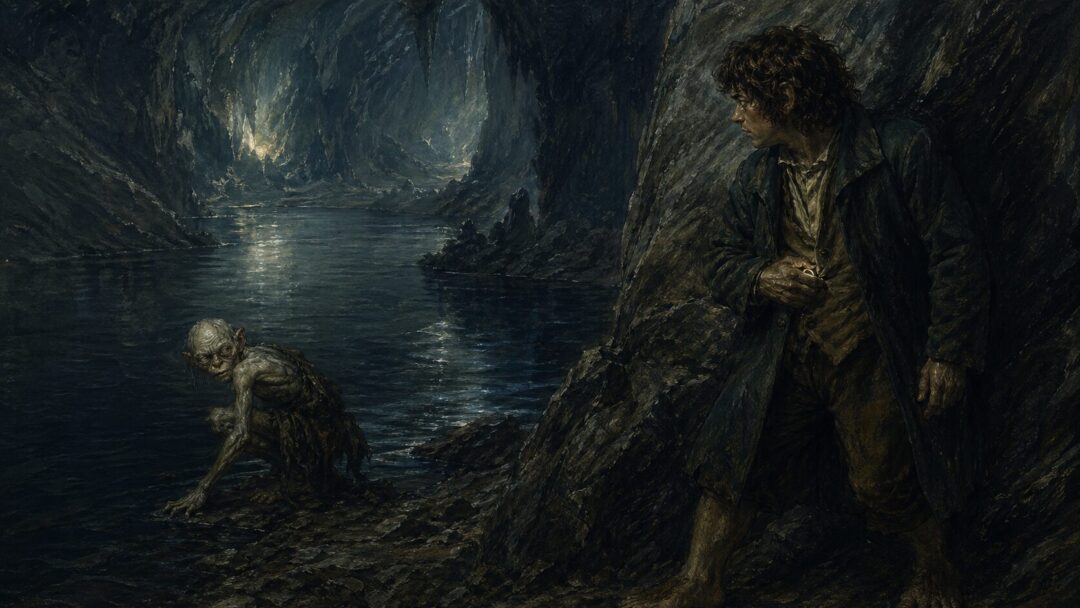
Most readers carry a very clear image of Gollum in their minds.
Thin. Pale. Crawling. Almost naked. Barely more than skin, bone, eyes, and hunger.
It is one of the strongest visual impressions attached to the character, and for many people it feels inseparable from him. Gollum seems like a creature who has slipped so far from ordinary life that even clothing no longer belongs to him.
But the books are more careful than that.
They do not present Gollum as a normal person in normal clothes. They do not give us a detailed inventory of what he wears in every scene. And they certainly do not stop the story to describe his outfit.
Yet the answer to the question is still surprisingly clear.
Gollum was not completely naked in the books.
The more interesting question is why that matters.
Because the small hints of clothing around Gollum do not make him less disturbing. If anything, they make him more tragic.
They remind us that Gollum is not simply a monster crawling out of the dark.
He is a ruined person.
The Image Most People Remember
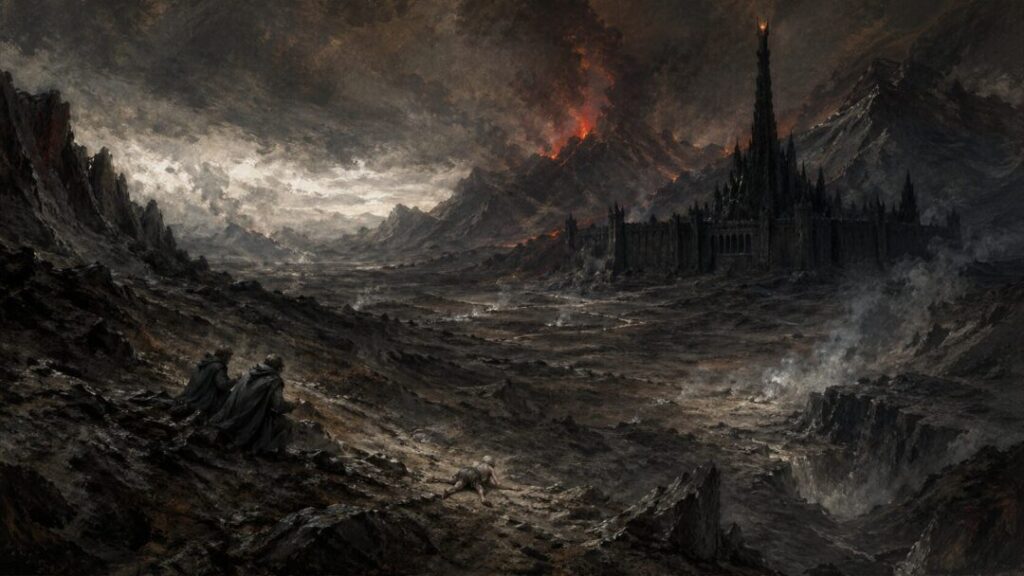
The popular image of Gollum is nearly bare.
He is imagined as a starved, crouching thing, with long limbs, pale skin, sharp bones, and only the smallest scrap of covering, if anything at all. That version feels natural because it matches so much of what the books emphasize.
Gollum is lean and withered. He crawls, climbs, sneaks, and clings to rock. He lives in dark places. He eats raw fish when he can get them. He avoids sunlight. He mutters to himself. He moves more like a spider or a creeping animal than like a Hobbit.
So when readers imagine him without proper clothes, the image does not come from nowhere.
It fits his condition.
But fitting the atmosphere of the story is not the same as being exactly what the text says.
The books describe Gollum as degraded, starved, and creature-like. They do not describe him as fully unclothed.
That distinction matters.
Gollum’s horror is not that he has become an animal in a simple physical sense. It is that he remains partly recognizable as something else.
He is still connected, however faintly, to the life he once had.
The First Clue: Gollum Has “Pocketses”
The earliest clue comes in The Hobbit, during “Riddles in the Dark.”
Bilbo meets Gollum deep beneath the Misty Mountains, beside the dark underground lake. At first, Gollum is described in shadowy terms: small, slimy, dark, with pale eyes. The focus is not on clothing, but on strangeness.
Then the riddle game turns toward Bilbo’s pocket.
Gollum becomes obsessed with what Bilbo has in his “pocketses.”
That word is easy to remember because it is part of Gollum’s voice. It sounds childish, possessive, and strange. But it also tells us something physical.
Gollum knows what pockets are.
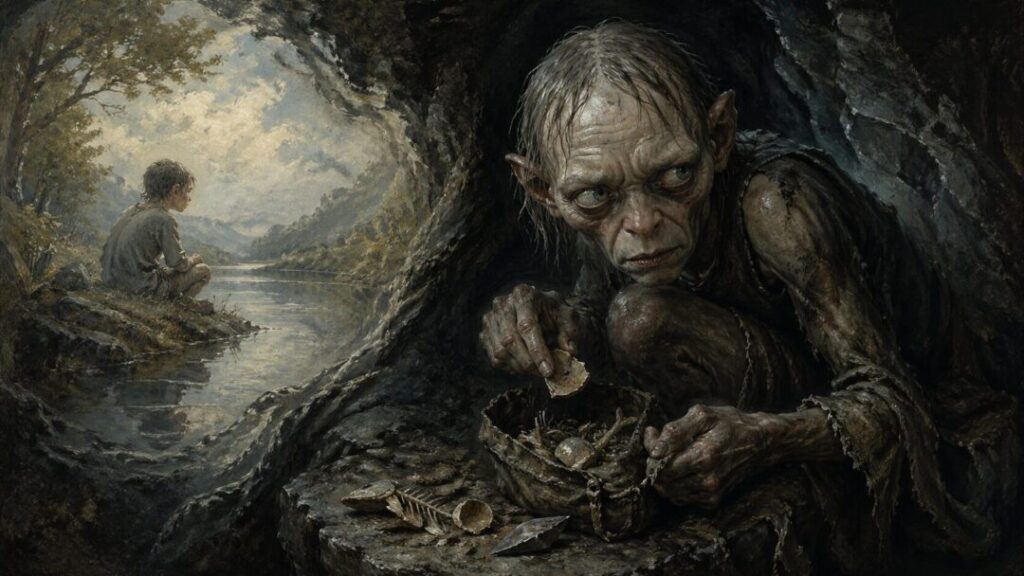
More than that, he has pockets of his own.
The text refers to the miserable little things Gollum keeps with him: bones, teeth, shells, scraps, and small tools. These are not treasures in any noble sense. They are the hoard of a creature who has been living for centuries in darkness, keeping whatever bits and fragments still matter to him.
But the point is simple.
Pockets imply some kind of garment, pouch, or clothing-like thing.
This does not prove that Gollum was neatly dressed. It does not tell us he wore trousers in any ordinary Hobbit sense. The text does not give that level of detail. But it does make the idea of total nakedness difficult to sustain.
Even in the deep places of the world, Gollum is not presented as completely without possessions or covering.
He carries remnants.
And that is the first hint of the deeper tragedy.
The Clearer Evidence in The Lord of the Rings
The strongest evidence comes later, in The Lord of the Rings.
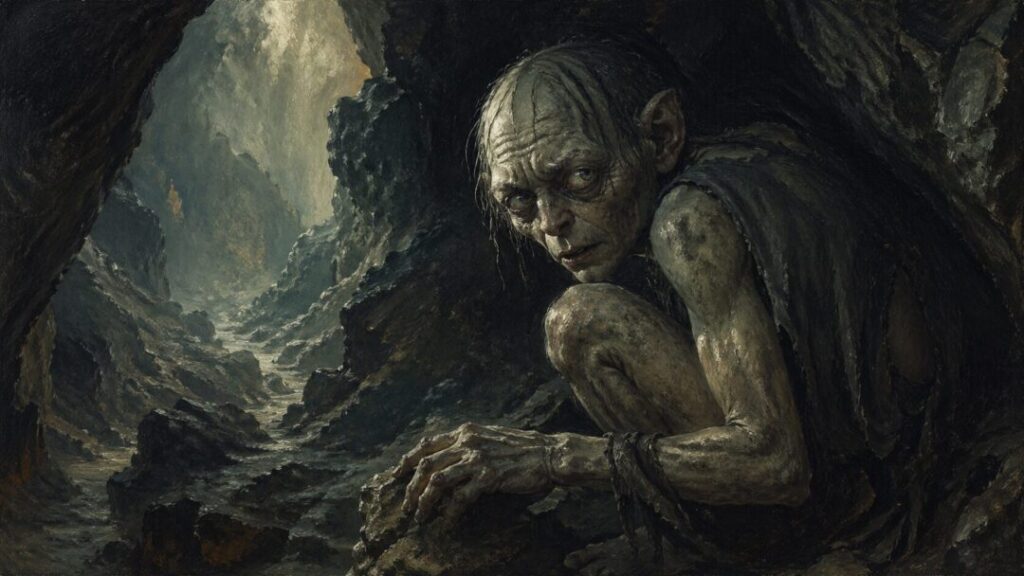
By the time Frodo and Sam are journeying with Gollum toward Mordor, the text gives us a more direct description. In one passage, Gollum is seen as a tiny, starved figure on the ground, with long arms and legs that look almost bone-white and bone-thin.
But the description also says that a ragged garment is still clinging to him.
That detail is decisive.
Whatever Gollum looks like in the imagination, the book gives him clothing.
Not fine clothing.
Not clean clothing.
Not anything that restores dignity or makes him appear whole.
A ragged garment.
Something torn, worn, and reduced almost to nothing.
But still there.
This is why the most accurate answer is not “Gollum was naked,” but something closer to this:
Gollum was barely clothed, miserably clothed, and often described in ways that emphasize his exposed, skeletal body — but he was not completely naked.
That is a small distinction on the surface.
In the story, it changes the feeling of the character.
Why He Still Seems Naked
So why does Gollum feel naked to so many readers?
Because the books make his body more important than his clothing.
When Gollum appears, we remember the pale eyes. The thin limbs. The crawling motion. The soft, horrible strength. The hunger. The hissing speech. The way he clings to stone and shadow.
The clothing is secondary.
It is not described as part of an identity, the way cloaks, mail, robes, or heraldic colors often are for other characters. Aragorn’s worn travel gear tells us something. Gandalf’s grey and white garments tell us something. The Elven cloaks tell us something. Even the Hobbits’ ordinary clothes connect them to home.
Gollum’s rags do not restore him to any community.
They only cling.
That word matters.
A garment clinging to him feels almost like another remnant of the past, unable to fall away completely. It does not make him look civilized. It makes him look abandoned.
The eye passes over the rags and remembers the bones.
That is probably why the popular image of Gollum becomes almost bare. His clothing has no grandeur, no warmth, no social meaning. It is only a scrap attached to a body that has been emptied by time.
He seems naked because everything that should have covered him in a deeper sense is gone.
Gollum Was Not Born a Monster
This is where the question becomes more than visual.
Gollum was once Sméagol.
The story does not give us a full account of his early life in ordinary domestic detail, but it does tell us enough to know that he came from Hobbit-kind. He had kin. He had a community. He had a birthday. He had a name before “Gollum.”
Then he murdered Déagol for the Ring.
After that, the Ring worked on him over long years. He was driven out, withdrew from the light, and eventually hid beneath the mountains. His life narrowed until almost nothing remained except appetite, secrecy, fear, and possession.
That matters because Gollum is not frightening simply because he is physically ugly.
He is frightening because he is a possible end-point of corruption.
The Ring does not merely tempt kings and warriors with armies and thrones. It can also reduce a small, obscure person into something mean, lonely, and enslaved.
Sméagol does not become a grand dark lord.
He becomes Gollum.
That is a different kind of horror.
The Rags Are Part of the Tragedy
If Gollum were simply naked, the image would suggest a complete break from personhood.
A wild thing.
A cave creature.
A monster outside the human or Hobbit world.
But the rags complicate that.
They show that Gollum has not become something entirely new. He is not a beast with no history. He is a person who has been worn down until only scraps remain.
The same is true of his speech.
Gollum’s language is broken, strange, and twisted, but it is still language. He bargains. He remembers. He complains. He flatters. He lies. He swears by the Precious. He speaks to himself as if split between impulses.
His clothing works in the same symbolic direction.
It is not enough to make him whole.
It is enough to remind us that he once was.
That is why the question of nakedness is not trivial. Gollum’s rags are part of the story’s refusal to turn him into a simple monster.
He is degraded, but not erased.
Pale Skin, Dark Shape, and Confusing Descriptions
There is another reason readers get confused about Gollum’s appearance.
The books describe him differently depending on light, distance, and point of view.
At times, he appears dark, especially in shadow or when seen at a distance. In other moments, his limbs are pale or bone-white. This can seem contradictory if we try to turn every description into a fixed character design.
But the story often presents Gollum as something glimpsed.
He is seen in caves, by night, in marshes, on rocks, near battlefields, or through the fear and suspicion of others. He is not introduced like a courtly figure standing still in clear daylight.
He is an impression.
A movement.
A shape.
A pair of eyes.
A crawling body.
A whisper in the dark.
Some later explanatory material connected with Tolkien’s guidance for artists also supports the idea that Gollum’s apparent darkness was not simply skin color, but involved dark clothing, shadow, and the conditions in which he was seen.
Even without relying on that, the main text already gives us the important point.
Gollum can look dark in the dark.
His limbs can look pale when exposed.
And he can still be wearing ragged clothing.
Those things do not cancel each other out.
They create the unsettling visual instability of the character.
Why the Books Avoid a Full Costume Description
It is worth noticing what the books do not do.
They do not give Gollum a clear costume.
There is no neat description of shirt, trousers, belt, cloak, or shoes. There is no stable visual formula. The text does not invite us to admire craftsmanship or identify his people by dress.
That absence fits the character.
Gollum has fallen out of ordinary categories. He is not fully part of the wild, because he still speaks and remembers. He is not fully part of society, because he has been severed from kinship, home, and moral life. He is not merely a victim, because he remains malicious and treacherous. He is not merely a villain, because pity follows him almost to the end.
His appearance reflects that in-between state.
Too clothed to be only an animal.
Too ruined to look like a Hobbit.
Too pitiful to be only a monster.
Too dangerous to be safely pitied.
The books do not need to dress him clearly, because Gollum’s whole existence is unclear.
He is a remnant.
The Difference Between Gollum and the Hobbits
The contrast with Frodo and Sam is especially important.
Frodo and Sam are constantly connected to material signs of home and identity: cloaks, packs, food, rope, gifts, and small practical objects. Their belongings are humble, but they are meaningful. They connect the journey back to the Shire, to friendship, and to memory.
Gollum also carries things.
But his things are not comforting.
They are scraps and leavings. They are the objects of survival, secrecy, and obsession. Even his “pocketses” feel pitiful, because they show the remains of Hobbit-like habits twisted into something lonely and grotesque.
Frodo and Sam carry provisions for a quest.
Gollum carries fragments from a life spent hiding.
This is one reason he functions as a warning to the Ring-bearer. Gollum is not only an enemy outside Frodo. He is an image of what possession can do to someone small, persistent, and vulnerable.
He shows the road of the Ring if pity, friendship, and resistance fail.
So Was Gollum Completely Naked?
No.
The book evidence points away from complete nakedness.
In The Hobbit, Gollum’s “pocketses” strongly suggest that he has some kind of clothing, pouch, or garment associated with him. In The Lord of the Rings, the description of a ragged garment clinging to his starved body makes the matter clearer.
But the books also do not present him as properly dressed in any normal sense.
He is ragged.
He is exposed.
He is skeletal.
He is visually closer to a starving creature than to a clothed traveler.
So the best answer is this:
Gollum was not completely naked, but he was clothed only in miserable remnants.
And those remnants matter.
They show that Gollum has not lost every trace of Sméagol. Something remains: a voice, a memory, a habit of keeping things, a scrap of covering, a twisted need to belong to something, even if that something is only the Ring.
That is what makes him so haunting.
A completely naked monster might be easier to separate from ourselves.
Gollum is harder.
Because the books do not show us a creature who has simply become other.
They show us someone diminished almost beyond recognition, yet not entirely severed from the person he used to be.
His rags are not a costume.
They are evidence.
Not of dignity restored, but of dignity ruined.
And in Middle-earth, that is often where pity begins.
Sources & Notes
- J.R.R. Tolkien, The Hobbit, Chapter 5, “Riddles in the Dark” — Gollum’s repeated concern with Bilbo’s “pocketses,” and the odd scraps kept in his own pockets, point away from total nakedness.
- J.R.R. Tolkien, The Lord of the Rings, Book IV, Chapter 1, “The Taming of Sméagol” — Frodo and Sam’s capture of Gollum gives the key close description of his starved body and ragged covering.
- J.R.R. Tolkien, The Lord of the Rings, Book I, Chapter 2, “The Shadow of the Past” — Gandalf recounts Sméagol’s origin, the murder of Déagol, and the long corruption that made him Gollum.
- J.R.R. Tolkien, The Lord of the Rings, Book IV, Chapter 2, “The Passage of the Marshes” — Gollum’s crawling movements, hunger, and divided speech show why he reads as creature-like while still remaining a ruined person.