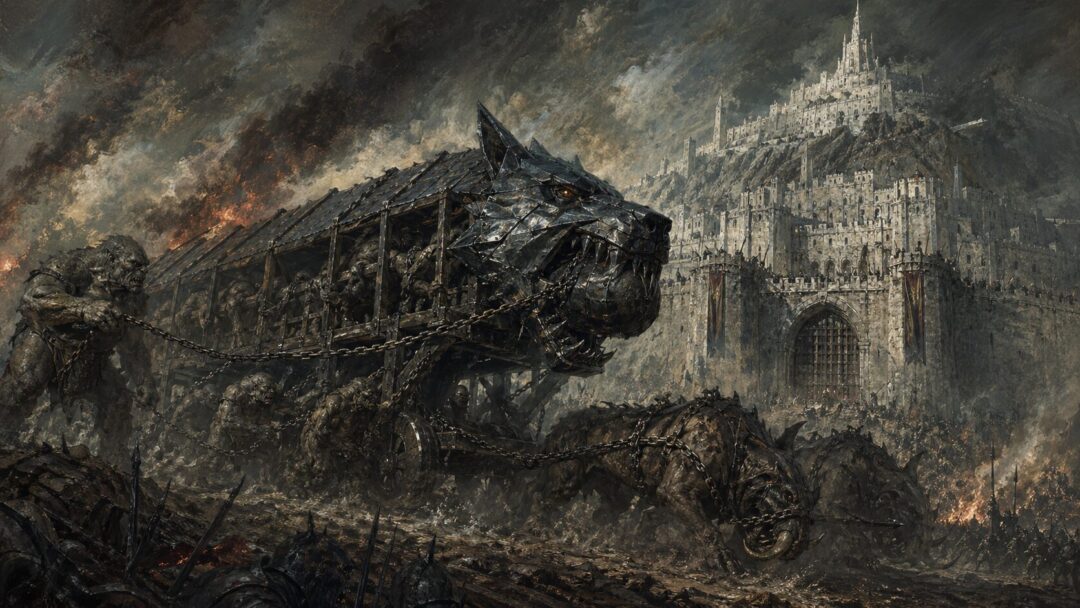
Grond enters the story like a nightmare made into wood and iron.
It is not introduced as an ordinary siege engine. It is named. It is chanted over. It is drawn across the battlefield before Minas Tirith like something more than a machine. The armies of Mordor cry its name again and again, and for a moment, it feels as though the whole weight of the Dark Tower has been concentrated into one terrible blow.
Then Grond breaks the Gate.
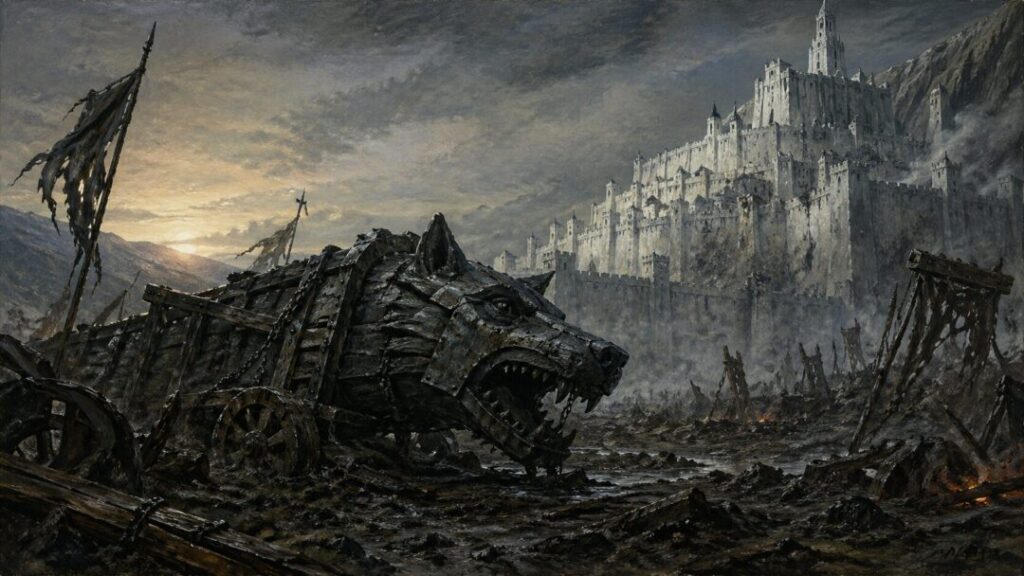
The Great Gate of Minas Tirith, which no enemy had ever passed, falls in ruin. The Witch-king rides beneath the archway. Gandalf stands alone before him. The city seems to hang on the edge of disaster.
And then the horns of Rohan sound.
After that, Grond disappears.
There is no farewell to it. No mention of its wreckage. No scene in which the Men of Gondor destroy it, melt it down, bury it, or drag it away. The story tells us what happened to the battle. It tells us what happened to the Witch-king. It tells us what happened to the Gate.
But Grond itself is left behind in silence.
So what happened to it after the War of the Ring?
The strict answer is simple:
The text never says.
But that does not mean the question is empty.
In fact, the silence around Grond may be exactly what makes its ending so fitting.
Grond Was Not Just a Battering Ram
Grond was a weapon of siege, but the story treats it with unusual weight.
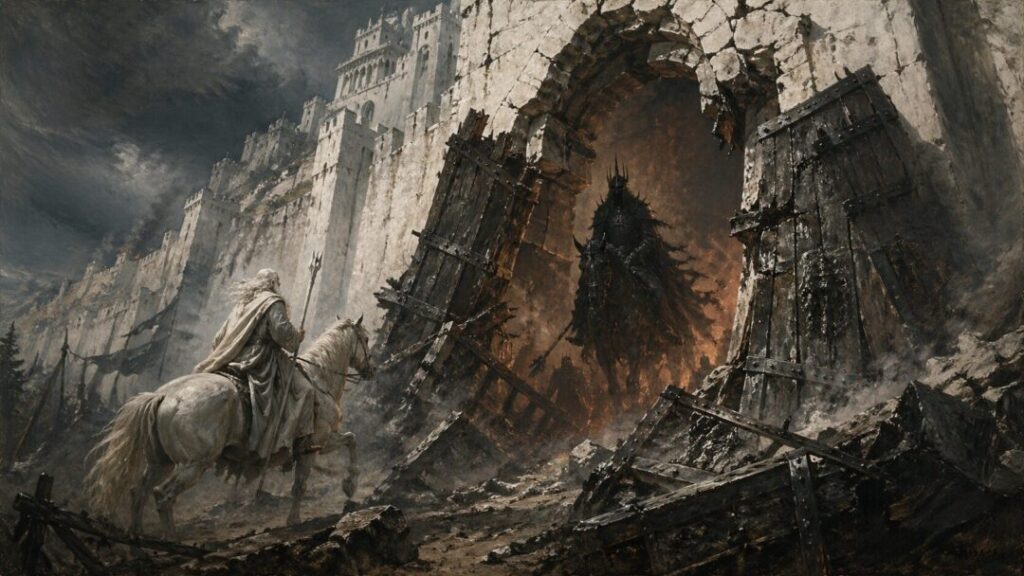
It was enormous, described as a great ram, a hundred feet in length, with a head of black steel shaped like a ravening wolf. It was protected from attack above, hung on chains, drawn by great beasts, and worked by mountain-trolls.
Nothing about it feels accidental.
This was not some crude log hauled from a nearby forest. It was a deliberate weapon of Mordor, made for one purpose: to break the strongest visible symbol of Minas Tirith’s defense.
The Great Gate mattered because it was the city’s face toward the enemy. Minas Tirith had many walls, rising in circles up the mountain-spur, but the Gate was the place where Mordor’s challenge became direct. If the Gate stood, the city still seemed unconquered. If it fell, the enemy could claim that the unbroken city had finally been breached.
That is why Grond matters.
It was not merely built to open a path.
It was built to make the defenders believe the end had come.
The Name Was Part of the Terror
The name Grond was not invented for the siege of Minas Tirith.
In the older legends of Middle-earth, Grond was the name of the Hammer of the Underworld, the great weapon of Morgoth. By giving the battering ram that same name, Mordor wrapped its siege engine in a memory of ancient evil.
This does not mean the ram was Morgoth’s hammer. It was not. It was a later weapon, made for the War of the Ring.
But the name matters.
Sauron’s war against Gondor was not only military. It was psychological. The Darkness over Gondor, the Nazgûl in the air, the despair spreading through Minas Tirith, and the chants of “Grond” before the Gate all belong to the same strategy.
The enemy wants the city to feel that resistance is useless.
Grond is therefore both weapon and message.
Its message is this:
The old darkness has returned, and it can break whatever stands before it.
For one moment, that message seems true.
The Gate Falls — But the Victory Does Not Follow
Grond strikes the Great Gate, and the Gate breaks.
This is one of the most dramatic moments in the siege. The doors burst apart, and the Witch-king enters the archway where no enemy had passed before. He comes in triumph, crowned with fear, facing Gandalf on Shadowfax.
If the story had turned only on force, this would have been the hour of Mordor.
But it does not.
The Witch-king does not conquer Minas Tirith. The confrontation at the Gate is interrupted by the horns of the Rohirrim. The battle changes shape. Rohan enters the field. The Witch-king turns away. Before the day is over, he is destroyed by Éowyn and Merry, and the armies of Mordor are overthrown on the Pelennor.
This is the key to understanding Grond’s disappearance.
Grond succeeds at its immediate task.
It breaks the Gate.
But it fails at its deeper purpose.
It does not deliver Minas Tirith into Sauron’s hands. It does not end the kingdom of Gondor. It does not open the way to final victory. It creates a terrifying breach, but the breach does not become conquest.
That makes Grond a symbol of Mordor’s power at its most deceptive.
It can break.
It can terrify.
It can wound.
But it cannot guarantee dominion.
What the Text Actually Says Afterward
After the Battle of the Pelennor Fields, the story turns away from Grond.
This matters. If Grond had been preserved, repurposed, displayed, or given some ceremonial destruction, we would expect some mention of it. The narrative is not uninterested in the aftermath of war. It tells us of the dead, the wounded, the Houses of Healing, the debate of the captains, the march to the Black Gate, and eventually the restoration of Minas Tirith.
But Grond is not mentioned again.
The Great Gate, however, is.
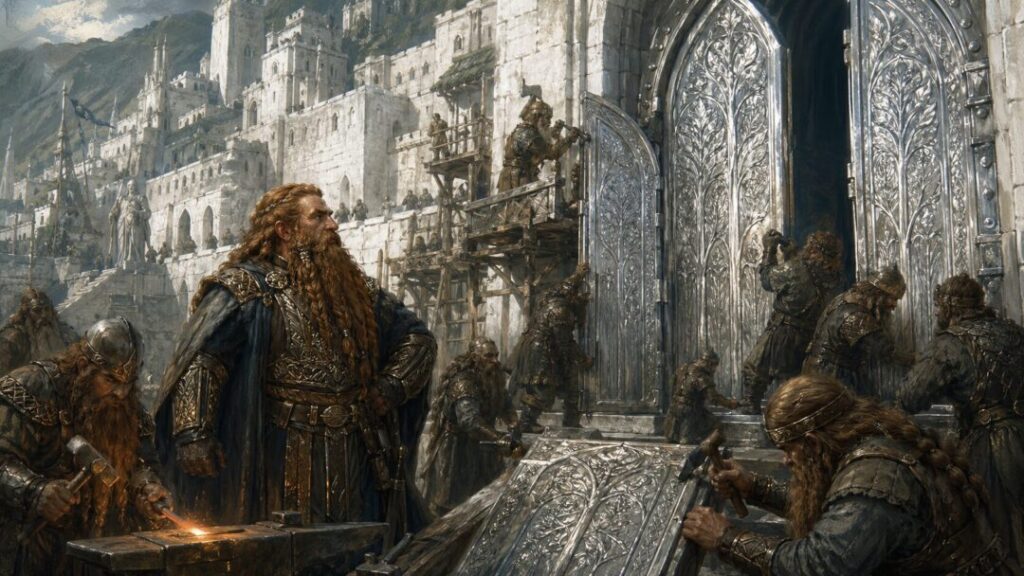
After the fall of Sauron and the beginning of Aragorn’s reign, Minas Tirith is renewed. The city is made more beautiful than before. Gimli, with Dwarves from the Glittering Caves, helps rebuild the Gate, and the new Gate is made of mithril and steel.
That is the canonically stated aftermath of Grond’s great blow.
The wound is repaired.
The weapon is not remembered.
This contrast is important. The story preserves the healing, not the instrument of harm.
Was Grond Destroyed?
Since the text never tells us directly, we cannot state with certainty what happened to Grond.
But we can speak carefully.
The most likely interpretation is that Grond was destroyed, dismantled, burned, or otherwise cleared away after the battle. A massive siege engine lying before the broken Gate of Minas Tirith would have had no future use for the restored kingdom. It was too large to ignore, too tainted in meaning to preserve, and too closely tied to Mordor’s assault to become a trophy of honor.
But that remains interpretation.
The text does not say, “They burned Grond.”
It does not say, “They broke it apart.”
It does not say, “It was left to rot on the Pelennor.”
Any exact answer would go beyond what is written.
What we can say is that Grond vanishes from the recorded story because its role is complete. It belonged to the siege, and once the siege failed, the weapon no longer mattered.
That is a very Middle-earth kind of ending.
Evil often makes a tremendous noise while it is rising. But after its fall, its instruments are reduced to wreckage, memory, and ash.
Why It Was Probably Not Kept as a Trophy
In another kind of story, Grond might have been displayed.
The people of Gondor might have dragged it into a square, mounted its wolf-head on a wall, or kept its iron as a reminder of victory.
But that does not fit the moral pattern of this story.
Gondor does not need Grond in order to remember the siege. The broken Gate already testifies to what happened. The dead on the Pelennor testify more deeply still. The Houses of Healing, the funeral of Théoden, the passing of Denethor, and the scars left on the city all carry the memory of that day.
Grond would not have been a noble relic.
It was an engine of terror.
Its name recalled Morgoth. Its shape evoked a wolf. Its purpose was to break the city and magnify fear. Keeping it would have meant preserving a symbol Mordor had designed for domination.
The restored kingdom under Aragorn is not built by staring forever at the tools of Sauron.
It is built by renewing what Sauron tried to destroy.
That is why the new Gate matters more than the old ram.
The Real Answer Is the New Gate
The most important thing that happened after Grond is not what happened to Grond.
It is what happened to the Gate.
The Gate that Grond broke was replaced. Not merely repaired in some temporary way, but remade with extraordinary craft. Gimli and the Dwarves of the Glittering Caves forged new gates of mithril and steel.
This is a quiet but powerful reversal.
Mordor sends a wolf-headed ram of black steel against Minas Tirith. After Mordor falls, the Free Peoples answer not with another weapon, but with craftsmanship.
Dwarves rebuild what Mordor broke.
The ruined entrance becomes stronger and more beautiful than before.
That is the deeper victory.
Grond can shatter iron and steel. It can burst the old doors apart. But it cannot prevent the world after Sauron from being remade.
The new Gate is the answer to the old ram.
Not vengeance.
Not display.
Not fear.
Restoration.
Grond’s Silence Is Its Defeat
There is something fitting about the fact that Grond receives no final scene.
During the siege, its name is shouted over and over. “Grond” becomes a chant of terror. The weapon arrives surrounded by noise, flame, fear, and expectation.
Then the battle turns.
By the end, the noise belongs to others: the horns of Rohan, the cry of the Rohirrim, the banners of Aragorn’s ships, the voices of the living after the Shadow passes.
Grond’s name is not chanted again.
That silence is not an oversight. At least, it does not feel like one.
It feels like judgment.
Grond was made to make despair seem inevitable. Once hope returns, the weapon has nothing left to say.
Its entire identity depended on the belief that Mordor could not be withstood. The moment that belief fails, Grond becomes only a ruined engine outside a city it did not conquer.
So What Happened to Grond?
The canon does not give a direct answer.
The safest conclusion is this:
Grond was left on the battlefield after the Battle of the Pelennor Fields and was almost certainly removed, dismantled, or destroyed during the clearing and restoration that followed. But the exact method is never recorded.
What is recorded is more meaningful.
The Gate was broken.
The city survived.
The Witch-king fell.
Sauron was overthrown.
And the Gate was remade.
Grond’s fate is not important because Grond was never meant to have a future. It was a weapon of one terrible hour, built to turn fear into certainty.
But that certainty failed.
The ram named after Morgoth’s hammer broke the doors of Minas Tirith, but it did not break Gondor. It did not break Gandalf. It did not stop Rohan. It did not prevent Aragorn’s return. It did not survive into the new age as anything worthy of memory.
In the end, Grond’s greatest blow became only the beginning of its defeat.
The weapon vanished.
The city endured.
Sources & Notes
- J.R.R. Tolkien, The Lord of the Rings, Book V, Chapter 4, “The Siege of Gondor” — introduces Grond as a hundred-foot ram with a wolf-shaped head of black steel, drawn by beasts and worked by mountain-trolls.
- J.R.R. Tolkien, The Lord of the Rings, Book V, Chapter 4, “The Siege of Gondor” — names the ram after Morgoth’s Hammer of the Underworld and shows its blows breaking the Great Gate of Minas Tirith.
- J.R.R. Tolkien, The Lord of the Rings, Book V, Chapter 4, “The Siege of Gondor” — has the Witch-king pass under the ruined arch before Gandalf, only for the horns of Rohan to interrupt the moment of apparent triumph.
- J.R.R. Tolkien, The Lord of the Rings, Book V, Chapter 6, “The Battle of the Pelennor Fields” — follows the battle after the Gate is broken, including the Witch-king’s fall and the overthrow of Mordor’s forces on the field.
- J.R.R. Tolkien, The Silmarillion, “Of the Ruin of Beleriand and the Fall of Fingolfin” — gives the older meaning of Grond as Morgoth’s great hammer, the “Hammer of the Underworld.”
- J.R.R. Tolkien, The Lord of the Rings, Appendix A, “Durin’s Folk” — records that Gimli and Dwarves from the Glittering Caves later made new gates of mithril and steel for Minas Tirith.