
Near the end of The Lord of the Rings, after the great battles are over and the Shadow has fallen, there is a quiet scene that many readers pass over too quickly.
The company is on the long road home. The hobbits sleep. The world has been saved, but the older powers of Middle-earth have not yet departed. Gandalf, Elrond, Galadriel, and Celeborn sit together beneath the stars.
And then the text tells us something remarkable.
They do not speak with their mouths.
They look “from mind to mind,” and their thoughts pass silently between them.
It is a brief moment. It is not explained. No one stops the story to define what is happening. There is no spell, no ritual, no dramatic display of power.
And yet the implication is clear.
Some of the greatest beings left in Middle-earth are communicating without ordinary speech.
At first, this seems like telepathy. But in Middle-earth, that word can be misleading. This is not a simple fantasy power where one character reads another’s thoughts at will. It is older, stranger, and much more morally controlled than that.
To understand what is happening, we have to look at the way thought, will, and openness work in the deeper lore.
Because Gandalf, Elrond, and Galadriel were not simply “mind-reading.”
They were doing something far more intimate.

The Silent Conversation After the War
The clearest example comes in The Return of the King, in the chapter “Many Partings.”
The War of the Ring has ended. The Fellowship is separating. The great figures of the age are beginning to withdraw from the center of the story. Aragorn remains in his restored kingdom. The hobbits are moving back toward the Shire. The Elves are drawing closer to departure.
In this atmosphere of endings, Gandalf, Elrond, Galadriel, and Celeborn sit together.
The hobbits, wrapped in sleep, do not hear any conversation. But the narrator reveals that the Wise are not silent in the ordinary sense. They are sharing thought directly.
This matters because it is not presented as a new ability suddenly appearing at the end of the story. It is presented almost casually, as though this kind of communication belongs naturally to beings of their stature.
That restraint is important.
The scene is not written to make us think, “Here is a new magical power.”
It is written to make us feel that these beings belong to a deeper layer of reality than the hobbits can fully perceive.
Frodo, Sam, Merry, and Pippin have carried the heart of the story. They have shown courage, pity, endurance, and loyalty. But Gandalf, Elrond, and Galadriel come from older orders of existence. Their lives and memories reach far beyond the ordinary scale of Hobbit experience.
So when they sit beneath the stars and speak without words, the moment feels less like a trick and more like a glimpse behind the veil.
Middle-earth Has a Lore for Thought-Speech
The deeper idea behind this is often called ósanwë, a Quenya term usually understood as thought-communication.
In the wider lore, minds are not sealed off from one another by nature. Thought can, under certain conditions, pass between minds. But this does not mean that everyone can casually invade everyone else’s inner life.
That distinction is crucial.
The lore treats the mind as something that can be open or closed. A person’s will matters. A closed mind cannot simply be broken open by another will as though it were a locked door waiting for enough force.
This is one of the most important limits on thought-communication in Middle-earth.
It is not domination by default.
True communication of thought depends on openness, relationship, and consent. It is easier between minds that are in harmony, trust, kinship, urgency, or authority. It is far harder where there is resistance, suspicion, fear, or moral opposition.
That is why the silent exchange between Gandalf, Elrond, and Galadriel feels so natural. These are not strangers. They are allies of long standing. They are bearers of deep wisdom. They have worked against Sauron for ages. They are united in purpose, and at this point in the story, the great burden has passed.
Their minds are not being forced.
They are open to one another.
Why This Was Not Ordinary Mind-Reading
Modern readers often imagine telepathy as the ability to hear another person’s private thoughts whenever one wishes.
Middle-earth does not treat it that way.
There is a moral boundary around the mind. To perceive, receive, or send thought is not the same as stealing secrets. The difference between communion and domination is one of the deepest moral lines in the story.
Sauron seeks to dominate.
The Wise seek to understand, guide, and preserve.
That difference matters.
Sauron’s whole mode of power is possessive. He searches, probes, commands, deceives, and tries to bend others to his will. The One Ring itself is the great instrument of this desire: a device made for mastery over other wills.
So when we see thought or perception connected to Sauron, it often carries danger. His Eye searches. His will presses outward. He gropes after what he cannot fully seize.
But when Gandalf, Elrond, and Galadriel share thought, the tone is completely different.
There is no violence in the scene. No fear. No sense that one mind is overpowering another.
Instead, the image is calm and luminous: shining eyes under the stars, thoughts moving silently between ancient friends.
That is not the language of invasion.
It is the language of communion.
Galadriel and the Closed Door
Galadriel gives us one of the clearest examples of how this kind of mental perception works.
In Lothlórien, she tells Frodo that she perceives the Dark Lord and knows his mind, or at least the part of his mind that concerns the Elves. But she also says that he gropes to see her thought, and that the door remains closed.
This is one of the most revealing statements in the whole story.
Galadriel is not saying that she knows everything Sauron thinks. She does not claim omniscience. Her wording is careful. She perceives what concerns the Elves.
At the same time, Sauron is trying to reach her thought.
But he cannot simply enter.
The door is closed.
That image tells us almost everything we need to know. Thought can be directed. Thought can be sought. Strong minds can perceive one another across great spiritual distance. But the inner self is not helpless before power.
Galadriel can resist.
Her mind is not an open field for Sauron to trample.
This also explains why the silent exchange among the Wise is so different. They are not groping against closed doors. They are not trying to conquer one another’s minds. They are opening thought in trust.

Gandalf at Amon Hen
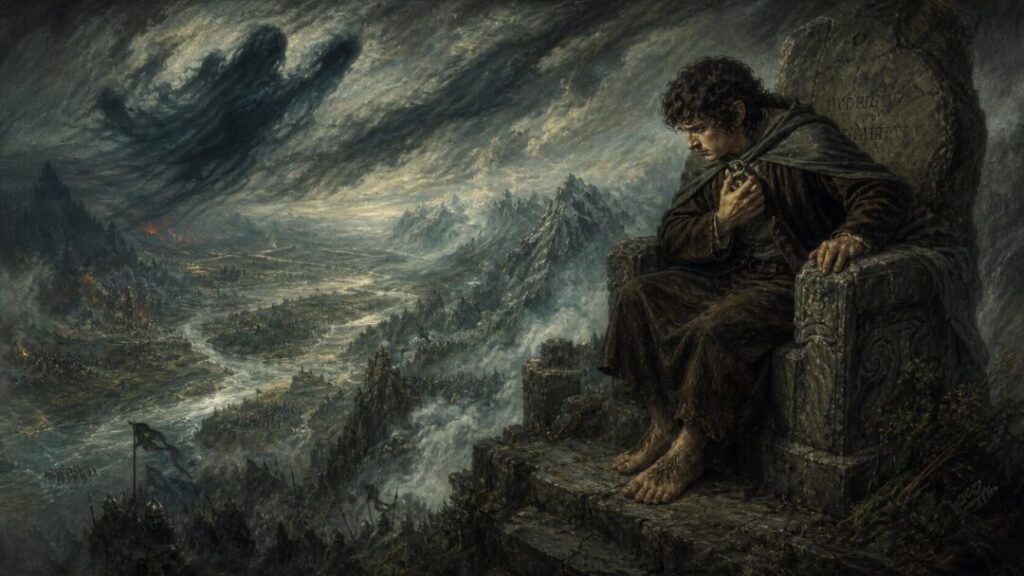
Another important moment happens at Amon Hen, when Frodo sits upon the Seat of Seeing.
From that high place, Frodo’s vision is extended. He sees far-off lands and armies. He becomes aware of the Eye seeking him. The Ring draws him toward exposure.
Then, in the crisis, he hears or perceives another command: “Take it off!”
The text does not present this as an ordinary spoken voice. It is part of a spiritual contest around Frodo’s will. Sauron seeks him. Another power urges him to remove the Ring before he is found.
Later, Gandalf indicates that he had been striving with the Dark Tower from afar. The implication is that Gandalf was involved in that moment of inner struggle.
Again, this is not simple mind-reading.
It is not Gandalf browsing Frodo’s thoughts like a book.
It is a moment of urgent spiritual communication, occurring when Frodo is in extreme danger and when the power of the Ring has drawn him into a perilous state of perception.
The situation is exceptional.
That is important because it keeps the lore grounded. Gandalf does not constantly speak into people’s minds whenever it would be convenient. He does not use thought-communication as an easy solution to every problem.
Middle-earth rarely works that way.
Power has limits. Wisdom has limits. Even the Wise must act within boundaries.
Why Elrond and Galadriel Could Do This
Elrond and Galadriel are not ordinary Elves.
Elrond is the lord of Rivendell, descended from both Elves and Men, and tied by ancestry to some of the greatest histories of the Elder Days. He is a keeper of memory, counsel, and healing. By the end of the Third Age, he is one of the greatest remaining figures of Elvendom in Middle-earth.
Galadriel is even older. She comes from the West, remembers the Elder Days, and possesses a depth of wisdom and power that few in Middle-earth can rival. She also bears Nenya, one of the Three Rings of the Elves, though the Three were not made for domination.
Neither Elrond nor Galadriel is described as using thought-communication casually in daily life. But both belong to a level of spiritual perception far beyond ordinary mortals.
Gandalf, meanwhile, is not merely an old man with a staff.
He is one of the Istari, a messenger sent to oppose Sauron. His power is veiled in the form of an old man, but his nature is higher than it appears. He is not free to dominate the peoples of Middle-earth by force, but his wisdom and spiritual authority are immense.
So when Gandalf, Elrond, and Galadriel communicate silently, it is not surprising that they can do so.
What is surprising is that the story lets us see it at all.
Why They Still Usually Spoke Aloud
If the Wise could communicate by thought, why did they ever bother speaking?
Because thought-communication was not a replacement for language.
Speech still matters deeply in Middle-earth. Words can counsel, heal, command, promise, deceive, bless, and bind. Public speech also includes others. It allows everyone present to hear, respond, and take part.
The Council of Elrond, for example, could not have been conducted silently between Elrond and Gandalf. Its purpose was not merely to exchange information. It was to bring many people into shared understanding: Elves, Men, Dwarves, Hobbits, and a wizard.
Likewise, Gandalf’s words to Frodo matter because Frodo must hear them as a person making choices. Galadriel’s words to the Fellowship matter because they test, reveal, and strengthen each member in turn.
Silent thought may be profound, but it is not always better.
Sometimes words are needed because the moment belongs not only to the Wise, but to everyone.
This is why the silent conversation comes near the end. The great decisions have already been made. The Ring has been destroyed. The public struggle is over. What remains between Gandalf, Elrond, Galadriel, and Celeborn is something quieter: memory, grief, relief, and perhaps the knowledge that their time in Middle-earth is ending.
Words may not be enough for that.
The Three Rings and the Question of Connection
There is another layer worth considering carefully.
Gandalf, Elrond, and Galadriel are the bearers of the Three Elven Rings at the end of the Third Age. Gandalf bears Narya, Elrond bears Vilya, and Galadriel bears Nenya.
The Three were made by Celebrimbor and were not made by Sauron, though they were still subject to the One Ring while it existed. Their purpose was not conquest. They were associated with preservation, healing, resistance to decay, and the sustaining of places like Rivendell and Lothlórien.
Does this mean the Three Rings caused their silent communication?
The text does not explicitly say so.
That is important.
It is tempting to imagine the Three as forming some kind of private mental network between their bearers. But the story never states that. We should not present it as fact.
What we can say is more careful: the bearers of the Three were among the greatest and most perceptive minds in Middle-earth, and the Rings were bound up with their long work of preservation and resistance. Their shared burden may deepen the meaning of the scene, but the ability to communicate thought should not be reduced to the Rings alone.
The silence beneath the stars is not merely a Ring-powered message.
It is the meeting of minds that have carried the same age-long struggle.
What They Might Have Been Saying
The text never tells us exactly what thoughts passed between them.
That silence is deliberate.
We can speculate, but we should keep speculation in its proper place.
Perhaps they spoke of Sauron’s fall and the end of the Third Age. Perhaps they shared grief for what had been lost. Perhaps they considered the fading of the Elves, the future of Men, and the departure that would soon come. Perhaps there were memories between them too old and too heavy for ordinary speech.
But none of that is stated directly.
What the story does give us is the mood.
This is not a council of war. It is not strategy. It is not secrecy for secrecy’s sake.
It is a scene of transition.
The Wise are together at the edge of an ending. Their long labor has succeeded, but that success also means the world they preserved is passing away. The Three Rings will lose their power. Rivendell and Lothlórien will no longer remain as they were. The Elves will diminish or depart. Gandalf’s mission in Middle-earth is nearly complete.
So the silent exchange feels like the last deep conversation of an age.
The hobbits sleep nearby, safe because of the victory they helped bring about.
The great ones keep watch beneath the stars.
And their thoughts go to and fro.
Why This Moment Matters
This small scene reveals something essential about Middle-earth.
Power is not only swords, armies, towers, and rings.
There is also the power of perception. The power of wisdom. The power of one mind meeting another without conquest.
Sauron’s tragedy is that he seeks to control the wills of others. He cannot imagine true communion because his desire is mastery. Even when he reaches outward in thought, he gropes and searches like a thief at a locked door.
The Wise stand in contrast to that.
Gandalf, Elrond, and Galadriel are powerful, but their highest moments are often marked by restraint. They do not seize the Ring. They do not rule through fear. They do not force the peoples of Middle-earth into obedience.
And when they speak mind to mind, the act is not domination.
It is trust.
That is why the moment is so beautiful.
The same world that contains the Eye of Sauron also contains this: ancient friends sitting together under the stars, sharing thought without speech, without violence, without possession.
Not because words are useless.
But because some things are too deep for words.
The Quiet Answer
So how could Gandalf, Elrond, and Galadriel communicate telepathically?
Because Middle-earth allows for the communication of thought between minds, especially among beings of great spiritual strength, trust, and openness.
But it was not casual mind-reading.
It was not a spell in the ordinary sense.
It was not an invasion.
It was a form of silent communion between some of the greatest remaining powers of the Third Age.
The scene is easy to miss because it is so quiet. But that quietness is the point. Middle-earth often reveals its deepest mysteries not in spectacle, but in passing lines that feel almost too ancient to explain.
The hobbits sleep.
The stars shine.
The mouths of the Wise do not move.
And for one brief moment, we glimpse what speech looks like among those who are already beginning to leave the world behind.
Sources & Notes
- J.R.R. Tolkien, The Lord of the Rings, Book VI, Chapter 6, “Many Partings” — the Wise sit together after the war and their thoughts pass silently from mind to mind.
- J.R.R. Tolkien, The Lord of the Rings, Book II, Chapter 7, “The Mirror of Galadriel” — Galadriel says she perceives Sauron’s mind where it concerns the Elves, while her own thought remains closed to him.
- J.R.R. Tolkien, The Lord of the Rings, Book II, Chapter 10, “The Breaking of the Fellowship,” and Book III, Chapter 5, “The White Rider” — Frodo’s Amon Hen crisis and Gandalf’s later account of striving with Sauron from afar.
- J.R.R. Tolkien, “Ósanwe-kenta,” in Vinyar Tengwar 39 — Tolkien’s late essay on thought-communication, openness of mind, will, and the moral limits on mental intrusion.
- J.R.R. Tolkien, The Silmarillion, “Of the Rings of Power and the Third Age” — background on the Three Rings, their keepers, and their non-dominating purpose of preservation and resistance.