It is one of the most debated moments in the film version of The Return of the King.
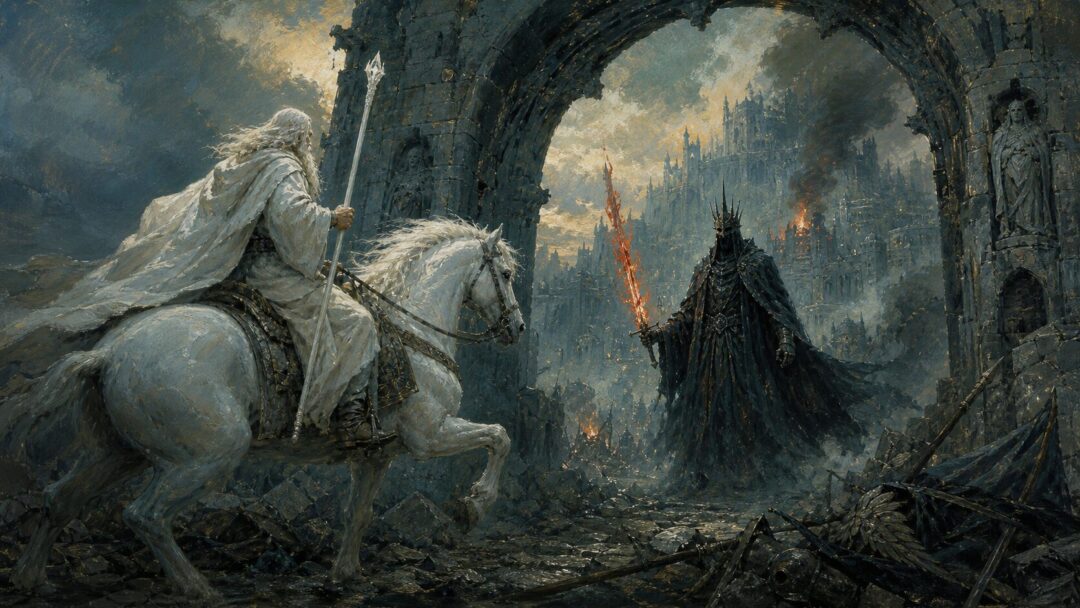
Minas Tirith is burning. The armies of Mordor have broken into the city. Gandalf rides through the ruin, trying to hold together the last defence of Gondor. Then the Witch-king appears above him on a fell beast.
The Lord of the Nazgûl draws a flaming sword.
Gandalf raises his staff.
And the staff shatters.
For many viewers, the meaning seems obvious. The Witch-king has overpowered Gandalf. The Black Captain has proven himself stronger than the White Wizard. The moment feels like the answer to a question the story has been building toward since the Nazgûl first appeared in the Shire.
But there is one problem.
That scene is not in the book.
And once that is understood, the real question becomes far more interesting.
Not “how did the Witch-king break Gandalf’s staff?”
But why does the book avoid letting that happen at all?
The Staff Does Not Break in the Text
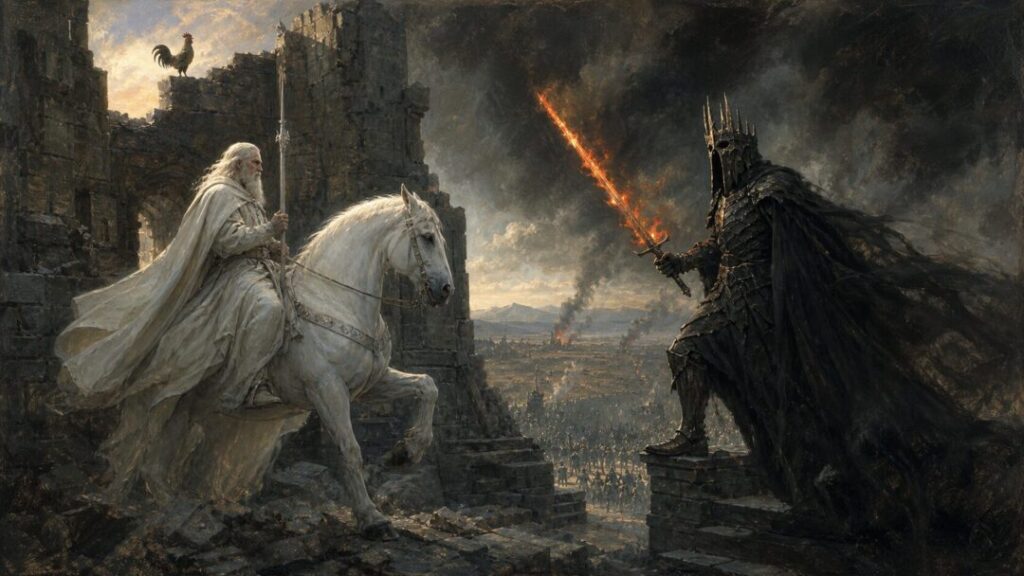
In the written account, the confrontation takes place at the broken Gate of Minas Tirith.
The Witch-king has just entered the city after Grond, the great battering ram, shatters the Gate. He is no longer merely a distant terror in the sky. He has become the first enemy to pass under that arch.
The defenders flee.
All except Gandalf.
Gandalf remains before him on Shadowfax, silent and still. This detail matters. Shadowfax, unlike other horses, endures the terror of the Lord of the Nazgûl. Gandalf does not panic, retreat, or visibly lose command of himself.
He confronts the Witch-king directly.
The Witch-king threatens him. His crown is visible, though no living head is seen beneath it. His sword burns with flame. The moment is terrifying, and the text clearly presents him as a figure of immense supernatural dread.
But he does not break Gandalf’s staff.
He does not strike Gandalf down.
He does not defeat him.
The confrontation is interrupted before any direct battle begins.
A rooster crows somewhere in the city. Then the horns of Rohan are heard in the distance. The Witch-king turns away from Gandalf and rides out to meet the new threat on the Pelennor Fields.
That is the book’s version.
A challenge.
A threat.
A moment suspended on the edge of disaster.
And then no duel.
The Movie Gives a Visual Answer
The film changes this by giving the scene a visible result.
The Witch-king raises his power, Gandalf’s staff breaks, and Gandalf is left visibly diminished. The scene communicates instantly what a long explanation would not: Mordor is at its strongest, hope is nearly gone, and even Gandalf appears vulnerable.
As a piece of film language, the choice is easy to understand.
A staff is a clear symbol. Gandalf carries one. Saruman carries one. Wizards are visually associated with them. If a staff breaks, the audience immediately feels that something has been taken away.
The film uses the staff as a shorthand for spiritual or magical authority.
But that is not exactly how the book treats the matter.
In the text, a wizard’s staff can be important. Gandalf uses a staff in moments of light, fire, command, and confrontation. He breaks Saruman’s staff at Orthanc, and that act clearly marks Saruman’s fall from authority. Earlier, in Moria, Gandalf’s staff is broken in the struggle at the Bridge of Khazad-dûm.
So staffs do matter.
But the books never reduce a wizard’s being or power to the staff alone.
Gandalf is not powerful because he owns a stick. The staff is a sign, an instrument, and sometimes a focus of action. It is not presented as the source of his nature.
That difference is crucial.
Because if the Witch-king breaks Gandalf’s staff in the film, it looks like a magical victory.
In the book, no such victory is granted.
The Witch-king Was Terrible at Minas Tirith
None of this means the Witch-king was weak.
That would be the opposite mistake.
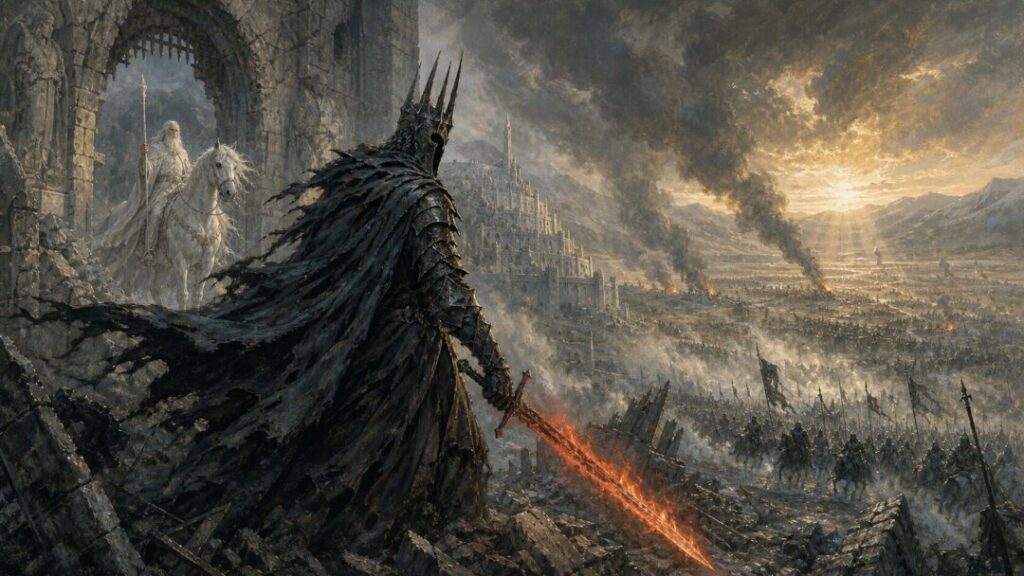
At the Siege of Gondor, the Lord of the Nazgûl is shown at the height of his terror. He commands Sauron’s assault. He rides with the armies from Minas Morgul. He brings despair with him. He is not merely a warrior but a weapon of fear.
The text also supports the idea that he is more terrible here than he was earlier in the story.
He is the chief of the Nine, and during the assault on Gondor he acts as Sauron’s captain. In one important explanation outside the main narrative, he is described as having been given an added demonic force for this role. That does not mean he becomes equal to Sauron. It does not give us a simple power level. But it does mean the Witch-king at Minas Tirith is not merely the same figure who fled the flood at the Ford of Bruinen.
He is empowered for the hour of Mordor’s greatest attack.
This helps explain why the scene feels so dangerous.
Gandalf is not facing an ordinary servant. He is facing the Black Captain at the peak of his mission, clothed in fear, command, and the momentum of Sauron’s war.
Yet the book still does not show him defeating Gandalf.
That silence is deliberate.
Gandalf the White Is Not Gandalf the Grey
The other half of the confrontation is Gandalf himself.
By this point, he is no longer Gandalf the Grey. He has passed through death and returned as Gandalf the White. He is not simply healed or promoted in a political sense. He has come back with greater authority to complete the task for which he was sent.
This is why the staff-breaking scene feels so jarring to many readers of the book.
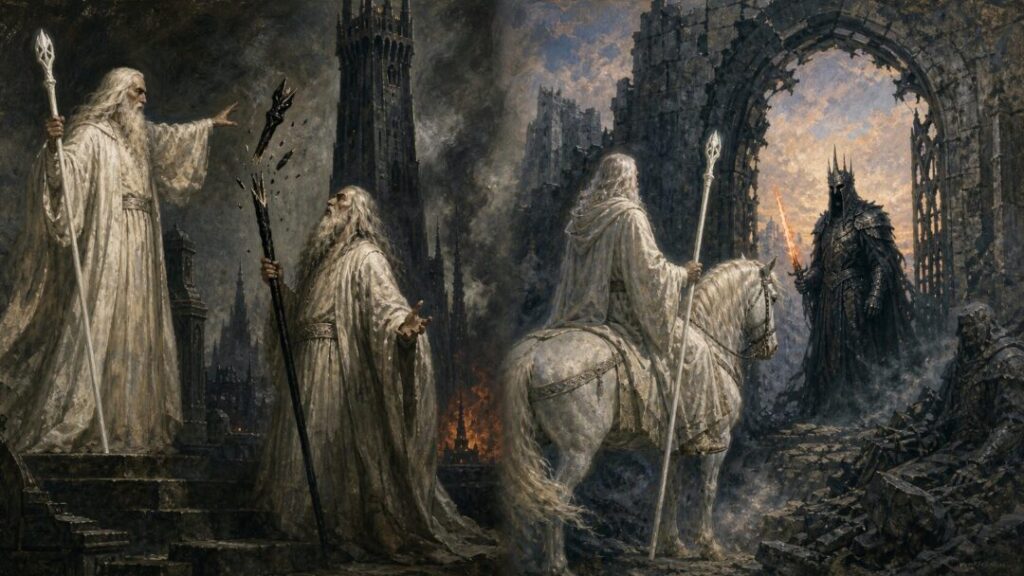
Gandalf the White is not presented as fragile in the same way Gandalf the Grey often was. He is sterner, clearer, and more unveiled. When he confronts Saruman, he does not win by throwing fire or calling lightning. He wins by authority. He commands. Saruman’s voice fails to master him. Saruman’s staff is broken.
So when the film has the Witch-king break Gandalf’s staff, it reverses a very specific symbolic pattern.
In the book, Gandalf breaks the staff of a fallen wizard.
In the film, the Witch-king breaks Gandalf’s staff.
That is a powerful image, but it is not the same meaning.
The book never says the Witch-king has authority over Gandalf. It never shows Gandalf stripped of office or power. It never presents the Lord of the Nazgûl as capable of unmaking what Gandalf has become.
Instead, the book places them face to face—and refuses to resolve the question through combat.
Would the Witch-king Have Defeated Gandalf?
This is where the debate usually begins.
Could the Witch-king have beaten Gandalf?
The honest answer is that the text does not say.
It gives us reasons to fear the Witch-king. It gives us reasons to trust Gandalf. It builds the confrontation until it feels almost unbearable. But it does not show the fight.
That means any confident answer goes beyond what is directly stated.
There are interpretations, of course.
One interpretation is that Gandalf would have withstood him, because Gandalf the White carries a higher authority and because the Witch-king’s terror is most effective against those who are overcome by fear.
Another interpretation is that the Witch-king, empowered by Sauron for this battle and standing at the head of Mordor’s assault, might have been a deadly threat even to Gandalf.
Both readings try to account for real details in the text.
But the book itself never gives us the duel.
And that may be the point.
The scene is not written like a tournament bracket. It is not asking us to rank powers in a clean order. Middle-earth rarely works that way. Victory often turns on courage, mercy, timing, providence, pity, hidden weakness, and choices made by the small.
The Witch-king is not destroyed by Gandalf.
He is destroyed later by Éowyn and Merry.
That matters.
The Prophecy Was Not a Power Ranking
The Witch-king’s end is surrounded by one of the most famous lines in the story.
Long before the Pelennor Fields, Glorfindel foretold that the Witch-king would not fall by the hand of man. Later, on the battlefield, the Witch-king himself declares that no living man may hinder him.
But this should not be treated as simple invincibility.
The prophecy does not say he cannot be harmed by anyone except a woman and a hobbit. It does not create a rule like a locked door. It points toward the strange shape of his doom.
He falls because Merry strikes him with a blade from the Barrow-downs, a blade with a history tied to the wars against Angmar. Then Éowyn, who is no man, finishes him.
The great terror of the North does not fall in the grand duel he expects.
He falls through courage he dismisses.
That is why having him decisively defeat Gandalf can feel out of step with the book’s moral pattern. The Witch-king is not overcome by someone proving to be a bigger magical force. He is overcome by those he does not properly see.
A shieldmaiden.
A hobbit.
A forgotten blade.
A moment of courage in the wreckage of battle.
Why the Book’s Version Is More Unsettling
The film gives the audience a dramatic blow.
The book gives the audience uncertainty.
And uncertainty can be more powerful.
At the Gate, Gandalf stands as the last barrier. Behind him is the city. Before him is the Lord of the Nazgûl. The Gate has fallen. Denethor is lost in despair. Faramir lies near death. Rohan has not yet arrived.
For one breath, it seems as if the fate of Minas Tirith may rest on Gandalf alone.
Then the rooster crows.
This is one of the most striking details in the entire siege. It is not a trumpet of victory. It is not a spell. It is the sound of morning.
Then come the horns of Rohan.
The darkness is not broken because Gandalf wins a duel. It is broken because dawn arrives, and with it the help that seemed impossible.
That is a very different kind of hope.
The story does not say, “Gandalf was stronger.”
It says, “The night did not last.”
So How Did the Witch-king Break the Staff?
In the movie, the answer is simple: he breaks it because the adaptation chooses to give him that power in that scene.
Within the film’s own visual language, the moment shows the Witch-king temporarily overwhelming Gandalf’s visible authority. It heightens the despair before the arrival of Rohan. It makes the battlefield feel as if it has reached the edge of absolute defeat.
But in book-lore terms, the answer is different:
He did not.
There is no textual event where the Witch-king breaks Gandalf’s staff at Minas Tirith. There is no canonical explanation for the act because the act belongs to the film, not to the book.
A lore-accurate explanation must stop there.
We can say the film may be interpreting the Witch-king’s heightened power, his flaming sword, and his role as Sauron’s captain in a more visually aggressive way.
We can say it uses the staff as a symbol of Gandalf’s apparent defeat.
But we cannot say the books teach that the Witch-king had the authority to break Gandalf’s staff.
They do not.
The Deeper Meaning of the Unbroken Staff
The most important thing about the book scene is not that Gandalf wins.
It is that Gandalf remains.
He stands before the broken Gate when everyone else has fled. He does not destroy the Witch-king. He does not need to. His role in that moment is to withstand despair long enough for hope to arrive from another direction.
That is one of the deepest patterns in The Lord of the Rings.
No single hero carries the whole victory.
Gandalf holds the Gate.
Théoden brings the dawn charge.
Merry strikes from below.
Éowyn stands when she is told she cannot.
Aragorn comes by the river.
Frodo and Sam crawl through Mordor unseen.
The fall of Sauron is not achieved by one overwhelming act of power.
It is woven from many acts of endurance.
That is why the book does not need the Witch-king to break Gandalf’s staff.
And it does not need Gandalf to strike the Witch-king down.
The real drama is not a magical duel.
It is the question of whether anyone can hold fast when the darkness seems complete.
At the Gate of Minas Tirith, Gandalf does.
And then, from far away, the horns answer.
Sources & Notes
- J.R.R. Tolkien, The Lord of the Rings, Book V, Chapter 4, “The Siege of Gondor” — Gandalf faces the Lord of the Nazgûl at the broken Gate; the scene is interrupted by the cockcrow and the horns of Rohan, with no staff-breaking in the text.
- J.R.R. Tolkien, The Lord of the Rings, Book V, Chapter 6, “The Battle of the Pelennor Fields” — the Witch-king’s fall comes through Merry’s Barrow-blade and Éowyn’s defiance, not through a duel with Gandalf.
- J.R.R. Tolkien, The Lord of the Rings, Book III, Chapter 10, “The Voice of Saruman” — Gandalf breaks Saruman’s staff as a sign of Saruman’s loss of authority, useful context for why a broken staff carries symbolic weight.
- J.R.R. Tolkien, The Lord of the Rings, Appendix A, “Gondor and the Heirs of Anárion” — Glorfindel’s prophecy that the Witch-king would not fall by the hand of man frames his doom without making it a simple invincibility rule.
- J.R.R. Tolkien, The Letters of J.R.R. Tolkien, Letter 210 — Tolkien discusses the Lord of the Nazgûl at Minas Tirith and notes the heightened force behind him in that hour, while still not narrating a completed fight with Gandalf.