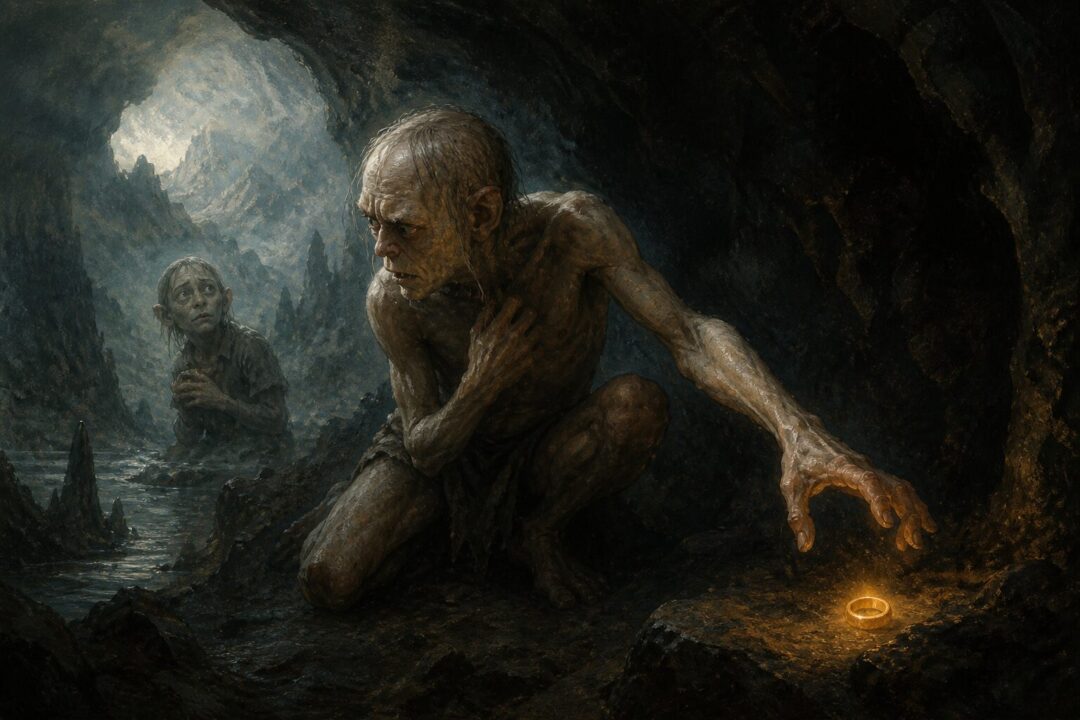
Gollum’s way of speaking is one of the most recognizable things about him.
He hisses. He mutters. He twists words into strange shapes. He speaks to himself as though someone else is always listening. And again and again, he uses one small word that seems simple until you look closer.
“We.”
Not “I want it.”
“We wants it.”
Not “I must have it.”
“We must have the precious.”
At first, this can sound like a strange habit, a piece of verbal oddity meant to make Gollum seem uncanny. But in Middle-earth, language often reveals what a character has become. Names matter. Speech matters. What a person calls something often tells us what that thing has done to the soul.
And Gollum’s “we” may be one of the clearest signs of how deeply the Ring has damaged him.
Not because the text gives one neat explanation.
It does not.
But because everything we are told about Gollum points in the same direction: he is no longer whole.
Gollum Was Not Always Gollum
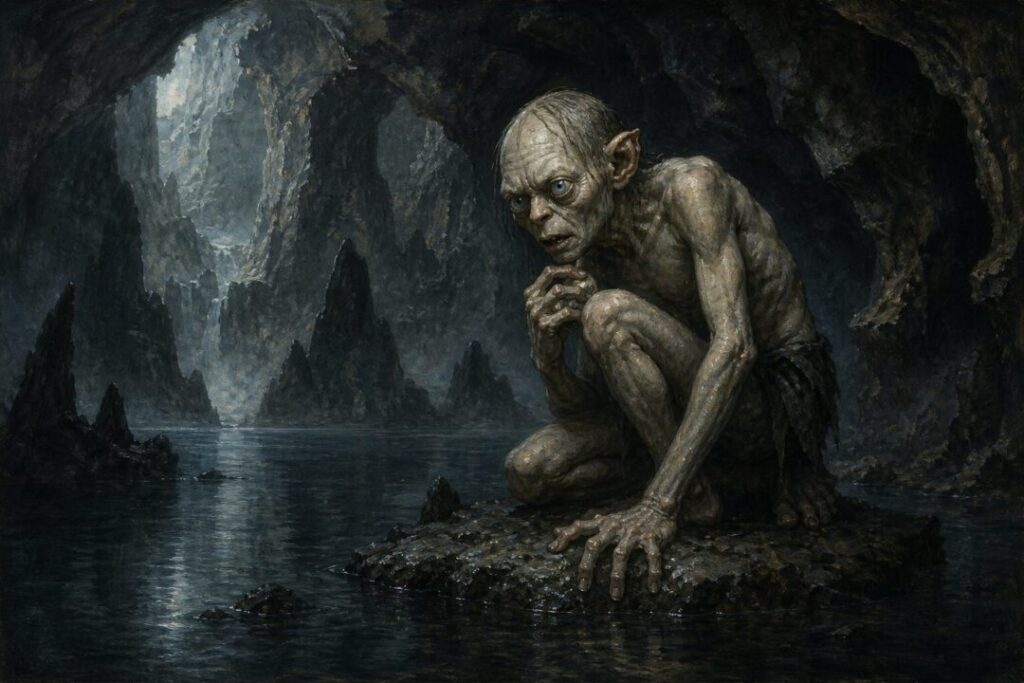
Before he was Gollum, he was Sméagol.
The story presents him as one of the Stoorish Hobbit-kind, connected with the River-folk near the Gladden Fields. He was not born as the cave-creature Bilbo later meets under the Misty Mountains. He had kin. He had a community. He had a name.
That matters.
Because Gollum is not a separate species. He is not some ancient goblin-creature from the deep places of the world. He is what remains of a Hobbit-like being after centuries of possession, exile, secrecy, and spiritual decay.
The fall begins with the Ring.
Déagol finds it in the river. Sméagol sees it and desires it. When Déagol refuses to give it to him, Sméagol kills him and takes it, calling it his birthday present.
From the beginning, then, the Ring enters Sméagol’s life through violence, secrecy, and self-deception. He does not simply find a treasure. He murders for it and then builds a lie around the murder.
That is the first fracture.
Long before he begins saying “we,” Sméagol has already divided himself from truth.
The Ring Became More Than a Possession
One of the most important details about Gollum is that he does not speak of the Ring like an ordinary object.
He calls it “my precious.”
This is not only greed. It is intimacy.
The word “precious” blurs the line between treasure, companion, and self. In The Hobbit, Gollum often uses “my precious” in a way that can feel directed both toward the Ring and toward himself. Later, in The Lord of the Rings, that ambiguity becomes even darker.
The Ring is something he owns.
But it is also something that owns him.
The texts are careful about this. The Ring does not turn Gollum into a puppet without will. He still chooses. He still schemes. He still fears, bargains, lies, remembers, and suffers. But his desire has been bent so completely around the Ring that his identity cannot be separated cleanly from it.
He loves it.
He hates it.
And he loves and hates himself in the same way.
That is why the word “precious” is so disturbing. It is not just a nickname for the Ring. It is a sign that Gollum’s sense of himself has become tangled with the thing that ruined him.
The Loneliness of the Deep Places
There is also a simpler, sadder layer to Gollum’s “we.”
He has been alone for a very long time.
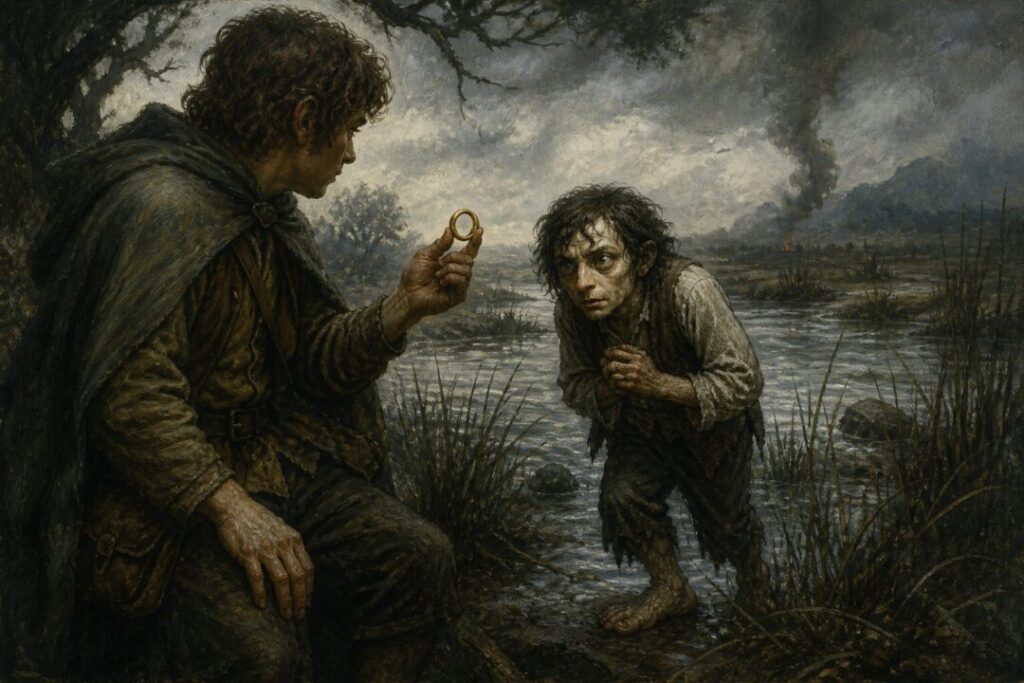
After being driven away from his people, Sméagol goes down into hidden places. Eventually he lives beneath the Misty Mountains, in darkness, beside a cold underground lake. By the time Bilbo meets him, Gollum’s world has shrunk almost entirely to fish, stone, darkness, memory, and the Ring.
A creature alone that long may speak to itself.
The story shows Gollum muttering, arguing, answering himself, and thinking aloud. His speech feels like a conversation because conversation is something he has almost lost. There is no household around him. No family. No friend. No ordinary voice to correct him, comfort him, or call him by his true name.
So “we” may partly come from isolation.
But isolation alone does not explain why his speech feels so split.
A lonely person might say “I.”
Gollum says “we” because he has become his own company—and because that company is not peaceful.
Sméagol and Gollum
By the time Frodo and Sam encounter him, the division inside Gollum becomes impossible to miss.
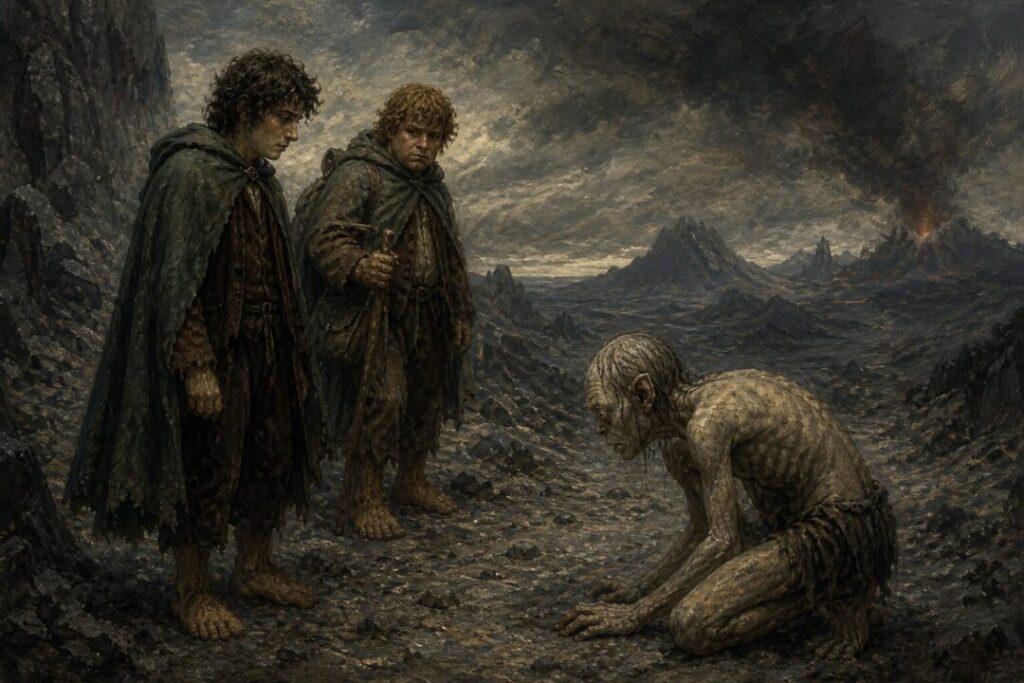
Sometimes he speaks as Sméagol. He can be submissive, pleading, frightened, almost childlike. Under Frodo’s pity, something of the old self rises toward the surface. He calls Frodo “master.” He swears by the Precious, though Frodo warns him about the danger of doing so.
At other times, the darker voice dominates.
This is the Gollum who plots, resents, hungers, and calculates. This voice is suspicious of kindness because it cannot understand it except as a trick. It sees possession everywhere. It expects betrayal because it has lived by betrayal.
The text does not present this as a modern clinical diagnosis, and we should be careful not to force one onto it. Middle-earth gives us a moral and spiritual portrait, not a medical case study.
Still, the division is real within the story.
There is a ruined Sméagol who might still respond to mercy.
There is a Gollum-self enslaved to appetite and the Ring.
And the two do not rest easily together.
So when Gollum says “we,” the word can sound like the grammar of a divided soul.
Does “We” Mean Gollum and the Ring?
This is the most tempting answer.
When Gollum says “we,” perhaps he means himself and the Ring.
There is some support for this as an interpretation, but it should be phrased carefully. The texts do not give a rule that every “we” means “Gollum plus the Ring.” Tolkien never pauses the story to explain Gollum’s grammar in that way.
But the interpretation makes sense because Gollum often treats the Ring as more than an object. It is his Precious. His secret. His companion. His loss. His entire reason for crawling back into danger after Bilbo takes it.
The Ring has become the center of his inner life.
So when he says “we wants it,” the “we” may carry the echo of Gollum and his Precious together. Not because the Ring is speaking with him in a simple dialogue, but because Gollum’s will has been so shaped by it that his desire no longer feels entirely his own.
He wants the Ring.
The Ring draws him.
His self and his obsession speak almost as one.
That is not stated as a mechanical rule in the story. But it is strongly implied by the way Gollum’s language, desire, and identity have fused around the Precious.
Why He Sometimes Says “I”
The most revealing thing about Gollum’s “we” is that he does not always use it.
There are moments when “I” appears.
That matters because “I” sounds more whole. More direct. More personal. When Gollum says “I,” it can feel as though Sméagol is nearer the surface, not always, but often enough to notice.
This is especially important in his relationship with Frodo.
Frodo does not treat him merely as a monster. He recognizes that Gollum was once something else. He speaks to him with pity and authority, and this draws out a different response. Gollum becomes, for a time, almost servant-like. Not healed. Not safe. But changed.
The old name, Sméagol, still has power.
That is one reason Frodo uses it.
Calling him Sméagol does not undo centuries of corruption. But it addresses the part of him that existed before the Ring. It speaks to the self that Gollum has not entirely lost.
And that makes the tragedy sharper.
Because the reader can see that Gollum is not simply pretending. There really is something left to reach.
But not enough, in the end, to master the Precious.
The Ring Does Not Destroy the Self All at Once
Gollum’s “we” also shows how the Ring works.
It does not merely command from outside. It corrupts inwardly. It takes existing desires and enlarges them. It feeds secrecy, possession, suspicion, resentment, and fear.
Sméagol already desires the Ring when he first sees it. He is willing to kill for it. The Ring does not create that act out of nothing. But after he takes it, the Ring deepens and prolongs the damage until his whole life bends around possession.
This is why Gollum is so frightening.
He is not a simple warning about an evil object. He is a warning about what happens when the self becomes organized around one desire.
Everything else falls away.
Kinship falls away.
Truth falls away.
The body changes.
The voice changes.
Even the word “I” becomes unstable.
By the time Gollum says “we,” he is speaking from the wreckage of a self that has spent centuries circling one thing.
The Saddest Meaning of “We”
There are several possible layers to Gollum’s “we.”
It may reflect loneliness.
It may reflect the habit of talking to himself.
It may reflect the conflict between Sméagol and Gollum.
It may also suggest how completely the Ring has entered his sense of identity.
But the saddest answer may be this:
Gollum says “we” because he is no longer able to stand alone as “I.”
The Ring has not erased him. That would almost be simpler. Sméagol is still there, and that is why the story hurts. He can still whimper. He can still remember. He can still respond, briefly, to Frodo’s mercy. He can still come close to repentance.
But he is never whole.
His speech keeps revealing the break.
“We” is not just a strange habit.
It is a wound made audible.
Why This Matters to the Story
Gollum’s way of speaking is not decorative. It prepares us for his role in the fate of the Ring.
He is both victim and villain. Both guide and betrayer. Both pitiable and dangerous. He is what Frodo might become, and also the creature through whom the Ring is finally destroyed.
That complexity is essential.
If Gollum were only evil, pity would seem foolish.
If he were only pitiable, caution would seem cruel.
But he is both.
His “we” holds that contradiction in a single word. It lets us hear the broken fellowship inside one ruined creature: Sméagol, Gollum, and the Precious that has bent them both.
The word is small.
The meaning is not.
Gollum says “we” because the Ring has divided him from himself, bound him to his obsession, and left him unable to speak with the clean simplicity of an undamaged soul.
And that is why his voice lingers.
Not because it is strange.
Because it tells the truth before the story explains it.
Sources & Notes
- J.R.R. Tolkien, The Lord of the Rings, Book I, Chapter 2, “The Shadow of the Past” — Gandalf’s account of Sméagol, Déagol, the murder, exile, and the Ring’s long hold gives the canonical origin of Gollum’s fractured self.
- J.R.R. Tolkien, The Hobbit, Chapter 5, “Riddles in the Dark” — Bilbo’s encounter with Gollum shows the “my precious” speech, self-address, riddling isolation, and possessive language that the article is interpreting.
- J.R.R. Tolkien, The Lord of the Rings, Book IV, Chapter 1, “The Taming of Sméagol” — Frodo names him Sméagol, warns him about swearing by the Precious, and draws out the tension between the old self and Gollum’s enslaved desire.
- J.R.R. Tolkien, The Lord of the Rings, Book IV, Chapter 2, “The Passage of the Marshes” — Gollum’s alternating voices, promises, fear, and muttered argument make the divided “we” more than a simple speech quirk.
- J.R.R. Tolkien, The Lord of the Rings, Book IV, Chapter 8, “The Stairs of Cirith Ungol” — the near-repentance scene shows Sméagol still reachable for a moment, before suspicion and the Precious pull him back toward betrayal.