Gollum is one of the most disturbing figures in Middle-earth.
He is thin, secretive, hungry, and divided against himself. He speaks to the Ring as if it were alive. He hates it and loves it. He curses it and cannot bear to lose it. By the time he enters the main story of The Lord of the Rings, he feels less like an ordinary person and more like a living wound.
But that may be why he is not always the most unsettling example of the Ring’s power.
Gollum is what corruption looks like after it has almost finished its work.
The more frightening moments come earlier.
They come when the corruption is not complete.
They come when the person is still recognizable.
Bilbo is still Bilbo. Frodo is still Frodo. Sam is still Sam. And yet, for a moment, something Gollum-like appears in them: possessiveness, hunger, self-importance, secrecy, or the sudden inability to let the Ring go.
The term “semi-Gollum” is not a phrase from the texts. It is an interpretive way of describing those brief, disturbing glimpses when another Ring-bearer begins to resemble Gollum without becoming him.
And that is what makes these moments so unsettling.
Gollum can be kept at a distance.
Bilbo, Frodo, and Sam cannot.
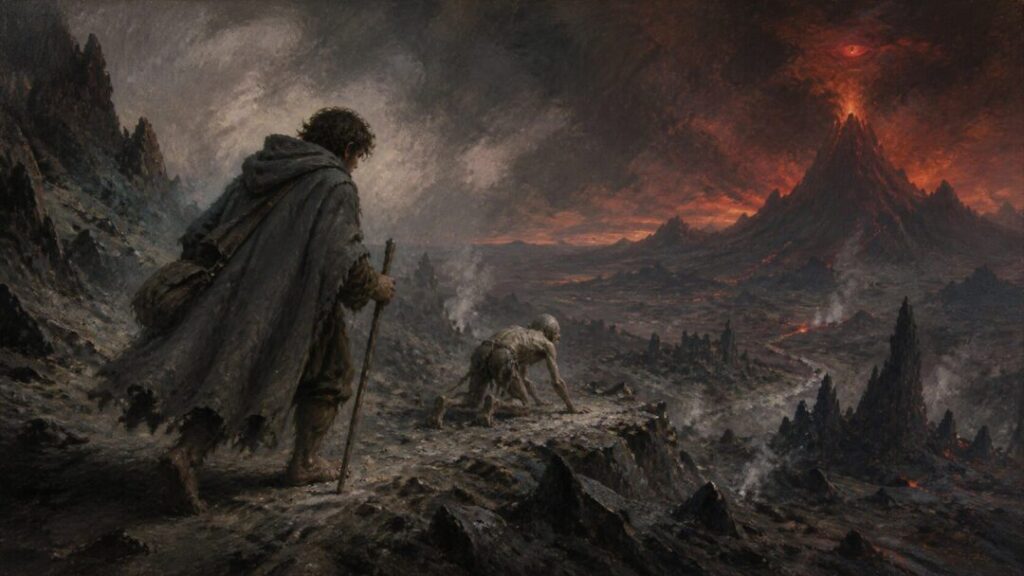
Gollum Is the End of the Road
To understand why the “almost Gollum” moments are so disturbing, we first have to understand what Gollum represents.
Sméagol does not begin as the creature Bilbo meets under the Misty Mountains. In Gandalf’s account, he belongs to a hobbit-like people of the River-folk near the Gladden Fields. When Déagol finds the Ring, Sméagol wants it at once. When Déagol refuses to give it to him, Sméagol kills him.
That beginning matters.
Gollum’s story does not begin with innocent curiosity. It begins with desire, possession, and murder. The Ring immediately finds something in him that can be exploited.
Afterward, Sméagol uses the Ring for spying, theft, and secrecy. He becomes disliked, then driven away. He retreats into the dark, and over long years the Ring stretches his life while narrowing everything else about him. His world contracts until nearly all meaning gathers around one object.
The Ring becomes “Precious.”
By the time Bilbo encounters him, Gollum is not simply a person who owns the Ring. He is a person whose identity has been hollowed out around it.
That is terrifying.
But it is also strangely complete.
Gollum is so far gone that readers can be tempted to treat him as a special case. A warning, yes—but a warning at a distance. He lives in caves. He eats raw fish. He mutters to himself. He is treacherous, miserable, and strange.
He feels like what happens to someone else.
The “semi-Gollum” moments take that comfort away.
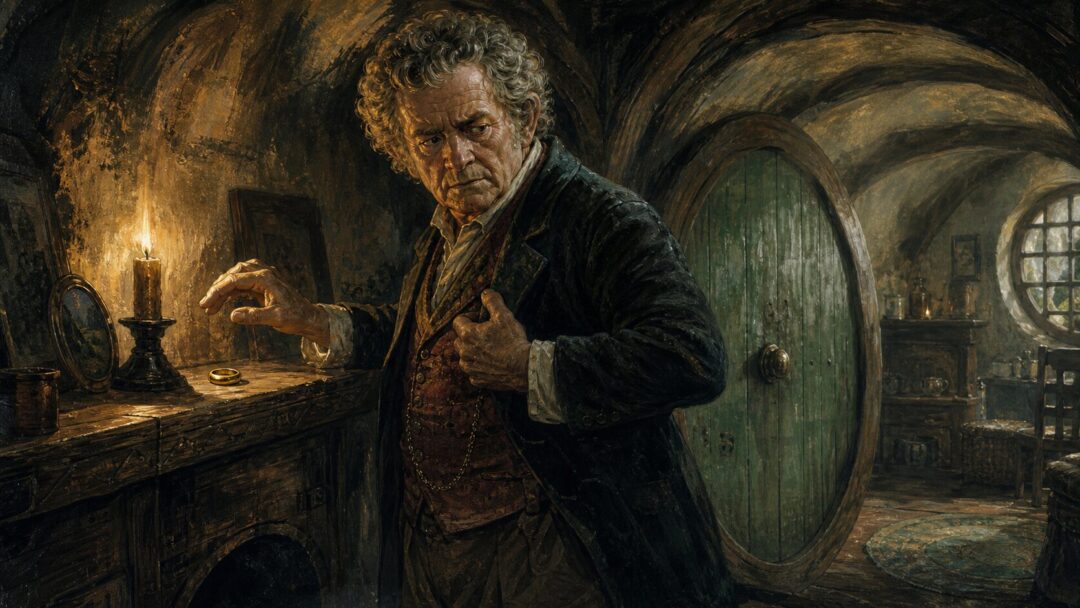
Bilbo’s Flash of Possession
Bilbo Baggins is one of the least monstrous characters in Middle-earth.
He is generous, humorous, fond of comfort, capable of courage, and moved by pity. His sparing of Gollum is one of the quiet acts on which the fate of the Ring eventually turns. He does not take the Ring through murder. He does not understand its true nature when he finds it. For most of his life, he thinks of it as a useful magical object and a private secret.
Yet the Ring still works on him.
That becomes clear when he prepares to leave the Shire.
Bilbo means to give the Ring to Frodo. He has even made arrangements. But when the moment arrives, he struggles. He delays. He argues with Gandalf. Most disturbingly, he calls the Ring “my Precious.”
That word is not accidental.
It links Bilbo, however briefly, with Gollum.
The scene is unsettling because Bilbo has not become Gollum. He is not crawling through darkness. He is not plotting murder. He is not ruined beyond recognition. He is a beloved old Hobbit standing in Bag End, surrounded by familiar things.
And yet the same possessive language rises in him.
For a moment, the boundary between Bilbo and Gollum thins.
This is not proof that Bilbo was secretly evil. The texts do not present him that way. In fact, his ability to give up the Ring is treated as extraordinary. But the scene shows that goodness does not make him immune.
That is the horror of the Ring.
It does not need to create desire from nothing.
It can fasten itself to the desire already there.
Why Bilbo Is More Frightening Than He Seems
Bilbo’s moment is disturbing because it happens inside a character we trust.
Gollum’s possessiveness is expected. Bilbo’s is not.
The contrast reveals something important about the Ring. Its corruption is not only physical. It is not simply a process of becoming thin, pale, secretive, and cave-dwelling. Those are Gollum’s outward signs after long possession and isolation.
But the deeper danger begins much earlier.
It begins when the bearer says mine.
Not as a harmless statement of ownership, but as a spiritual claim. The Ring becomes not just something possessed, but something tied to the self. To give it up feels like being diminished.
That is why Bilbo’s anger at Gandalf is so uncomfortable.
The scene shows the Ring defending itself through Bilbo’s own attachment. It uses his secrecy, his pride, perhaps even his fear of aging and losing what has made him unusual. The text never reduces Bilbo to those weaknesses, but it does allow us to see how the Ring presses on them.
Then Bilbo releases it.
That release matters deeply.
But the flash remains.
And once we have seen it, Gollum no longer seems like an impossible endpoint. He seems like a possible direction.
Frodo Understands Gollum Too Well
Frodo’s “semi-Gollum” quality is different from Bilbo’s.
Bilbo’s most disturbing moment comes when he resists giving up the Ring. Frodo’s comes more slowly, through sympathy, burden, and exhaustion.
At the beginning, Frodo is horrified by Gollum. Like many readers, he wishes Bilbo had killed him when he had the chance. Gandalf corrects him. He tells Frodo not to be too eager to deal out death in judgment, because even the wise cannot see all ends.
That lesson becomes one of the moral centers of the story.
But as Frodo carries the Ring, his pity for Gollum becomes more personal. He does not merely pity Gollum from above. He begins to understand him from within.
This is one of the most uncomfortable developments in The Lord of the Rings.
Frodo sees Gollum’s misery. He sees his enslavement to the Ring. He sees that Sméagol is not entirely gone, even though he is terribly damaged. But Frodo also begins to recognize the path ahead of himself.
Gollum is not only a creature to be pitied.
He is a possible future.
The texts never say that Frodo becomes Gollum. He does not. His motives, choices, endurance, and compassion remain profoundly different. But the nearer he comes to Mordor, the heavier the Ring becomes, and the harder it is for him to remain wholly free within himself.
That is what makes Frodo’s closeness to Gollum so painful.
He does not look at Gollum and see a monster only.
He sees a warning shaped like a person.
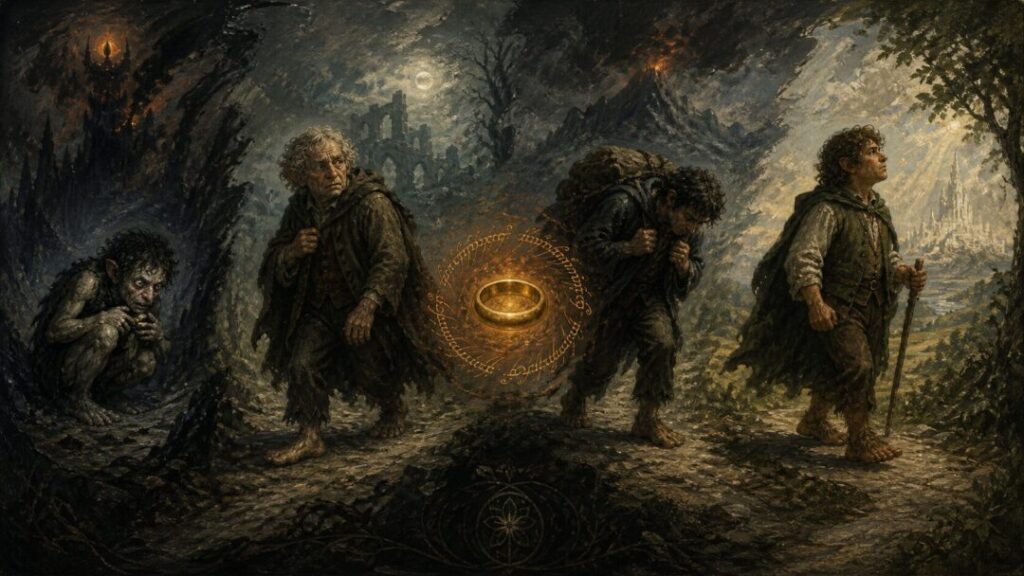
The Terror of the Mirror
Gollum is frightening as an enemy.
He is more frightening as a mirror.
Frodo’s relationship with him is built on that tension. Frodo needs Gollum’s knowledge to reach Mordor. He also extends mercy to him, even when Sam distrusts him. This mercy is not naïve in a simple way. Frodo knows Gollum is dangerous. He knows betrayal is possible. But he also knows something Sam cannot fully know at first: what it means to be under the Ring’s pressure.
This creates one of the strangest emotional patterns in the story.
The closer Frodo comes to the place where the Ring must be destroyed, the more Gollum’s existence matters. Not because Gollum is wise. Not because he is trustworthy. But because he embodies the question Frodo cannot escape.
Can anyone bear this thing and remain untouched?
The answer, by the end, is no.
At the Cracks of Doom, Frodo claims the Ring. This is often misunderstood if treated as a simple moral collapse. The pressure of the Ring at that place, after the long torment of the journey, is presented as overwhelming. Frodo has spent himself. He has brought the Quest to the point where it can be fulfilled, but he cannot cast the Ring away by his own strength.
That moment is not Gollum’s story repeated exactly.
But it is the final and most terrible “semi-Gollum” moment.
Frodo, who has pitied Gollum, now speaks the language of possession.
The Ring is mine.
Sam’s Brief Vision of Power
Samwise Gamgee may seem like the least Gollum-like person imaginable.
He is loyal, practical, humble, stubborn, and rooted in ordinary loves: gardens, food, home, Frodo, and the Shire. He does not crave kingdoms. He does not dream of thrones. He wants things to grow.
Yet even Sam is not beyond temptation.
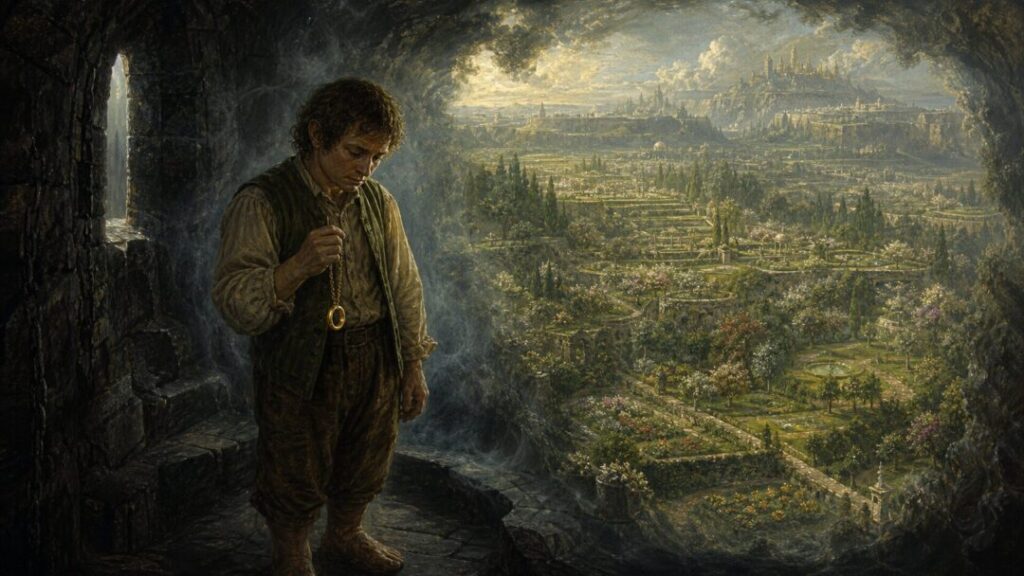
When he bears the Ring briefly after believing Frodo dead, the Ring works upon him too. It offers him a vision of himself made great: Samwise the Strong, a hero with power to command and transform. The temptation is shaped to him. It does not make him desire the same things Boromir desired. It does not give him Gollum’s cave-hunger. It offers greatness through the things Sam already values.
This is crucial.
The Ring does not tempt everyone in the same costume.
It adapts.
For Sam, the dream of power is tangled with gardens and healing. That almost makes it seem innocent. But the danger is still there. A garden imposed by domination would no longer be the humble goodness Sam actually loves.
Sam rejects the temptation in part because he knows himself. He is a gardener, not a lord of the world. His humility protects him.
But the scene still matters.
Even Sam can be shown a false version of himself.
Even Sam can be invited to become larger than he should be.
That is why his brief possession of the Ring is not just a pause in the plot. It is another glimpse of the Ring’s method. It does not merely whisper evil. It magnifies desire until it becomes mastery.
Why “Almost Corrupted” Is More Unsettling Than Corrupted
A fully corrupted figure can be frightening.
But an almost corrupted figure is intimate.
Gollum is tragic and horrifying, but he is also visibly ruined. His outward form tells us that something has gone terribly wrong. We are prepared to fear him.
Bilbo’s possessiveness is different because it appears in a warm room in the Shire.
Frodo’s claim is different because it comes after sacrifice, mercy, and endurance.
Sam’s temptation is different because it grows out of love for simple, good things.
These moments are unsettling because they do not allow evil to remain theatrical. The Ring does not only work through cruelty, ambition, or malice. It works through attachment. Through fear. Through the desire to protect. Through the wish to repair the world according to one’s own will.
That is far more disturbing than a monster in a cave.
A monster in a cave can be avoided.
A desire in the heart cannot.
Gollum Makes the Ring Visible
Gollum’s role is not weakened by this reading. It becomes more important.
He shows what the Ring looks like when possession has lasted almost beyond memory. He is the long result: the self split, the body diminished, the will bent around one object.
But the other Ring-bearers show the process.
Bilbo shows the first visible flash of possessive dependence.
Frodo shows the burden becoming inward, personal, and finally impossible to overcome alone.
Sam shows that even the purest loyalty can be offered a vision of command.
Together, they reveal the full terror of the Ring more completely than Gollum alone.
Gollum shows the destination.
The “semi-Gollum” moments show the road.
And roads are more frightening when we can imagine ourselves walking them.
The Ring Does Not Make Everyone the Same
One reason these moments are so powerful is that the Ring does not erase personality at once.
Bilbo remains Bilbo. Frodo remains Frodo. Sam remains Sam. Their temptations are shaped by who they are.
This is why the Ring feels so dangerous. It does not simply replace the bearer with a generic servant of evil. At least at first, it works through the bearer’s own nature.
Bilbo’s secrecy and love of his marvelous possession become a point of pressure.
Frodo’s endurance becomes a path toward unbearable suffering.
Sam’s love of growing things becomes vulnerable to a fantasy of remaking the world.
Gollum, too, is not a blank monster. The remains of Sméagol persist in him, which is why Frodo’s pity is possible and why his near-repentance before Shelob’s Lair is so heartbreaking. The tragedy is not that Sméagol was never there. It is that he is still there, but terribly weakened and divided.
That is the deepest horror.
The Ring does not merely destroy the self.
It can preserve enough of the self to torment it.
The Real Reason These Moments Stay With Us
The “semi-Gollum” moments are more unsettling than Gollum himself because they collapse the safe distance between monster and hero.
Gollum is not presented as a different species of soul. He is a warning about possession, addiction, secrecy, and the shrinking of the self around a single desire.
Bilbo shows that a good person can cling.
Frodo shows that a merciful person can be overmastered.
Sam shows that even humble love can be tempted by power when power disguises itself as usefulness.
None of this makes them equal to Gollum. That would be false. Their choices matter. Their resistance matters. Their mercy matters. Their differences matter.
But the resemblance matters too.
For a moment, each of them stands close enough to Gollum that we can see the same shadow falling across very different hearts.
That is why these scenes disturb us.
Not because they turn heroes into monsters.
Because they show that monsters are not always born far away in the dark.
Sometimes they begin with a word.
Mine.
Sometimes with a secret.
Sometimes with the belief that only we can set things right.
And sometimes the most frightening thing in Middle-earth is not Gollum crouching in the dark with the Ring in his hand.
It is the brief look on a beloved face when the Ring asks to be kept.
Sources & Notes
- J.R.R. Tolkien, The Lord of the Rings, Book I, Chapter 2, “The Shadow of the Past” — gives Gandalf’s account of Sméagol murdering Déagol, using the Ring for secrets and theft, and being drawn into the dark around his “Precious.”
- J.R.R. Tolkien, The Lord of the Rings, Book I, Chapter 1, “A Long-expected Party” — shows Bilbo struggling to give up the Ring, calling it “my Precious,” and needing Gandalf’s help to leave it behind.
- J.R.R. Tolkien, The Lord of the Rings, Book IV, Chapter 1, “The Taming of Sméagol” — develops Frodo’s pity for Gollum and his recognition that the Ring’s hold makes Gollum a warning rather than merely a monster.
- J.R.R. Tolkien, The Lord of the Rings, Book VI, Chapter 1, “The Tower of Cirith Ungol” — presents Sam’s brief Ring-temptation as a vision of power shaped around gardens, healing, and command.
- J.R.R. Tolkien, The Lord of the Rings, Book VI, Chapter 3, “Mount Doom” — brings Frodo’s burden to its crisis when he claims the Ring at the Cracks of Doom and can no longer surrender it by will alone.