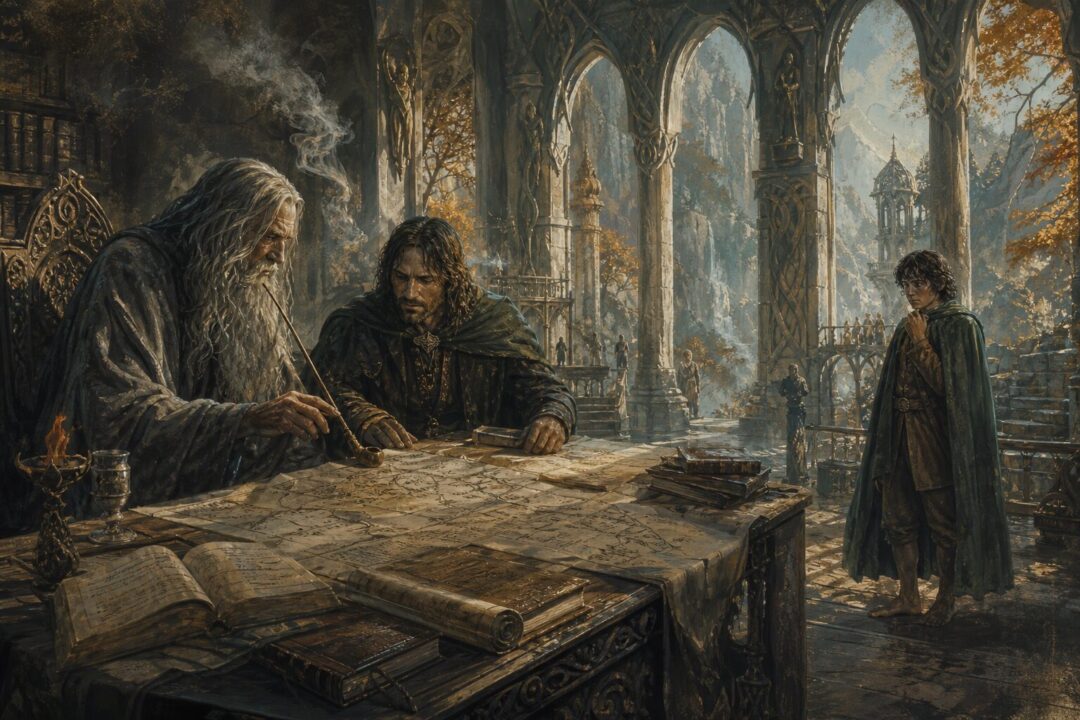
It seems like one of the most obvious questions in The Lord of the Rings.
Why did Frodo not take a map?
He was walking from the Shire to Mordor. He was carrying the One Ring. The fate of Middle-earth depended on reaching a specific place: the fire of Orodruin, Mount Doom, where the Ring had been made and where alone it could be unmade.
And yet the story never pauses to show Frodo unfolding a map beside a campfire.
He does not measure the road to Mordor with inked lines.
He does not mark a safer crossing.
He does not carry some secret chart from Rivendell to guide him through the mountains.
At first, this can look like an oversight.
But it is not.
The deeper answer is not that maps were unknown, or that Frodo was careless, or that no one in Rivendell thought about the road. The books show the opposite. Maps existed. They were studied. The wise considered the journey carefully.
The reason Frodo does not depend on a map is much more revealing.
A map could show lands, rivers, mountains, and roads.
But Frodo’s Quest was not really a journey through a mapped world.
It was a journey through a world where every clear road was watched, every obvious passage was dangerous, and every plan could break before it was completed.
Frodo Knew Maps
Frodo was not a Hobbit with no interest in geography.
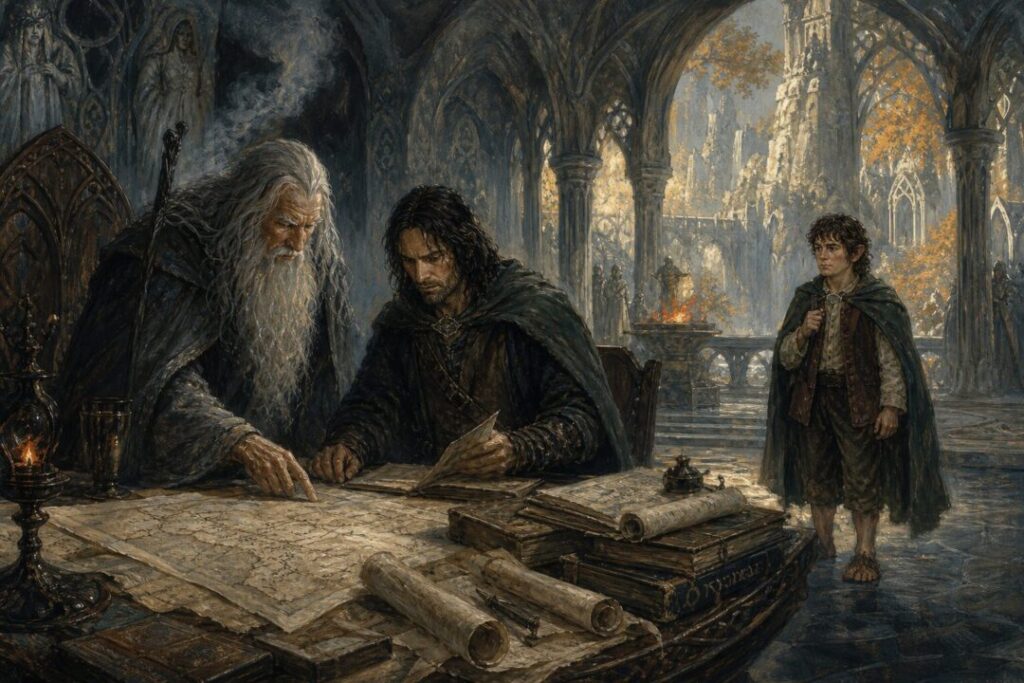
The Shire was small compared to the great lands of Middle-earth, but Frodo’s imagination had already gone beyond it. The text says that he looked at maps and wondered what lay beyond their edges. It also says that maps made in the Shire showed mostly blank spaces outside its borders.
That detail is important.
Frodo did not come from a culture of explorers, soldiers, or wandering captains. Most Hobbits cared little for the world outside the Shire. Their maps, where they existed, were naturally centered on what they knew: lanes, villages, fields, rivers, and the country close at hand.
So when Frodo began his journey, a Shire-map would not have been useless inside the Shire. But beyond it, the world became less certain.
The blank edges of those maps are almost symbolic.
Frodo’s path begins in familiar country, but the Quest immediately pulls him beyond the limits of ordinary Hobbit knowledge. The road to Buckland, the Old Forest, Bree, Weathertop, Rivendell—each step carries him farther from the kind of world a Hobbit map could explain.
A map might have shown distance.
It could not show danger.
Bilbo Loved Maps, But Bilbo’s Adventure Was Different
There is another reason the question feels natural.
Bilbo Baggins loved maps.
In The Hobbit, Bag End is associated with comfort, order, and maps. Bilbo has a map of the country round, with his favourite walks marked on it. Later, Thorin’s map becomes a central object in the quest for Erebor.
So it is tempting to ask why Frodo does not inherit that same kind of map-based adventure.
But Bilbo’s map and Frodo’s Quest belong to very different stories.
Thorin’s map points toward a known goal: the Lonely Mountain. It carries hidden information, yes, but the journey is still shaped like an expedition. There is a company. There is a destination. There is a secret door. There is treasure to reclaim.
Frodo’s journey is darker.
The goal is known, but the road is not. The Quest is not about reclaiming a kingdom or reaching a hidden door at the right moment. It is about entering the land of the Enemy without being found.
A map can help a traveller reach a city.
It is far less useful when the city’s ruler must never know you are coming.
Rivendell Did Not Ignore the Road
The strongest answer comes after the Council of Elrond.
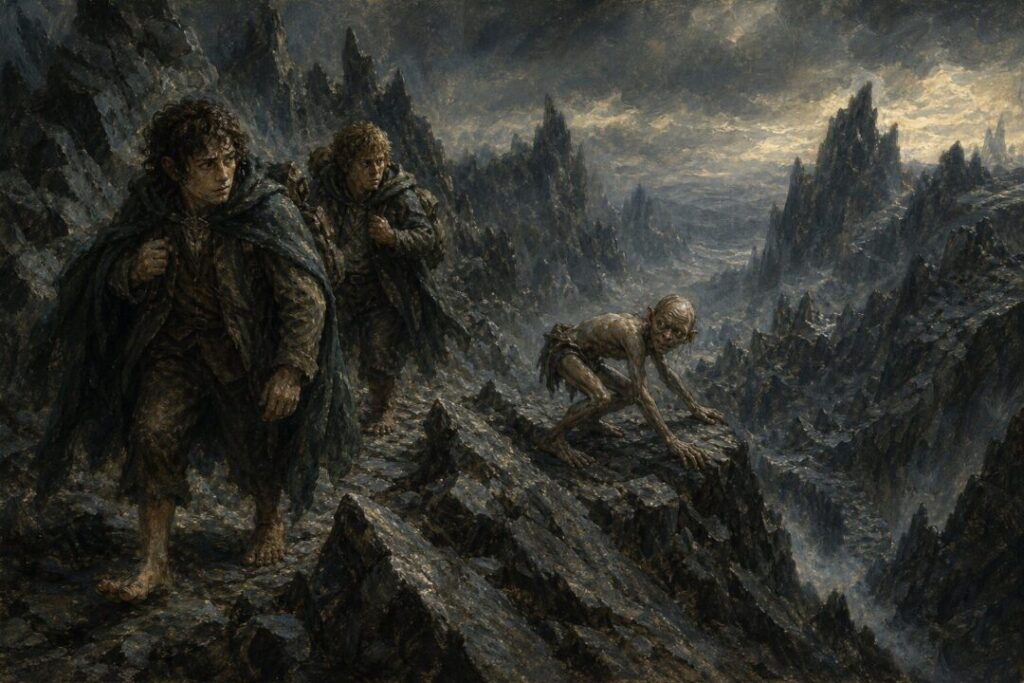
Before the Fellowship leaves Rivendell, the road is considered with care. Gandalf and Aragorn speak together about the path and its dangers. They study the storied and figured maps and books of lore in Elrond’s house. Frodo is sometimes with them, but the text says he is content to lean on their guidance.
This is the crucial passage.
The problem was not that no one thought of maps.
The problem was that Frodo was not the one best equipped to use them.
Gandalf had travelled widely. Aragorn knew the wild and had long experience as a Ranger. Elrond’s house contained ancient lore that reached far beyond anything the Shire could provide.
Frodo’s task was not to become the chief navigator of the Company.
His task was to bear the Ring.
That may sound simple, but it is the center of the entire story. Frodo carries a burden no map can lighten. The others can guide, guard, advise, scout, and fight. Frodo must endure the thing that none of them can safely take from him.
The Fellowship is built around different kinds of strength.
Aragorn knows the lands.
Gandalf understands the wider peril.
Boromir knows the wars of Men.
Legolas and Gimli bring knowledge of their own peoples.
Sam, Merry, and Pippin bring loyalty that becomes far more important than anyone expects.
Frodo brings the Ring.
He does not need to be the mapmaker.
He needs to keep walking.
The Fellowship Had No Fixed Route
Another reason a personal map would have mattered less than expected is that the Fellowship’s road was uncertain from the start.
They leave Rivendell intending to go south, but the exact way is not simple. The Redhorn Pass becomes impossible. The attempt to cross the mountains fails. They enter Moria not because it was the easy first choice, but because other ways are closed or too dangerous.
That alone shows the weakness of any fixed plan.
The Fellowship’s route changes because weather, enemies, fear, and circumstance force it to change.
After Moria, Gandalf falls.
After Lórien, the Company travels by the Great River.
At Parth Galen, the Fellowship breaks.
Frodo and Sam go on alone.
From that point, whatever plan was made in Rivendell is shattered.
A map, even if Frodo had carried one, would not solve the deeper problem. He and Sam are no longer following the full counsel of the Wise. They are two Hobbits on the eastern side of the Anduin, trying to approach Mordor with no army, no open road, and no clear guide.
And then Gollum enters the story again.
Gollum Becomes the Map No One Wanted
Once Frodo and Sam are separated from the Fellowship, their most important guide is not parchment.
It is Gollum.
This is deeply uncomfortable, and the story knows it.
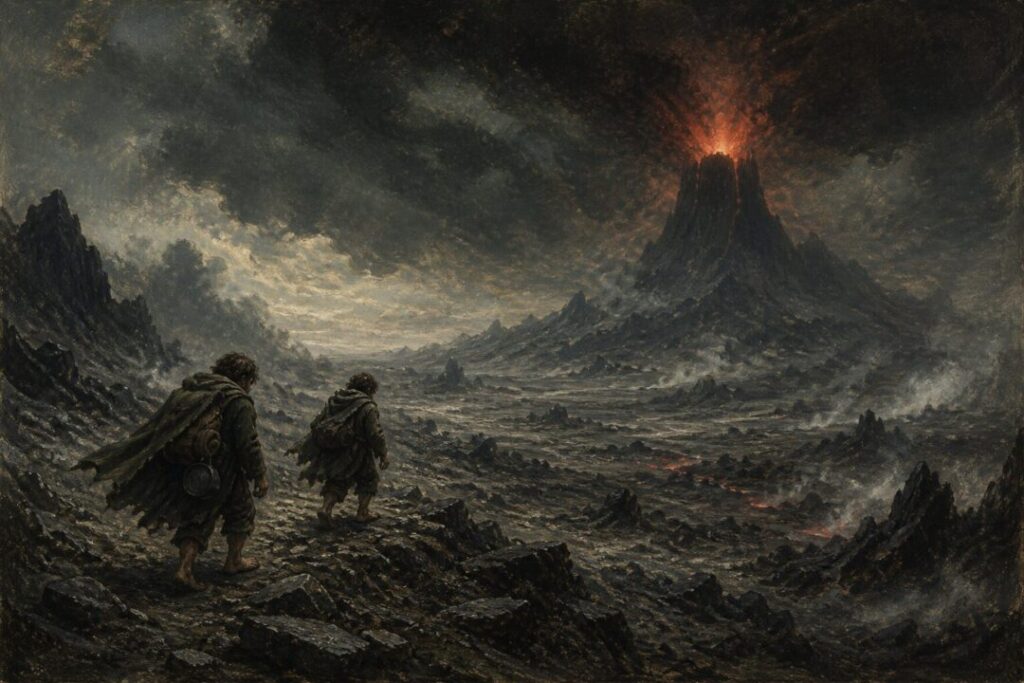
Gollum is treacherous. He is driven by desire for the Ring. He cannot be trusted in any simple sense. And yet he knows paths that Frodo and Sam do not know. He has been in Mordor. He knows the Dead Marshes. He knows a way toward the Black Gate. Later, he leads them toward Cirith Ungol.
This does not mean Gollum is a safe guide.
He is not.
It means that the last stage of the Quest depends on something no map from the Shire, and perhaps no ordinary map from Rivendell, could have provided: lived knowledge of hidden, dreadful ways near Mordor itself.
Even then, Gollum’s guidance is morally dangerous.
He leads them toward Shelob. He intends betrayal. The path he knows is not merely difficult; it is part of his own broken cunning.
But without him, Frodo and Sam would have had almost no practical way forward after reaching the borders of Mordor.
The story never presents this as neat strategy.
It presents it as one of the strange patterns of the Quest: pity, chance, mercy, and danger all tangled together.
Mordor Was Not a Place for Ordinary Navigation
By the time Frodo and Sam enter Mordor, the idea of a helpful map becomes even weaker.
Mordor is not just another country.
It is the land of Sauron’s power. Its roads, fortresses, passes, and guarded ways exist under his control. The Black Gate is watched. The mountains are barriers. The inner land is hostile, barren, and filled with danger.
A traveller’s map might show the shape of Mordor.
It would not make Mordor passable.
Frodo and Sam do not move through Mordor like ordinary wayfarers. They hide. They crawl. They endure thirst, ash, fear, exhaustion, and the growing weight of the Ring. Their journey becomes less and less about choosing the correct road and more and more about surviving the next hour.
At that point, navigation narrows to something brutal.
Where can they hide?
Where can they find water?
How close is the mountain?
Can they take another step?
A map belongs to a traveller who still has options.
Frodo and Sam often have almost none.
The Quest Was Designed Around Secrecy, Not Efficiency
This is the heart of the answer.
A map is useful when speed, clarity, and planning are the main concerns.
But the Quest of the Ring depends on secrecy.
The Wise do not send Frodo with an army. They do not try to storm Mordor. They do not choose the most direct road and march openly toward Mount Doom. Their hope rests on the possibility that Sauron will not imagine anyone trying to destroy the Ring.
That hope is fragile.
It depends on doing what the Enemy does not expect.
A clear map might help someone plan the shortest route, but the shortest route is not necessarily the safest. The great roads are watched. The obvious passes are dangerous. The straight way into Mordor is impossible for two Hobbits carrying the Enemy’s own Ring.
The Quest succeeds not because every mile was perfectly planned, but because Sauron’s understanding has a blind spot.
He understands power.
He understands possession.
He understands fear, armies, domination, and the desire to use the Ring.
He does not truly understand renunciation.
So Frodo’s path cannot be reduced to geography. It is a moral and spiritual route as much as a physical one.
The road to Mount Doom is hidden not only on the land, but in the Enemy’s imagination.
Frodo’s Missing Map Reveals His Real Role
Frodo not carrying a visible map can feel strange because modern readers often imagine quests as logistical problems.
Where is the destination?
What is the route?
How many miles?
What supplies are needed?
What is the backup plan?
The Lord of the Rings does care about roads, distances, rivers, mountains, hunger, weariness, and weather. The physical journey is very real.
But Frodo’s deeper burden is not logistical.
It is interior.
The Ring presses upon him. Its power grows as he comes nearer to the place where it was made. His choices become harder. His pity toward Gollum, his endurance, his willingness to continue when hope is almost gone—these matter more than any object he might carry in his pack.
A map could tell Frodo where Mordor lay.
It could not tell him how to bear the Ring once he arrived.
That is why the absence of a map is not a flaw in the story. It points to the kind of story this is.
The Quest is not won by perfect information.
It is carried by guidance, friendship, endurance, mercy, and grace.
So Why Did Frodo Not Take a Map?
The most careful answer is this:
The books do not explicitly say that Frodo never carried any map at all. They simply do not show him relying on one, and they do show that the route was studied by wiser and more experienced guides before the Fellowship left Rivendell.
So the safest conclusion is not “Frodo forgot.”
It is this:
Frodo did not need to be the keeper of the map because the Quest was never organized around his skill as a navigator. Before the breaking of the Fellowship, he relied on Gandalf, Aragorn, and the counsel of Rivendell. After the breaking, he and Sam relied on immediate necessity, their own courage, and eventually Gollum’s dangerous knowledge of the ways near Mordor.
And beyond all that, a map could only ever take them so far.
It could not predict Moria.
It could not prevent Boromir’s fall.
It could not replace Gandalf.
It could not make Gollum faithful.
It could not make Mordor safe.
It could not teach Frodo how to surrender the Ring at the end.
That last point matters most.
The final crisis on Mount Doom is not a failure of navigation. Frodo reaches the place. The map, if there had been one, would have done its job.
The real crisis is whether anyone can willingly destroy the Ring.
And there, no map in Middle-earth would have helped.
The Road That Could Not Be Drawn
Frodo’s journey begins in a world of paths and lanes.
It ends in fire, ash, and moral impossibility.
That is why the missing map matters. Not because it exposes a practical mistake, but because it reveals the limits of planning in a world shaped by powers greater than planning.
Maps belong to the world of knowledge.
Frodo’s Quest belongs partly to that world, but not entirely.
It also belongs to the world of pity shown in the dark, help arriving unlooked-for, choices made without certainty, and small hands carrying what the great could not safely claim.
A map could show the mountain.
But it could not show the way through fear.
It could not show the cost of mercy.
It could not show why Gollum, spared long before, would matter at the very edge of the Fire.
So Frodo did not fail to take the one thing that would have solved the journey.
He walked into a story where the most important road was never drawn on parchment at all.
Sources & Notes
- J.R.R. Tolkien, The Lord of the Rings, Book I, Chapter 1, “A Long-expected Party” — shows Frodo’s interest in maps and the limited Hobbit view beyond the Shire, with maps becoming blank at the edges.
- J.R.R. Tolkien, The Hobbit, Chapter 1, “An Unexpected Party” — contrasts Bilbo’s map-friendly adventure, from his local walking map to Thorin’s map of the Lonely Mountain.
- J.R.R. Tolkien, The Lord of the Rings, Book II, Chapter 3, “The Ring Goes South” — states that Gandalf and Aragorn studied maps and lore in Rivendell while Frodo trusted their guidance before the Company set out.
- J.R.R. Tolkien, The Lord of the Rings, Book II, Chapter 4, “A Journey in the Dark” — the failed Redhorn Pass and turn toward Moria show why the Fellowship could not simply follow a fixed plotted route.
- J.R.R. Tolkien, The Lord of the Rings, Book IV, Chapters 1–3, “The Taming of Sméagol,” “The Passage of the Marshes,” and “The Black Gate Is Closed” — makes Gollum’s dangerous local knowledge central once Frodo and Sam are alone near Mordor.
- J.R.R. Tolkien, The Lord of the Rings, Book V, Chapter 9, “The Last Debate” — explains the strategic hope that Sauron would not imagine the Ring-bearer’s true aim was destruction rather than use.