At first, the scene seems almost impossible.
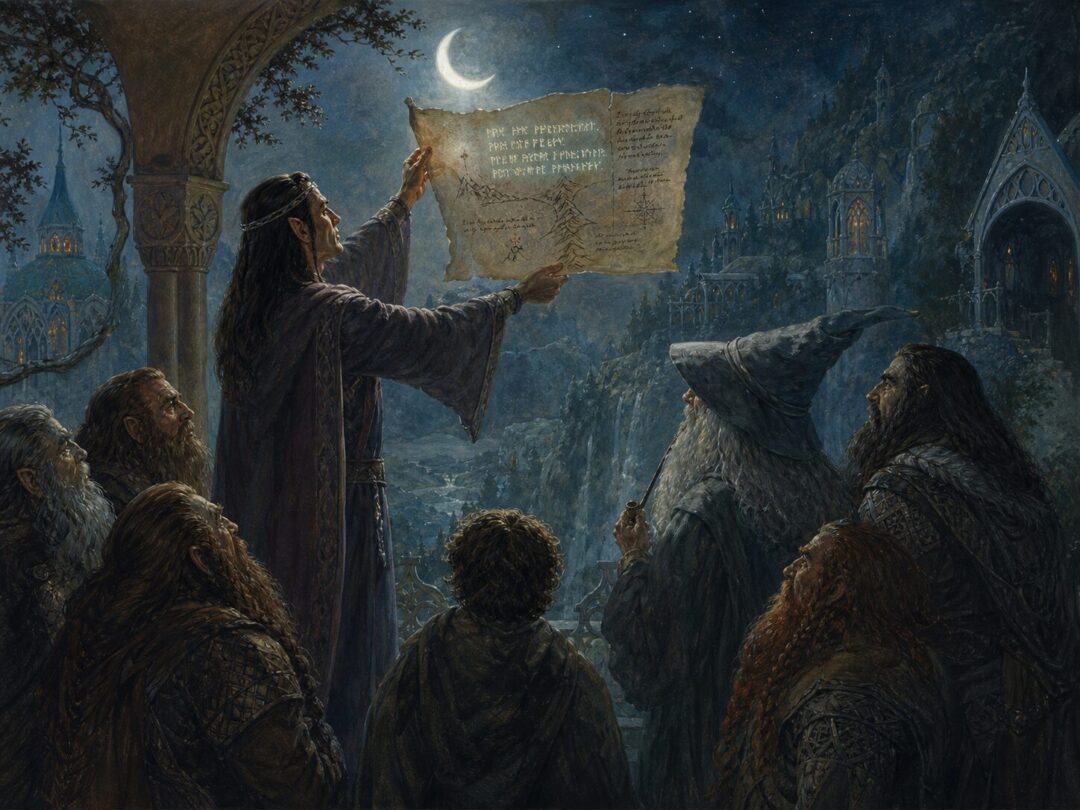
Thorin Oakenshield arrives in Rivendell carrying Thrór’s Map, a map tied to the secret entrance of the Lonely Mountain. The company has already passed through danger. Trolls have nearly ended the quest before it properly began. Gandalf has brought them to the Last Homely House, and there, in the presence of Elrond, the map finally gives up part of its secret.
Not to Thorin.
Not to Gandalf.
To Elrond.
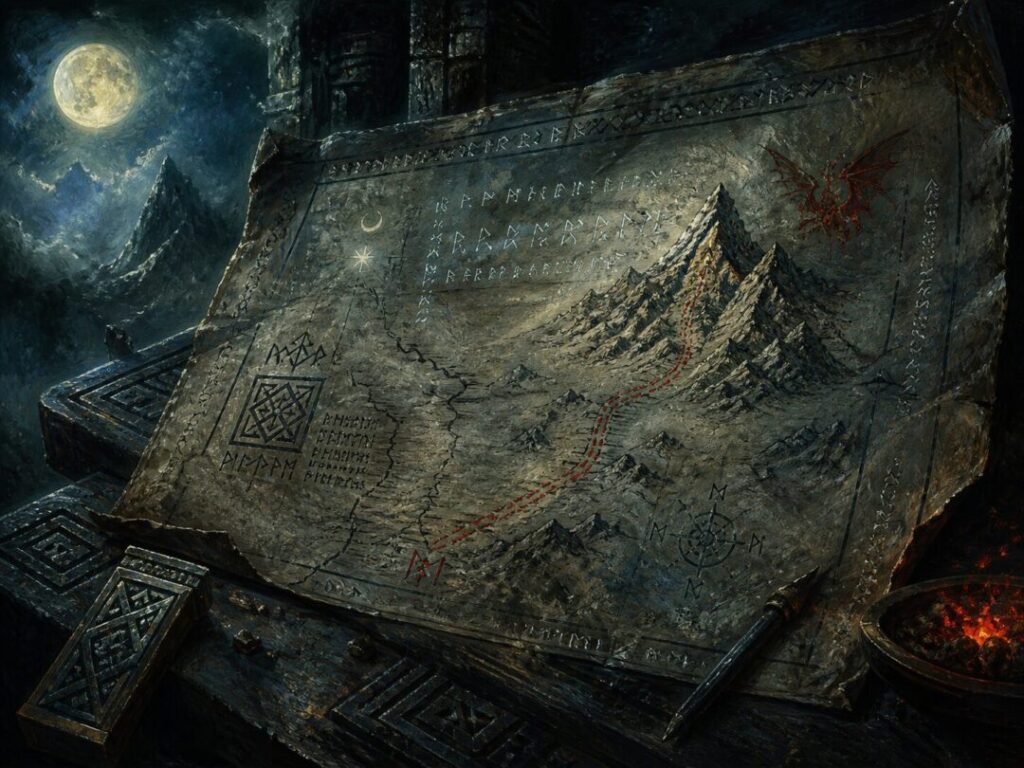
He sees the moon-letters. He knows what they are. He explains that such letters cannot be seen by looking straight at them. They appear only when the moon shines behind them, and the more cunning kind requires a moon of the same shape and season as the one under which they were written.
This is not ignorance.
It is deep knowledge.
And then, after reading the hidden message, Elrond asks a question that feels strangely simple:
What is Durin’s Day?
For many readers, this is the puzzle. Elrond is among the wisest figures remaining in Middle-earth. He knows ancient swords by sight. He knows histories reaching back into elder days. He can identify a subtle Dwarven writing system that no one else in the company has noticed.
So how can he not know something as important as Durin’s Day?
The answer is quieter than it first appears.
Elrond is not asking because he is foolish. He is asking because Durin’s Day is not merely a fixed holiday. It is a Dwarvish reckoning tied to the moon, the sun, the end of autumn, and the beginning of winter.
And even Thorin admits that the matter is no longer easy.
Elrond Knows More Than the Company Does
The first thing to notice is that Elrond is not presented as uninformed in this scene.
He is the one who identifies the hidden writing. He is the one who explains moon-letters. He is the one who says the writing must have been made on a midsummer’s eve, under a crescent moon, long ago.
That matters.
The text is not showing Elrond as someone out of his depth. It is showing him as someone with wide learning, including knowledge of a Dwarven craft that remains hidden to ordinary eyes.
Thorin has the map, but he has not read the moon-letters.
Gandalf has carried the map, but he has not solved the message.
Elrond, by contrast, can see what kind of secret is before them.
So when he asks about Durin’s Day, the question should not be treated as proof that he lacks wisdom. It is more precise than that. Elrond understands the writing, but he is asking Thorin to explain a Dwarvish term embedded inside it.
That distinction changes the whole scene.
Elrond knows how the message is hidden.
He does not claim to know the Dwarven calendar behind the message.
Durin’s Day Is Not Just “A Date”
Thorin’s answer is the key.
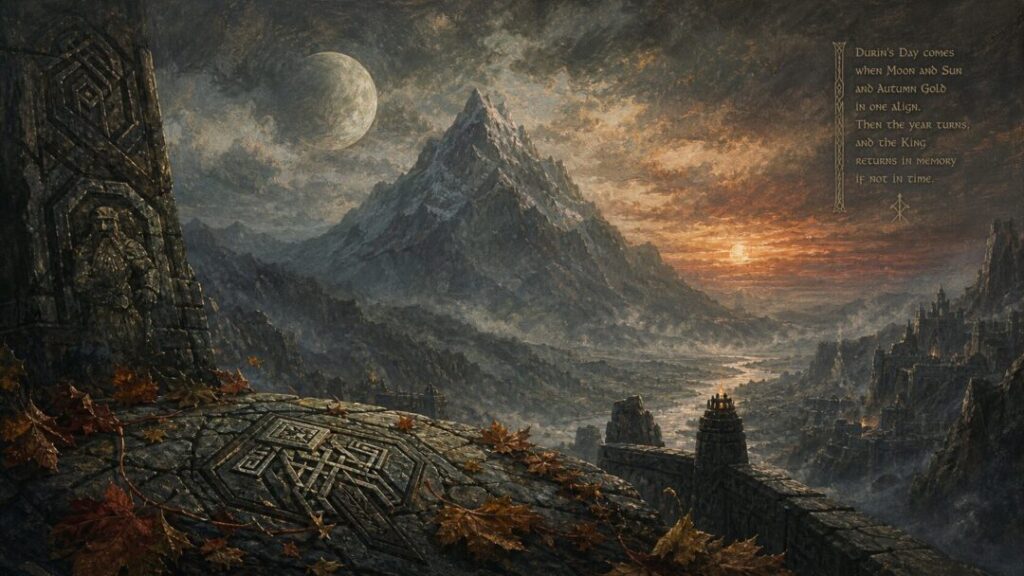
He says the first day of the Dwarves’ New Year is the first day of the last moon of autumn, on the threshold of winter. He then says that they still call it Durin’s Day when the last moon of autumn and the sun are in the sky together.
This is much more complicated than a simple anniversary.
Durin’s Day is not described as “the tenth day of a month” or “the same day every year.” It depends on the moon. It depends on autumn. It depends on the approach of winter. It also depends on the sun and moon both being visible in the sky.
The wording is beautiful, but it is not simple.
The “last moon of autumn” must be identified. The “threshold of winter” must be understood. The first day of that moon must be reckoned. And then the condition of sun and moon appearing together must be met.
The text does not give us a mathematical rule that any reader can apply with certainty.
More importantly, Thorin does not act as though the answer is easy.
He does not say, “Durin’s Day is next week.”
He does not say, “We have already calculated it.”
He says the opposite.
It passes their skill in those days to guess when such a time will come again.
That is the sentence most explanations overlook.
Even Thorin Cannot Easily Reckon It
Thorin is not a random Dwarf.
He is heir of Durin. He is the leader of the quest. The map belongs to his house. The secret door concerns his own ancestral kingdom. If anyone in the company should be able to use the phrase “Durin’s Day” confidently, it should be him.
Yet Thorin himself admits uncertainty.
This does not mean the Dwarves have forgotten what Durin’s Day means. Thorin defines it clearly enough. They know the tradition. They still call the day by that name.
What seems to have been lost, or at least become difficult, is the ability to predict the exact occurrence in advance.
That is a very different kind of ignorance.
It is one thing to know the rule.
It is another thing to calculate the moment.
A modern reader may be tempted to think of a calendar as something printed and fixed. But Thorin’s explanation points to a lunar reckoning, not a simple numbered date. The day depends on the relationship between moon, sun, season, and the turning of the year.
The text never says exactly why this has passed their skill. It may imply a loss of older Dwarven learning, or the practical difficulty of applying an old reckoning after exile and long years away from the Mountain. But that must be stated carefully: the story does not give a full technical explanation.
What it does tell us is enough.
The heir of Durin knows what Durin’s Day is.
He does not know how to confidently predict it.
Elrond’s Question Makes Narrative Sense
Once Thorin’s answer is taken seriously, Elrond’s question becomes much less strange.
Elrond is not asking, “What is this famous name Durin?”
He has just heard Thorin invoke Durin as his ancestor. The question concerns the phrase in the moon-letter message: “Durin’s Day.”
That phrase belongs to Dwarvish tradition. It is not presented as common knowledge among Elves, Men, or Hobbits. Thorin even says “as all should know,” but in context that sounds like Dwarven pride speaking as much as universal fact.
There is no reason the story requires Elrond to know the exact details of a Dwarven New Year.
Elrond’s knowledge is vast, but it is not infinite. Middle-earth contains separate peoples, languages, customs, memories, and forms of secrecy. Dwarves in particular are often associated with guarded names, hidden crafts, and things not freely shared with outsiders.
The scene works because Elrond and Thorin each hold part of the key.
Elrond can reveal the hidden writing.
Thorin can explain the Dwarvish term.
Neither alone can solve the entire problem.
That is part of the quiet brilliance of the chapter. Rivendell gives the quest knowledge, but not certainty. The company leaves with a clue, not a timetable.
The Moon-Letters Point to a Vanishing Kind of Skill
The moon-letters themselves deepen the issue.
Elrond explains that some moon-letters can be read only under very specific conditions. The more cunning kind requires the same moon-shape and season as when they were written. Thrór’s Map contains such hidden writing, and Elrond can read it because the right moon is present in Rivendell.
This is a craft of timing.
The message is not merely written in secret ink. It is bound to the heavens. The moon must be right. The season must be right. The reader must know what to look for.
The secret door under the Lonely Mountain works in a similar symbolic pattern.
The moon-letter message does not say, “Look for a visible keyhole beside the door.” It says the last light of Durin’s Day will shine upon the key-hole. The entrance is not simply hidden by stone. Its discovery depends on being there at the right place, at the right time, under the right conditions.
This is why the question of Durin’s Day matters so much.
The map does not give them a route they can follow whenever they choose.
It gives them an appointment.
And that appointment is set by the sky.
The Door Opens Only When the World Aligns
Later, when the company reaches the Lonely Mountain, they do not simply walk in.
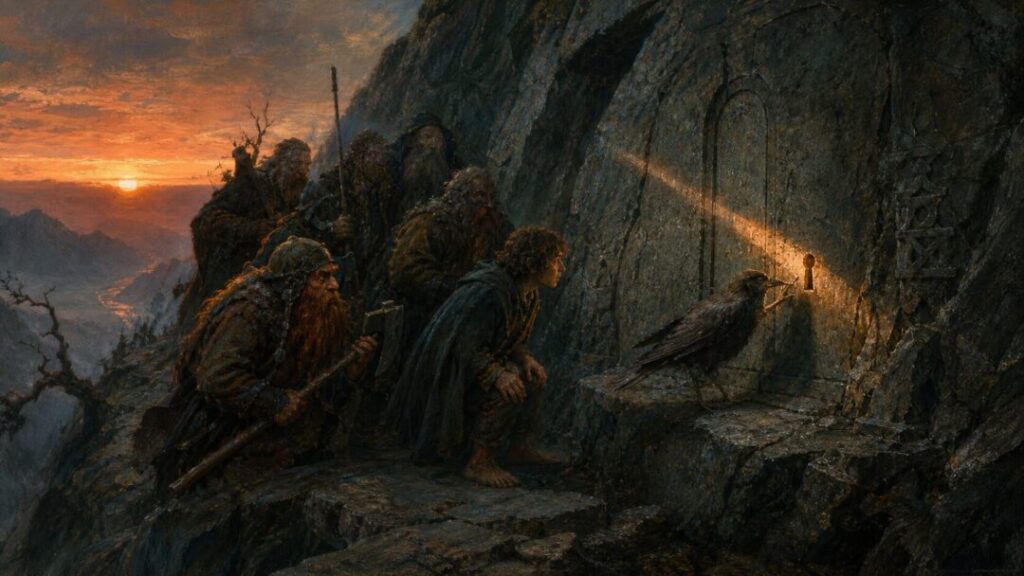
They find the place. They search. They wait. The thrush appears and knocks. The sun sinks. At the last moment, the hidden keyhole is revealed by a ray of light.
The solution is exact, but it is not mechanical in the ordinary sense.
The secret has been preserved in stone, moon-writing, memory, and timing. The map points to the door, but the door does not yield until the appointed moment comes.
This makes Durin’s Day feel less like a calendar note and more like a threshold.
The Dwarves who made or preserved this secret did not merely hide an entrance. They tied its revelation to a rare conjunction of signs: the grey stone, the knocking thrush, the setting sun, and the last light of Durin’s Day.
The text does not say that the door opens only once a year. It does not provide a complete rule for every possible year. It shows us one crucial moment in which the old signs come together.
That is enough.
The quest depends not only on courage, but on arriving at the edge of chance and meaning at exactly the right time.
Why the Dwarves’ Own Ignorance Matters
There is a sadness under this scene.
Thorin’s people are not ignorant because they are careless. They are a dispossessed people, driven from Erebor by Smaug. The map comes from a lost kingdom. The secret entrance belongs to a home they no longer possess.
So when Thorin says it passes their skill to guess when Durin’s Day will come again, the line carries more weight than a calendrical inconvenience.
It suggests distance from an older world of Dwarven knowledge.
The Dwarves still remember Durin.
They still honor the name.
They still possess the map.
But something has become difficult to recover.
That is one of the recurring patterns in Middle-earth: memory survives, but not always whole. Songs remain after kingdoms fall. Names remain after places are ruined. Maps remain after the roads have become dangerous. Knowledge is preserved in fragments, and those fragments must be read at the right time by the right people.
Elrond’s house is a refuge for such fragments.
But even Rivendell does not make the clue complete.
So Why Does Elrond Not Know?
The simplest answer is this:
Elrond does not know because Durin’s Day is a Dwarvish lunar reckoning, not a universally fixed date, and the text shows that even Thorin cannot confidently calculate its next occurrence.
But the deeper answer is more interesting.
Elrond knows the lore of moon-letters. Thorin knows the tradition of Durin’s Day. The map contains a secret neither can fully use without the other. And even once the words are understood, the company still must journey to the Mountain and wait for the appointed signs.
That is why the scene works.
It is not a failure of Elrond’s wisdom.
It is a reminder that Middle-earth is larger than any single mind, even one as learned as Elrond’s. Elven knowledge, Dwarven memory, ancient craft, natural signs, and chance all meet in one narrow doorway under the Lonely Mountain.
The question is not, “How could Elrond not know?”
The question is, “Why would we expect one person to hold every key?”
In this story, the key is literal. Thorin carries it. But the meaning of the key is scattered.
The moon reveals one part.
Elrond reads one part.
Thorin explains one part.
The thrush announces one part.
The setting sun completes the rest.
And only then does the Mountain open.
The Real Mystery Is Not Elrond
In the end, Elrond’s question is not an error to be solved away.
It is part of the design of the quest.
If Elrond already knew everything, the scene would become a simple explanation. Instead, it becomes a meeting of different kinds of knowledge. The Elf-lord, the Dwarf-king-in-exile, the wizard, and the hobbit all stand around a map whose secret is older and stranger than any of them can command alone.
Durin’s Day matters because it cannot be reduced to a date.
It is memory.
It is timing.
It is Dwarven identity.
It is the last light touching a hidden door at the exact moment when hope seems almost gone.
Elrond does not need to know when Durin’s Day is for the story to make sense.
In fact, the story becomes more powerful because he does not.
The road to Erebor is not opened by one person’s knowledge. It is opened by fragments coming together: moonlight in Rivendell, Dwarven tradition, an old map, a secret key, a knocking thrush, and the final ray of the sun.
That is why the moment feels so strange.
The answer was never simply written on the map.
It was waiting in the sky.
Sources & Notes
- J.R.R. Tolkien, The Hobbit, “A Short Rest” — Elrond identifies the moon-letters on Thrór’s Map, explains their lunar conditions, reads the hidden message about Durin’s Day and the keyhole, then asks Thorin what Durin’s Day means.
- J.R.R. Tolkien, The Hobbit, “A Short Rest” — Thorin defines Durin’s Day as the first day of the last moon of autumn when sun and moon are in the sky together, and admits it “passes our skill” to predict.
- J.R.R. Tolkien, The Hobbit, “On the Doorstep” — the company reaches the hidden door, waits through the signs of the thrush and sunset, and sees the last light reveal the keyhole at the appointed moment.