When Sauron fell at the end of the Second Age, Middle-earth did not immediately become whole again.
The Dark Lord was overthrown. Barad-dûr was cast down. The armies of the Last Alliance had won a victory so great that later generations could scarcely imagine it.
And in the middle of that victory lay a broken sword.
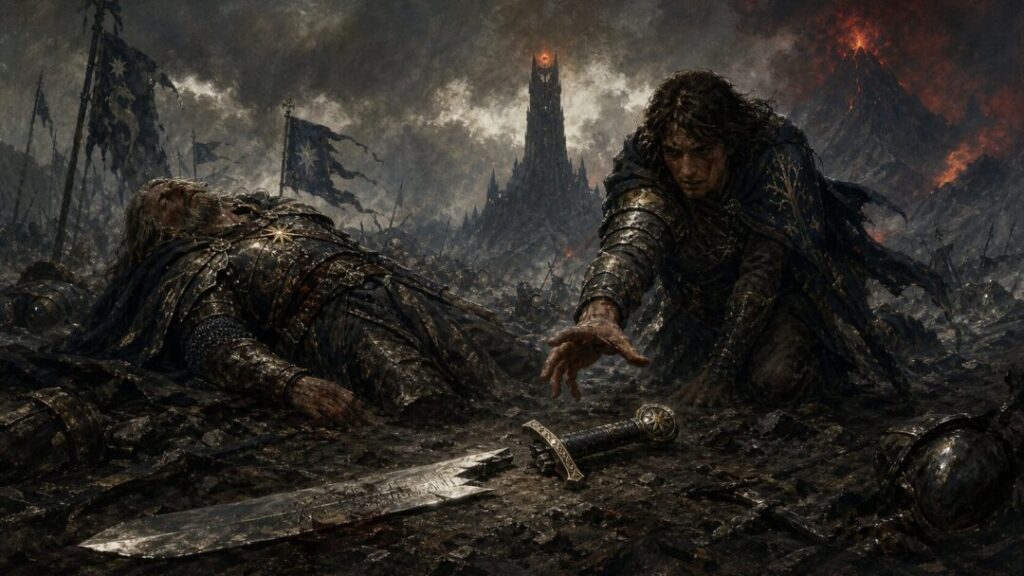
Narsil, the sword of Elendil, had shattered beneath him when he fell in his final struggle with Sauron. Isildur, Elendil’s son, took up the hilt-shard and cut the One Ring from Sauron’s hand.
That moment changed the history of the world.
But it also raises a quiet question.
If Narsil was the great sword of Elendil, and if Isildur had just used its broken remnant to defeat Sauron, why did he not repair it afterward?
Why did the Sword that was Broken remain broken for almost the entire Third Age?
The answer begins with an important correction:
The texts never give us a simple scene where Isildur explains his decision.
There is no passage where he says, “I will not reforge this blade.” There is no council debating whether it should be repaired. There is no stated law forbidding it.
So the safest answer is this:
Tolkien’s texts do not explicitly tell us why Isildur did not repair Narsil.
But they do give us enough to understand why the broken sword mattered—and why its repair belonged to a later moment.
Narsil Was Not Just a Weapon
Narsil was already ancient before the fall of Sauron.
It had been made by Telchar of Nogrod, the great Dwarven smith of the First Age. By the end of the Second Age, it was borne by Elendil, the High King of the Dúnedain in exile.
This matters because Narsil was never treated as merely useful iron.
It belonged to the line of Elendil. It shone with a significance larger than battle. When Elendil fell, the sword broke with him.
That is the first key.
Narsil was not broken in some ordinary accident. It was broken at the very moment the old High King died.
Then, in its broken state, it became the instrument by which the Ring was cut from Sauron’s hand.
So the sword’s story did not become weaker when it shattered.
It became more powerful.
A repaired Narsil might have been a great sword again. But the shards of Narsil were something different. They were the physical memory of the Last Alliance: Elendil’s fall, Isildur’s victory, and the terrible choice that followed.
Isildur Did Keep the Shards
One reason the question feels so strange is that Isildur clearly did not discard Narsil.
He did not leave it on the battlefield.
He did not treat it as a useless relic.
He did not forget what it was.
The later account of the Disaster of the Gladden Fields shows that Isildur still had the shards with him when he was journeying north early in the Third Age.
That is a crucial detail.
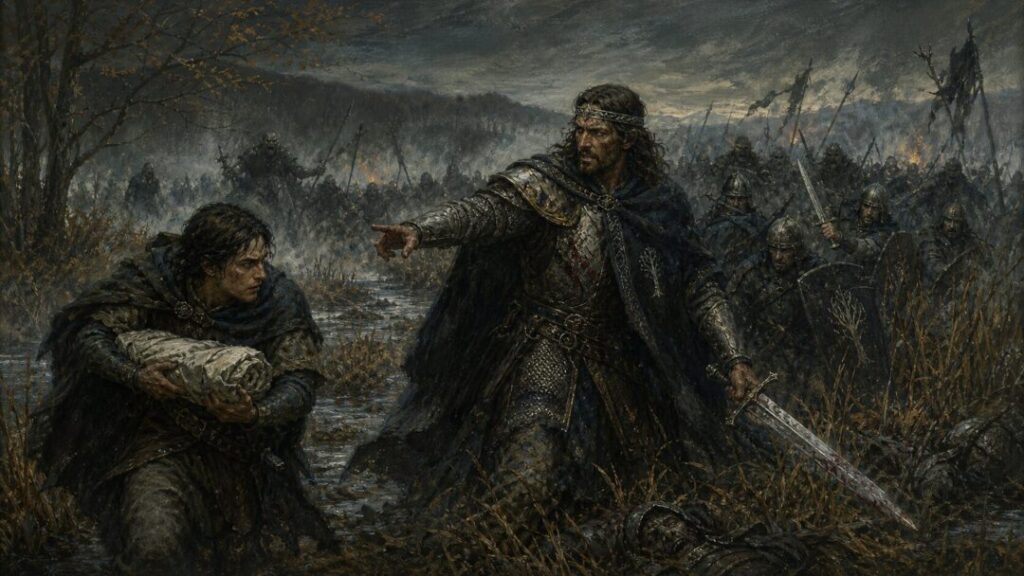
Before the final disaster overtook his company, Isildur ordered his esquire Ohtar to take the shards of Narsil and escape. The sword was to be saved from capture.
This tells us something important about Isildur’s priorities.
At that moment, he knew his company was in grave danger. His eldest sons were with him. The Ring was secretly in his possession. Orcs were closing in. The survival of his house and memory was at stake.
And among the things he made sure to preserve were the shards of his father’s sword.
That does not look like neglect.
It looks like reverence.
The Ring Overshadowed Everything
The simplest practical answer is that Isildur did not live long enough for Narsil’s story to move forward.
After Sauron’s defeat, Isildur did not enter a long peaceful reign in which all old wounds could be mended. He remained bound to the aftermath of the war.
Gondor had to be ordered. The losses of the Last Alliance were immense. His brother Anárion had been slain. His father Elendil had been slain. Sauron had been overthrown, but not destroyed beyond return, because the Ring endured.
And Isildur himself had taken the Ring.
This is the shadow behind every question about him.
The texts do not support the idea that Isildur immediately understood the full future danger of the Ring in the way Elrond, Gandalf, or later Frodo came to understand it. But they do show that the Ring became a central burden in his story.
In the account preserved in Unfinished Tales, Isildur intended to go north. His youngest son Valandil was in Rivendell, and Isildur was heading toward the North-kingdom. The journey ended in the Disaster of the Gladden Fields.
So even if one imagines that Narsil could have been repaired in time, the texts never show Isildur reaching a stable moment where that restoration happens.
His story is cut short.
Like the sword.
A Broken Sword Can Mean More Than a Whole One
There is also a deeper symbolic reason.
Narsil’s brokenness matches the condition of Isildur’s world.
The Last Alliance had won, but the victory was incomplete. Sauron’s bodily form was overthrown, but the Ring remained. Elendil’s line survived, but it had been wounded. The Dúnedain kingdoms endured, but their unity would not last in the same form.
A fully repaired Narsil immediately after the war might have suggested closure.
But the story does not give us closure.
It gives us survival.
The shards pass into the keeping of Isildur’s heirs. They become an heirloom of the North, not a battlefield weapon used by king after king. They are carried forward as a sign that something has not yet been fulfilled.
That is why the phrase “the Sword that was Broken” matters so much later.
It is not just a description.
It is an identity.
The sword’s brokenness becomes part of its meaning.
The Sword Belonged to the Heirs of Isildur
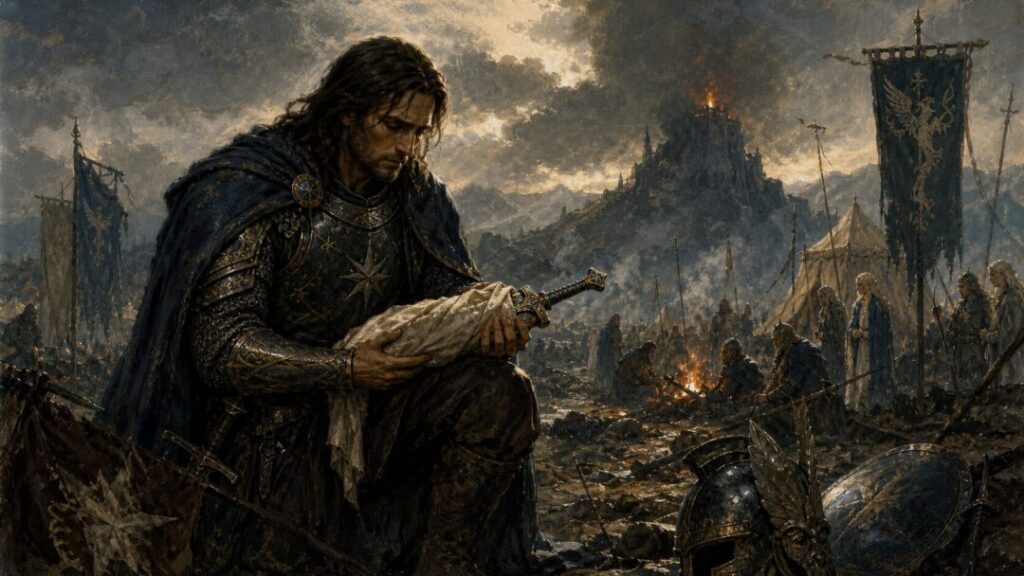
After Isildur’s death, the shards of Narsil were preserved through his line.
This is important because the sword’s future is tied not to Gondor alone, but to the heirs of Isildur in the North.
Isildur’s youngest son, Valandil, survived because he had remained in Rivendell. Through him the line continued. The shards became one of the great heirlooms of that house.
But the North-kingdom itself later declined and fell. Arnor was divided. Its successor realms were broken. The kingship disappeared from public power and continued in hidden form through the Chieftains of the Dúnedain.
The sword remained with that story.
A broken blade for a broken royal line.
This is why its eventual reforging is not just about making a weapon usable again. It is about the restoration of a kingship that has been hidden, diminished, and long delayed.
Why Aragorn, Not Isildur?
By the time Aragorn enters the story, Narsil has become more than Elendil’s sword.
It is the visible sign of a claim that has survived ruin.
Aragorn carries the shards before they are reforged. At the Council of Elrond, the broken sword is revealed and recognized. Its presence is not accidental. It declares who Aragorn is before he ever takes the throne.
Then comes the old verse:
“All that is gold does not glitter,
Not all those who wander are lost;
The old that is strong does not wither,
Deep roots are not reached by the frost.”
And later:
“Renewed shall be blade that was broken,
The crownless again shall be king.”
The connection is unmistakable.
The blade is renewed when the crownless king is ready to move toward his kingship.
That moment belongs to Aragorn because Aragorn’s story is one of return. Not merely survival, not merely inheritance, but restoration.
Isildur’s story is different.
Isildur stands at the beginning of the long wound. Aragorn stands at its healing.
Was Isildur Unworthy to Reforge It?
This is where the answer must be careful.
It is tempting to say Narsil was not reforged for Isildur because he failed to destroy the Ring.
That idea is dramatic, but the texts do not state it directly.
Isildur’s refusal to destroy the Ring is one of the great turning points in Middle-earth’s history. He claimed it as weregild for his father and brother. That choice allowed Sauron’s power to endure in hidden form.
But we should not claim that some explicit doom fell on Narsil because of that decision.
The texts do not say the sword could not be reforged because Isildur was morally unworthy. They do not say the blade rejected him. They do not say Elvish smiths refused him.
What they do show is more subtle.
Isildur’s victory was incomplete because the Ring survived. Therefore the full renewal symbolized by Narsil could not truly arrive in his day.
This is interpretation, but it is strongly aligned with the pattern of the story.
The sword is renewed when the Ring is about to be challenged again—and when the heir of Isildur is ready to do what Isildur did not complete.
Why Not Repair It for Practical Use?
There is another possibility: perhaps the shards simply were not repaired because their value as an heirloom outweighed their value as a weapon.
This is not stated outright, but it fits the evidence.
In Middle-earth, ancient objects can carry memory, authority, and identity. The shards of Narsil were not merely broken steel. They were proof of descent from Elendil and Isildur.
If repaired too soon, the sword might have become one more royal weapon.
Left broken, it became a sign.
Every generation that preserved it was preserving a promise it could not yet fulfill.
This is why the broken sword works so powerfully in Aragorn’s hands. Before it is reforged, it does not show that he already possesses restored kingship. It shows that he bears the burden of a kingship still waiting to be restored.
The Reforging Was Timed to the War of the Ring
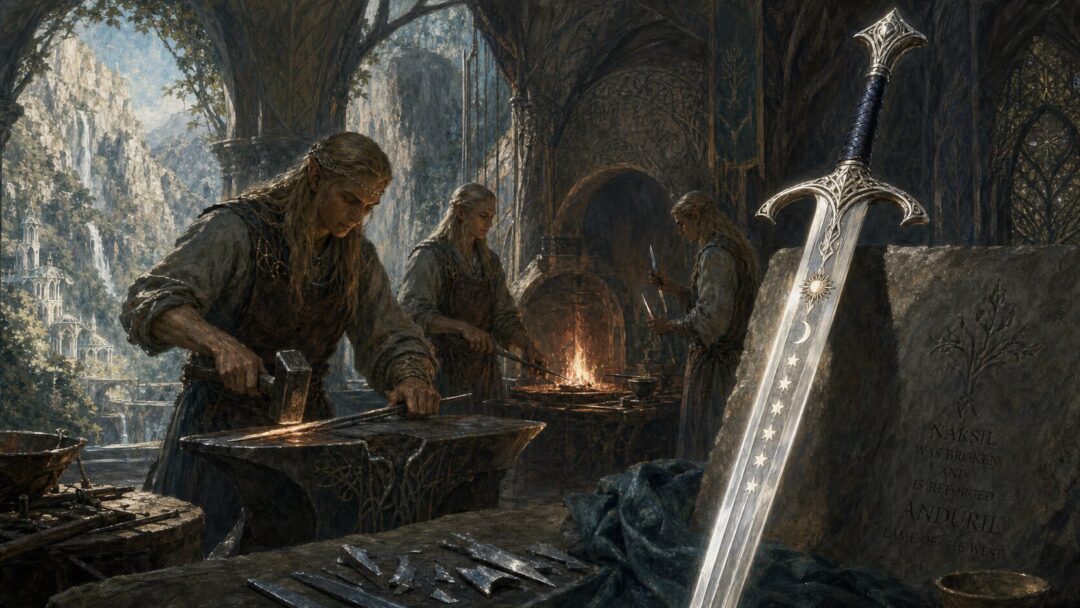
Narsil is finally reforged in Rivendell before the Fellowship sets out.
The timing matters.
The Ring has been found.
Sauron has openly returned.
The heir of Isildur is revealed.
The final struggle has begun.
Only then does the Sword that was Broken become Andúril, Flame of the West.
This is not just a repair job.
It is a declaration.
The old light of Narsil returns in a new form. The sword that cut the Ring from Sauron’s hand is now carried by the man who will help bring about Sauron’s final defeat—not by claiming the Ring, but by opposing him while the Ring is carried to its destruction.
Andúril is not the answer by itself. Aragorn does not defeat Sauron through sword-strength alone. The Ring is destroyed through Frodo, Sam, Gollum, mercy, endurance, and providence.
But Andúril still matters.
It is the visible sign that the West has not forgotten who it is.
The Real Answer
So why did Isildur not repair Narsil?
Because the texts never show him doing so, and they never give one explicit reason.
But the strongest lore-accurate answer is this:
Isildur preserved the shards because they were already sacred as the sword of Elendil and the weapon by which Sauron was overthrown. He died before any later restoration could take place. Afterward, the shards became an heirloom of his line, carrying the memory of a broken kingship until the time came for that kingship to return.
Narsil was not waiting because no one cared.
It was waiting because the story was not ready.
The sword broke with Elendil.
It passed through Isildur.
It survived the fall of kings.
It remained with the hidden heirs of the North.
And when the Ring returned, when Sauron rose again, and when the crownless king finally stepped out of shadow, the blade was renewed.
Not as Narsil.
As Andúril.
The Flame of the West.
That is the quiet power of the broken sword.
It was not repaired after the first victory because the first victory was not the end.
It was only the beginning of the long wait.
Sources & Notes
- J.R.R. Tolkien, The Lord of the Rings, Book II, Chapter 2, “The Council of Elrond” — gives the core account: Elendil fell, Narsil broke beneath him, Isildur cut the Ring from Sauron’s hand with the hilt-shard, and later claimed the Ring as weregild.
- J.R.R. Tolkien, Unfinished Tales, “The Disaster of the Gladden Fields” — shows Isildur carrying the shards after the war and ordering Ohtar to save them, supporting preservation rather than neglect.
- J.R.R. Tolkien, The Lord of the Rings, Appendix A, “The Númenórean Kings” — traces Isildur’s heir Valandil and the later northern line, the context in which the shards become an heirloom of Isildur’s house.
- J.R.R. Tolkien, The Lord of the Rings, Book I, Chapter 10, “Strider” — Aragorn’s verses link the broken blade with the crownless king, especially “Renewed shall be blade that was broken.”
- J.R.R. Tolkien, The Lord of the Rings, Book II, Chapter 3, “The Ring Goes South” — records the reforging of the Sword of Elendil as Andúril in Rivendell before the Fellowship sets out, tying renewal to Aragorn’s moment in the War of the Ring.