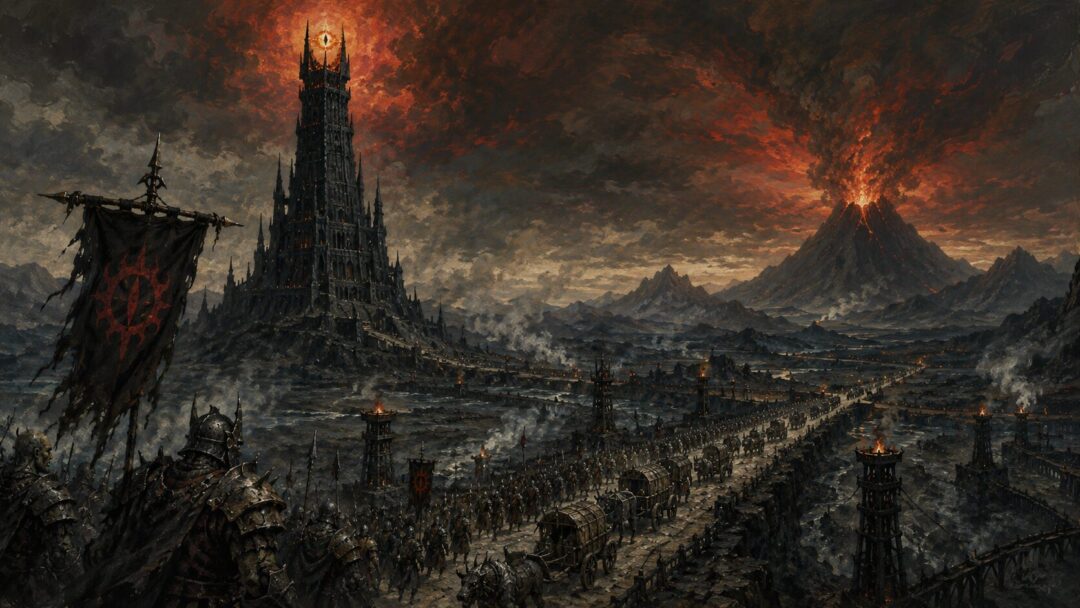
Most people picture Sauron’s victory as the end of everything.
The sky darkens. Armies pour from Mordor. Minas Tirith falls. The Shire burns. The Elves vanish. The last free peoples of Middle-earth are crushed beneath the Eye.
That image is not wrong.
But it is incomplete.
The deeper horror of Sauron is not that he wanted to destroy Middle-earth. Destruction was often useful to him, but it was not the final shape of his desire.
Sauron wanted dominion.
He wanted a world ordered by his will, arranged according to his design, and stripped of any freedom strong enough to resist him. In the texts, he is not presented as a force of mindless ruin. He is a ruler, a deceiver, a maker of systems, a commander of armies, and a spirit whose desire for order has become inseparable from domination.
That is what makes his imagined victory so disturbing.
A conquered Middle-earth would not simply have become a wasteland.
It would have become a machine.
Sauron Did Not Want Chaos
One of the most important things to understand about Sauron is that he is not merely destructive.
The texts consistently show him as a being of control.
Morgoth, his first master, poured much of his will into the corruption and marring of the world itself. Sauron is different. He inherits evil, but his own particular evil is more administrative, more strategic, and in some ways more coldly rational.
He builds fortresses.
He organizes armies.
He sends messengers.
He treats with enemies when it serves him.
He corrupts kings.
He uses Rings, oaths, fear, tribute, spies, roads, and chains.
This does not make him less evil.
It makes him more dangerous.
A purely destructive power can burn a city. Sauron can make the survivors rebuild it in his name.
That is the essential difference.
His goal was not a Middle-earth where nothing lived. His goal was a Middle-earth where everything that lived bent toward him.
Mordor Was the Model
The clearest glimpse of Sauron’s intended world is Mordor itself.
Mordor is often imagined as only ash, smoke, and volcanic ruin. And parts of it are exactly that. The lands near Gorgoroth are blasted and dreadful, dominated by the Dark Tower, Mount Doom, roads, camps, pits, and marching armies.
But Mordor is not merely a dead land.
It has structure.
It has supply lines. It has watchtowers and guarded passes. It has mustering places and roads. It has the fortified Black Gate in the north-west, Minas Morgul guarding the western approach, Cirith Ungol above the pass, and Barad-dûr as the center of Sauron’s power.
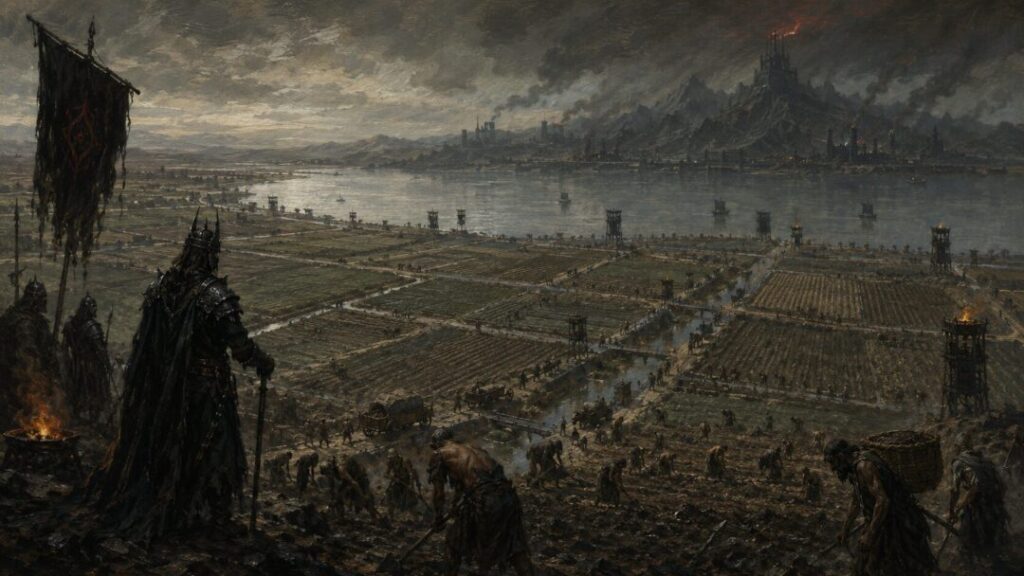
Most importantly, the south of Mordor around the Sea of Núrnen contains lands worked by slaves. After Sauron’s fall, Aragorn releases the slaves of Mordor and gives them the lands around Lake Núrnen as their own. That small detail tells us a great deal.
Sauron’s empire was not sustained by Orcs alone.
It rested on labor.
On fear.
On command.
On the conversion of living peoples into instruments of his war.
This is probably the closest thing we have to a practical model of Sauron’s rule: not universal slaughter, but organized enslavement beneath a military and spiritual tyranny.
The Terms at the Black Gate
The most direct glimpse of Sauron’s political plan comes through his messenger at the Black Gate.
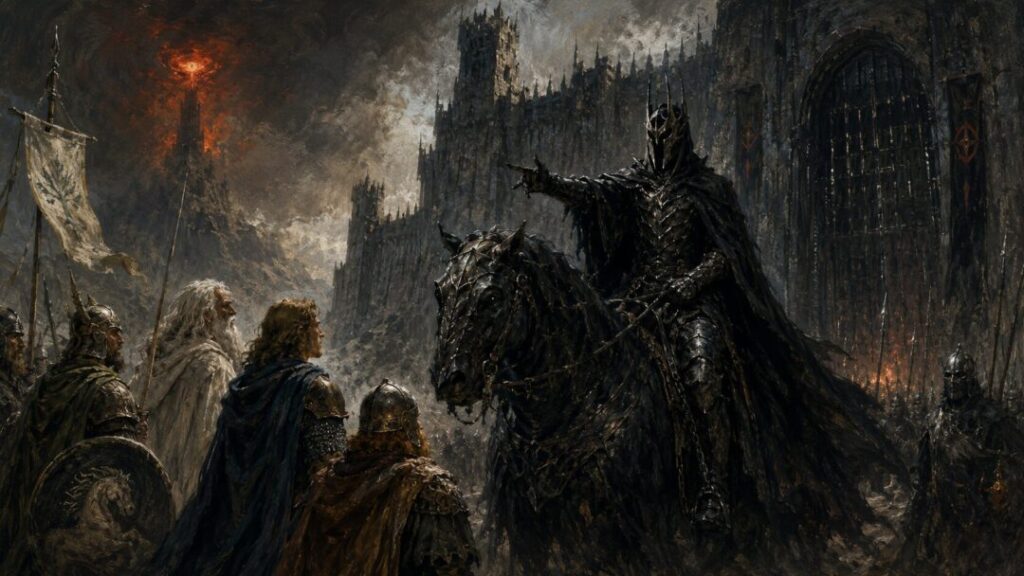
When the Captains of the West stand before Mordor, the Mouth of Sauron offers terms. These terms are not mercy. They are domination disguised as settlement.
The armies of Gondor and their allies are to withdraw beyond Anduin and swear never again to attack Sauron, openly or secretly. All lands east of Anduin are to belong to Sauron forever. The lands west of Anduin as far as the Misty Mountains and the Gap of Rohan are to become tributary to Mordor. The Men there are to bear no weapons, though they will be permitted to govern their own affairs.
That last phrase is chilling.
On the surface, it sounds like limited autonomy. The peoples of the West would still have names, homes, local leaders, and perhaps even laws of their own.
But the Captains understand the truth behind it. Looking into the messenger’s mind, they perceive that he would be set over them as lieutenant, and that they would become his slaves.
This is one of the most revealing moments in the whole War of the Ring.
Sauron did not need to abolish every kingdom immediately.
He only needed to empty them of real power.
A disarmed Gondor.
A tributary Rohan.
A West ruled through fear.
A lieutenant of Barad-dûr standing above local rulers.
No independent armies.
No resistance, open or hidden.
No freedom strong enough to matter.
That is not peace.
It is occupation.
What Would Happen to Gondor and Rohan?
The texts do not give a detailed future history of a victorious Mordor, so anything beyond the stated terms must be handled carefully.
But the terms themselves allow a conservative conclusion.
Gondor would not remain truly sovereign. Even if some local administration survived, it would exist only under Mordor’s permission. Its military strength would be broken. Its eastern lands would be lost. Its people would be forbidden to wage war against Sauron in any form.
Rohan would likely fall under the same shadow, since the offered tributary zone reaches as far as the Gap of Rohan. The Rohirrim’s identity is inseparable from horses, arms, oaths, and military service. A disarmed Rohan would still have its fields and people, but the heart of its freedom would be removed.
This is interpretation, but it follows directly from the terms: Sauron’s plan for the West was not immediate extermination, but submission.
He would allow what served him to remain.
He would remove what could resist.
What About the Shire?
The Shire is not mentioned in the Mouth of Sauron’s terms.
That silence should not be overread. We cannot claim a specific canon plan for Hobbiton under Sauron, because the texts do not provide one.
But we can say this: the Shire would not have remained safely outside history.
Even before Sauron’s final defeat, the Shire suffers under a lesser tyranny through Sharkey’s men. That episode is not Sauron directly ruling the Shire, and it should not be confused with Mordor’s formal plan. But it does show how fragile an ordinary peaceful land becomes when power, fear, informers, rules, and petty domination enter it.
Under Sauron, the Shire might have been ignored for a time if it had no military value. Or it might have been absorbed into wider systems of tribute and control. The texts do not say.
What they do make clear is that Sauron’s victory would leave no free corner permanently untouched.
The Ring was not made to rule only kings.
It was made for mastery.
The Ring Was the Final Instrument
Sauron was already terrifying without the Ring.
By the end of the Third Age, he commands vast armies, dominates Mordor, threatens Gondor, influences the East and South, and sends the Nazgûl across Middle-earth. His power is real even while the Ring is lost.
But the Ring is still central.
It was made as the Ruling Ring, the Master Ring, created to dominate the other Rings and their bearers. Sauron placed much of his own power into it. With it restored to him, his victory would be more than military. It would become spiritual and political mastery intensified.
This does not mean every mind in Middle-earth would instantly become a puppet. The texts do not describe the Ring as working in such a simple mechanical way.
But the Ring is consistently tied to domination of wills. In Sauron’s hand, it would have completed the pattern already visible in Mordor: fear, obedience, hierarchy, surveillance, and the crushing of rival powers.
The armies would win the land.
The Ring would secure the mastery.
Would the Elves Survive?
The Elves were among Sauron’s deepest enemies.
His hatred of them is rooted in the long history of the Rings, the wars of the Second Age, and the resistance of the Eldar. The Three Rings were hidden from him, and their power was used to preserve places like Rivendell and Lórien.
If Sauron regained the One, the position of the Elven realms would become hopeless.
The Three would be subject to him if their bearers continued to use them. If they removed them, the preservation they sustained would fail. Either way, the time of the great Elven refuges in Middle-earth would end.
This does not require imagining Sauron personally hunting every Elf. The result is already built into the logic of the Rings. The Elves would have to flee, fade, hide, or fall under a power they had resisted since the Second Age.
A Sauron-ruled Middle-earth would be a world where the last visible lights of the Elder Days were extinguished or driven away.
The Fate of Men
Men would likely become the central population of Sauron’s empire.
That may sound strange, but it fits the evidence. Many Men already serve him: Easterlings, Haradrim, Black Númenóreans, and others under his influence or command. The Nine themselves were once Men, and their fate shows the most extreme form of Sauron’s domination over human kings.
Sauron does not merely kill Men.
He uses them.
He turns ambition, fear, pride, and desire for power into chains. Some serve him willingly. Others serve through terror. Others are born into lands where his shadow is already established and know no other lord.
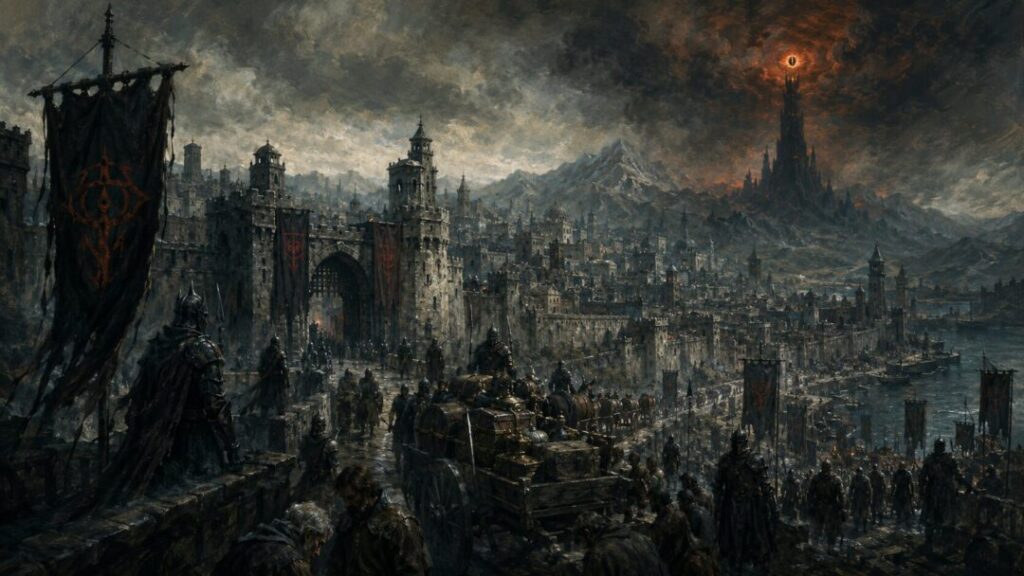
In a conquered Middle-earth, Men would probably remain rulers, soldiers, laborers, messengers, craftsmen, and administrators—but only within the boundaries set by Mordor.
There might still be thrones.
But the thrones would be beneath the Eye.
Would Sauron Demand Worship?
Here the evidence becomes especially dark.
The letters indicate that Sauron desired not only political rule but divine honor. He wished to be treated as a god-king by his servants, and in victory would have demanded that kind of reverence from rational creatures.
This matters because it means his rule would not be merely imperial.
It would be blasphemous in shape.
Sauron’s empire would demand more than taxes, soldiers, and obedience. It would seek inward submission. It would require peoples to acknowledge not simply that he was stronger, but that he had the right to rule absolutely.
That is why the struggle against him is not only a war for territory.
It is a war over worship, freedom, and the rightful limits of power.
Sauron wants what no creature in Middle-earth has the right to claim.
A World That Still Looks Alive
The most unsettling version of Sauron’s victory is not a silent world of ash.
It is a world that continues.
Fields are harvested.
Roads are patrolled.
Messengers ride.
Local rulers issue commands.
Tribute is collected.
Children are born into fear and taught that the Eye has always watched.
Old songs are forbidden, forgotten, or emptied of meaning.
The names of kings remain, but their authority is hollow.
The map still has borders, but freedom has vanished from them.
That is the nightmare.
Not the end of life.
The conquest of life.
Sauron’s plan, as far as the texts allow us to see it, was not to erase Middle-earth but to possess it. To make every land useful, every people subordinate, every rival power broken, and every will answerable to his own.
Mordor was not simply his fortress.
It was the beginning of his design.
And if the Ring had returned to him, that design would have spread until Middle-earth still had mountains, rivers, cities, fields, and names—but no free heart left beneath them.
That is why the destruction of the Ring matters so deeply.
The West did not merely avoid defeat.
It escaped being remade into the image of Sauron’s will.
Sources & Notes
- J.R.R. Tolkien, The Lord of the Rings, Book V, Chapter 10, “The Black Gate Opens” — the Mouth of Sauron’s terms give the clearest picture of Sauron’s intended settlement: disarmament, tribute, lost lands east of Anduin, and rule through a lieutenant.
- J.R.R. Tolkien, The Lord of the Rings, Book VI, Chapter 5, “The Steward and the King” — Aragorn’s freeing of Mordor’s slaves and granting them the lands about Lake Núrnen supports the article’s point that Sauron’s empire ran on organized labor and subjugation, not mere destruction.
- J.R.R. Tolkien, The Silmarillion, “Of the Rings of Power and the Third Age” — the One Ring was made to rule the other Rings and their bearers, explaining why Sauron’s victory would threaten the Elven realms as well as military opponents.
- J.R.R. Tolkien, The Lord of the Rings, Book I, Chapter 2, “The Shadow of the Past” — Gandalf’s account of the Ruling Ring and the Nine shows Sauron’s characteristic method: mastery of wills through fear, corruption, and enslavement.
- J.R.R. Tolkien, Letter 131 — Tolkien distinguishes Sauron from mere ruin by stressing his desire to order all things according to his own will and to be treated as a god-king by his servants.