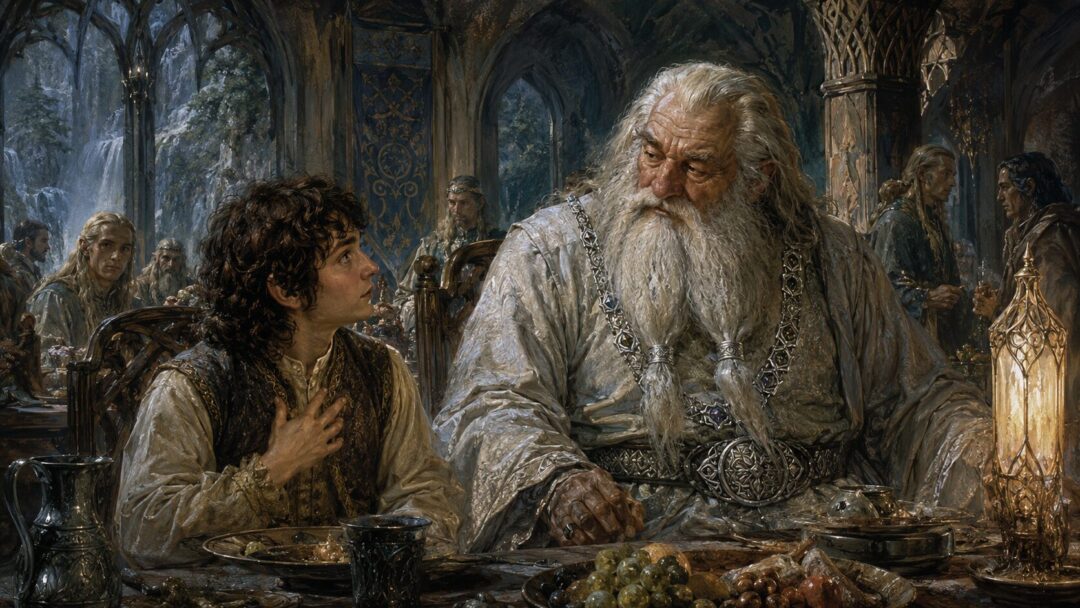
It feels like one of those conversations that must have happened.
Frodo Baggins and Gimli son of Glóin spend weeks together as members of the Fellowship of the Ring. They travel south from Rivendell, cross the wild lands of Eriador, attempt the Redhorn Pass, enter Moria, pass through Lothlórien, and journey down the Great River toward the breaking of the Company.
And behind both of them stands an older story.
Frodo is Bilbo’s heir. Gimli is Glóin’s son.
Bilbo and Glóin had travelled together long before, as part of Thorin Oakenshield’s company on the Quest of Erebor. They had crossed the Misty Mountains, endured capture, wandered through Mirkwood, reached the Lonely Mountain, and lived through the events surrounding Smaug and the Battle of Five Armies.
So the question seems almost unavoidable:
Did Frodo and Gimli ever talk about the adventure that connected their families?
The careful answer is no — not in any scene the text records.
But that does not make the question unimportant.
In fact, the silence may be the most interesting part.
Frodo Meets Glóin Before He Meets Gimli
The strongest connection between the two generations appears in Rivendell.
After Frodo recovers from the wound he received at Weathertop, he attends the feast in Elrond’s house. There, seated beside him, is a richly dressed Dwarf with a white beard, a silver belt, and a chain of silver and diamonds.
This is Glóin.
Frodo recognizes the significance immediately. He asks whether this is the Glóin who was one of the companions of Thorin Oakenshield. Glóin confirms it, and he already knows who Frodo is: the kinsman and adopted heir of Bilbo.
That matters.
Frodo does not need anyone to explain Glóin’s importance. He already knows the old story well enough to identify him. This strongly implies that Bilbo’s adventures were not distant family gossip to Frodo. They were part of the living memory of his household.
Glóin also speaks warmly of Bilbo. He calls him “Bilbo the renowned,” and the whole exchange is marked by courtesy, recognition, and shared affection.
Before Frodo ever sets out with Gimli, he has already met Gimli’s father.
And that meeting is not casual.
It is one of the clearest bridges between The Hobbit and The Lord of the Rings.
What Frodo and Glóin Actually Discuss
The conversation between Frodo and Glóin does not become a detailed retelling of the Quest of Erebor.
Instead, it becomes something more revealing.
Glóin speaks of the northern lands as they now are. He tells Frodo of the Beornings, the Men of Dale, the kingdom under the Mountain, and the works his people have made since Smaug’s fall. Frodo learns that Dáin is still King under the Mountain, and that several of Thorin’s surviving companions remain with him.
This is not nostalgia for the old adventure.
It is the aftermath of that adventure.
The Desolation of Smaug has not merely been survived. It has been rebuilt. Dale has grown. Erebor has prospered. Roads, waterways, halls, and towers have been made. The victory of the earlier story has become a living civilization.
But then the shadow enters.
When Frodo asks about Balin, Ori, and Óin, Glóin’s face darkens. He says they do not know what has become of them, and that Balin is largely the reason he has come to Rivendell.
That one moment quietly changes the whole tone.
The cheerful memories of the old quest open onto something unresolved. One of Bilbo’s old friends has gone into Moria and vanished. The past is not safely behind them. It is reaching forward.
This is where Gimli’s presence becomes important.
Gimli Is There, But Not Yet Central
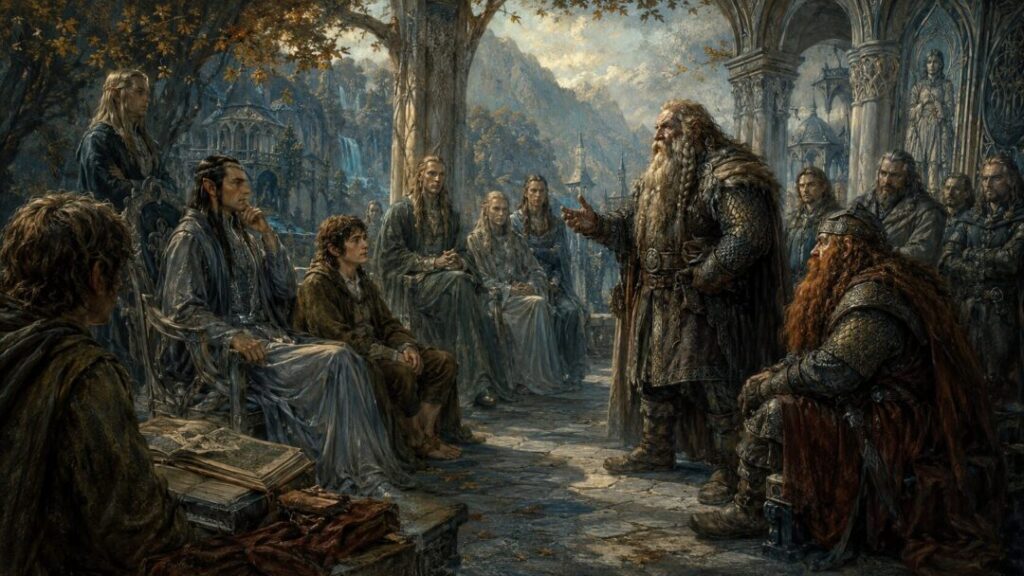
At the Council of Elrond, Gimli is introduced simply and directly: he is the younger Dwarf at Glóin’s side, his son.
That is all the text needs to say.
Gimli is not yet the fully developed companion readers will come to know. He is not yet the friend of Legolas, the admirer of Galadriel, or the future lord associated with the Glittering Caves. At this point, he stands in his father’s shadow.
And that shadow is full of history.
Glóin brings news from Erebor. He reports the troubling visit of a messenger from Mordor, who asked about hobbits and about a ring. He explains the concern over Balin’s expedition to Moria. He helps tie the fate of the Dwarves to the larger danger of Sauron.
Gimli hears all of this.
Frodo hears all of this.
They are in the same council, receiving the same story, standing at the meeting point between Bilbo’s adventure and the War of the Ring.
Yet the text does not show Frodo and Gimli turning to each other and saying what readers might expect them to say.
There is no recorded exchange like: “Your father knew Bilbo,” or “Bilbo spoke of Glóin,” or “Our families have shared a road before.”
The connection is obvious.
The conversation is absent.
Does That Mean They Never Spoke of It?
Not necessarily.
This is where careful phrasing matters.
The text never states that Frodo and Gimli discussed Bilbo and Glóin. It also never states that they did not.
The Lord of the Rings does not record every conversation among the Fellowship. Even the Council of Elrond is summarized in places, and the narration openly tells us that not all that was spoken and debated needs to be told.
So it is entirely possible, as interpretation, that Frodo and Gimli may have spoken at some unrecorded moment about Bilbo, Glóin, Erebor, or the old road east.
But that remains speculation.
Canon gives us no direct scene of such a conversation.
And because of that, the safer answer is this:
Frodo and Gimli almost certainly knew of the connection between Bilbo and Glóin, but no surviving narrative passage shows them discussing it with each other.
That distinction matters.
It keeps us from inventing a scene the text does not provide, while still acknowledging what the text strongly implies.
Why the Silence Feels Strange
The silence stands out because The Lord of the Rings is deeply interested in memory.
Characters carry old stories everywhere.
Aragorn carries the memory of Númenor and the broken kingdoms. Legolas carries the long memory of the Elves. Gimli carries the memory of Khazad-dûm and Durin’s people. Frodo carries Bilbo’s book, Bilbo’s Ring, and eventually Bilbo’s burden.
The Fellowship is not just a group of travelers.
It is a meeting of histories.
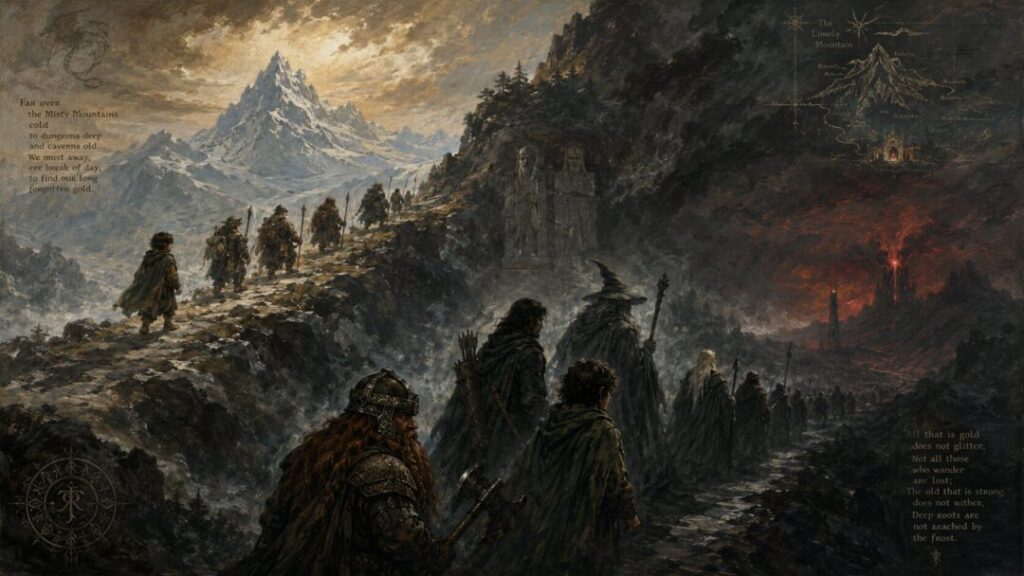
That is why the Frodo-Gimli connection feels so significant. Through Bilbo and Glóin, Hobbits and Dwarves had already shared one unlikely alliance. A Hobbit had once joined Dwarves on a desperate journey into danger. Now, decades later, a Dwarf joins a Hobbit on an even darker road.
The pattern is unmistakable.
But the second journey is not a simple repetition of the first.
Bilbo’s road led to treasure, dragon-fire, and the restoration of a kingdom. Frodo’s road leads toward renunciation, loss, and the unmaking of power.
That difference may explain why the story does not pause for warm comparison.
The old adventure is present, but it is not enough to explain the new one.
Moria Changes the Meaning of the Connection
The deepest reason this question matters appears in Moria.
Glóin came to Rivendell partly because of Balin’s disappearance. Frodo had already heard that uncertainty at the feast. Gimli enters the Fellowship with hope that Moria might still hold some sign of Dwarven life and glory.
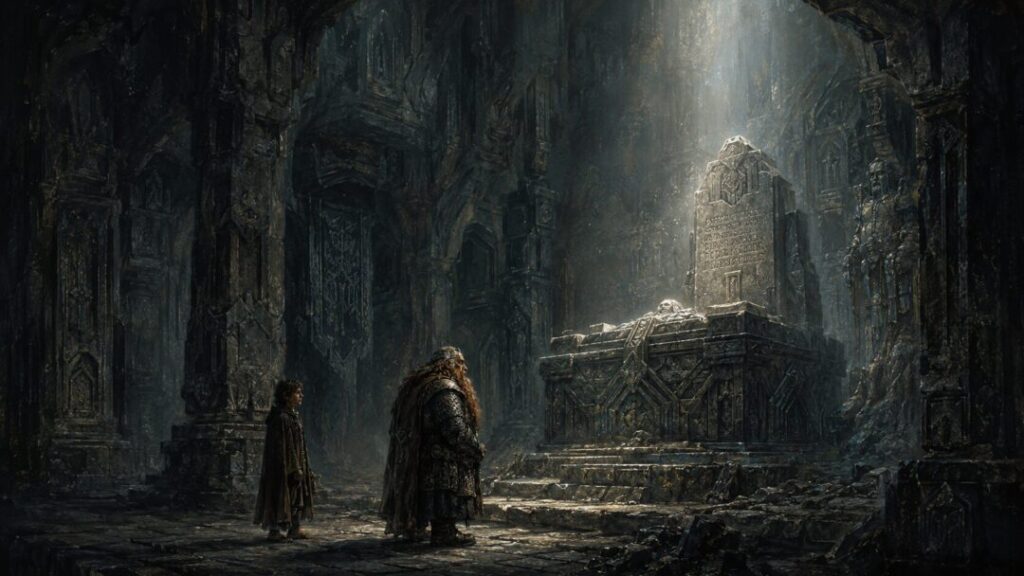
But inside Moria, the Fellowship discovers Balin’s tomb.
This moment pulls The Hobbit’s surviving world into tragedy.
Balin was not just a name from Dwarven history. He was one of Bilbo’s companions. He had known Bilbo personally. Bilbo later went with Dwarves to Dale after leaving the Shire, and he says that old Balin had already gone away. That detail, small as it is, makes the loss feel close.
For Frodo, Moria is not only an ancient Dwarven realm.
It is connected to Bilbo’s friends.
For Gimli, it is ancestral memory made grief.
If Frodo and Gimli ever might have spoken of Bilbo and Glóin with fondness, Moria turns that possible conversation into something darker. The old adventure’s companions are no longer merely figures of a great tale. Some are missing. Some are dead. Their world is under pressure from the same Shadow that now hunts the Ring.
The past has caught up with the present.
Frodo and Gimli Share More Than They Say
Frodo and Gimli are not among the most verbally developed friendships in the Fellowship.
Gimli’s most famous bond becomes his friendship with Legolas. Frodo’s closest companions remain Sam, Merry, and Pippin, with Aragorn and Gandalf guiding him in different ways.
But Frodo and Gimli still share an important symbolic connection.
Both are heirs to stories they did not begin.
Frodo inherits Bilbo’s Ring, his home, his writings, and the consequences of his discovery in the Misty Mountains. Gimli inherits the pride, grief, and hopes of Durin’s Folk, including his father’s connection to Erebor and the unresolved longing for Moria.
Neither of them chooses the old history.
They step into it.
That is one of the quiet patterns of The Lord of the Rings. The past is never dead, but it is also never merely repeated. It returns changed. Bilbo’s adventure begins almost playfully, with an unexpected party and an unwilling burglar. Frodo’s begins with secrecy, pursuit, and a wound that never fully heals.
Glóin’s journey helped restore a kingdom.
Gimli’s journey becomes part of the effort to save all free peoples from domination.
The connection is real, but the scale has changed.
Why No Direct Conversation May Be the Right Choice
A direct conversation between Frodo and Gimli about Bilbo and Glóin would have been satisfying.
It would also have been easy.
Too easy, perhaps.
The Lord of the Rings often trusts readers to notice patterns without naming them. It does not always underline its echoes. It lets them gather slowly.
Frodo meeting Glóin is enough.
Gimli standing beside Glóin at the Council is enough.
The journey through Moria is more than enough.
By refusing to give Frodo and Gimli a neat reflective exchange, the story allows the connection to remain embedded in the world rather than turned into explanation. It feels less like a reference and more like history.
That is part of what makes Middle-earth feel deep.
People do not always stop to explain the significance of the moment they are living through. Often, they only understand later — if they survive long enough to look back.
The Careful Answer
So, did Frodo and Gimli ever discuss the adventures of Bilbo and Glóin?
In the recorded text, no.
There is no direct scene in which Frodo and Gimli talk about Bilbo and Glóin’s shared journey with Thorin’s company.
What the text does show is more subtle.
Frodo knows who Glóin is. Glóin knows Frodo as Bilbo’s heir. They speak warmly in Rivendell. Gimli is present with his father at the Council. The Fellowship later passes through Moria, where the fate of Balin and his companions turns the legacy of Bilbo’s adventure into grief.
It is possible that Frodo and Gimli spoke of these things off the page.
But that is interpretation, not stated fact.
The true power of the connection lies in what remains unsaid.
Bilbo and Glóin once shared a road to the Lonely Mountain.
Frodo and Gimli later shared a road toward Mordor.
One journey helped awaken the North.
The other carried the fate of the world.
And between them stands a silence that feels less like an omission than a doorway — one of those quiet spaces in Middle-earth where the reader can sense a whole history moving beneath the words.
Sources & Notes
- J.R.R. Tolkien, The Lord of the Rings, Book II, Chapter 1, “Many Meetings” — Frodo sits beside Glóin in Rivendell, recognizes him as one of Thorin Oakenshield’s companions, and hears news of Erebor, Dale, and Balin.
- J.R.R. Tolkien, The Lord of the Rings, Book II, Chapter 2, “The Council of Elrond” — Glóin appears with Gimli, reports Mordor’s inquiries about hobbits and rings, and links the Dwarves’ concerns to the larger War of the Ring.
- J.R.R. Tolkien, The Lord of the Rings, Book II, Chapter 4, “A Journey in the Dark” — Gimli’s hopes for Moria and the Fellowship’s entry into Khazad-dûm ground the article’s point that the old Dwarven story returns in a darker form.
- J.R.R. Tolkien, The Lord of the Rings, Book II, Chapter 5, “The Bridge of Khazad-dûm” — Balin’s tomb and the Book of Mazarbul reveal the fate of Bilbo’s old companion, making Moria a direct bridge between The Hobbit and Frodo’s quest.
- J.R.R. Tolkien, The Hobbit, Chapters 1 and 18, “An Unexpected Party” and “The Return Journey” — Glóin is part of Thorin’s company at the start of Bilbo’s adventure, while Balin’s later visit to Bilbo shows the continuing bond behind Frodo’s recognition in Rivendell.