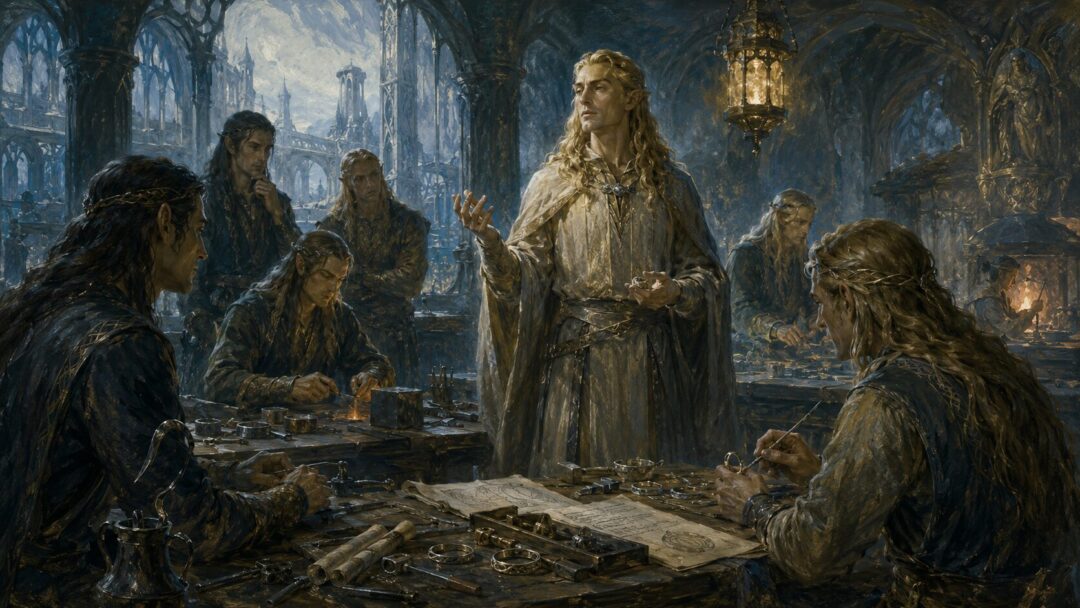
The most disturbing thing about Annatar is not that he was Sauron in disguise.
It is that his disguise answered a desire the Elves already had.
By the time he came among them in the Second Age, Middle-earth was not the world it had once been. Morgoth had been defeated, but the wounds of the Elder Days had not vanished. The Elves who remained east of the Sea lived in a land still touched by loss, memory, and change.
They had known beauty.
They had known ruin.
And many of them were not ready to abandon Middle-earth to fading.
So when Annatar appeared, offering knowledge, craft, and the hope of making Middle-earth more like the Undying Lands, his offer did not sound like conquest.
It sounded like restoration.
That is what made him dangerous.
Annatar Was Not Supposed to Look Like Sauron
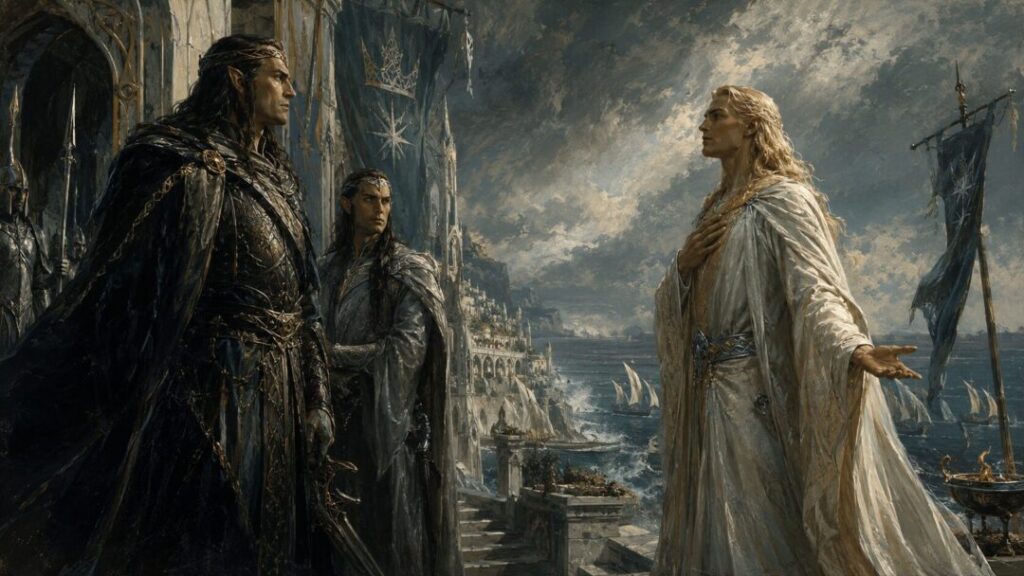
The texts are clear that Sauron came in a fair form.
This matters because the Elves were not deceived by a dark lord openly pretending to be harmless. They were deceived by someone who presented himself as noble, wise, and generous.
The name Annatar means “Lord of Gifts.”
Even the name was part of the deception.
It did not suggest domination. It suggested blessing. It implied that he had come to give, not to take. And among the Elven-smiths of Eregion, that claim was powerful.
But the texts do not tell us that every Elf accepted him.
That distinction matters.
Gil-galad and Elrond were suspicious of him and did not admit him into Lindon. Their rejection shows that Annatar’s disguise was not beyond question. Something about him, his claims, or his purpose troubled the greatest leaders of the Eldar in the West of Middle-earth.
Yet suspicion in Lindon did not prevent acceptance elsewhere.
In Eregion, the smiths listened.
They Thought He Was an Emissary of the Valar
The safest answer is this:
The Elves who accepted Annatar believed he was what he claimed to be—an emissary of the Valar.
That does not necessarily mean the texts give us a complete biography that Annatar invented for himself. They do not. We are not told the full story he used to explain his origin, his past, or why he had come specifically then.
But we are told enough.
He presented himself as one sent from the Powers of the West, bringing wisdom and aid. In other traditions of the story, he is associated with names such as Aulendil, meaning servant or devotee of Aulë, and Artano, connected with smithcraft. These names fit the nature of the deception: he came not as a warrior, but as a master of craft.
That was exactly the form of help most likely to appeal to Eregion.
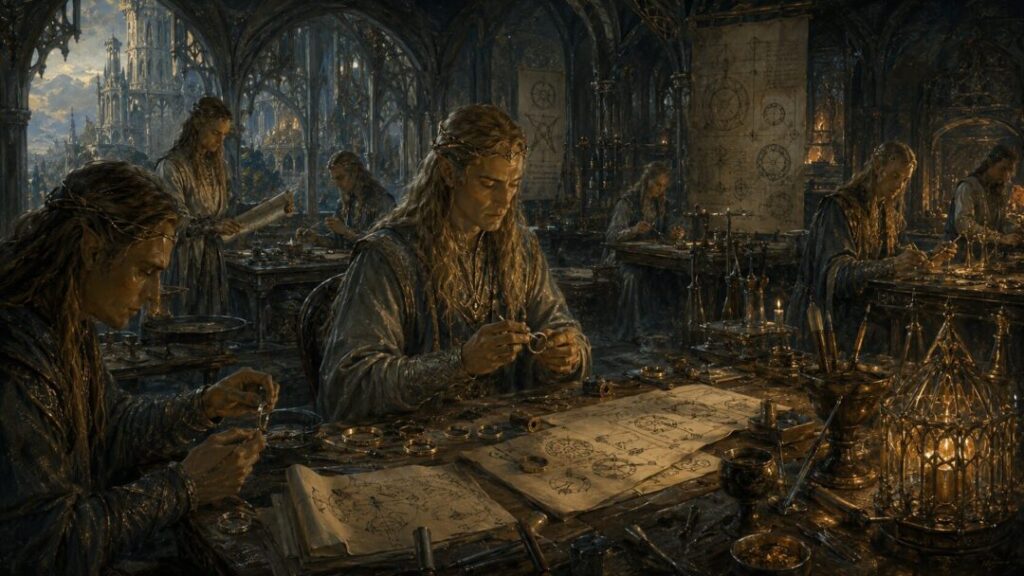
The Elves of Eregion were not merely soldiers or rulers. Their greatest fame lay in craft, jewel-work, and making. The Gwaith-i-Mírdain, the people of the jewel-smiths, were the very audience most likely to value hidden knowledge of making.
So Annatar did not tempt them randomly.
He came to the people most able to use what he offered—and most likely to desire it.
Did They Think He Was a Maia?
The texts do not always spell this out in simple terms.
But if Annatar claimed to be an emissary of the Valar, then the implication is that he was presenting himself as a being connected with the angelic order of the West rather than as an ordinary Elf.
In Middle-earth, the servants of the Valar are the Maiar. Sauron himself was one. Before his fall, he had been associated with Aulë, the Vala most connected with craft, making, and substances of the earth.
That made the lie especially cruel.
Annatar did not invent a mask unrelated to his true nature. He twisted something close to the truth. He really was an ancient spirit. He really possessed deep knowledge. He really understood craft at a level beyond the Children of Ilúvatar.
The falsehood was not that he had power.
The falsehood was what that power served.
He came as a giver.
But he intended mastery.
Why Eregion Was Vulnerable
Eregion was not weak.
That is important.
The fall of the Elven-smiths should not be read as foolishness from lesser minds. Celebrimbor and the smiths of Eregion were among the greatest craftsmen remaining in Middle-earth. Their tragedy comes precisely because their gifts were real.
Annatar offered them the thing they were most prepared to receive: knowledge.
His temptation was subtle because it did not begin with evil aims.
The Elves did not want to become tyrants. They did not want to enslave Middle-earth. The desire associated with the Rings was preservation—the slowing of decay, the protection of beauty, the making of Middle-earth into something less wounded by time.
That longing was not evil in itself.
But it was dangerous.
Because it opened a door to control.
To preserve something completely, one must resist change. To resist change too fiercely, one may begin to impose the will upon the world. Sauron understood this. He could not easily seduce the Elves with crude promises of conquest, so he offered them a nobler dream.
He offered them a Middle-earth that would not fade.
Why Gil-galad and Elrond Rejected Him
The rejection of Annatar in Lindon is one of the most important parts of the story.
It prevents us from saying simply that “the Elves believed Annatar.” Some did. Some did not.
Gil-galad and Elrond were not persuaded. The texts do not give us a long explanation of their reasoning, so we should be careful not to invent one. We are not told that they knew he was Sauron from the beginning. We are told they distrusted him.
That difference matters.
Distrust is not the same as knowledge.
They may have sensed danger in his claims. They may have doubted the sudden arrival of a supposed messenger from the West. They may have been wary of gifts that promised too much. The texts do not state their full thoughts.
What they did is clear.
They refused him.
And because of that refusal, Annatar’s influence took root elsewhere.
What Celebrimbor Believed
Celebrimbor’s role is tragic because he was not knowingly serving Sauron.
The texts present him as deceived by Annatar’s identity and purpose. Under the knowledge gained from Annatar, the smiths of Eregion made Rings of Power. Later, Celebrimbor made the Three Rings himself, without Sauron touching them.
That point is essential.
The Three were not made by Sauron’s hand. But they were still made using arts learned during the period of Annatar’s instruction, and so they were bound up with the fate of the One Ring.
This is where the deception becomes almost unbearable.
Even the works made apart from Sauron’s direct touch were not entirely free from the shadow of his teaching. The danger was not only in the objects he handled.
It was in the knowledge he had planted.
When the Elves Discovered the Truth
The truth did not come through interrogation.
It came when Sauron forged the One Ring.
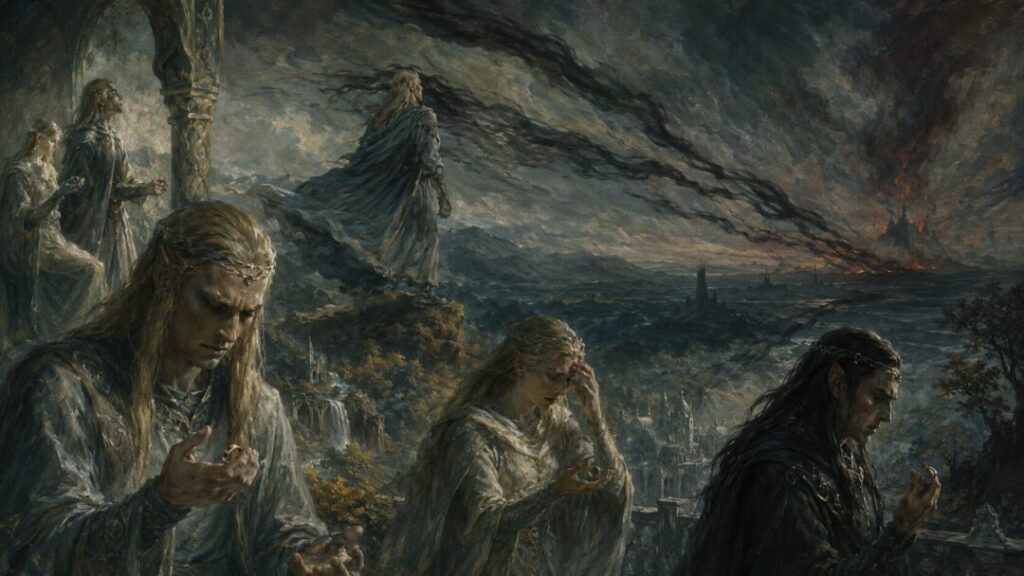
In Mordor, he made the Ruling Ring in secret. His purpose was to dominate the bearers of the other Rings. When he put on the One and spoke the words of command, the Elves became aware of him and understood that they had been betrayed.
This moment is one of the great reversals of the Second Age.
Until then, Annatar had appeared as a giver of wisdom. Suddenly the hidden shape of his gift was revealed. The Rings were not merely instruments of preservation. They were part of a design of rule.
The Elves took off their Rings.
They refused him.
And Sauron, unable to gain by deception what he desired, turned to war.
The Answer Is More Tragic Than “They Thought He Was an Elf”
So who did the Elves think Annatar was?
The conservative answer is that those who accepted him believed he was a benevolent emissary of the Valar, a lord of gifts and wisdom, bringing knowledge from the West.
Some descriptions and names connected with him imply a figure especially associated with Aulë and the arts of making. It is reasonable to say that he presented himself as more than an ordinary Elf, though the texts do not give us every detail of how each individual in Eregion understood his nature.
But the deeper answer is this:
They thought he was the answer to their grief.
Not in a simple emotional sense. Not as a savior figure invented from nothing. But as someone whose offer matched one of the central desires of the Elves who remained in Middle-earth.
They wanted beauty to endure.
They wanted their lands healed.
They wanted Middle-earth to become less unlike the Blessed Realm.
Annatar offered that dream with open hands.
And behind those hands was Sauron.
Why the Deception Worked
Annatar’s success reveals something important about evil in Middle-earth.
It does not always begin by offering darkness.
Often it offers a good thing in a distorted form.
Healing without humility.
Preservation without surrender.
Beauty without freedom.
Order without mercy.
Sauron’s genius as deceiver was not merely that he could appear fair. It was that he understood how to wrap domination in the language of improvement. He did not need the Elves of Eregion to desire evil. He only needed them to accept his method of achieving good.
That is why Annatar remains so disturbing.
He was not believed because the Elves were stupid.
He was believed because his lie was close enough to a truth they longed for.
The Lord of Gifts Was Never Giving Freely
The name Annatar is the final irony.
“Lord of Gifts.”
But a true gift does not secretly bind the receiver to the giver.
Sauron’s gifts were designed to create dependence. His teaching led toward Rings that could be ruled. His generosity concealed a claim of ownership. What looked like wisdom was the beginning of a chain.
The Elves discovered this before he could master them fully.
That is why the story of Annatar is not merely the story of Sauron fooling the Elves. It is the story of a temptation that almost succeeded because it touched something noble.
The desire to preserve beauty was real.
The longing to heal Middle-earth was real.
The craft of Eregion was real.
And that is what makes the betrayal so devastating.
Annatar did not come to destroy their dream at once.
He came to inhabit it.
Then he tried to make it his own.
Sources & Notes
- J.R.R. Tolkien, The Silmarillion, “Of the Rings of Power and the Third Age” — Sauron comes among the Elves in fair seeming, calls himself Annatar, and teaches the smiths before forging the One Ring in secret.
- J.R.R. Tolkien, Unfinished Tales, “The History of Galadriel and Celeborn” — gives the sharper Second Age tradition: Gil-galad and Elrond reject Sauron’s fair emissary, while the smiths of Eregion accept his lore.
- J.R.R. Tolkien, Unfinished Tales, “The History of Galadriel and Celeborn,” notes on the Eregion traditions — preserves Annatar’s claim to be sent by the Valar and the related craft-names Aulendil and Artano.
- J.R.R. Tolkien, The Silmarillion, “Valaquenta: Of the Enemies” — establishes Sauron as a Maia originally associated with Aulë, making the craft-centered disguise a corruption of real knowledge rather than a random mask.
- J.R.R. Tolkien, Letter 131 — explains the Elvish motive behind the Rings as preservation and arresting change, and frames Sauron’s Ring-design as domination disguised through that desire.