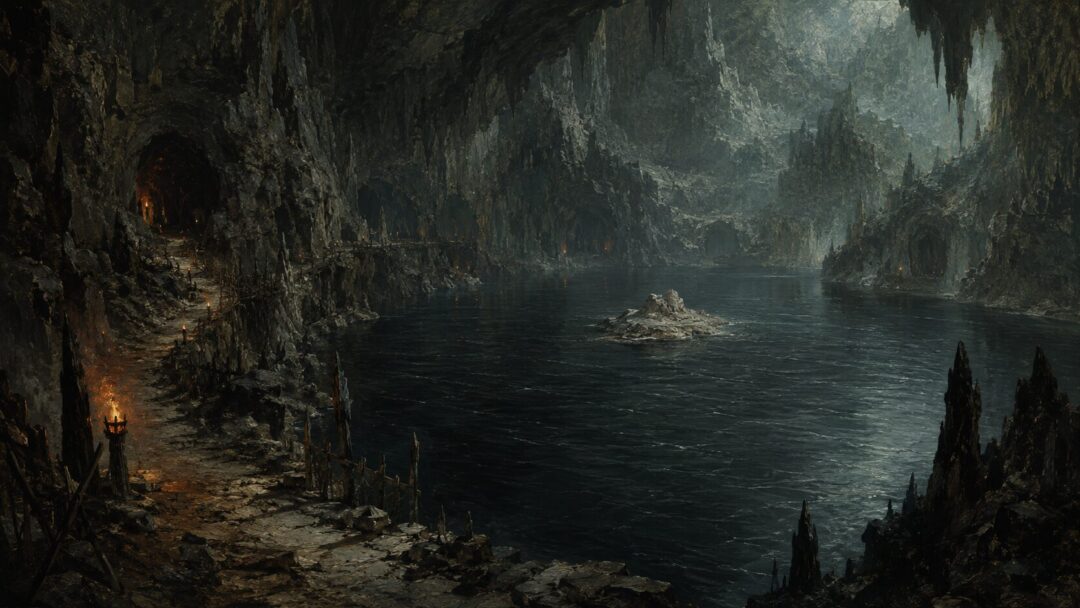
Deep under the Misty Mountains, beneath the noise and cruelty of Goblin-town, there was a black lake.
It was cold.
It was still.
And in the middle of it was a small island.
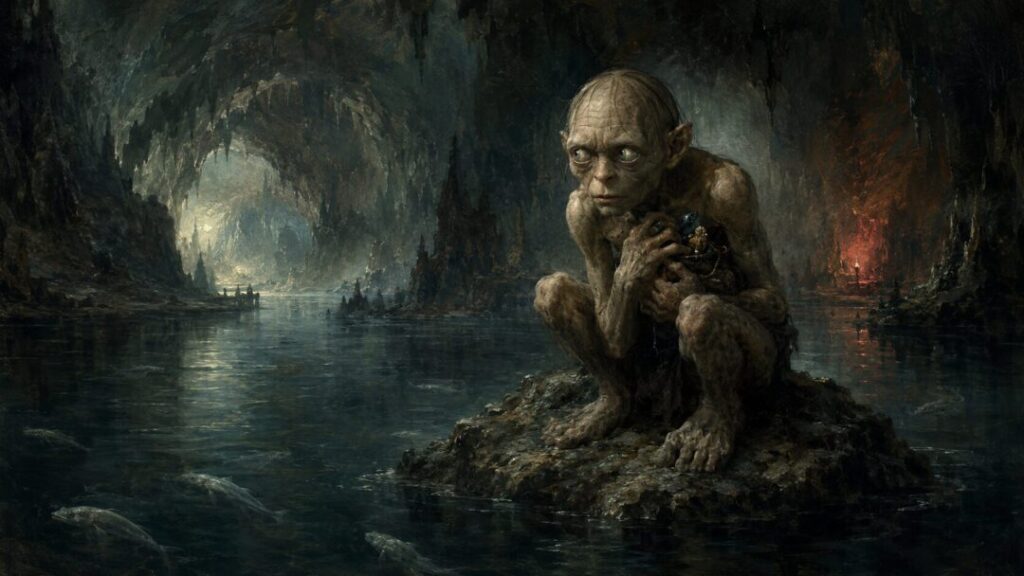
That island was Gollum’s world.
For hundreds of years, he lived there in the dark, catching blind fish from the water and creeping through tunnels when hunger drove him outward. He was hidden, but not impossibly far away. The Goblins were above him. Their tunnels ran near him. Their roads reached down into the depths.
And that raises a strange question.
What would have happened if the Goblins had discovered Gollum?
At first, the answer seems simple. They would have killed him. Or he would have killed them. But the actual situation in the text is more unsettling than that.
Because the Goblins did discover the lake.
They knew something was there.
They simply did not fully understand what it was.
The Goblins Already Knew the Lake Was There
The important detail is easy to miss.
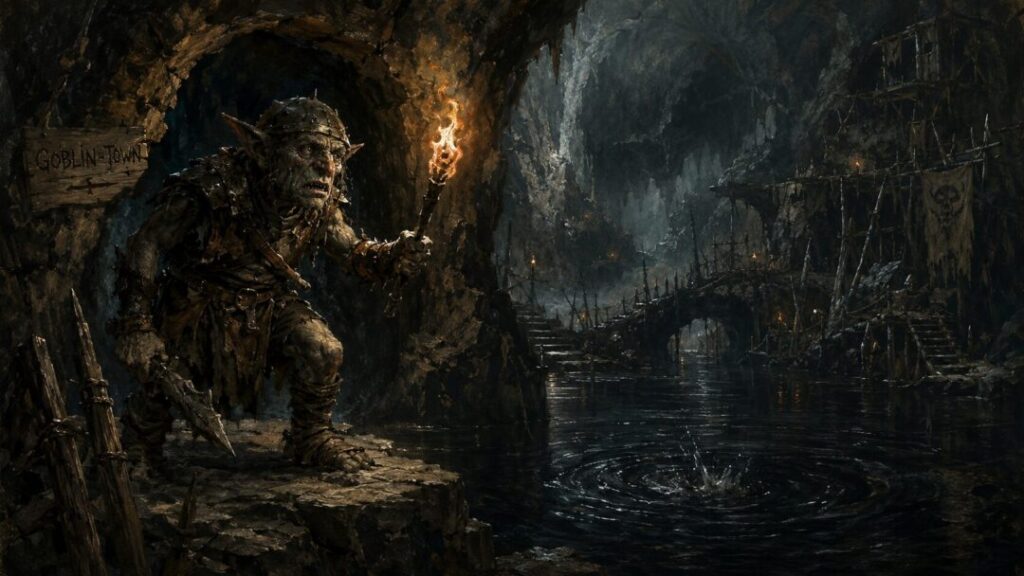
Gollum’s lake was not sealed away from the Goblins forever. It lay deep below Goblin-town, but it was connected to their tunnels. Their road went down to it. The Goblins had found it long before Bilbo arrived.
But they did not continue their road across it.
They seldom went there.
The reason given is simple and chilling: they sensed that something unpleasant lived there, and those who went down to the lake did not always return.
That means Gollum was not an undiscovered creature in the absolute sense. He was not safely hidden in some untouched cavern beyond all reach.
He was a known danger.
Not a named enemy.
Not a prisoner.
Not a servant.
But a dark presence at the end of a road.
To the Goblins, the lake may have been one of those places in the mountain where even they did not like to linger. They were cruel, noisy, and dangerous, but they were not fearless. They knew when a tunnel was wrong. They knew when something waited in the dark.
And near Gollum’s lake, something did.
Gollum Was Hunting Them
Gollum did not live only on fish.
The text makes clear that he sometimes caught Goblins who strayed too far from Goblin-town. This matters, because it changes the balance between him and them.
Gollum was not merely hiding from the Goblins.
He was feeding on them.
That does not mean he could defeat Goblin-town. He could not. If a large armed group had surrounded him, especially without the Ring, Gollum would have been in terrible danger.
But that was not how he survived.
He survived by secrecy.
By darkness.
By water.
By patience.
And, for much of his long life under the mountains, by the Ring.
A lone Goblin wandering too far from the road would not be facing a fair fight. He would be facing a creature who knew every stone, every echo, every ledge and pool. A creature who could move in darkness. A creature who had learned to creep, listen, wait, and strike.
To the Goblins, this would not look like warfare.
It would look like disappearance.
One goes too far.
One does not come back.
Something lives by the lake.
That is enough to build fear.
The Ring Made Gollum More Than a Cave-Creature
The greatest danger was not Gollum’s teeth.
It was the Ring.
In The Hobbit, Gollum keeps his “birthday present” on the island in the lake. He uses it when he wants to catch Goblins rather than fish. While wearing it, he becomes invisible.
That single fact explains how he could survive so close to Goblin-town for so long.
Without the Ring, Gollum is still dangerous in the dark. He is thin, quick, secretive, and adapted to his underground life. But he is not invincible. A determined group of Goblins could likely overwhelm him if they trapped him away from the water or caught him without escape.
With the Ring, the situation changes.
A Goblin could hear something.
Feel something.
Lose sight of something.
Then never return.
Gollum did not need to fight Goblin-town openly. He only needed the Goblins to fear the lake enough to avoid it most of the time.
And they did.
This is why the question “What if the Goblins discovered Gollum?” has two answers.
If they discovered only the creature, they might have tried to kill him.
If they discovered the Ring, the danger would have become far greater.
Would the Goblins Have Captured Him?
The texts never state that the Goblins captured Gollum, interrogated him, or learned exactly what he was. So anything beyond the known facts must be treated carefully.
But the likely answer is that a full discovery would have led to violence almost at once.
Gollum was killing Goblins.
The Goblins were cruel and suspicious.
Goblin-town was ruled by the Great Goblin at the time of Thorin and Company’s capture, and his people were quick to imprison, threaten, and torment outsiders.
If they had found Gollum plainly, especially after connecting him to missing Goblins, they would have had little reason to spare him.
But capturing him would not have been easy.
Gollum’s island gave him protection. The lake separated him from the shore. He had lived there for centuries. The Goblins were familiar with tunnels, but Gollum was familiar with that place in a more intimate way. It was not just his dwelling. It was his trap, refuge, and hunting ground.
The text does not say that the Goblins feared Gollum by name.
But it does say enough to show that the lake had become a boundary.
They could go down to it.
They usually chose not to.
What If They Found the Ring?
This is where the question becomes much darker.
If the Goblins had discovered Gollum’s island and found the Ring there, the consequences could have been enormous.
But we have to be careful.
The texts do not give us a scene where a Goblin claims the One Ring. They do not tell us exactly how long such a Goblin could have kept it, whether he would have understood it, or how quickly word of it might have spread.
What can be said is this:
The Ring was not a simple treasure.
It was already trying, in its own way, to return to its master.
And by the time of Bilbo’s journey, Sauron had returned to Dol Guldur as the Necromancer, though his identity was not yet openly known to all.
Gandalf later suggests that the Ring’s abandonment of Gollum was not meaningless. It had left him, and it was trying to get back into the world.
A Goblin finding it would almost certainly not have understood its true nature. He might have seen only a useful magic ring. A secret weapon. A way to sneak, steal, murder, or rise among his own kind.
But the Ring was never merely useful.
It worked through desire.
Among the Goblins, desire would not have been hard to find: fear, hunger, domination, rivalry, revenge. Even if none of them knew the name of Sauron, the Ring would have been in a place full of violence and ambition.
That does not mean the Ring would instantly reach its master.
But it would no longer be hidden in Gollum’s private darkness.
It would be moving.
And that is exactly what made it dangerous.
Why Gollum’s Isolation Protected Middle-earth
Strangely, Gollum’s misery helped keep the Ring hidden.
For centuries, he did almost nothing with it beyond surviving. He used it to hunt. He cherished it. He spoke to it. He hid it on his island. He became enslaved to it in mind and spirit, but he did not carry it into kingdoms or courts.
He did not try to rule.
He did not gather followers.
He did not deliver it to a lord.
This does not make him innocent. He murdered Déagol to take the Ring. He became cruel, secretive, and dangerous. But his isolation limited the damage he could do.
The Ring, in Gollum’s keeping, was buried.
That was not safe forever.
But it was safer than many alternatives.
If the Goblins had found it, the Ring might have entered a society of armed Orcs beneath a major mountain pass. From there, it could have passed by violence from hand to hand. It might have become a cause of conflict within Goblin-town. It might have been taken by a stronger Orc. It might eventually have moved eastward or southward.
Those possibilities are interpretation, not stated history.
But they are consistent with what the Ring does: it tempts, it betrays, and it seeks a path back to power.
Why Bilbo’s Arrival Changed Everything
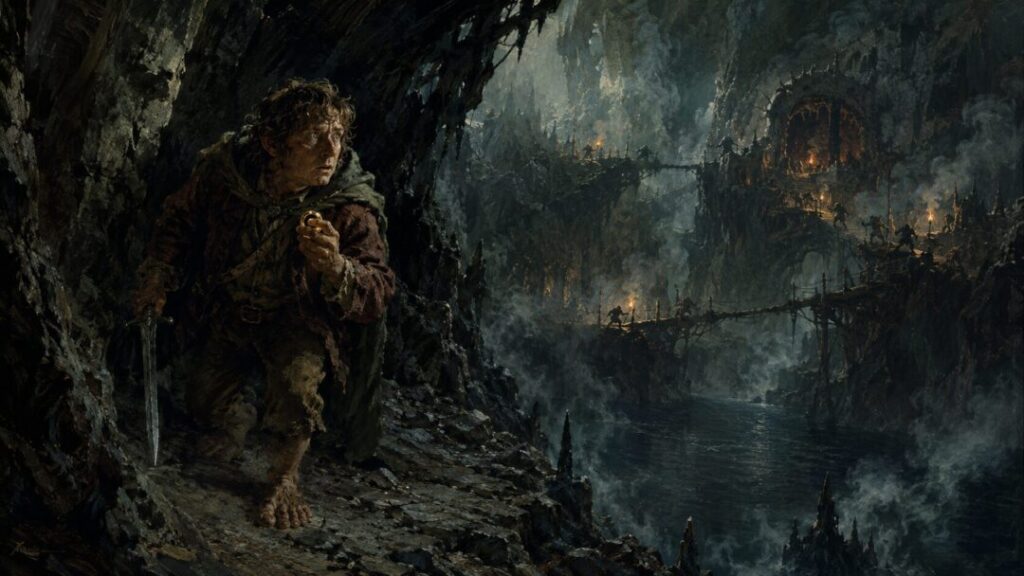
Bilbo did not enter the dark lake as a warrior.
He was lost, alone, frightened, and separated from the Dwarves. He had already found the Ring in the tunnel, though he did not yet understand what it was.
This is crucial.
By the time Bilbo meets Gollum, the Ring is no longer on Gollum’s island.
The most dangerous thing in the cave has already changed hands.
Gollum realizes this too late.
His panic is not just anger over a lost possession. It is the collapse of the entire life he has built. His secret power is gone. His protection is gone. His precious is gone. And now a stranger from the world outside may have it.
The Goblins, meanwhile, remain unaware of the true disaster that has just passed through their tunnels.
They chase Thorin and Company.
They guard the back-door.
They nearly catch Bilbo.
But they do not understand that the small invisible figure squeezing through the gate has carried out of their mountains the one object that could reshape the fate of the age.
That is the great irony.
The Goblins were close to Gollum.
Gollum was close to the Ring.
The Ring was close to Sauron’s return.
And yet none of them saw the whole pattern.
What Would Have Happened Without the Ring?
If the Goblins had discovered Gollum after Bilbo took the Ring, his position would have been much weaker.
This is not speculation about his emotions; the story itself shows his desperation once the Ring is gone. He follows Bilbo toward the back-door, torn between rage, fear, and the need to recover what he has lost.
Without the Ring, he can still move in the dark. He still knows the tunnels. He is still dangerous to the unwary.
But his greatest advantage is gone.
If Goblins found him then, especially in numbers, he would have had fewer ways to escape. He might have fled deeper. He might have hidden in places they hated to enter. He might have survived by the same miserable cunning that carried him later through the world.
But he would no longer be the invisible hunter of the lake.
He would be only Gollum.
And Gollum, without the Ring, is a creature of fear as much as malice.
The Goblins Were Never the Main Threat
The Goblins are dangerous in The Hobbit. They capture Thorin and Company. They pursue them through the tunnels. Their king recognizes ancient Elvish blades and is enraged by them. Their power under the mountains is real.
But in the story of the Ring, they are not the deepest threat.
They are part of the darkness around it.
Gollum is closer to the centre.
Not because he is stronger than they are, but because he is bound to the Ring in a way they are not. His whole being has been shaped by it. His memory, hunger, hatred, and identity revolve around it.
The Goblins might have found a monster.
They might even have found a ring.
But they would not have understood the thing they had touched.
That is one of the most frightening patterns in Middle-earth: evil often moves through hands that do not fully understand it. A creature may think he has found a weapon. A thief may think he has found treasure. A ruler may think he has found strength.
The Ring allows all of them to be wrong.
The Real Answer
So what happens if the Goblins discover Gollum?
In one sense, they already did.
They discovered the lake.
They discovered the danger.
They learned, without fully knowing why, that some places below their tunnels were better left alone.
But if they had discovered Gollum clearly, named him, hunted him, and reached his island, the outcome would depend almost entirely on whether he still had the Ring.
With the Ring, Gollum could remain a terror of the dark: unseen, patient, and almost impossible for lone Goblins to catch.
Without it, he would be exposed.
And if the Goblins had discovered the Ring itself, the danger would have moved beyond Gollum entirely. It could have passed into the violent world of Goblin-town, where secrecy, ambition, and murder were already waiting for something powerful to feed them.
That did not happen.
Instead, the Ring passed to Bilbo.
Not to a Goblin-chief.
Not to a warrior.
Not to a servant of Sauron.
To a frightened Hobbit in the dark, who spared Gollum when he had the chance to kill him.
That mercy mattered more than anyone in Goblin-town could have guessed.
Because the Goblins may have known there was something unpleasant by the lake.
But they never understood that the fate of Middle-earth had been lying there in the dark.
Sources & Notes
- J.R.R. Tolkien, The Hobbit, ch. 5, “Riddles in the Dark” — Gollum’s black lake lies below Goblin-town; the goblins know the road down to it but avoid the place, and Gollum uses the Ring to catch goblins.
- J.R.R. Tolkien, The Hobbit, ch. 4, “Over Hill and Under Hill” — the Great Goblin’s realm, the capture of Thorin’s company, and the goblins’ cruelty and organization under the Misty Mountains.
- J.R.R. Tolkien, The Lord of the Rings, Book I, ch. 2, “The Shadow of the Past” — Gandalf’s account of Sméagol’s murder of Déagol, Gollum’s corruption by the Ring, and the Ring’s tendency to leave one bearer for another.
- J.R.R. Tolkien, The Lord of the Rings, Appendix B, “The Tale of Years” — the wider chronology of Sauron’s return to Dol Guldur and the Ring’s long concealment before Bilbo found it.
- J.R.R. Tolkien, The Lord of the Rings, Book I, ch. 2, “The Shadow of the Past” — Bilbo’s pity toward Gollum is presented by Gandalf as a mercy with consequences beyond Bilbo’s understanding.