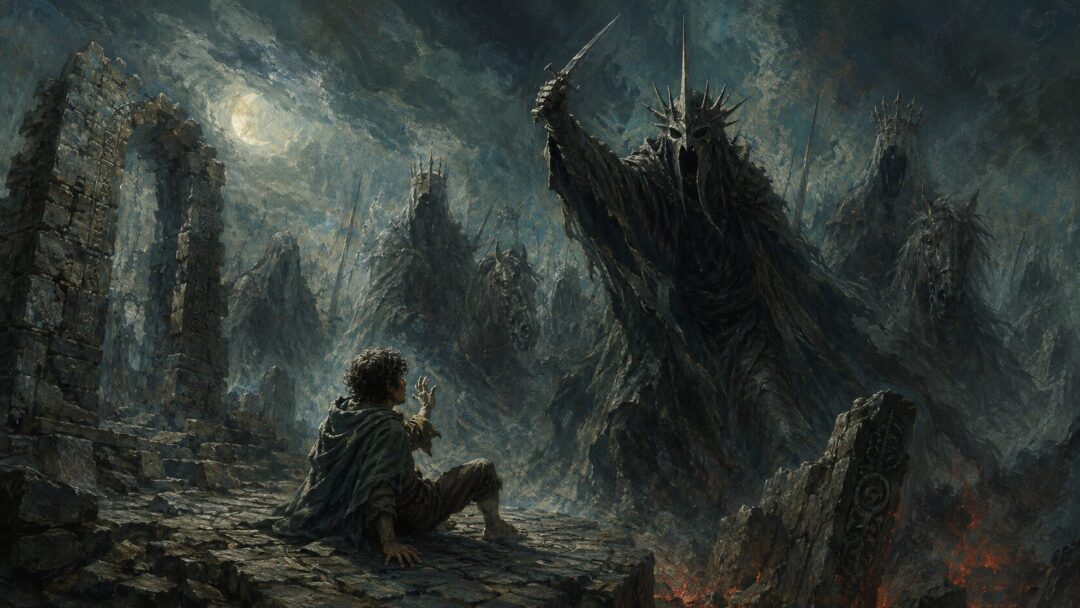
Most readers remember Frodo’s wound at Weathertop as the moment he was nearly killed.
But that is not quite what makes it so terrifying.
The Morgul-knife was not simply a weapon meant to end his life. It was a weapon meant to change what he was.
That difference matters.
Because Frodo does not merely survive Weathertop and carry a scar afterward. He carries the memory of an attack that reached deeper than flesh. The blade entered his shoulder, broke in the wound, and left behind a splinter that slowly worked inward. Gandalf later explains that if it had reached Frodo’s heart, he would have become a wraith under the dominion of the Dark Lord.
So the question is not only why Frodo’s shoulder hurt again.
The question is why a wound that was healed by Elrond still had power over him at all.
The answer leads into one of the most painful truths in The Lord of the Rings:
Some victories do not erase what happened to the person who endured them.
The Knife Was Not Trying to Kill Frodo
At Weathertop, Frodo is attacked by the Nazgûl while he is wearing the Ring.
That detail is essential.
When he puts on the Ring, the Black Riders become clearer to him. He sees them more fully, because he has partly entered the unseen world in which they exist. The Witch-king then strikes him with a Morgul-knife, wounding him in the shoulder.
On the surface, this looks like a failed assassination.
But the later explanation makes it darker.
The knife leaves a fragment inside the wound. That fragment is not passive. It is moving inward. The danger is not simply blood loss, poison, or infection. The danger is transformation.
Frodo is being drawn toward wraithhood.
Gandalf makes this clear in Rivendell. If the splinter had reached Frodo’s heart, Frodo would have become like the Ringwraiths, though weaker and under the command of Sauron.
That means the Witch-king’s attack was not merely meant to remove Frodo from the road.
It was meant to take him.
To make him into something enslaved, diminished, and bound to the very power he was trying to escape.
Elrond Healed the Wound, But Not the Whole Damage
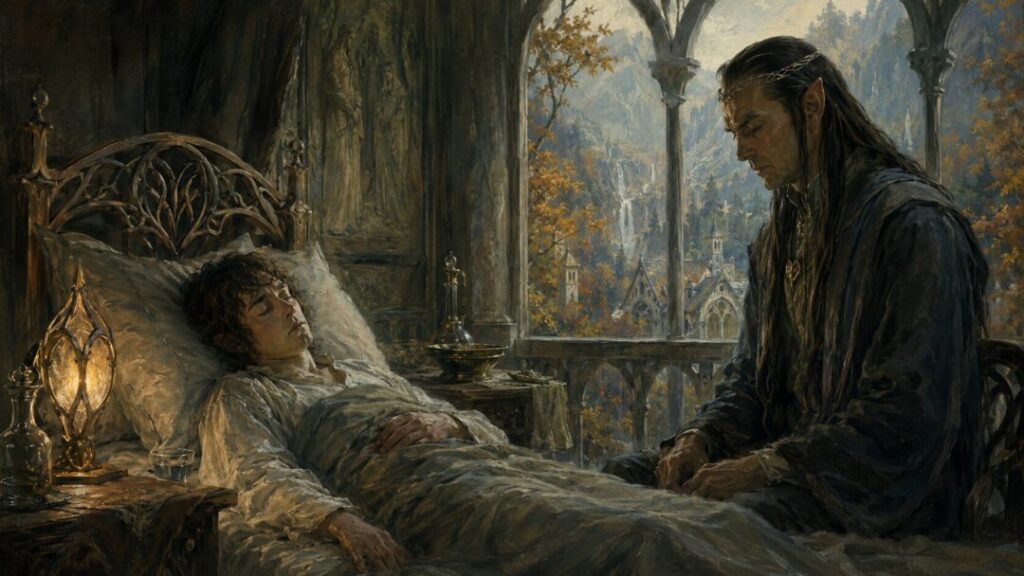
Frodo reaches Rivendell after days of increasing weakness.
By then, the shard has nearly done its work. Elrond finds it and removes it, and Frodo wakes after a long sleep. In one sense, he is healed. The immediate danger is gone. The fragment is no longer inside him. He will not become a wraith.
But the text never treats this as a complete return to innocence.
Gandalf notices that Frodo has changed. He sees a kind of transparency in him, especially in the wounded side. This does not mean Frodo has become evil. Gandalf even hopes that Frodo will not come to evil. But it does mean the wound has left more than a mark on the body.
Frodo has been touched by the world of the Nazgûl.
He has stood close to the edge of becoming something other than himself.
That kind of contact does not vanish just because the blade is gone.
This is one of the quiet rules of the story. Evil can be defeated, but its effects may remain. A wound can be closed and still not be wholly cured.
Why the Pain Returns on October 6
The most important clue comes on the journey home.
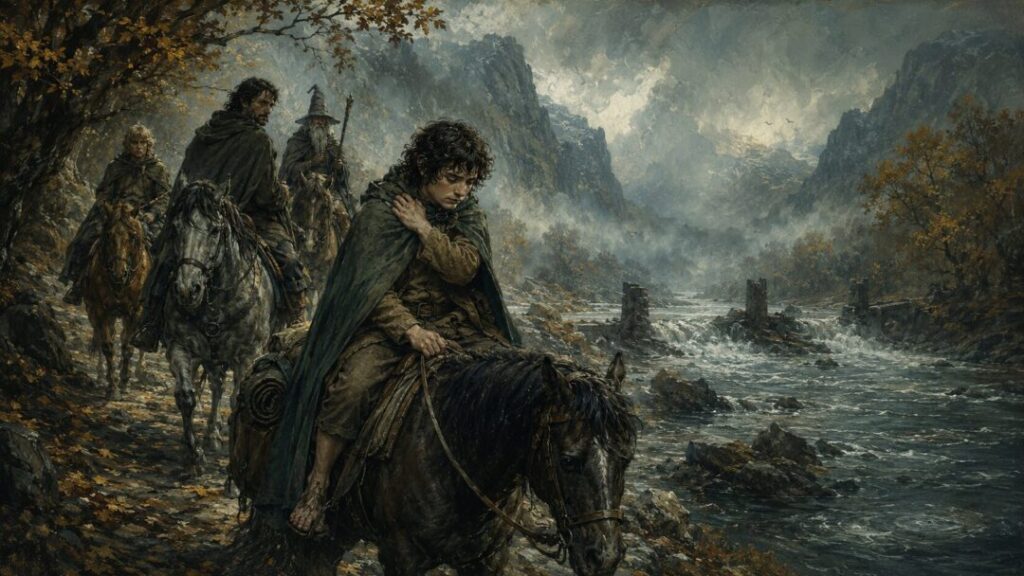
A year after Weathertop, on October 6, Frodo becomes silent and troubled. He feels pain in his shoulder again. The memory of darkness lies heavily on him.
This is not described as a new attack. The Ring has already been destroyed. Sauron has fallen. The Nazgûl are gone.
And yet the wound returns.
That matters because the date itself matters.
October 6 is the anniversary of the stabbing at Weathertop. The pain is tied not only to the injury, but to the memory of the injury. Frodo’s body and spirit seem to remember what happened there, even after the power behind the wound has been overthrown.
Gandalf’s response is one of the most revealing lines in the book.
He says that there are some wounds that cannot be wholly cured.
He does not say Frodo is imagining it. He does not say it will simply pass forever. He recognizes that Frodo’s suffering belongs to a deeper category.
The wound is healed enough for Frodo to live.
It is not healed enough for Frodo to be unchanged.
The Wound Is Physical, Spiritual, and Remembered
It is important not to simplify Frodo’s pain into only one thing.
The text does not reduce it to a purely physical scar. Nor does it describe it in modern clinical terms. It belongs to the moral and spiritual world of Middle-earth, where wounds from evil powers can touch the body, the mind, and the inner life at once.
The Morgul-knife pierced his shoulder.
The shard tried to reach his heart.
The fear and darkness of that moment returned with the anniversary.
All of these belong together.
Frodo’s pain is not just “his shoulder hurts.” It is the return of a darkness he once nearly entered. The wound is a place where the seen and unseen worlds met inside him.
That is why it lingers differently from an ordinary injury.
He was not stabbed by a common blade. He was stabbed by a weapon of the servants of Sauron, while wearing the One Ring, by a being already consumed by the shadow-world.
The wound remembers that contact.
And Frodo remembers it too.
The Second Anniversary Makes It Even Clearer
The story does not only show this happening once.
In the chapter “The Grey Havens,” Frodo falls ill again on October 6, two years after Weathertop. He is described as very pale, and his eyes seem to look far away.
Again, the date is not accidental.
Again, the illness passes.
But the pattern has become unmistakable.
Frodo is living with wounds that return at the times when they were first made. The past is not safely behind him. It breaks back into the present.
This is why it is slightly misleading to say only that Frodo’s wound “hurt every year.” The text specifically shows the anniversary pain returning after Weathertop, and it strongly gives that pain a cyclical shape. But it does not provide a long medical record of every year of Frodo’s life.
What it does show is enough.
The wound is not finished with him.
Weathertop Was Not Frodo’s Only Lasting Wound
Frodo himself later names the full burden.
He says he is wounded with knife, sting, and tooth, and a long burden.
That single line gathers nearly the whole cost of the Quest.
The knife is Weathertop.
The sting is Shelob.
The tooth points to Gollum at the Crack of Doom.
And the long burden is the Ring itself.
This matters because Frodo’s suffering after the Quest is not caused by one wound alone. The Morgul wound is central, but it belongs to a larger pattern. Frodo has been hurt repeatedly, and not only in ways that leave visible marks.
He carried the Ring closer to the heart of Sauron’s power than anyone else.
He resisted it for as long as he could.
He saw the Shire again.
But he did not return as the same person who left it.
That is why the restored Shire cannot fully restore Frodo.
Why the Shire Could Not Heal Him
The Shire is saved.
That is one of the great consolations of the story. The fields can grow again. The trees can be replanted. The damage done by Sharkey’s men can be repaired. Sam, Merry, and Pippin all find ways to live in the world after the Quest.
Frodo does not.
This is not because Frodo is weaker than the others.
In many ways, it is because he was wounded more deeply.
He bore the Ring longest after Bilbo. He was stabbed by the Morgul-knife. He was poisoned by Shelob. He was maimed at the end. He carried the burden to the very place where it could be destroyed.
When he returns home, the place he saved cannot give him what he needs.
The Shire can offer peace, but not the kind of healing that reaches the deepest wounds left by the Quest.
That is the tragedy of Frodo’s homecoming.
He saved the Shire for others.
But he could not remain fully healed within it himself.
Why the West Matters
Frodo’s departure over the Sea is often misunderstood.
It is not a simple reward. It is not a promotion into glory. It is not a mortal becoming immortal.
It is an act of mercy.
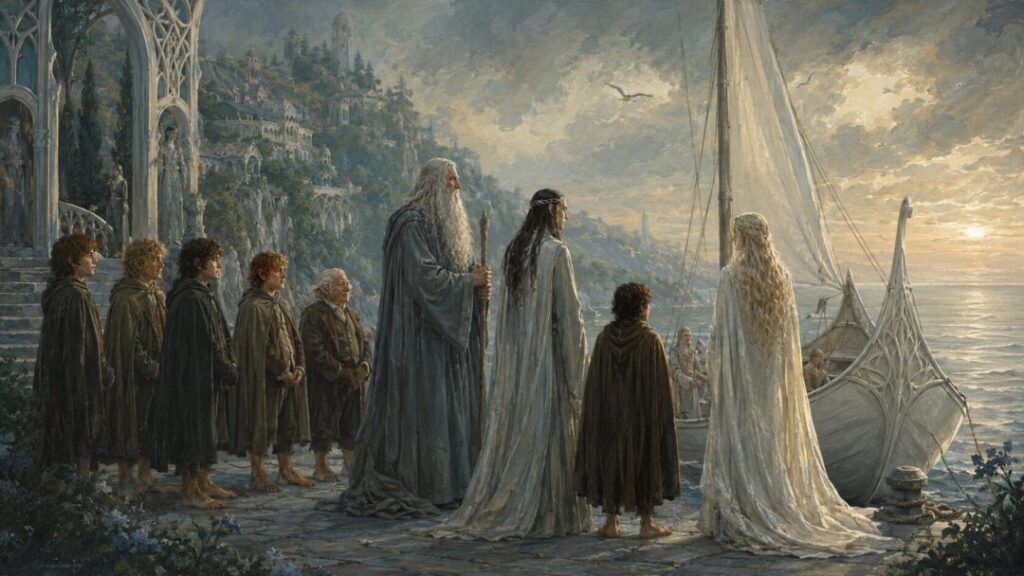
The Undying Lands do not remove Frodo’s mortality. But for the Ring-bearers, the journey west offers healing that Middle-earth cannot provide. Frodo is allowed to go because his wounds are beyond the ordinary remedies of the world he saved.
This is where the anniversary pain becomes crucial.
It shows that Frodo’s suffering is not finished after the victory. The destruction of the Ring ends Sauron’s power, but it does not erase every wound made along the way.
Frodo’s pain on October 6 is one of the signs that he cannot simply settle back into ordinary life.
He needs rest beyond the circles of his old home.
Not because he failed.
Because he endured.
The Real Meaning of the Returning Pain
So why did Frodo’s wound hurt after Weathertop?
Because the wound was never only a wound.
It was the mark of an attempted unmaking. The Morgul-knife tried to draw Frodo into the shadow-world and bind him under the Dark Lord’s command. Elrond removed the shard and saved him from that fate, but the encounter left a lasting damage that neither time nor victory could fully erase.
The anniversary pain reveals what the story refuses to hide:
The body remembers.
The spirit remembers.
The world can be saved, and the savior can still be wounded.
That is why Frodo’s ending is so quiet and so devastating.
He does not leave Middle-earth because he no longer loves it. He leaves because he has been hurt in ways Middle-earth cannot wholly mend.
The wound at Weathertop was not the end of Frodo’s road.
But it marked him for the rest of it.
And in the end, the only answer left was not triumph.
It was mercy.
Sources & Notes
- J.R.R. Tolkien, The Lord of the Rings, Book I, Chapter 11, “A Knife in the Dark” — Frodo puts on the Ring at Weathertop, sees the Riders more clearly, and is struck by the Morgul-knife.
- J.R.R. Tolkien, The Lord of the Rings, Book II, Chapter 1, “Many Meetings” — Gandalf explains the knife-splinter, Elrond’s healing, and the danger that Frodo would have become a wraith under Sauron’s command.
- J.R.R. Tolkien, The Lord of the Rings, Book VI, Chapter 7, “Homeward Bound” — on October 6, Frodo feels the old wound again, and Gandalf says some wounds cannot be wholly cured.
- J.R.R. Tolkien, The Lord of the Rings, Book VI, Chapter 9, “The Grey Havens” — Frodo’s later illness, his words about being wounded by knife, sting, and tooth, and his departure west frame the mercy offered to the Ring-bearer.