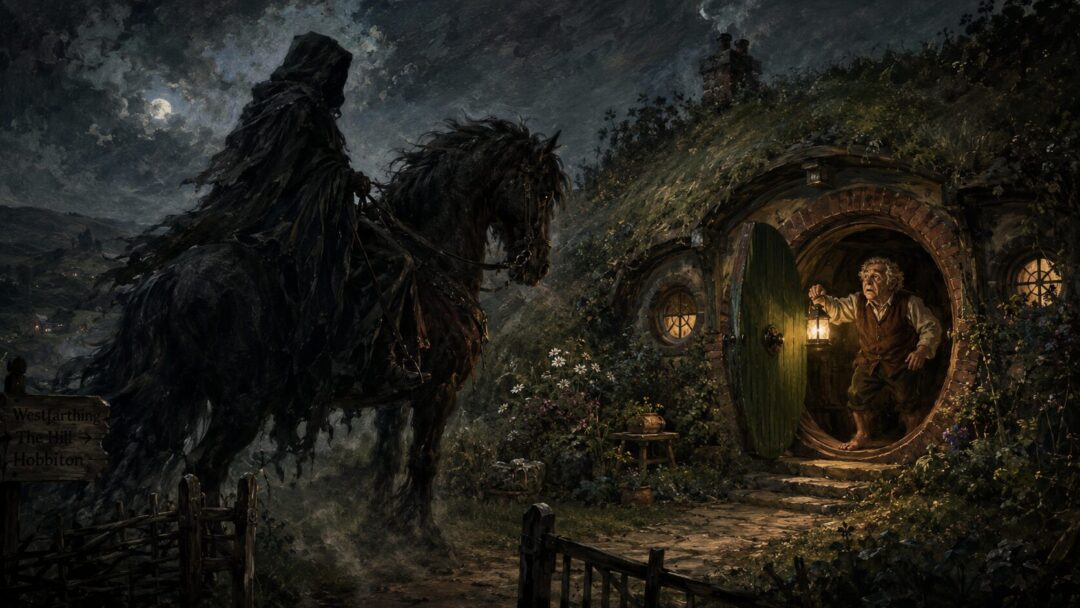
Everyone asks why the Nazgûl did not simply attack the Shire openly.
But that may be the wrong question.
The real issue is not whether the Black Riders were dangerous enough. They clearly were. Their presence spread fear. Their master sent them because ordinary spies had failed. They were the most terrible servants Sauron could put on the road.
And yet, when they reached the Shire, they did not begin with fire, slaughter, and conquest.
They asked questions.
They knocked at doors.
They frightened Hobbits in lanes and on lonely roads.
They searched for “Baggins.”
That restraint is not weakness. It is the clue.
Because the Nazgûl did not enter the Shire as an army certain of its target. They entered as hunters with incomplete knowledge, limited time, and a mission that could collapse the moment their prey understood how close they were.
The Shire looks helpless.
But the hunt for the Ring was never as simple as riding into Hobbiton and taking it.
Sauron Did Not Know Enough
The most important point is also the easiest to overlook.
Sauron did not begin with Frodo’s name.
He did not begin with Bag End.
He did not begin with a neat description of the Shire, its roads, its borders, or its customs.
From Gollum, Sauron learned the words “Shire” and “Baggins.” That was enough to alarm him, but not enough to solve the problem. Gollum’s knowledge was old, narrow, and shaped by his own obsessions. He knew the name of the creature who had taken the Ring from him. He knew that this creature came from a place called the Shire.
But that did not tell Sauron where the Ring was now.
It did not tell him that Bilbo had left the Ring to Frodo.
It did not tell him exactly how to move through Hobbit society.
It did not even immediately give him a clear location.
This matters because the Nazgûl were not sent to perform a simple arrest. They were sent to turn two fragments of information into the recovery of the One Ring.
That is a much more delicate task.
If they attacked too openly before they knew what they needed, they risked destroying the trail.
The Shire Was Hidden by More Than Distance
The Shire was not hidden by magic in the way Lórien or Rivendell might seem hidden.
Its protection was quieter.
It was obscure.
It was ignored.
It was guarded.
For most of the great powers of Middle-earth, Hobbits barely mattered. That smallness became a kind of shield. The Shire was not a fortress, but it was difficult to understand from the outside because no one important had taken it seriously for very long.
Sauron’s servants had to learn what Gandalf already understood: that the small, overlooked country in the northwest mattered more than anyone had guessed.
The Rangers also complicate the question.
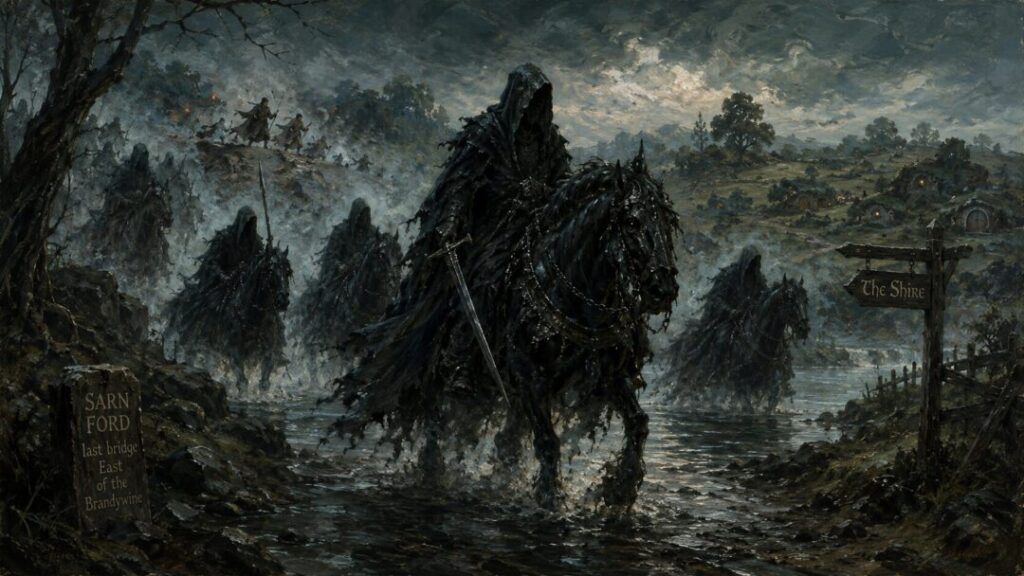
The Dúnedain guarded the borders of the Shire, though the Hobbits themselves did not understand the full extent of that protection. When the Black Riders came to Sarn Ford, the Rangers tried to bar their passage. They were overcome, but their presence proves that the Shire was not simply lying exposed for Mordor to enter unnoticed.
An open attack would not have happened in a vacuum.
It would have announced that Mordor was searching the northwest for something of immense importance.
That was exactly what Sauron could not afford to reveal too soon.
Terror Was Their Weapon — But Also Their Limitation
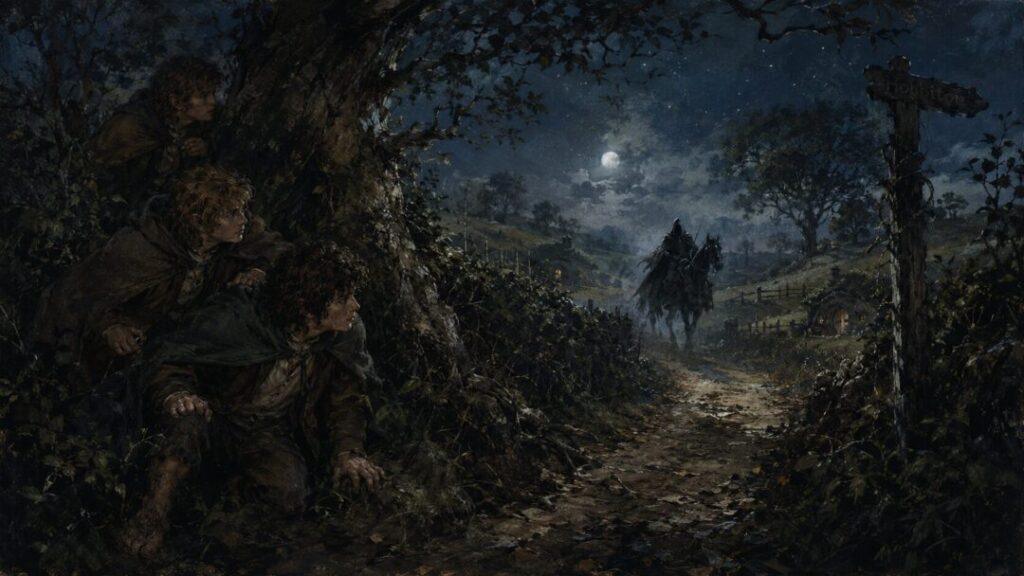
The Nazgûl were terrifying, but their terror worked best when it isolated people.
A lone Hobbit on a road.
A farmer at his gate.
A frightened servant in the dark.
A gatekeeper who could be bent.
That is how the Black Riders operate during the early hunt. They do not need to defeat every person they meet in battle. They need to make people speak, flee, obey, or freeze.
But terror is not the same thing as perfect control.
If the entire Shire had been roused at once, the result might not have helped them. Hobbits are not warriors in the usual sense, but they are numerous, stubborn, and deeply rooted in their own country. More importantly, panic spreads information in every direction.
A public assault would have created noise.
And noise is dangerous when the thing you are hunting can be carried in a pocket.
The Ring-bearer did not need an army to escape. He needed a warning, a road, and a little time.
The Nazgûl’s best chance was to get close before anyone understood what was happening.
They Did Not Know Where the Ring Was
One of the strongest reasons they could not simply attack the Shire is that attacking “the Shire” is not the same as finding the Ring.
The Shire is not a single house.
It has villages, lanes, farms, woods, bridges, rivers, and families whose names repeat across generations. Even once the Riders learned to connect Baggins with Hobbiton, they still did not possess the whole truth.
Was the Baggins they sought still there?
Did he still have the Ring?
Had he passed it on?
Had Gandalf taken it?
Had it already been moved?
These questions were not minor. They shaped the entire hunt.
By the time the Riders came near Bag End, Frodo was already leaving. That timing is one of the great tensions of the early story. The danger is almost unbearable because the Nazgûl are close enough to touch the edge of Frodo’s life, but not close enough to understand it fully.
They are hunting the right place with the wrong amount of certainty.
That is why they ask.
That is why they follow.
That is why they frighten witnesses instead of burning the Shire from end to end.
They need the Ring alive in the trail of rumor.
An Open Attack Could Have Driven Frodo Straight Into Hiding
There is another problem.
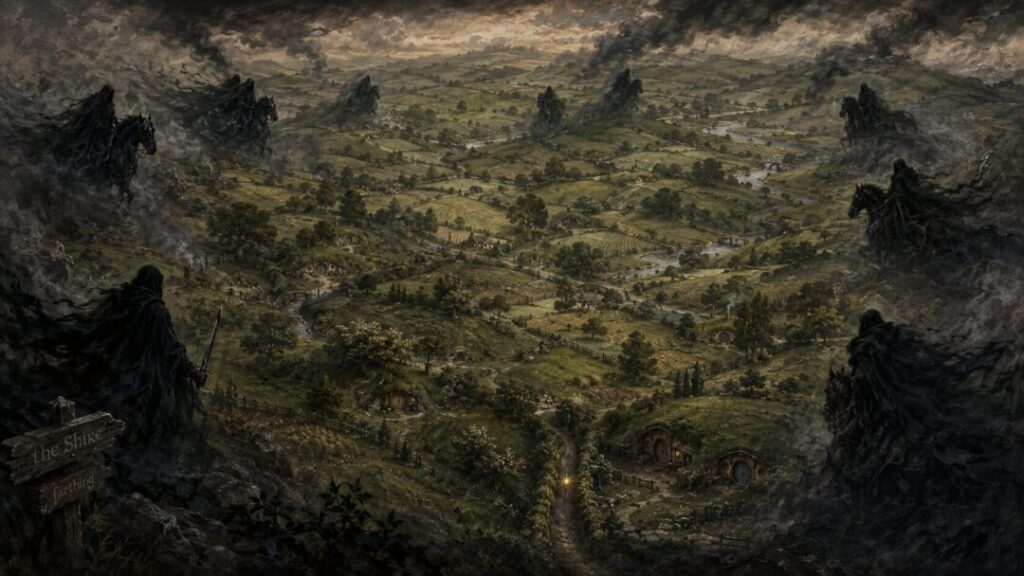
If the Nazgûl had openly attacked Hobbiton before confirming the Ring’s location, Frodo might have vanished completely.
This is not speculation about a new event. It follows from what the story actually shows. Frodo is already preparing to leave quietly. Gandalf has warned him that the Ring must not be used and must not remain in the Shire. His friends are helping him move under the cover of an ordinary change of residence.
The plan is fragile, but it exists.
An open attack would have shattered the disguise, but not necessarily in Mordor’s favor. Frodo might have fled sooner. The countryside might have been alarmed. Messages might have reached Buckland, Bree, or the Rangers faster. Gandalf, had he appeared at the right moment, would have known the danger instantly.
The Nazgûl did not need chaos.
They needed the Ring-bearer located before chaos began.
That is why their secrecy is so important.
The hunt only becomes more violent when the trail narrows.
At Crickhollow, after Frodo has already gone, the Riders do strike more openly. That attack shows they were not morally restrained. They were not unwilling to break doors or spread terror. But even there, the point is not conquest of the Shire. It is the recovery of a specific quarry.
Once they believe they have found the right place, they act.
They are simply too late.
Sauron’s Fear Was Not Just Losing the Ring — It Was Revealing the Hunt
Sauron’s position was more precarious than it appears.
He was mighty, but he did not yet have the Ring. That means his enemies still had one possible path to victory, even if they barely understood it.
If he announced too clearly that he was searching for something in the Shire, he risked helping the Wise understand the truth faster.
The White Council had long concerned itself with the Rings of Power. Gandalf had already begun to suspect the truth about Bilbo’s ring and had confirmed it before Frodo left. Saruman had his own knowledge and his own treachery. Aragorn had captured Gollum and brought him to be questioned.
The situation was already full of dangerous minds moving toward the same secret.
An open assault on the Shire would have been a signal fire.
It would have told every watcher in the North that Sauron’s greatest servants had come for something among Hobbits.
The Nazgûl were not merely trying to find Frodo.
They were trying to find him before the meaning of the search became impossible to hide.
The Nazgûl Were Powerful, Not All-Powerful
It is easy to imagine the Nine as unstoppable because they feel unstoppable.
But the text presents them more carefully.
They are terrifying, ancient, and enslaved to Sauron’s will. Yet they operate under conditions. They ride horses. They gather information. They misjudge. They can be delayed. They can be resisted by courage, by Elvish power, by fire, by water, and by the intervention of greater powers.
They are not a replacement for an army.
They are a weapon of pursuit.
That distinction matters.
An army attacks territory. A hunter follows signs.
In the Shire, the Nazgûl were hunters.
Their failure was not that they lacked menace. Their failure was that the Ring had entered a kind of story Sauron did not understand: a quiet departure, helped by friendship, secrecy, local knowledge, and small acts of courage.
The Black Riders were dreadful on the road.
But the road had already begun to move beneath their feet.
The Real Reason They Could Not Simply Invade
So why did the Nazgûl not simply attack the Shire openly?
Because an open attack would have solved the wrong problem.
It might have terrified the Shire.
It might have killed innocent Hobbits.
It might have revealed Mordor’s strength.
But it would not necessarily have found the Ring.
The Ring was not in a treasury, a fortress, or a royal court. It was in the keeping of a Hobbit who could slip out of a door, cross a field, and disappear into lanes no servant of Mordor truly understood.
That is the hidden danger of the Shire.
Its smallness made it hard to dominate in the way Sauron preferred. There was no throne to seize. No captain to corrupt. No single gate that opened onto the Ring.
There were only names, rumors, gardens, ferries, roads, and ordinary people who did not know they were standing at the edge of the War of the Ring.
The Nazgûl came as quietly as creatures like them could come because their mission required secrecy until the final moment.
And by the time the final moment arrived, Frodo was gone.
Why This Makes the Shire Scenes More Frightening
The early Shire chapters are sometimes remembered as slow, gentle, or pastoral.
But beneath them, something terrible is happening.
The servants of Sauron are already inside the borders of the small world Frodo is trying to leave behind. They are close enough to question his neighbors. Close enough to pass near his road. Close enough that one wrong answer, one delay, one use of the Ring could have ended the quest before it began.
That is why the Nazgûl do not need to storm the Shire to be frightening.
Their restraint is the horror.
They are not failing to attack.
They are searching.
And for a few terrible days, they are almost searching well enough.
The Shire is saved not because the Black Riders are weak, and not because Frodo’s escape is easy.
It is saved because Sauron’s knowledge is incomplete, because the Rangers delay the hunt, because Gandalf’s warnings matter, because Frodo’s friends help him move quietly, and because the great designs of Mordor stumble over the small, stubborn details of Hobbit life.
The Nazgûl could bring terror into the Shire.
But they could not simply conquer the one thing they needed most.
They had to find it first.
And that was the one task in which darkness, for all its power, could still be too late.
Sources & Notes
- J.R.R. Tolkien, The Lord of the Rings, Book I, Chapter 2, “The Shadow of the Past” — Gandalf reports that Gollum revealed only “Shire” and “Baggins,” showing why Sauron’s hunt began with dangerous but incomplete information.
- J.R.R. Tolkien, The Lord of the Rings, Book I, Chapter 3, “Three is Company” — the Black Rider questions the Gaffer about Baggins and later searches the road by stealth, matching the article’s point that the Riders first hunted for a name and trail.
- J.R.R. Tolkien, The Lord of the Rings, Book I, Chapter 5, “A Conspiracy Unmasked” — Merry and the others explain how Frodo’s quiet move to Crickhollow was meant to disguise his departure from Hobbiton.
- J.R.R. Tolkien, The Lord of the Rings, Book I, Chapter 11, “A Knife in the Dark” — the attack on Crickhollow shows the Riders could use open terror once they thought they had found the right target.
- J.R.R. Tolkien, Unfinished Tales, “The Hunt for the Ring” — Tolkien’s account of the Nazgûl entering the North, breaking through the Rangers at Sarn Ford, and seeking “Baggins” in the Shire supports the strategic limits of their mission.