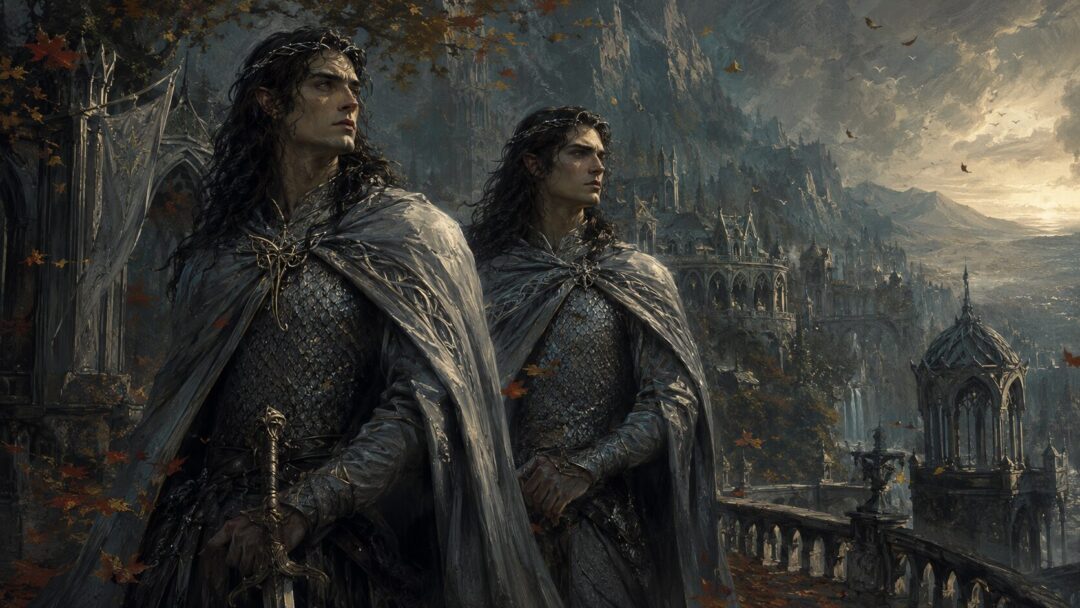
Most readers think Elladan and Elrohir stayed in Middle-earth because their story was simply left unfinished.
But that is only the surface answer.
The deeper truth is stranger.
Elrond’s sons remain in the story at the exact moment when almost everyone around them is being forced into a final choice. Their father sails West. Their sister chooses mortality. Their mother has already departed across the Sea. The Elves are fading from Middle-earth, the Three Rings have lost their power, and the age that sustained Rivendell is ending.
And still, Elladan and Elrohir remain.
Not forever, as far as the texts tell us.
Not clearly as Men.
Not clearly as Elves departing into the West.
They remain “for a while.”
That small phrase may be one of the quietest tragedies in the history of Elrond’s house.
Because Elladan and Elrohir are not just two warriors left behind after the War of the Ring. They are the last unresolved answer to the question that haunted their family from the First Age onward:
What does it mean to belong to two worlds when both are passing away?
The Sons of a Divided House
Elladan and Elrohir were the twin sons of Elrond and Celebrían.
That alone places them at the meeting point of several ancient lines. Through Elrond, they descend from both Elves and Men, from the houses bound up with Eärendil, Elwing, Beren, Lúthien, Tuor, and Idril. Through Celebrían, they are the grandsons of Galadriel and Celeborn.
They are not ordinary Elves of Rivendell.
They belong to a family shaped by choices that are larger than any single life.
Elrond chose the fate of the Elves. His brother Elros chose the fate of Men and became the first king of Númenor. Arwen, Elrond’s daughter, later makes the choice of Lúthien and binds herself to Aragorn, accepting mortality.
Elladan and Elrohir stand beside all of this.
But unlike Arwen, their final decision is never narrated.
That silence matters.
It means their story does not close with a clean answer. The texts allow us to see where they stand, what they lose, and whom they serve. But they do not tell us whether they finally sail West or accept the fate of Men.
Their ending remains suspended.
And that suspension is not empty. It is full of grief.
The Wound That Changed Their Lives
To understand why they stayed, the first place to look is not the Grey Havens.
It is the Redhorn Pass.
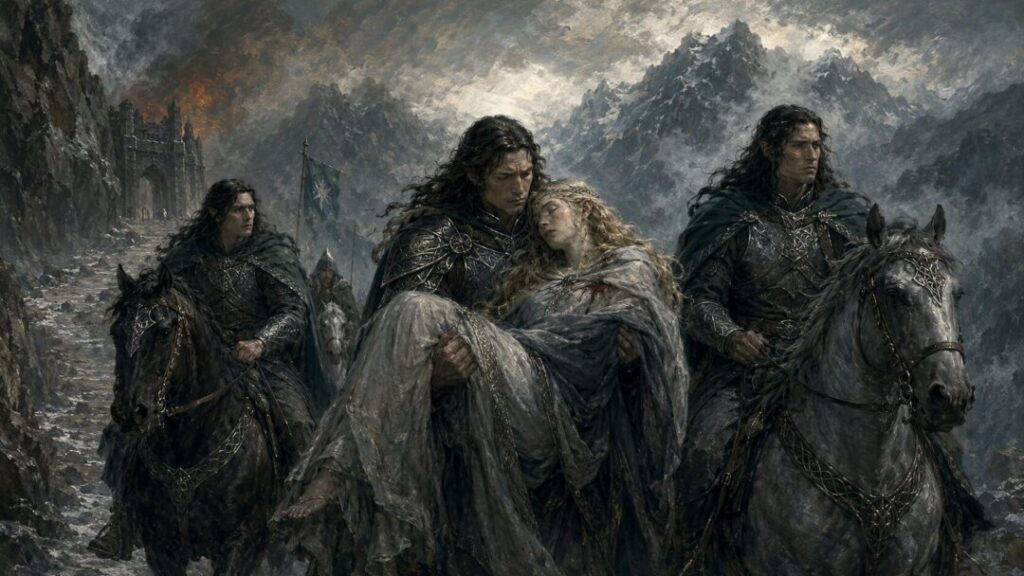
In the Third Age, Celebrían journeyed to Lórien and was waylaid by Orcs in the mountains. Her escort was scattered. She was captured, tormented, and received a poisoned wound.
Elladan and Elrohir pursued and rescued her.
Elrond healed her body, but the deeper hurt remained. Celebrían lost all delight in Middle-earth, and the next year she departed over the Sea.
This is one of the most important facts about Elrond’s sons.
They did not merely hear about the violence of Middle-earth. They rode into it to recover their mother.
And they succeeded only partly.
They saved her life, but they could not restore her joy in the world.
That distinction is devastating.
It also explains why the brothers are later associated so closely with the Rangers of the North and with war against Orcs. In “Many Meetings,” we are told that they had not forgotten their mother’s torment and that they often rode far afield with the Rangers.
This is not presented as a reckless hunger for glory.
It reads more like a grief that became action.
Middle-earth had wounded their house. They answered by riding into the wild places where that wound had come from.
Their Loyalty Was Not Passive
Elladan and Elrohir are easy to overlook because they do not dominate the narrative.
They do not speak often.
They do not receive long interior passages.
They do not become central protagonists in the way Aragorn, Frodo, Sam, Gandalf, or even Arwen do.
But their actions are not small.
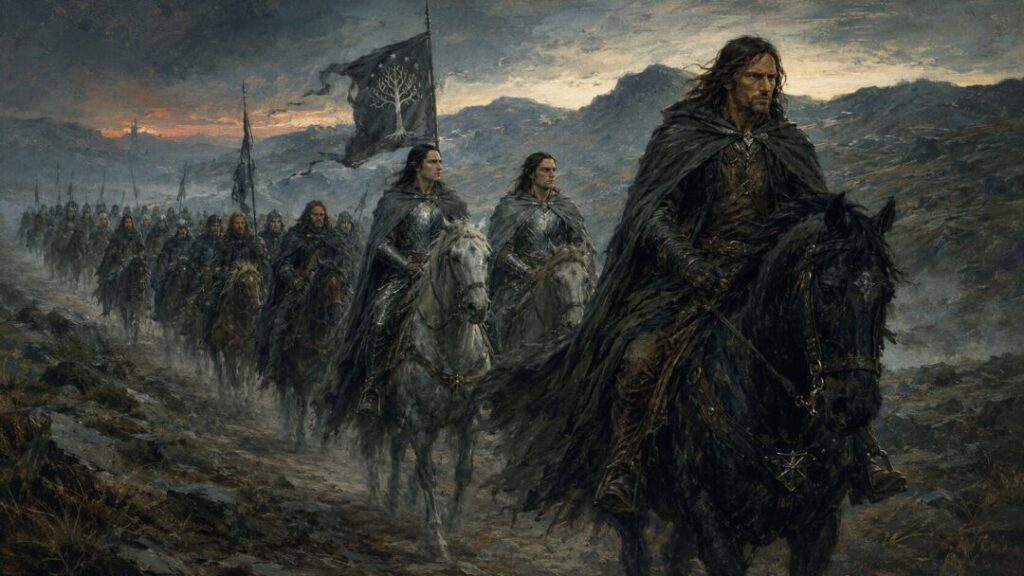
During the War of the Ring, they accompany the Grey Company south. Elrohir brings Aragorn a message from Elrond: remember the Paths of the Dead. The brothers then follow Aragorn through that terrible road, continue with him to the southern war, and are present in the great struggle that follows.
This matters because the sons of Elrond are not standing outside the ending of the age.
They are inside it.
They ride with the Dúnedain, the remnant of the North. They serve beside Aragorn, the heir of Isildur and descendant of Elros. They help the world of Men come into its kingship even as the world of the Elves is passing away.
That is the tension at the heart of their story.
They are Elrond’s sons, but they are also bound to the people of Aragorn.
They belong to Rivendell, but they ride with the Rangers.
They have the right to depart into the West, but they remain in the lands where Men must now carry history forward.
The Age of Rivendell Was Ending
When the One Ring is destroyed, the victory is real.
Sauron is overthrown. The Shadow is broken. Aragorn becomes king. The Shire is scoured and restored. Gondor and Arnor are renewed.
But for the Elves, victory is also an ending.
The Three Rings lose their power. The hidden strength of places like Rivendell and Lórien cannot remain what it was. The great preservations of the Third Age are over.
Elrond does not remain.
Galadriel does not remain.
The keepers of the Three depart, and with them goes much of the old beauty that had lingered in Middle-earth.
This is the world Elladan and Elrohir choose to remain in, at least for a time.
Not the Rivendell of its full power.
Not the Middle-earth of Elven memory still held in living enclaves.
A diminished world.
A healed world, yes.
But also a narrower one.
That makes their staying more meaningful, not less.
If they had stayed in a world still rich with Elven power, the choice would feel easier. But they remain after the tide has turned. They remain when their father’s house is no longer the same kind of refuge it once was.
Arwen’s Choice Deepened the Wound
There is another reason their story feels so painful.
Arwen stays too, but in a different way.
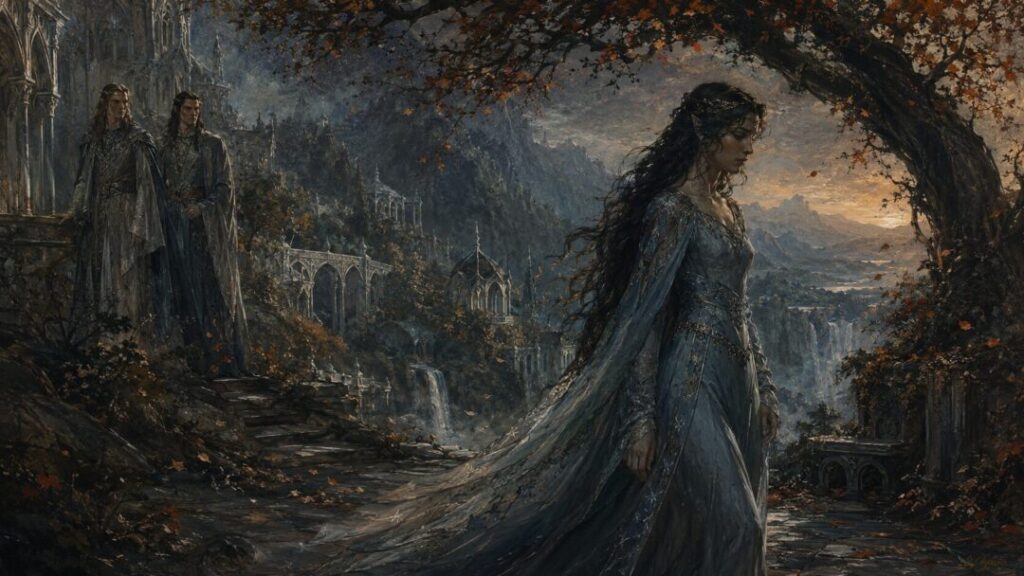
She chooses Aragorn. She chooses mortality. She becomes queen of the Reunited Kingdom, and for a time her choice brings joy. But it also means permanent parting from Elrond after he sails.
For Elladan and Elrohir, Arwen’s choice would have carried enormous weight.
The texts do not give us their private thoughts, so we should be careful. We cannot say exactly what they felt. We cannot claim that they remained only for her sake.
But it is fair to say that their family had been divided.
Celebrían had gone West.
Elrond was departing.
Arwen was remaining as mortal.
The brothers stood between those paths.
If they sailed immediately with Elrond, they would leave Arwen behind in the mortal world she had chosen. If they remained, they would be parted from their father and from the West where their mother had gone.
There was no painless road.
That is why “they remained for a while” feels so heavy.
It is not just a logistical note.
It is the sound of two brothers delaying the final break.
Did They Choose Mortality?
This is where lore accuracy matters.
The texts do not tell us that Elladan and Elrohir became mortal Men.
They also do not tell us that they definitely sailed West.
Their end is not told.
A letter states that they delayed their choice and remained for a while. The Prologue’s note on the Shire Records also says that Elrond’s sons long remained in Rivendell after Elrond had departed.
That is the boundary of what we can say with confidence.
Anything beyond that becomes interpretation.
It is possible to imagine that they eventually sailed West, perhaps after remaining long enough to settle what could be settled in Rivendell and among the Dúnedain. It is also possible to imagine that they chose mortality, especially because of their closeness to the Rangers, Aragorn, and Arwen.
But the texts do not confirm either ending.
And perhaps that is the point.
Elladan and Elrohir are left in the space before finality. Their story is not about the choice itself, but about the delay.
About remaining when departure would be easier to understand.
About standing in a world that has lost its old shape.
Why Staying Matters
Their staying should not be read as failure.
Nor should it be read as a simple refusal of the West.
It is more delicate than that.
Elladan and Elrohir remain because their lives are tied to unfinished bonds. Rivendell still exists, though diminished. The Dúnedain still matter, though Aragorn has now become king. Arwen remains in Middle-earth. The memory of Celebrían’s wound still belongs to the lands where it happened.
The brothers are not clinging to power.
They are not trying to preserve the Third Age unchanged.
They seem, instead, to remain as witnesses.
Witnesses to the last days of Elrond’s house in Middle-earth.
Witnesses to the transition from Elven guardianship to the dominion of Men.
Witnesses to a family divided by fate, love, grief, and grace.
That may be why their story feels so haunting.
They do not get a grand farewell scene.
They do not receive a final speech.
They are not shown boarding a ship, nor dying in Middle-earth.
They simply remain.
And in that remaining, they carry the sorrow of an age that cannot be repaired by victory.
The Last Unanswered Grief of Elrond’s House
Elrond’s life is full of partings.
He is separated from his brother Elros by their different choices. He loses Celebrían to the Sea after her torment. He loses Arwen to mortality. At the end of the Third Age, he leaves Middle-earth himself.
But Elladan and Elrohir make that sorrow more complicated.
Because their fate is not closed.
They are the unfinished line in the story of Elrond’s children.
Arwen’s path is clear. She chooses the fate of Men. Elrond’s path is clear. He departs into the West. Celebrían’s path is clear. She sails because Middle-earth has become unbearable to her.
But the sons remain between those endings.
That is what makes them so powerful.
They are not forgotten because they are unimportant.
They are quiet because their story belongs to the silence after the great songs have ended.
The War of the Ring is won. The King has returned. The ships have sailed.
And somewhere in the fading valley of Rivendell, the sons of Elrond remain a little longer.
Not because the world is still what it was.
But because they are not yet ready—or not yet called—to leave what it has become.
Their story ends without an answer.
And that may be the most truthful ending they could have been given.
Because some griefs in Middle-earth are not resolved.
They are endured.
Sources & Notes
- J.R.R. Tolkien, The Lord of the Rings, Book II, Chapter 1, “Many Meetings” — Elladan and Elrohir’s grief over Celebrían’s torment and their riding with the Rangers ground the brothers’ long warlike attachment to Middle-earth.
- J.R.R. Tolkien, The Lord of the Rings, Book V, Chapter 2, “The Passing of the Grey Company” — Elrohir brings Elrond’s counsel about the Paths of the Dead, and the sons of Elrond ride south with Aragorn and the Dúnedain.
- J.R.R. Tolkien, The Lord of the Rings, Appendix A, “The Númenórean Kings” and “The Tale of Aragorn and Arwen” — Elrond and Elros’s divided choices, Arwen’s mortality, and Elrond’s final parting frame the family pattern behind the brothers’ unresolved fate.
- J.R.R. Tolkien, The Lord of the Rings, Prologue, “Note on the Shire Records” — the note that Elrond’s sons long remained at Rivendell after Elrond’s departure supports the article’s emphasis on their lingering presence.
- J.R.R. Tolkien, The Letters of J.R.R. Tolkien, Letter 153 — Tolkien states that Elladan and Elrohir delayed their choice and remained for a while, confirming that their ultimate end is deliberately untold.