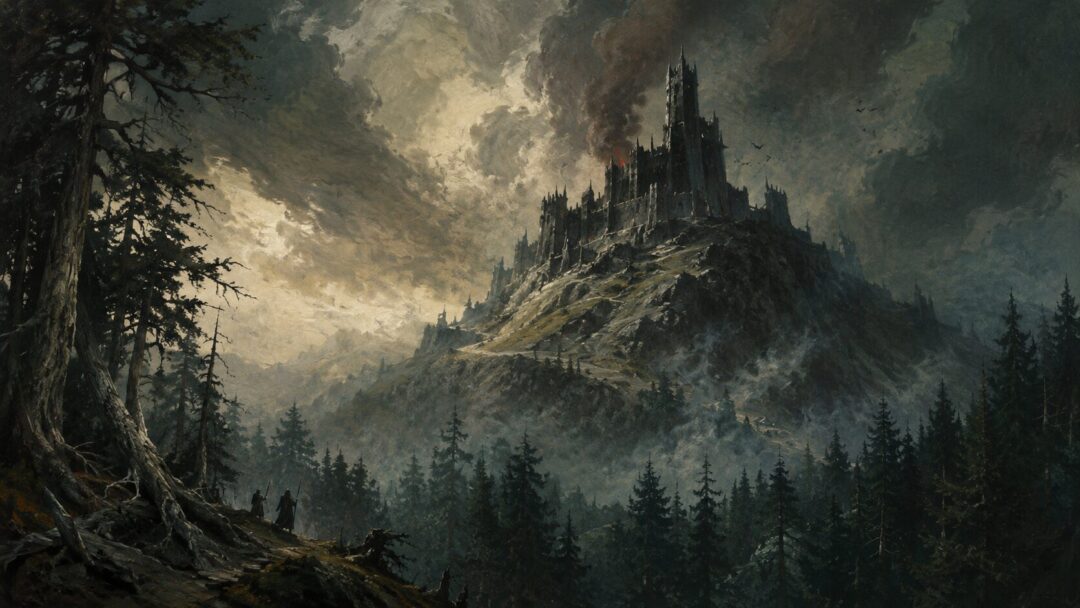
Most people think the Necromancer hid in Mirkwood because Sauron was not yet strong enough to return to Mordor.
That is true, but it is not the whole truth.
The deeper answer is more unsettling.
Dol Guldur was not merely a refuge for a defeated Dark Lord. It was a mask. It allowed Sauron to return without fully returning, to gather strength without declaring himself, and to let Middle-earth feel the pressure of his shadow before it understood whose shadow it was.
For a long time, the evil in southern Mirkwood was known only as the Necromancer.
Not Sauron.
Not the Lord of Barad-dûr.
Not the maker of the One Ring.
Just a dark power in the forest.
And that uncertainty was useful.
A Shadow Without a Name
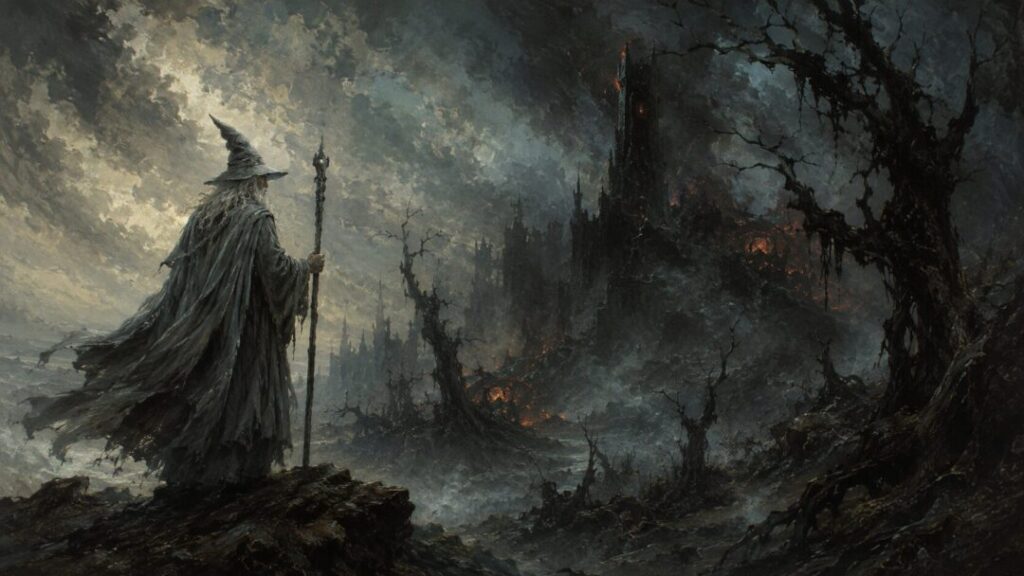
After Sauron’s overthrow at the end of the Second Age, he did not immediately rise again in open power. His return in the Third Age was gradual. The texts place the coming of the shadow over Greenwood the Great around the year 1050 of the Third Age, when the forest began to be called Mirkwood. Dol Guldur, the stronghold on Amon Lanc in the south of the forest, became the seat of the evil power later known as the Necromancer.
That name matters.
“Necromancer” is frightening, but it is also limited. It sounds like a sorcerer, a dark worker of spirits, a hidden master of death. It does not immediately reveal the full truth.
At first, even the Wise did not know with certainty who dwelt in Dol Guldur. The early suspicion was that the power might be one of the Nazgûl. Only later did the fear grow that it might be Sauron himself returning in secret.
That delay was not a small detail.
It gave Sauron time.
A named enemy creates urgency. An unnamed enemy creates hesitation.
And hesitation was exactly what Dol Guldur allowed.
Why Mirkwood Was the Perfect Place to Disappear
Mirkwood was not random.
Geographically, Dol Guldur stood in the south of the great forest, east of the Anduin and near the lands that mattered deeply in the later history of the Ring. It was not Mordor, where Sauron’s return would have been unmistakable. It was not openly tied to his ancient throne. It was a place where he could be present without forcing the world to recognize him too soon.
From there, his shadow could press upon the North.
The Woodland Realm of Thranduil withdrew northward as the darkness spread. Lórien lay to the west. The Anduin ran nearby. The Misty Mountains, the Gladden Fields, and the northern roads all mattered. Later fears about Dol Guldur were not abstract. Gandalf worried that Sauron might use that stronghold to strike at Lórien and Rivendell, and that Smaug in Erebor could become a terrible factor in the North.
This does not mean the texts say Sauron chose Dol Guldur only for one reason.
They do not.
But they strongly show that Dol Guldur gave him a strategic position. It let him threaten the northern world while avoiding the full exposure that would come with an open return to Mordor.
In other words, Mirkwood let Sauron become dangerous before he became obvious.
The First Retreat Was Not Defeat
The clearest sign of Sauron’s caution comes in the year 2063 of the Third Age.
By then, the power of Dol Guldur had grown enough to alarm the Wise. Gandalf went there to investigate. The Necromancer fled into the East. The texts indicate that he was not yet powerful and did not wish to be identified.
That moment is easy to misread.
It can look like cowardice.
But for Sauron, retreat was often strategy. If Gandalf had confirmed the truth too early, the Wise might have moved against Dol Guldur before Sauron had prepared enough strength elsewhere. By fleeing, he preserved the uncertainty around himself.
The result was the Watchful Peace, a period of roughly four centuries during which Sauron was absent from Dol Guldur and the shadow in Mirkwood lessened.
But peace is not the same as safety.
The very name “Watchful Peace” tells us that the Wise did not simply forget the danger. They watched because the question had not been answered.
The Necromancer had vanished.
But he had not been destroyed.
Returning Stronger
In 2460, Sauron returned to Dol Guldur.
This return is one of the most important parts of the timeline. The Watchful Peace ended. The shadow resumed. Around the same period, the One Ring came into the possession of Sméagol after Déagol found it. The texts place these events close together, though they do not state that Sauron knew the Ring had been found.
That distinction matters.
It would be too strong to say that Sauron returned to Dol Guldur because he knew the Ring was there. The safer reading is that Dol Guldur placed him near the wider region connected to Isildur’s death and the loss of the Ring, while also allowing him to rebuild influence in the North.
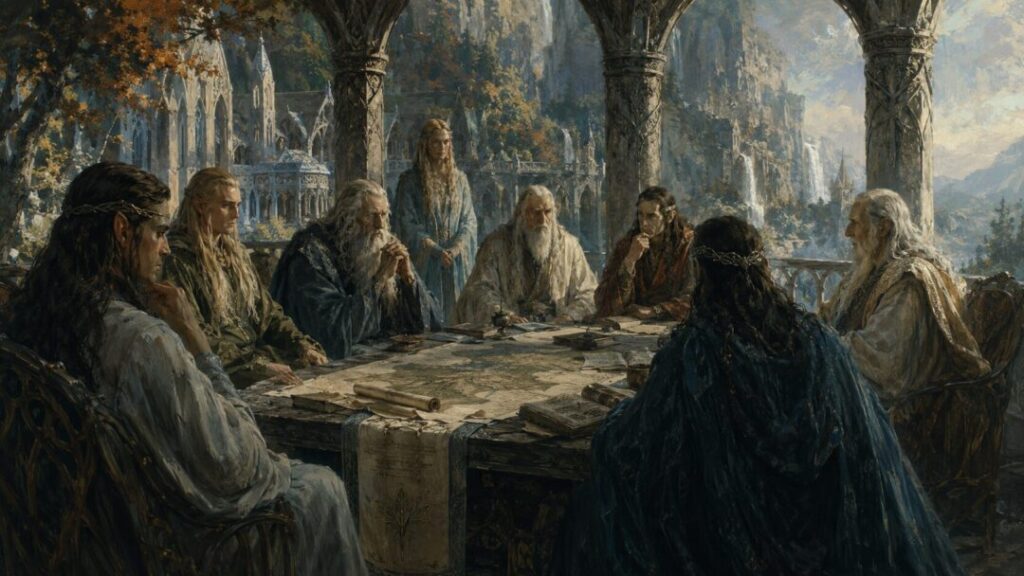
The White Council was formed soon after, in 2463. Its formation shows that the Wise understood the danger had grown. But knowledge and action were not the same thing.
Sauron’s concealment continued to work.
He was feared.
He was suspected.
But he was still not openly declared.
The Discovery Gandalf Made
The mask finally began to crack in 2850.
Gandalf entered Dol Guldur again. There he found Thráin II, father of Thorin Oakenshield, dying in the dungeons. Thráin had possessed the last of the Seven Rings of the Dwarves, and that Ring had been taken from him. Gandalf also learned the truth: the Necromancer was Sauron.
This was the moment the hidden enemy became identifiable.
But even then, the response was delayed.
In 2851, Gandalf urged the White Council to attack Dol Guldur. Saruman overruled him. The texts connect Saruman’s resistance with his own secret desire for the One Ring and his belief that the Ring might reveal itself if Sauron were allowed to continue growing in power.
This is one of the darker layers of the whole story.
Sauron hid behind the name of the Necromancer.
Saruman hid behind wisdom.
And between those two concealments, the shadow was allowed to remain.
Why Sauron Did Not Simply Return to Mordor Earlier
The easy answer is that Mordor was not ready.
But the fuller answer is that secrecy still served Sauron better than open rule.
Mordor was his ancient land of power, but returning there openly would have announced the truth to all his enemies. Dol Guldur gave him time to rebuild while Mordor was prepared by others. The Nazgûl had already taken Minas Ithil earlier in the Third Age, and it became Minas Morgul. Later, after Sauron withdrew from Dol Guldur in 2941, the Nazgûl had prepared Barad-dûr for his return.
This suggests a long, staged return.
First, the shadow in Mirkwood.
Then the strengthening of servants.
Then the search for the Rings and the One.
Then the open return to Mordor.
Sauron was not merely waiting because he had no other option. He was using delay as a weapon.
A Dark Lord does not always need to conquer immediately.
Sometimes he only needs his enemies to move too slowly.
The Attack That Came Too Late
In 2941, the White Council finally attacked Dol Guldur.
This is the same year as the Quest of Erebor. That overlap matters because Gandalf’s concerns about the North included both Sauron in Dol Guldur and Smaug in the Lonely Mountain. A dragon in Erebor and Sauron in southern Mirkwood could have made the northern lands far more vulnerable.
But when the Council moved, Sauron was not truly trapped.
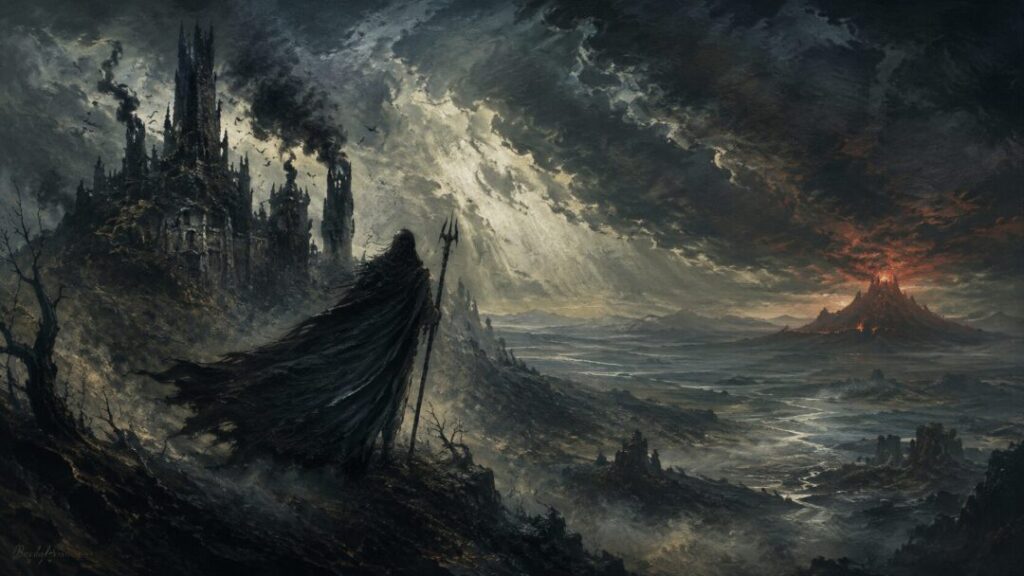
The texts say he had already made plans. He withdrew from Dol Guldur and went to Mordor, where his return had been prepared. In 2951, he declared himself openly, began rebuilding Barad-dûr, and sent Nazgûl back to Dol Guldur.
That is the crucial point.
The attack drove him out of Mirkwood, but it did not end the threat.
It forced the mask to fall.
And by then, Sauron was ready to wear his own name again.
Dol Guldur Was a Mask, Not a Mistake
So why did the Necromancer hide in Mirkwood for so long?
Because hiding worked.
It let Sauron return in stages. It let him darken Greenwood into Mirkwood without immediately provoking the full force of the Wise. It let him remain close to the northern world, the Anduin, and the region tied to the loss of the Ring. It let him threaten Lórien, Rivendell, the Woodland Realm, and the northern passes. It let him gather, search, corrupt, and prepare.
Most of all, it let him be underestimated.
Not because the Wise were foolish.
They were not.
But because Sauron’s return was not a single event. It was a long concealment.
For centuries, Middle-earth did not face the Dark Lord in open war. It faced a rumor in the trees. A shadow on a hill. A nameless fear in the south of a darkening forest.
That was the genius of Dol Guldur.
It was not Sauron’s throne.
It was his disguise.
The Real Horror of the Necromancer
The name “Necromancer” can make Sauron seem smaller than he was.
That was the danger.
A sorcerer in a tower is a problem.
Sauron returned is a crisis.
For hundreds of years, Middle-earth lived in the space between those two understandings. The Wise suspected. Gandalf investigated. Saruman delayed. The shadow deepened. And all the while, the enemy behind the mask was moving toward the moment when secrecy would no longer be needed.
That is why Dol Guldur matters so much.
It shows that Sauron’s greatest weapon was not only force.
It was patience.
He did not need Middle-earth to ignore the darkness forever.
He only needed it to misunderstand the darkness long enough.
Sources & Notes
- J.R.R. Tolkien, The Lord of the Rings, Appendix B, “The Tale of Years” — the Third Age chronology places the shadow in Greenwood, Sauron’s secret dwelling at Dol Guldur, his flights, returns, and final declaration in Mordor.
- J.R.R. Tolkien, The Silmarillion, “Of the Rings of Power and the Third Age” — describes Sauron rising again in southern Mirkwood as the “Necromancer” and the Wise slowly realizing the hidden power was Sauron.
- J.R.R. Tolkien, Unfinished Tales, “The Quest of Erebor” — Gandalf’s concern that Sauron in Dol Guldur and Smaug in Erebor could threaten the North supports the article’s strategic reading of Mirkwood.
- J.R.R. Tolkien, Unfinished Tales, “The Hunt for the Ring” — notes Sauron’s long search for the Ring and the importance of the Anduin/Gladden region, giving context for Dol Guldur’s position near the Ring’s history.
- J.R.R. Tolkien, The Lord of the Rings, Book II, Chapter 2, “The Council of Elrond” — Gandalf recounts finding Thráin in Dol Guldur and the loss of the last Dwarven Ring, tying the Necromancer’s disguise to Sauron’s wider Ring-policy.