Most readers remember Rohan’s arrival on the Pelennor as one of the great moments of sudden hope in Middle-earth.
The darkness lies over Minas Tirith. The gates have been broken. The Lord of the Nazgûl has entered the field. Gondor is surrounded, battered, and nearly spent.
Then the horns of Rohan sound in the morning.
It is easy to read the scene as a rescue by loyal allies.
That is true.
But it is also incomplete.
Rohan’s ride does not only reveal the courage of Théoden and his Riders. It reveals something more uncomfortable about Gondor itself. For all its ancient pride, for all its Númenórean inheritance, for all its towers, captains, and long memory, Gondor could not stand alone forever.
And the texts had been preparing that truth for centuries.
Gondor Was Great, But Not Untouched
Gondor was never presented as a small or fragile realm.
Even in decline, it remained the chief power resisting Mordor in the West. Minas Tirith was strong. The line of the Stewards endured. Its captains still guarded the crossings of the Anduin, defended Ithilien, and watched the borders of the Enemy.
But greatness and sufficiency are not the same thing.
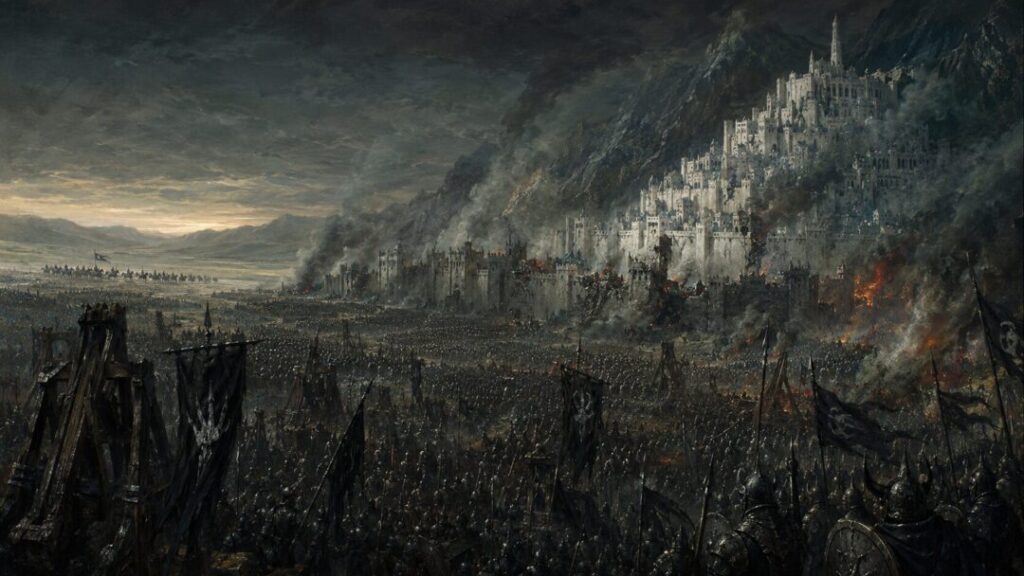
By the late Third Age, Gondor is a realm under immense pressure. Osgiliath, once its great city upon the River, has become a place of ruin and war. Ithilien, once fair and inhabited, is largely abandoned by ordinary settlement and held only by hidden companies such as Faramir’s Rangers. Mordor presses from the east. Harad and the Corsairs threaten from the south.
This matters because Gondor’s pride rests on an old identity: the South-kingdom, heir of Númenor, guardian of the West.
But the War of the Ring exposes the difference between memory and capacity.
Gondor remembers being vast.
Gondor still acts with dignity.
Yet its enemies are gathering on too many fronts.
The realm has courage. It has discipline. It has ancient strength.
But it does not have enough.
The Alliance Was Born From Desperation
Rohan did not begin as a decorative ally beside Gondor.
Its origin is bound to one of Gondor’s great moments of danger.
In the days of Cirion, Steward of Gondor, the realm was attacked by the Balchoth, while Orcs from the Misty Mountains also threatened its northern lands. Gondor’s province of Calenardhon had become thinly peopled and vulnerable. Cirion sent for aid to the Éothéod in the north.
Eorl the Young answered.
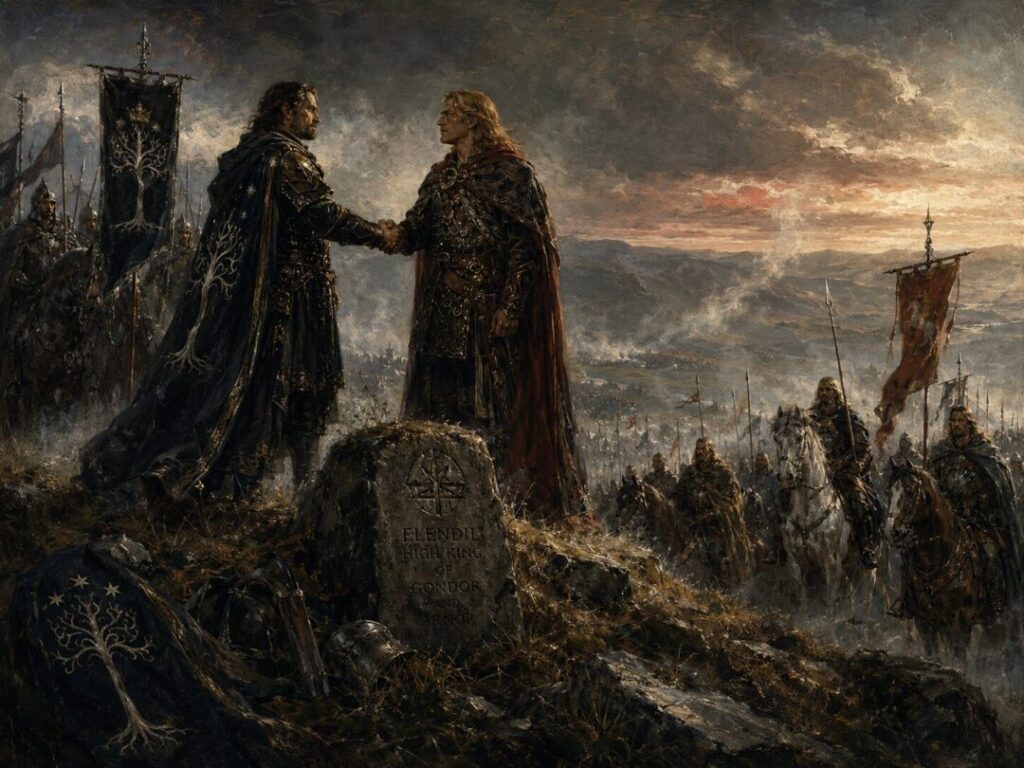
His riders came south and helped Gondor win the Battle of the Field of Celebrant. Afterward, Cirion granted Calenardhon to Eorl and his people. There, the horse-lords founded the realm later known as Rohan.
The Oath of Eorl was sworn between them.
This is often remembered as a noble alliance, and it is. But the nobility of the oath should not hide the practical truth beneath it.
Gondor gave away a great land because Gondor needed living strength there.
Calenardhon was not merely a gift of generosity. It was also a strategic answer to a hard reality: Gondor could no longer hold that northern region as it once had.
Rohan became a friend.
But it also became a shield.
Pride Could Accept Friendship More Easily Than Dependence
This is where the tension becomes interesting.
Gondor could honor Rohan. Gondor could swear friendship with Rohan. Gondor could call the Rohirrim allies.
But dependence is harder to admit.
The Men of Gondor carried the weight of older blood, older learning, and older political memory. Rohan, by contrast, was younger, less formally learned, and culturally different. The Rohirrim were not city-builders in the Gondorian mode. They were horse-lords of the Mark, bound by oaths, songs, kinship, and open land.
That difference does not make them lesser.
But from Gondor’s point of view, it makes the alliance complicated.
The proud realm of stone and memory needed the riders of grassland and horse.
Not once.
Again and again.
This is not because Gondor lacked courage. The defense of Minas Tirith proves the opposite. Men such as Faramir, Beregond, Imrahil, and the soldiers of the City show immense loyalty and endurance.
The problem is not moral weakness.
The problem is scale.
Sauron’s war is too large for one realm to bear alone.
The Red Arrow Reveals the Truth
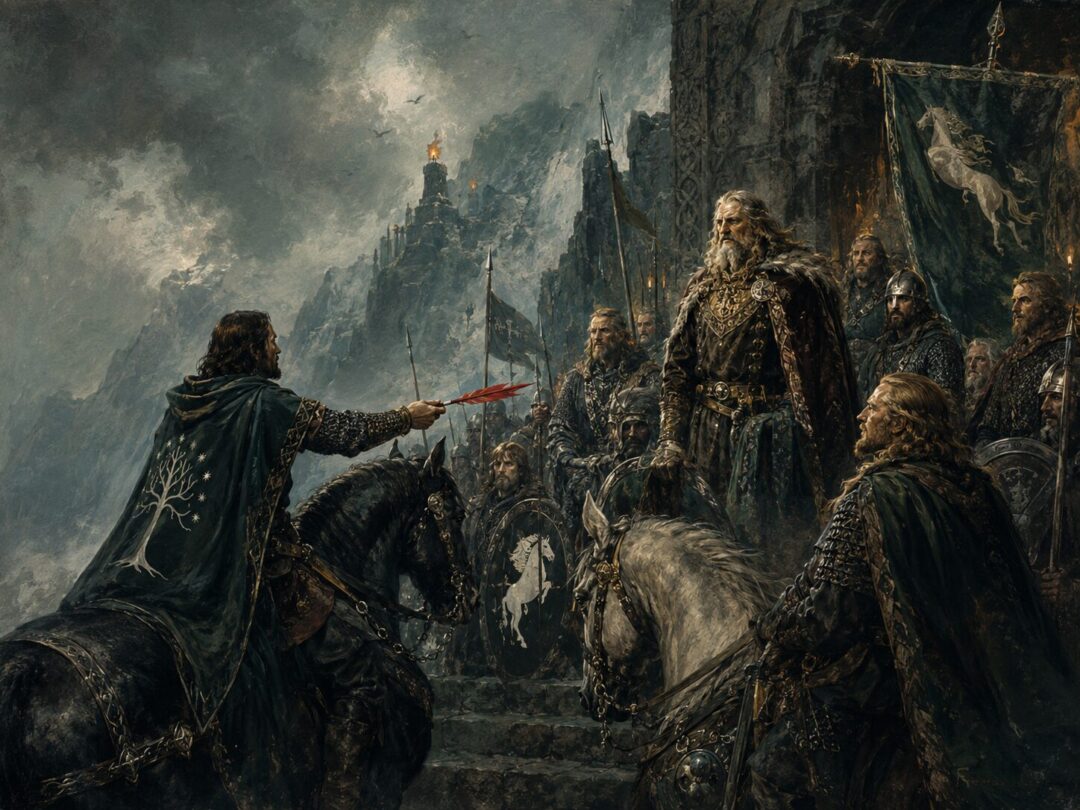
By the time Denethor sends the Red Arrow to Rohan, the old arrangement has become painfully visible.
The Red Arrow is a summons of great urgency. It is not a polite request sent during peace. It is a sign that Gondor needs aid in war.
And Rohan’s answer is not simple or easy.
Théoden has only just survived the crisis of Saruman. His own realm has been invaded. The Westfold has suffered. The people have taken refuge. The king is old, and his strength has only recently been restored.
Yet Gondor calls.
And Théoden prepares to ride.
That moment is sometimes treated as if Rohan is merely keeping a promise. But the promise itself is the point. Gondor’s survival strategy includes Rohan. The alliance is not sentimental background. It is part of the architecture holding the West together.
Denethor may be proud. Gondor may be ancient. Minas Tirith may be mighty.
But the Red Arrow admits what pride cannot say aloud:
Gondor needs the Mark.
Gondor’s Own Aid Was Not Enough
One of the most revealing details before the siege is the arrival of Gondor’s southern reinforcements.
They do come.
But not in the strength expected.
The threat of the Corsairs has drawn off much of the power of the southern fiefs. Men arrive from Lossarnach, Ringló Vale, Morthond, Anfalas, Lamedon, and Dol Amroth, but the numbers are fewer than hoped. Prince Imrahil’s force is noble and important, yet even this does not solve the larger crisis.
This is one of the quietest signs of Gondor’s vulnerability.
The realm is not empty.
It is not cowardly.
It is stretched.
Sauron does not attack Gondor as if it were a single gate to be battered in one place. His war pulls at many edges. Mordor presses Minas Tirith directly, while allies and subject peoples threaten Gondor’s other regions.
So when the great siege comes, Minas Tirith is not receiving the full strength of its own lands.
That makes Rohan’s coming even more essential.
The Rohirrim are not simply additional soldiers.
They are the force Gondor cannot produce from within itself at the decisive hour.
The Ride Changes More Than the Battle
When the Rohirrim arrive on the Pelennor, they do not merely add numbers.
They change the shape of the battle.
Before their coming, the forces of Mordor are pressing against a city close to despair. After their charge, the Enemy’s attention is broken and redirected. The field becomes contested in a new way. Théoden’s ride brings not only military relief, but a sudden restoration of hope.
That matters in Middle-earth.
Again and again, morale is not treated as decoration. Courage rises and fails. Songs, horns, banners, names, and remembered oaths have power over the hearts of those who fight.
The horns of Rohan do something that stone walls cannot.
They tell the defenders of Minas Tirith that they are not alone.
This does not make Gondor weak.
It makes Gondor part of something larger.
The West survives because its peoples answer one another. Elves, Men, Hobbits, Dwarves, Rangers, horse-lords, and city-soldiers each carry what the others cannot.
Gondor’s pride alone cannot defeat Mordor.
But Gondor joined to Rohan can endure long enough for the hidden hope of the Ring’s destruction to reach its end.
Théoden’s Greatness Exposes Denethor’s Tragedy
The contrast between Théoden and Denethor makes this even sharper.
Denethor sees much. He is not a fool. He understands Gondor’s danger with terrible clarity. But his vision narrows under despair. He sees strength measured against strength, and in that calculation Sauron appears overwhelming.
Théoden, by contrast, rides even though victory is not guaranteed.
He does not ride because the odds are favorable. He rides because the oath, the need, and the hour demand it.
This does not make Théoden wiser in every way, nor Denethor worthless. The texts give Denethor great dignity, power, and intelligence before his fall into despair. But at the crisis point, Théoden embodies something Denethor loses: the willingness to act faithfully without possessing certainty.
That is why Rohan’s arrival cuts so deeply.
It is not only a military answer.
It is a moral answer.
Gondor, under Denethor, is collapsing inward into isolation and despair. Rohan breaks that isolation from the outside.
The horns sound, and the world is larger than Denethor’s fear.
Rohan Was Never Lesser Help
There is a temptation to treat Rohan as the simpler realm: brave, rustic, emotional, less ancient than Gondor.
The texts do show real cultural differences. Gondor is older, more learned, and more connected to the legacy of Númenor. Rohan is younger and rooted in a different way of life.
But the War of the Ring does not rank them by sophistication.
It tests whether they will answer the hour appointed to them.
And Rohan does.
The Rohirrim do not possess Gondor’s ancient towers. They do not carry the same memory of Númenor. They do not have the same place in the long war against Mordor.
But they bring something Gondor desperately needs: speed, cavalry, loyalty, and the ability to strike the field from beyond the expected line of siege.
More than that, they bring proof that old oaths still live.
In a world where treachery has done terrible damage, that faithfulness is no small thing.
The Debt Went Both Ways
It is important not to overstate the case.
Rohan needed Gondor too.
The alliance was mutual. Gondor had helped create the conditions in which Rohan could exist by granting Calenardhon. The two realms were bound by friendship and need, not by one-sided dependence.
Rohan also faced grave dangers of its own. Saruman’s war nearly broke the Mark before the ride to Minas Tirith ever began. Without the victory at Helm’s Deep and the overthrow of Isengard’s power, Rohan might not have been able to answer Gondor at all.
So the point is not that Gondor was secretly helpless or that Rohan was the true power of the West.
That would be too simple.
The point is more interesting:
Gondor’s greatness did not remove its need.
Its pride did not make it self-sufficient.
And its survival depended on a younger ally whose strength looked different from its own.
Why This Changes the Pelennor
The Ride of the Rohirrim is often remembered as a burst of glory.
It is that.
But it is also the return of a very old truth.
When Eorl rode south to aid Cirion, Gondor was saved by horsemen from the North. When Théoden rides to the Pelennor, the pattern repeats on a greater and darker stage.
The alliance is not background history.
It is one of the deep structures of the story.
Gondor stands as the great wall against Mordor, but walls need living defenders. Kingdoms need friends. Ancient blood needs present courage. Memory needs renewal.
Rohan supplies what Gondor lacks at the moment of crisis.
And Gondor gives Rohan’s courage a field where it can matter for the fate of the world.
That is why the horns before dawn feel so powerful.
They are not only announcing an army.
They are announcing that Gondor was never meant to bear the Shadow alone.
The Humility Hidden Inside Victory
The Pelennor is not a story of one realm saving another in a simple way.
It is a story of interdependence.
Gondor’s soldiers hold long enough for help to come. Rohan rides far enough to break the siege. Aragorn arrives with the southern strength released from the terror of the Corsairs. And far away, Frodo and Sam carry the true burden into Mordor.
No single pride wins the war.
That may be the deeper lesson.
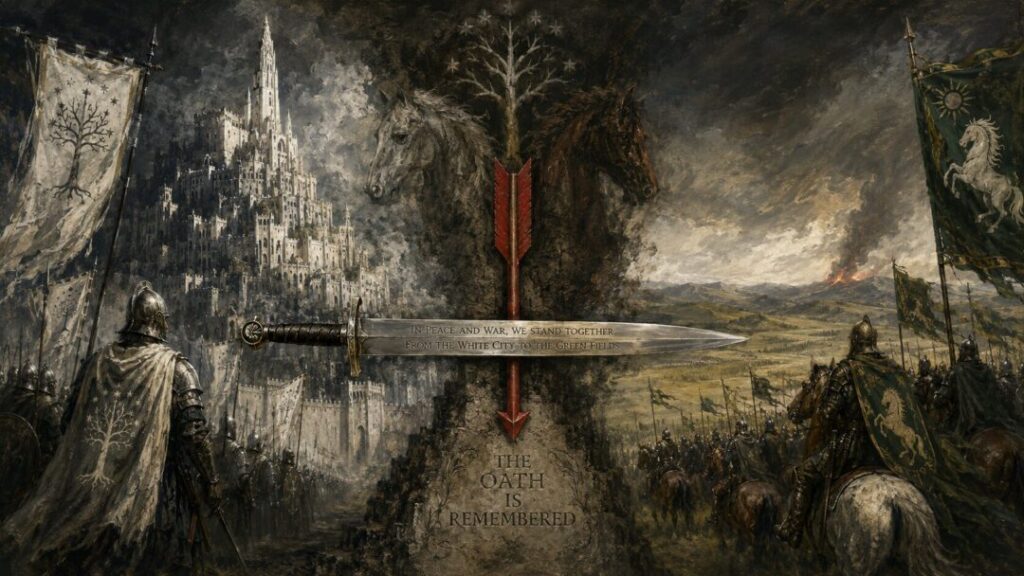
Gondor needed Rohan more than pride admitted because Middle-earth itself is not saved by isolated greatness. It is saved by bonds: oaths kept, mercy remembered, help answered, and peoples unlike one another choosing to stand together.
The White City is not diminished because the horse-lords came.
It is revealed.
Its greatness was never that it needed no one.
Its greatness was that, at the end, it still had allies who would ride through darkness to reach it.
Sources & Notes
- J.R.R. Tolkien, Unfinished Tales, ‘Cirion and Eorl and the Friendship of Gondor and Rohan’ — for the Balchoth crisis, Eorl’s ride to Celebrant, the grant of Calenardhon, and the oath binding the two realms.
- J.R.R. Tolkien, The Lord of the Rings, Appendix A, ‘The House of Eorl’ — summarizes Rohan’s founding and its long alliance with Gondor after Cirion’s need for northern horsemen.
- J.R.R. Tolkien, The Lord of the Rings, Book V, Chapter 1, ‘Minas Tirith’ — shows Gondor stretched thin, with the southern fiefs sending fewer men because of the Corsair threat.
- J.R.R. Tolkien, The Lord of the Rings, Book V, Chapter 3, ‘The Muster of Rohan’ — gives the Red Arrow, Théoden’s response, and Rohan’s costly decision to ride to Gondor’s aid.
- J.R.R. Tolkien, The Lord of the Rings, Book V, Chapters 5–6, ‘The Ride of the Rohirrim’ and ‘The Battle of the Pelennor Fields’ — for the horns before dawn, the breaking of the siege’s momentum, and the decisive battlefield relief brought by Rohan.