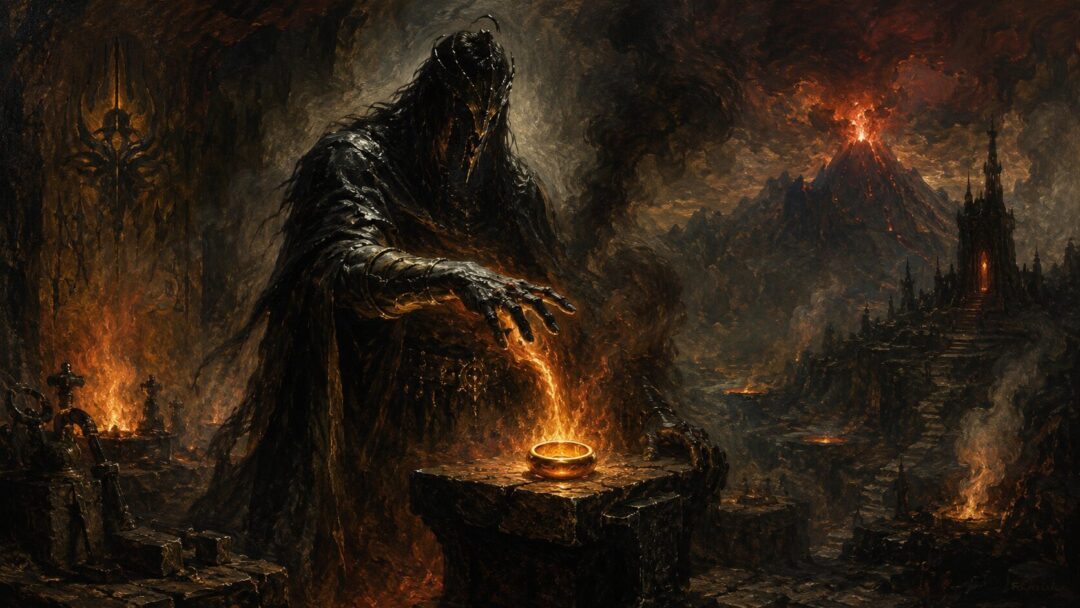
Most readers think the One Ring was dangerous because it made people powerful.
But that is only the surface.
The darker truth is that the Ring’s real power was not strength, invisibility, or even long life. Those things matter, but they are not the heart of it. The Ring was dangerous because it was made for mastery.
That word changes everything.
It explains why Gandalf recoils from it. It explains why Galadriel’s vision of herself is so terrible. It explains why Boromir’s desire to use it against Mordor is not treated as a practical military suggestion, but as the beginning of a fall. And it explains why Frodo, after resisting so long, cannot finally throw it away by his own strength.
The Ring does not merely offer power.
It teaches the bearer to think in terms of possession, command, control, and rightful rule over others.
That is why it is not just a magical object.
It is the central moral danger of the whole story.
The Ring Was Not Made as a Simple Weapon
The easiest mistake is to imagine the One Ring as a kind of ultimate weapon.
A sword cuts. A fortress defends. A crown commands loyalty. A Ring of Power, we might assume, simply gives its bearer greater force.
But the One Ring is more specific than that.
It was forged by Sauron in Orodruin, the Fire-mountain, during the Second Age. Its purpose was tied to the other Rings of Power. The Elven-smiths had made Rings, and Sauron secretly made the One so that their power would be bound to it.
The Ring-verse says this plainly:
One Ring to rule them all.
One Ring to find them.
One Ring to bring them all.
And in the darkness bind them.
Those are not words of ordinary conquest.
They are words of mastery.
The Ring was made to rule the other Rings and, through them, to dominate their bearers. That is why its true danger cannot be measured by whether Frodo can shoot lightning from his hands or defeat armies in open battle. That is not what the Ring is primarily for.
Its deepest purpose is control.
Invisibility Was Never the Main Point
For Bilbo, Frodo, and Sam, the most obvious effect of the Ring is invisibility.
Bilbo uses it to escape danger in The Hobbit. Frodo puts it on in moments of fear or pressure. Sam briefly uses it in Mordor. To a Hobbit, this can make the Ring seem like a tool for hiding.
But that is not the Ring’s central power.
Invisibility is what mortals experience when they wear it, because the Ring draws the wearer partly into the Unseen world. This matters, especially when the Ringwraiths are near, because they belong far more to that unseen mode of existence than ordinary living beings do.
But invisibility is not why Sauron made it.
Sauron did not pour so much of his power into the Ring so that he could vanish from sight. He made it to rule. To bind. To command. To extend his will through the structure of the Rings themselves.
This is why the Ring can seem strangely underwhelming when Hobbits use it.
Frodo does not become a warrior-king when he puts it on. Bilbo does not become a lord of armies. Sam does not suddenly overthrow Mordor.
They are not trained to wield it.
They are not beings of Sauron’s stature.
And most importantly, they are not trying to use it according to its true purpose.
They mostly use it to escape.
But the Ring was made for domination.
Why the Wise Refuse It
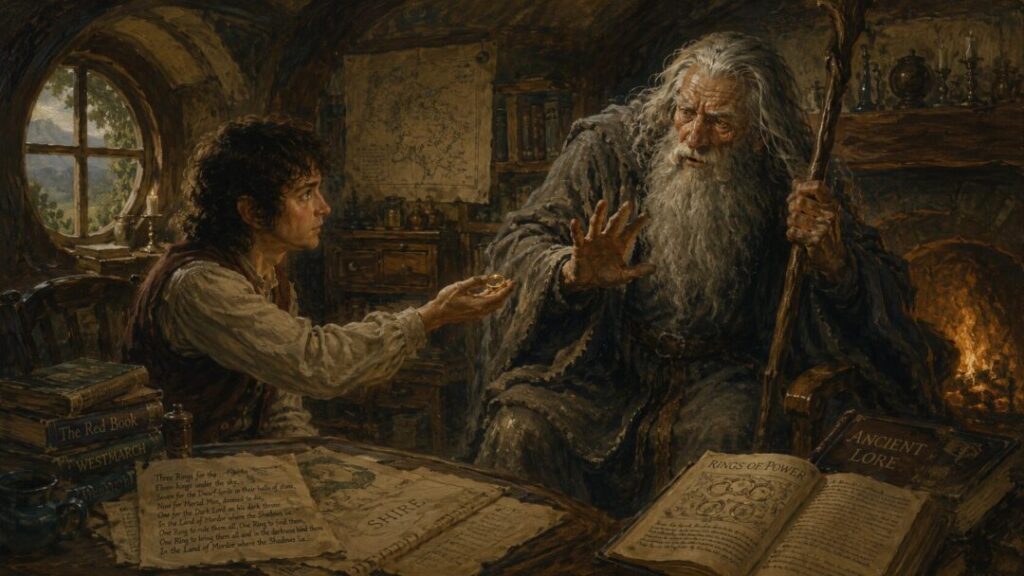
This is why Gandalf’s refusal is so important.
When Frodo offers him the Ring, Gandalf does not treat it as a harmless tool that he is too modest to accept. He is afraid of it. He understands that if he took it, he would wield it with a desire to do good.
And that would be the danger.
The Ring would not need to make Gandalf petty, cruel, or obviously wicked at first. It could work through his wisdom, his authority, his pity, and his desire to set things right. That is the horror. The Ring does not only tempt the selfish.
It also tempts the noble.
It offers them the power to impose their goodness upon the world.
That is why Gandalf says that through him it would gain a power too great and terrible. The problem is not that Gandalf secretly wants to become Sauron. The problem is that the Ring would turn even his good intentions toward command.
First order.
Then correction.
Then compulsion.
Then mastery.
The road to tyranny would not have to begin with hatred.
It could begin with pity armed with absolute power.
Galadriel Sees the Shape of the Temptation
Galadriel’s temptation shows the same pattern in a different form.
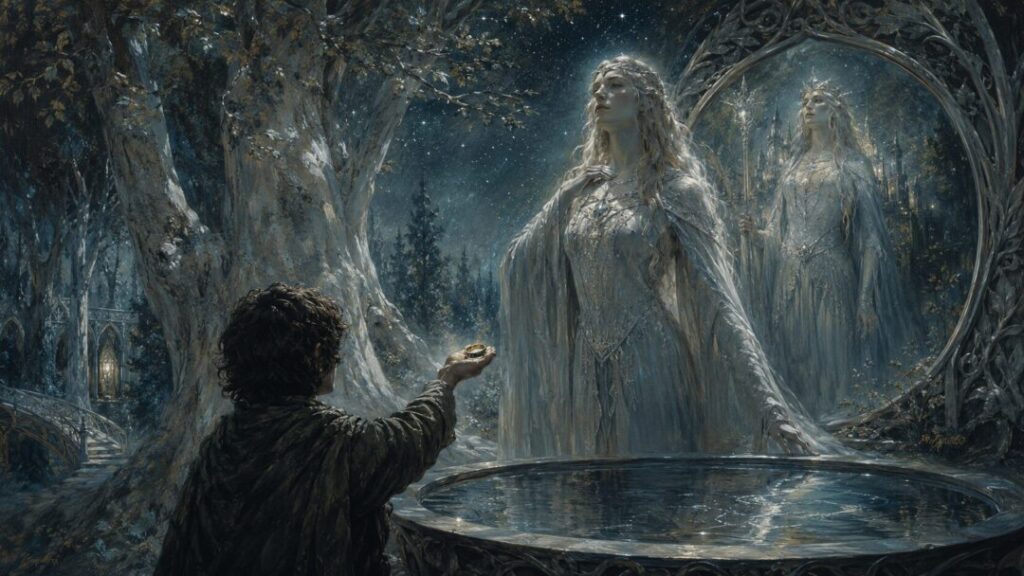
When Frodo offers her the Ring in Lothlórien, she does not imagine herself as a crude conqueror. Her vision is far more beautiful and far more frightening.
She sees herself as a queen.
Not dark in the simple sense. Not ugly. Not small. She imagines herself as radiant, beloved, and terrible. All would love her and despair.
That moment reveals the Ring’s subtlety.
It does not merely whisper, “Destroy.”
It can whisper, “Heal.”
“Preserve.”
“Guide.”
“Rule wisely.”
“Make the world what it should be.”
For Galadriel, who has preserved Lothlórien with Nenya and carries the memory of ancient loss, the temptation is not simple greed. It is the temptation to stop decline by force. To preserve beauty by command. To become the will that orders the world.
But preservation through mastery would no longer be true preservation.
It would become possession.
Galadriel passes the test because she refuses that path. She accepts diminishment. She allows the world to move beyond her control.
That is the opposite of the Ring.
Boromir Asks the Wrong Question
Boromir’s temptation is often remembered as weakness.
But his mistake is more specific than that.
He asks why the Ring should not be used against Sauron. From a military point of view, the question almost sounds reasonable. Gondor is under terrible pressure. Mordor is rising. The Free Peoples are divided and outmatched. If a weapon lies within reach, why not turn it against the Enemy?
But the Ring is not just a weapon.
That is what Boromir fails to see.
He imagines using the Enemy’s power while remaining himself. He imagines victory without inward surrender. He imagines command without corruption.
And this is exactly how the Ring begins its work.
Boromir does not want the Ring because he loves evil. He wants it because he loves Gondor, fears its ruin, and believes strength can save it. His desire is understandable. That is why it is tragic.
The Ring does not need him to say, “I want to serve Sauron.”
It only needs him to say, “I have the right to take this, because my need is great.”
That is mastery beginning to speak.
Sam’s Vision Shows the Ring’s Method
Sam’s brief time as Ring-bearer is one of the clearest windows into how the Ring tempts according to the bearer.
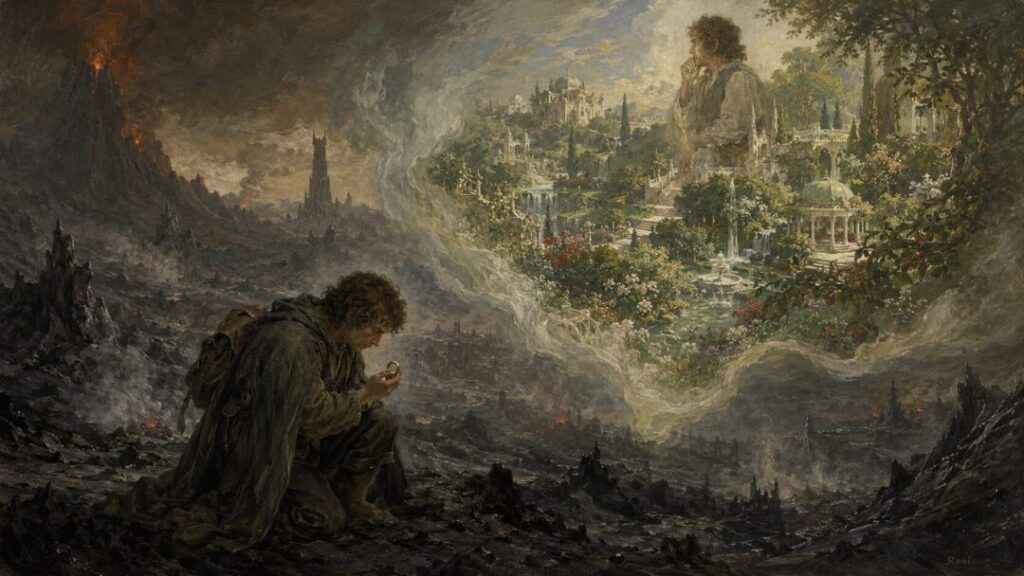
Sam does not dream of becoming a Dark Lord in the same way a great king or wizard might. His heart is rooted in gardens, simple loyalties, and love for Frodo. So the temptation comes in a form that fits him.
He imagines Mordor transformed into a vast garden.
On the surface, this seems almost innocent. What could be less Sauronic than turning a wasteland into flowers and green growing things?
But the vision is still a vision of mastery.
It is not merely Sam tending a small garden with his own hands. It is Sam ordering a land according to his will. The scale is wrong. The humility is gone. The Ring inflates the good desire until it becomes lordship.
And Sam resists because, in the end, he knows himself.
He wants his own garden, not a realm.
That humility saves him. Not because Sam is immune to the Ring, but because his deepest desires are small enough to reject the grand vision it offers.
The Ring tries to turn even gardening into dominion.
That is how dangerous it is.
Frodo’s Failure Reveals the Final Truth
At the Cracks of Doom, the question is finally stripped bare.
Frodo has carried the Ring farther than anyone could reasonably have expected. He has endured terror, hunger, wounds, pursuit, and the constant pressure of the Ring itself. He has come to the one place where it can be destroyed.
And there he cannot do it.
He claims it.
This moment is sometimes misunderstood as a sudden moral collapse, but the story is more tragic and more merciful than that. Frodo has resisted beyond the strength of ordinary endurance. At the final point, inside the place where the Ring was made, its pressure reaches its height.
And the words Frodo speaks are words of possession:
The Ring is mine.
That is the final form of its temptation.
Not “I will serve Sauron.”
Not “I will destroy the Shire.”
Not even “I will rule Middle-earth wisely.”
Mine.
The Ring’s deepest work is to make surrender impossible. It binds the will inward. It makes letting go feel like death, theft, loss, and violation.
At the end, Frodo does not master the Ring.
The Ring masters him.
Its destruction comes through Gollum’s attack and fall, not through Frodo calmly exercising command over himself. That matters. The story does not pretend that good people can simply dominate evil by being determined enough.
Mastery is the thing being judged.
Why Sauron Could Not Imagine Its Destruction
Sauron’s own blindness also reveals the Ring’s nature.
He understands power through domination. He assumes that anyone who gains the Ring will want to use it. This is why the plan to destroy it is so strange and so powerful. It moves outside the logic by which Sauron understands the world.
To Sauron, the Ring is the supreme instrument of mastery.
Therefore, the idea that someone would carry it into Mordor in order to unmake it is almost unthinkable. He expects rivalry. He expects challenge. He expects someone to claim.
He does not expect renunciation.
That is why the Quest succeeds not by matching Sauron’s strength, but by rejecting the very principle on which his strength depends.
The answer to mastery is not greater mastery.
It is surrender.
The Ring Turns Good into Control
This is the most unsettling part of the Ring.
It does not tempt every person in the same way. It does not offer everyone the same fantasy. It works through what is already there.
To Boromir, it offers victory for Gondor.
To Galadriel, preservation and queenly splendor.
To Gandalf, the terrible possibility of doing good by force.
To Sam, a garden enlarged beyond humility.
To Frodo, at the end, simple possession.
The forms differ.
The pattern is the same.
The Ring takes desire and bends it toward command. It turns care into control, courage into conquest, preservation into possession, and responsibility into rule.
That is why it cannot be used safely.
Not by the cruel.
Not by the wise.
Not even by those who want to do good.
Especially not by those who want to do good.
Why Mastery Had to Be Unmade
The Ring is destroyed only when the logic of mastery collapses.
No army conquers it.
No hero wields it successfully.
No wise lord bends it to noble purposes.
No one proves strong enough to possess absolute power without being changed by it.
Instead, the Ring is unmade in the fire where it was forged, after pity, endurance, failure, and providence have all met in one terrible moment.
That ending is not accidental.
The Ring’s power was mastery, and mastery could not defeat mastery. The world could not be saved by someone becoming a better Dark Lord. It could only be saved by the refusal, however fragile and incomplete, to claim domination as the answer.
This is why the Ring remains one of the most frightening objects in Middle-earth.
Not because it makes the wearer invisible.
Not because it extends life.
Not because it can command armies.
But because it offers the oldest and most dangerous lie in a form that can sound almost righteous:
If you had the power to rule, you could put everything right.
Middle-earth is saved because that lie is finally unmade.
And the Ring, the great instrument of mastery, goes into the fire.
Sources & Notes
- J.R.R. Tolkien, The Silmarillion, “Of the Rings of Power and the Third Age” — Sauron forges the One Ring to rule the other Rings and dominate their bearers, grounding the article’s mastery theme.
- J.R.R. Tolkien, The Lord of the Rings, Book I, Chapter 2, “The Shadow of the Past” — Gandalf explains the Ring’s ruling verse and refuses Frodo’s offer because through him it would gain power too great and terrible.
- J.R.R. Tolkien, The Lord of the Rings, Book II, Chapter 7, “The Mirror of Galadriel” — Galadriel’s imagined queenly form, “beautiful and terrible,” shows the Ring tempting even noble power toward command.
- J.R.R. Tolkien, The Lord of the Rings, Book II, Chapter 10, “The Breaking of the Fellowship” — Boromir’s argument that the Ring should be used as a weapon against Mordor turns quickly into coercion of Frodo.
- J.R.R. Tolkien, Letter 131 — Tolkien describes Sauron’s desire to order all things according to his own wisdom, a useful storycraft gloss on domination rather than mere battlefield strength.