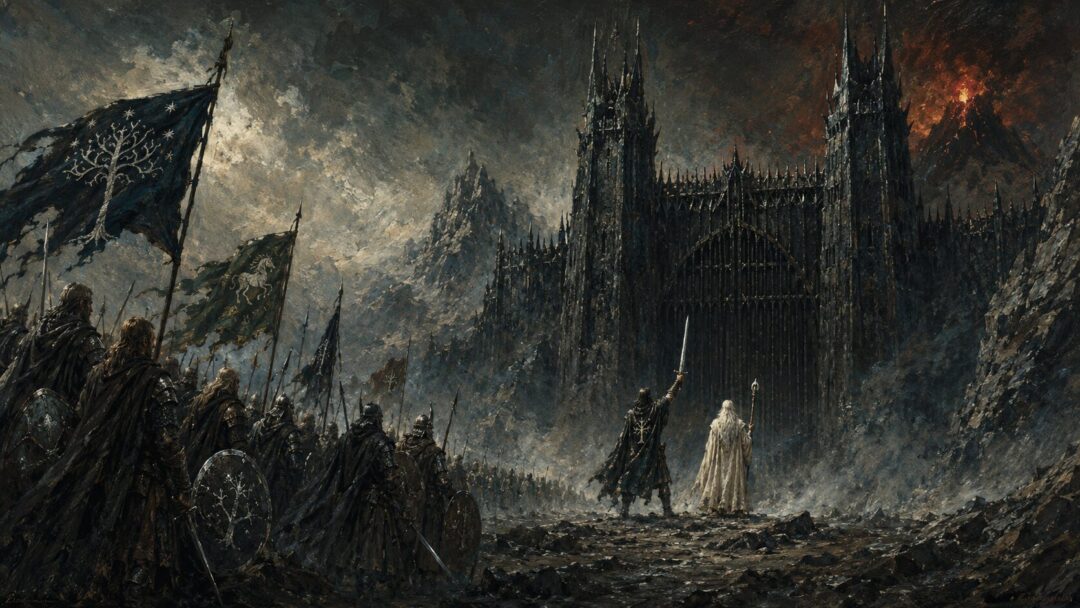
The march to the Black Gate is often remembered as a final act of courage.
And it is.
But it is also one of the most dangerous deceptions in the War of the Ring.
The Captains of the West do not ride to Mordor because they believe they can defeat Sauron in open war. They do not march because Gondor has suddenly become strong enough to break the Black Gate. They do not go because victory by arms is within reach.
They go because it is not.
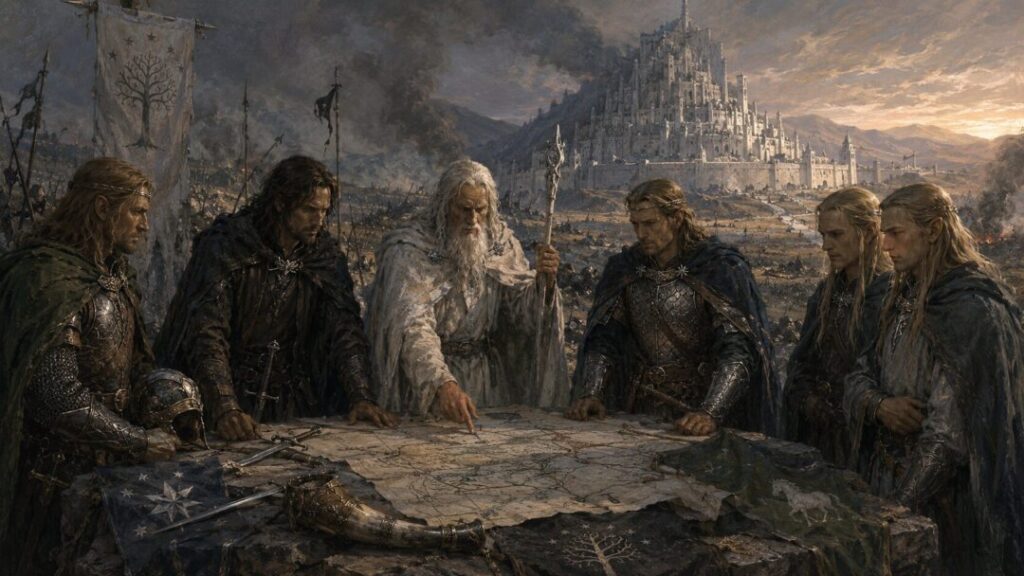
At the Last Debate, after the Battle of the Pelennor Fields, the leaders of the West face the truth plainly. Sauron has suffered a setback, but he is not broken. Minas Tirith has survived, yet Mordor remains vast. The hosts gathered against Gondor were not the whole strength of the Dark Lord.
So Gandalf proposes something that looks insane on the surface.
They will gather what force they can, march to the Black Gate, and challenge Sauron at the entrance to his own land.
Not to win.
To distract him.
The entire plan rests on one hope: that Sauron will look away from his true peril long enough for Frodo and Sam to reach Mount Doom.
But that raises the real question.
Why would Sauron take the bait?
Why would the Dark Lord, ancient, calculating, and almost victorious, turn his attention toward a small army he could clearly outnumber?
The answer is not that Sauron was stupid.
It is far more interesting than that.
He was trapped by the shape of his own mind.
The Army Was Never the Real Threat
The host that marches from Minas Tirith is not large enough to conquer Mordor.
That matters.
The plan is not a secret invasion. It is not an attempt to storm Barad-dûr. It is not even a realistic military gamble. The Captains know this. Gandalf knows this. Aragorn knows this.
Their army is bait.
That does not make their courage smaller. It makes it greater. They are not marching under a comforting illusion. They understand that if Frodo fails, they will likely be destroyed.
The Black Gate is not chosen because it is weak. It is chosen because it is visible.
Sauron must see them.
He must hear their challenge.
He must believe that what is coming toward him is not merely an army, but a declaration.
This is why the march works as theatre as much as strategy. Aragorn does not creep toward Mordor. He comes openly. The heralds name him. The banners are raised. The heir of Elendil stands before the Gate of the Dark Land.
To any ordinary commander, this might look reckless.
To Sauron, it looks like something else.
It looks like the beginning of a claim.
Aragorn Had Already Shown Himself
Before the march to the Black Gate, Aragorn had already done something bold.
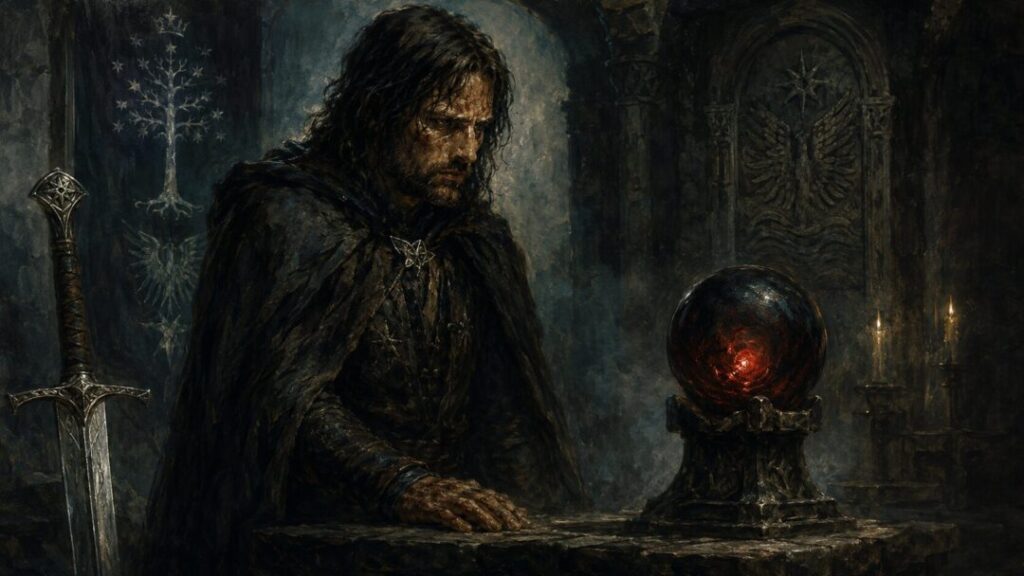
He looked into the palantír of Orthanc and revealed himself to Sauron.
This was not a casual act. The seeing-stones were dangerous, and Sauron had used one to dominate Saruman and torment Denethor through fear and false emphasis. Yet Aragorn had a rightful claim to the stone as heir of Elendil, and he used that moment to announce himself.
He showed Sauron the sword reforged.
That image mattered.
For Sauron, the line of Elendil was not just an old royal house. It was tied to one of his greatest defeats. Elendil and Gil-galad had overthrown him at the end of the Second Age, and Isildur had cut the Ring from his hand.
Now the heir of that line had appeared.
Not hidden.
Not doubtful.
Not as a ranger in the wild, but as a king returning.
The texts do not say that Sauron knew every detail of Aragorn’s thought. They do not need to. The point is simpler: Aragorn gave Sauron the exact image most likely to provoke him.
The sword was reforged.
The king had returned.
And somewhere in the world, the Ring had also returned.
For Sauron, those facts could not be safely separated.
Sauron Expected the Ring to Be Used
The deepest reason the trap worked is that Sauron could not imagine the real plan.
The Wise intended to destroy the Ring.
Sauron did not believe that was what his enemies would do.
This is not because he had never considered danger. It is because destruction of the Ring required a kind of renunciation completely opposed to his nature. Sauron understood power as something to possess, order, command, and bend to the will. The Ring was made for domination. Its whole purpose was mastery.
So when the Ring reappeared, Sauron’s expectation was not that someone would carry it into the fire.
His expectation was that someone would try to use it.
That assumption was not baseless. Boromir was tempted by exactly that idea. Saruman desired the Ring. Even the Wise understood that the Ring could not be used safely, because the desire to wield it would corrupt the heart. The temptation was real because the Ring offered a path that looked practical, heroic, and urgent.
Use the weapon of the Enemy against him.
Save the world by taking command.
Become strong enough to overthrow darkness.
Sauron would understand that logic perfectly.
What he could not understand was the humility of refusing it.
That is why a small army at the Black Gate could appear far more dangerous than it was.
If Aragorn had the Ring, the size of his army was no longer the main question.
The question was whether he had come too soon, in pride, before mastering it fully.
The Trap Was Built from Sauron’s Fear
Sauron’s fear was not simple fear of battle.
He did not look at Aragorn’s army and think it could defeat Mordor by ordinary means.
The fear was subtler.
What if the Ring had been claimed?
What if Aragorn, heir of Isildur, had taken it?
What if the victory at the Pelennor, the Paths of the Dead, the sudden arrival of the southern forces, and the return of the king all seemed to point to one conclusion?
Sauron did not need to be certain.
He only needed to consider the possibility.
That is what made the Black Gate a trap he could not ignore. If Aragorn was bluffing, Sauron could crush him. But if Aragorn truly had the Ring and was allowed more time, the danger might grow.
From Sauron’s point of view, delay was risky.
A rival Ring-lord could become more dangerous with time. A claimant might learn. A king might gather strength. Even if Sauron believed the Ring ultimately belonged to him, he could not simply allow a potential challenger to stand openly before his land.
So he answered.
The Gate opened.
The armies of Mordor came forth.
And the Eye was drawn away from the two small figures moving through the waste of Mordor.

Sauron Was Wrong, But Not Foolish
It is tempting to say Sauron was tricked because he was arrogant.
That is true, but incomplete.
His arrogance matters because it limits what he can imagine. He judges others by the logic of domination. He assumes that those who possess power will want to use it. He expects ambition because ambition is what he understands.
But within that worldview, his response makes sense.
Aragorn had revealed himself. The West had won an unexpected victory. The Ring was unaccounted for. A direct challenge arrived at his gate.
Sauron did not know Frodo and Sam were inside Mordor carrying the Ring toward Mount Doom. When he finally became aware of the Ring at the fire, he reacted immediately. Until then, his attention had been successfully drawn elsewhere.
That is the brilliance of Gandalf’s counsel.
The plan does not require Sauron to be careless.
It requires him to be himself.
The trap works because it gives Sauron a false story that fits his deepest assumptions better than the truth does.
A king using the Ring to challenge him?
That he can believe.
Two hobbits carrying it into the heart of his realm to destroy it?
That he cannot.
The Mouth of Sauron Shows the Trap Tightening
At the Black Gate, Sauron does not immediately rush out in person.
Instead, he sends the Mouth of Sauron.
This moment is chilling because it shows that Sauron is still testing, probing, and manipulating. The Mouth displays tokens taken from Frodo and Sam: the mithril-coat, the cloak, the sword. He tries to break the Captains with despair and force them into surrender.
This also reveals something important.
Sauron has found signs of intruders, but he has not understood the full truth.
He does not present Frodo himself. He does not reveal that he possesses the Ring. He uses the captured items as psychological weapons, hoping to convince the West that their mission has failed.
Gandalf sees through the terms. He refuses them.
And the confrontation continues exactly where the Captains need it to continue: at the Gate, in the open, with Sauron’s attention fixed on them.
The Mouth thinks he is playing on the fears of the West.
But the West is playing on the fear of Sauron.
Why the Black Gate Had to Open
Sauron could have stayed behind his walls.
But doing nothing would have meant accepting uncertainty.
That was the one thing he could not afford.
If Aragorn had the Ring, then the challenge had to be answered quickly. If Aragorn did not have it, then destroying the Captains of the West would still complete Sauron’s military victory. Either way, from Sauron’s perspective, sending out overwhelming force made sense.
This is why the trap is so powerful.
It offers Sauron a choice where every path seems to lead him toward the same response.
Ignore Aragorn, and risk giving a possible Ring-claimant more time.
Attack Aragorn, and crush the last military strength of the West.
The second option is too tempting to refuse.
So Sauron commits his attention to the battle.
The Nazgûl are there. His armies surround the Captains. The West is nearly overwhelmed.
And then, far away in the Sammath Naur, the truth finally appears.
The Ring is not at the Black Gate.
It is in the fire-mountain.
At that moment, Sauron understands.
But too late.
The Real Blindness of the Dark Lord
Sauron’s great failure is not lack of intelligence.
It is moral blindness.
He can calculate armies. He can use fear. He can corrupt, deceive, and dominate. He can imagine rivals seeking mastery because that is the world as he understands it.
But he cannot truly understand the strength of renunciation.
He cannot understand why Bilbo would spare Gollum.
He cannot understand why Frodo would carry the Ring without intending to rule.
He cannot understand why Sam would give it back.
He cannot understand why Aragorn would stand before the Black Gate without possessing the very weapon that could make such a challenge seem rational.
That is why the smallest people in the story move beneath the notice of the greatest Eye in Middle-earth.
Not because they are powerful.
Because they are doing something power cannot explain.
The Trap Was Made of Truth and Misreading
The Black Gate deception works because it is not built from pure lies.
Aragorn really is the heir of Elendil.
The sword really has been reforged.
The king really has returned.
The West really is challenging Sauron.
And the Ring really is inside Mordor.
But Sauron arranges those truths into the wrong story.
He sees Aragorn and imagines possession.
He sees defiance and imagines pride.
He sees courage and imagines ambition.
The Captains of the West do not defeat Sauron by becoming stronger than him. They defeat him, in part, by allowing him to misread them according to the pattern of his own heart.
That is what makes the Black Gate so fascinating.
It is not merely a battlefield.
It is a mirror.
Sauron looks into it and sees the kind of enemy he expects: a rival lord, grasping for power, coming too soon to challenge him.
But the real enemy is elsewhere.
A weary hobbit.
A faithful gardener.
A broken creature driven by desire.
And a Ring that, at the final moment, passes beyond every design laid by the Wise or by the Dark Lord.
Why the Trap Could Not Be Ignored
The Black Gate was a trap Sauron could not ignore because it struck at the one fear he had to take seriously.
Not defeat by ordinary armies.
Not the courage of Men.
Not even the return of a king by itself.
The fear was that the Ring had found a new claimant.
Everything Aragorn did made that fear believable enough. Everything Sauron believed about power made it almost impossible for him to dismiss.
So he turned his Eye toward the Gate.
And in doing so, he looked away from the only place that truly mattered.
That is the quiet genius of the plan.
The Captains of the West did not win by strength.
They won time.
They stood in front of the Dark Lord and told him a story he was willing to believe.
And while he listened, the Ring came to the fire.
Sources & Notes
- J.R.R. Tolkien, The Lord of the Rings, Book V, Chapter 9, “The Last Debate” — Gandalf frames the march on Mordor as a deliberate feint, meant to draw Sauron’s Eye away from Frodo’s road.
- J.R.R. Tolkien, The Lord of the Rings, Book III, Chapter 11, “The Palantír” — Aragorn’s confrontation through the Orthanc-stone shows why Sauron would connect the heir of Elendil, the reforged sword, and the Ring.
- J.R.R. Tolkien, The Lord of the Rings, Book V, Chapter 10, “The Black Gate Opens” — the Mouth of Sauron’s taunts and the Captains’ stand keep the confrontation fixed at the Morannon while Sauron misreads the threat.
- J.R.R. Tolkien, The Lord of the Rings, Book VI, Chapter 3, “Mount Doom” — when Frodo claims the Ring, Sauron finally perceives the true danger and turns from the battle too late.
- J.R.R. Tolkien, Letter 131 — Tolkien’s description of Sauron’s will to dominate and order others helps explain the article’s point that he expected power to be claimed, not renounced.