At first glance, Galadriel’s Phial looks simple.
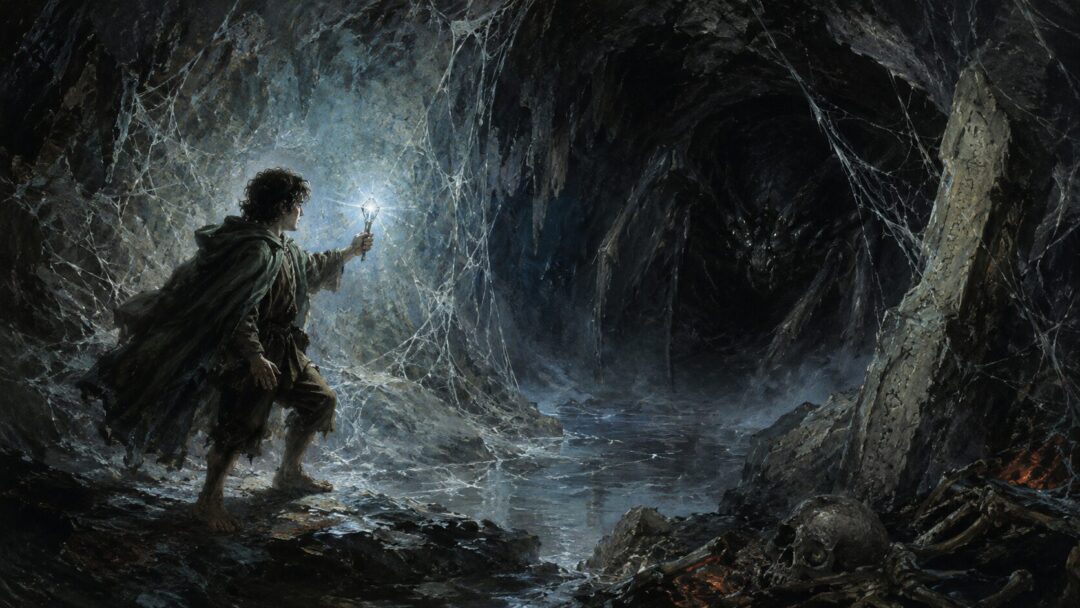
Frodo is trapped in darkness. Shelob is coming. He remembers the gift given to him in Lothlórien, raises it, and light breaks through the horror.
It feels like the natural shape of the scene: evil darkness against good light.
But that is only the surface.
The real power of the Phial is not just that it shines. Many things shine in Middle-earth. Torches shine. Stars shine. Elven blades gleam. The Phial matters because of what kind of light it carries, where that light comes from, and what kind of darkness it confronts.
Shelob’s lair is not merely a dangerous tunnel.
And Galadriel’s gift is not merely a useful object.
When Frodo lifts the Phial in that black passage, two lines of ancient history meet: the preserved light of the Elder Days, and the devouring darkness descended from Ungoliant.
That is why the moment feels larger than the scene itself.
Because it is.
The Phial Is Not Just a Lamp
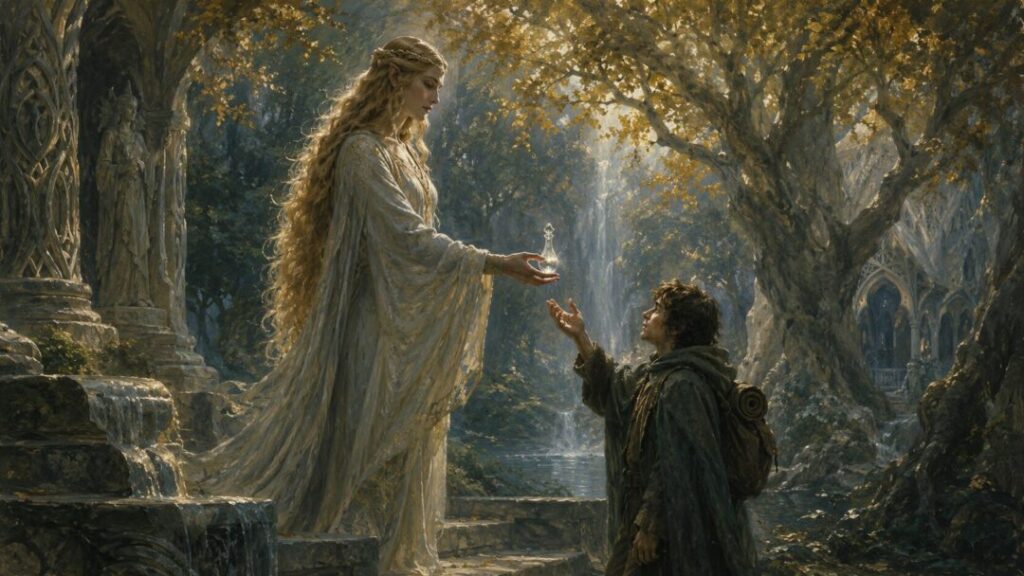
When Galadriel gives Frodo the Phial in Lothlórien, she does not describe it as a weapon.
She calls it a light for dark places, when all other lights go out.
That wording matters.
She does not promise that it will defeat Sauron. She does not say it will destroy monsters. She does not explain all the ways it may be used. The gift is given quietly, almost gently, as if its full meaning will only become clear when Frodo has no other help left.
And that is exactly what happens.
In Shelob’s lair, the hobbits have entered a darkness that is not simply the absence of light. The tunnel is foul, oppressive, and almost alive with malice. Frodo and Sam are not merely unable to see. They are being pressed inward by fear, stench, exhaustion, and the unseen presence of something waiting.
Ordinary light would help them see.
The Phial does more than that.
It answers the darkness.
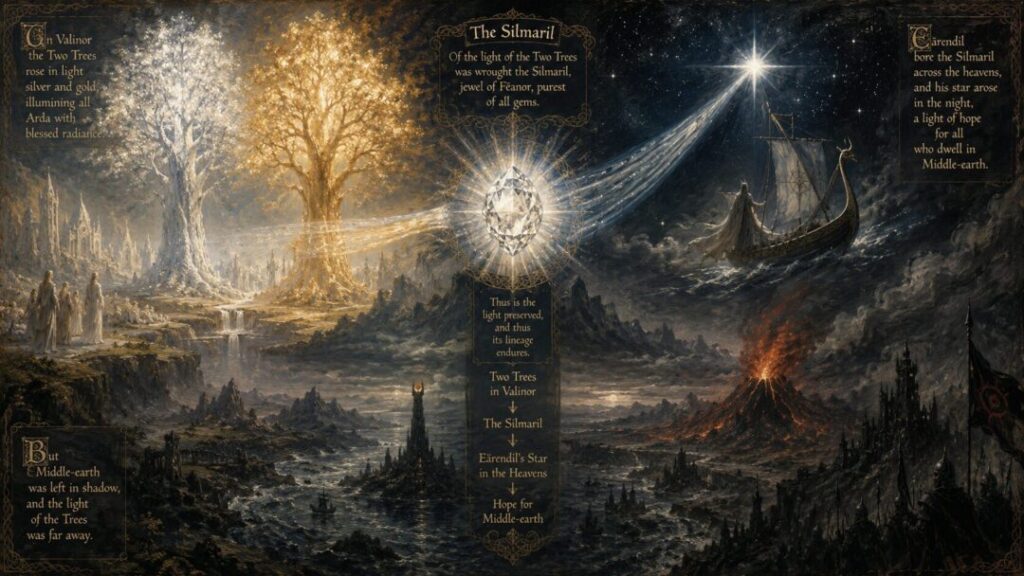
This is why its origin matters so deeply. Galadriel’s Phial contains the light of Eärendil’s star, caught in the water of her fountain. That star is bound to one of the Silmarils, and the Silmarils preserved the light of the Two Trees of Valinor.
So the Phial is not just bright.
It carries a remnant of the most ancient light still reachable in Middle-earth.
The Light Comes From Before the Sun
By the late Third Age, the world feels old.
The Elves are fading. The great works of the past are passing away. The power of the Three Rings is nearing its end, even if few fully understand it yet. Much of Middle-earth is already living in the long shadow of things that happened ages before.
The Phial is one of those survivals.
Its light reaches back beyond the Sun and Moon, to the Two Trees of Valinor. Their light was preserved in the Silmarils, and one of those Silmarils was carried into the heavens by Eärendil.
That is the star Galadriel’s gift draws from.
This does not mean Frodo is carrying a Silmaril. He is not. Nor does it mean the Phial has the same nature or power as a Silmaril. The text does not say that.
But it does mean that the Phial carries reflected, captured light from a source tied to the deepest sacred history of the world.
That is why the moment in Shelob’s lair is not random.
Frodo does not simply happen to have a bright object at the exact time he needs one. He bears a gift whose light belongs to a story older than Mordor, older than Sauron’s dominion there, and older than the age in which Frodo himself lives.
Against Shelob, that matters.
Shelob Is Not Just a Monster
Shelob is often remembered as a giant spider.
That is true, but it is not enough.
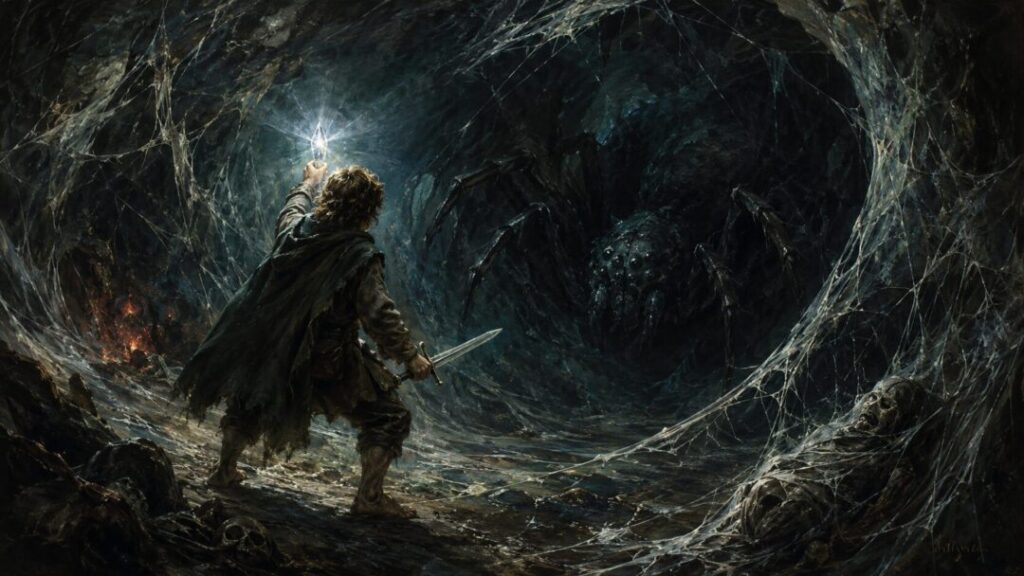
The text presents her as something far older and darker than a natural beast. She is connected to Ungoliant, the monstrous being who, in the Elder Days, helped destroy the Two Trees and drank their light. Shelob is described as the last child of Ungoliant to trouble the unhappy world.
That single connection changes the entire meaning of the scene.
Shelob is not merely an obstacle placed near Mordor. She is a lingering remnant of an older darkness, one that predates the War of the Ring. She serves no master in any loyal sense. Sauron knows of her and uses her presence near the pass, but she is not simply his servant. She is hungry, ancient, and self-willed.
Her darkness is not political.
It is appetite.
She does not want kingdoms. She does not want order. She does not want the Ring as Sauron wants it. The text emphasizes her hunger, her webs, her hidden lair, her long feeding on those who come within reach.
This is why she is so terrifying.
Sauron represents domination.
Shelob represents devouring.
And the Phial confronts that devouring darkness with a light linked to what Ungoliant once consumed.
The Oldest Pattern Returns
There is a deep irony in Shelob recoiling from the Phial.
Her ancestor Ungoliant helped drink the light of the Two Trees. Yet in Shelob’s lair, a remnant of that same ancient light returns—not as a blazing tree, not as a Silmaril in full glory, but as a small glass vessel carried by a hobbit.
This should not be overstated.
The text never says Shelob recognizes the light’s history. It does not say she understands Eärendil, the Silmarils, or Valinor. We should not imagine her pausing in some conscious memory of the Elder Days.
But the pattern is unmistakable.
The darkness descended from Ungoliant is checked by light descended from the Trees.
Not destroyed at once.
Not erased.
Checked.
That restraint is important. The Phial does not turn Shelob into dust. It does not make the passage safe. It does not spare Frodo from being poisoned. Its power is real, but it works within the moral and spiritual logic of the story, not like a simple magical weapon.
It reveals. It resists. It gives courage.
But it does not remove the need for endurance.
Frodo’s Cry Matters
When Frodo raises the Phial, he does more than hold up an object.
Words come to him: “Aiya Eärendil Elenion Ancalima.”
Hail Eärendil, brightest of stars.
The moment is strange because Frodo is not presented as carefully choosing a spell from knowledge he has mastered. It is more as if the words rise through him in the crisis. The Phial shines more fiercely, and Shelob draws back.
Again, this should be phrased carefully.
The text does not lay out a mechanical rule: say these words, activate this power. Middle-earth is rarely that crude. But it does show a relationship between memory, invocation, courage, and light.
Frodo is not merely using an artifact.
He is reaching, in terror, toward the ancient hope the artifact carries.
Eärendil is not just a name attached to a star. His star is a sign of hope in the darkness. It belongs to the long history of resistance against overwhelming shadow. When Frodo invokes that name in Shelob’s lair, the scene becomes more than a physical confrontation.
It becomes an act of remembrance.
And in Middle-earth, remembrance has power.
Why Galadriel’s Gift Is So Precise
Galadriel’s gifts to the Fellowship are not random.
They are suited to the people who receive them, though the full meaning is often only revealed later. To Frodo, the Ring-bearer, she gives something small enough to carry into the darkest places and strong enough to answer despair.
This is not the same as giving him a sword.
Frodo already carries a blade. Sting will matter, especially in Sam’s hands. But Frodo’s deepest trial is not only physical danger. It is the pressure of the Ring, the exhaustion of the road, and the spiritual suffocation of approaching Mordor.
He needs more than a weapon.
He needs a light that can remain when every ordinary light is gone.
That is exactly what the Phial becomes.
It is especially significant that the Phial does not belong to the logic of domination. The Ring is power bent toward mastery. It works by possession, secrecy, and control. The Phial works differently. It is given freely. It is carried humbly. Its light does not conquer by ruling; it strengthens by revealing.
The contrast could hardly be sharper.
The Ring makes its bearer more alone.
The Phial reminds its bearer that he is not alone.
The Phial Does Not Save Frodo Completely
One of the most important details in the Shelob episode is that the Phial is not enough to prevent disaster.
Frodo drives Shelob back for a time, but he is still eventually stung. Sam still finds him seemingly dead. The Quest still reaches one of its most devastating moments. For a while, it looks as if everything has failed.
That matters because it prevents the scene from becoming simple.
If the Phial were merely a magic solution, the meaning would be much thinner. Frodo would raise it, Shelob would vanish, and the Quest would continue.
Instead, the light gives him a chance, but not immunity.
This is very consistent with the larger moral shape of the story. Grace appears, but it does not cancel suffering. Help comes, but it does not remove choice. Light shines, but the characters still have to walk.
The Phial does not replace courage.
It awakens it.
That is why Sam’s role becomes so crucial. After Frodo falls, Sam takes up both the sword and the Phial. Against Shelob, he becomes the one who stands, speaks, wounds, and refuses to yield. The light helps him, but it does not act apart from him.
Middle-earth rarely gives victory to passive possession.
The gift must be answered.
Sam Understands More Than He Knows
Sam does not fully understand the ancient history of the Phial.
He is not a scholar of the Silmarils. He does not know the whole story of Ungoliant in detail. But he understands something essential: the light is connected to hope beyond his own strength.
That is enough.
This is one of the beautiful patterns of The Lord of the Rings. The deepest histories of the world often pass into the hands of people who cannot explain them fully, but who can still be faithful to them.
Sam does not need to define the metaphysics of the Phial.
He needs to lift it.
He needs to trust that light still means something in a place designed to make light seem impossible.
And that is exactly what he does.
In that sense, the Phial becomes one of the clearest examples of how the past remains active in the present. The Elder Days are not gone in a dead, museum-like way. Their light still reaches forward, sometimes in forms so small that the great powers of the world might overlook them.
A star.
A glass.
A hobbit’s hand.
What the Scene Really Means
Galadriel’s light in Shelob’s lair means that evil in Middle-earth is never only local.
Shelob is not just a monster near Mordor. She is a remnant of an older hunger. The Phial is not just an Elven trinket. It is a remnant of an older light. Their meeting turns a narrow tunnel into a place where the history of the world suddenly contracts into one terrifying moment.
But the scene also means something more intimate.
The light does not appear in the hands of a king, a great Elf-lord, or a Maia revealed in power. It appears in the hands of Frodo and Sam, two small figures nearly crushed by the road.
That is the quiet wonder of it.
The greatest light remaining to them does not arrive as a vast army or a thunderous miracle. It arrives as something they have carried almost without understanding.
This is why Galadriel’s words are so precise.
A light in dark places, when all other lights go out.
Not a guarantee.
Not a weapon of conquest.
A light.
And in Shelob’s lair, that is exactly what is needed.
The Darkness Does Not Get the Last Word
Shelob’s tunnel is one of the darkest passages in the journey to Mordor.
It is filled with fear, stench, webs, hunger, and betrayal. Gollum has led the hobbits there for his own purpose. Sauron’s land lies ahead. Frodo is nearly spent. Sam is nearly overwhelmed. Everything seems to be narrowing toward ruin.
Then the Phial shines.
Not enough to make the road easy.
Not enough to undo every wound.
But enough to prove that the darkness is not absolute.
That is the real meaning of Galadriel’s gift. It carries the memory of a light older than the present terror. It brings the Elder Days into the War of the Ring, not as nostalgia, but as living resistance. It shows that even in the blackest tunnel, the story of light has not ended.
Shelob recoils because the Phial is more than brightness.
It is witness.
It bears witness that darkness has devoured light before, but has never truly mastered it.
And that may be the deepest reason the scene remains so powerful.
Frodo and Sam do not yet know how the Quest will end. They do not know whether they will survive. They do not know that pity, endurance, and mercy will still matter at the edge of the Fire.
But in Shelob’s lair, they are given one undeniable sign.
The darkness is ancient.
But the light is older in meaning.
And it is still there.
Sources & Notes
- J.R.R. Tolkien, The Lord of the Rings, Book II, Chapter 8, ‘Farewell to Lórien’ — Galadriel gives Frodo the Phial as Eärendil’s star caught in her fountain, ‘a light to you in dark places, when all other lights go out.’
- J.R.R. Tolkien, The Lord of the Rings, Book IV, Chapter 9, ‘Shelob’s Lair’ — Frodo raises the Phial, cries ‘Aiya Eärendil Elenion Ancalima,’ and its light makes Shelob pause and recoil in the tunnel.
- J.R.R. Tolkien, The Lord of the Rings, Book IV, Chapter 9, ‘Shelob’s Lair’ — Shelob is named as the last child of Ungoliant, independent of Sauron though useful to him, grounding the article’s older-devouring-darkness theme.
- J.R.R. Tolkien, The Lord of the Rings, Book IV, Chapter 10, ‘The Choices of Master Samwise’ — Sam takes up Sting and the Phial after Frodo falls, showing the light as aid to courage rather than an automatic rescue.
- J.R.R. Tolkien, The Silmarillion, ‘Of the Darkening of Valinor’ and ‘Of the Voyage of Eärendil’ — Ungoliant’s destruction of the Trees and Eärendil’s Silmaril-star supply the Elder Days background behind the Phial’s light.