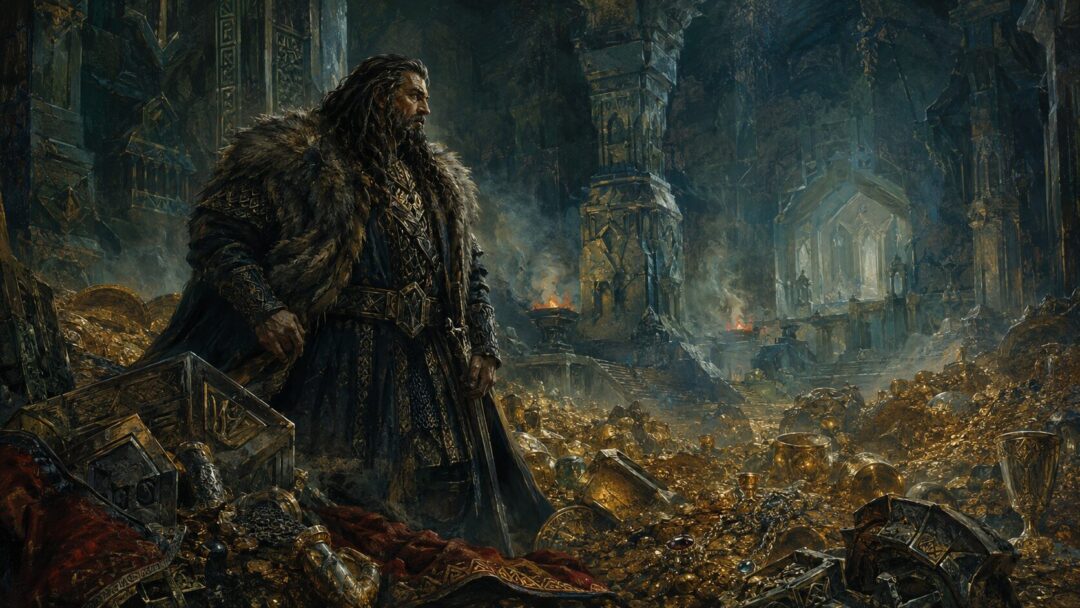
Most readers think Thorin Oakenshield falls because he loves gold too much.
But that is only the easy answer.
The more unsettling truth is that Thorin’s claim to the treasure is not simply false. He is not a stranger grabbing wealth that never belonged to him. He is the heir of a dispossessed royal house. Erebor was taken by violence. Smaug murdered, burned, scattered, and hoarded what was not his.
So when Thorin returns to the Lonely Mountain, he is not merely chasing riches.
He is trying to recover a world.
That is what makes his fall so dangerous. The treasure does not need to tempt him with an obvious lie. It only needs to take a true grief, a true inheritance, and a true injustice—and bend them inward until nothing remains but possession.
Thorin’s Claim Is Not Invented
Thorin’s desire for Erebor is not presented as meaningless greed from the beginning.
The Lonely Mountain was the home of his people. Its halls belonged to Durin’s Folk. The treasure inside it was gathered by Dwarves before Smaug came, and Smaug’s wealth is stolen wealth.
That matters.
If Thorin were merely a thief, his fall would be simple. But he is not. His anger has roots. His longing has history. His pride is tied to exile, loss, and the memory of kingship.
The problem is not that Thorin remembers too much.
The problem is that, once he reaches the treasure, memory becomes possession.
Erebor stops being a home to restore and becomes a hoard to defend. The treasure stops being part of a people’s story and becomes the measure of Thorin’s authority. The more he clings to it, the smaller his world becomes.
That is one of the sharpest moral turns in The Hobbit.
A quest that begins with a home ends, for a time, with a locked gate.
The Gold Has Power
The text does not treat Smaug’s treasure as morally neutral.
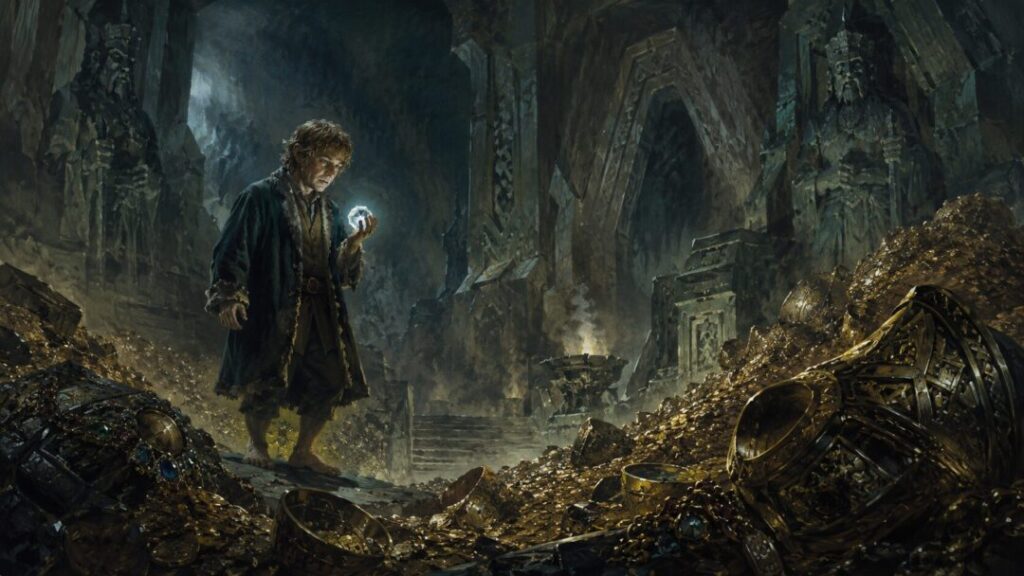
After the dragon’s death, Bilbo hopes that some agreement might still be possible. But the narration warns that he has not fully reckoned with “the power that gold has upon which a dragon has long brooded.”
That line is crucial.
The danger is not only ordinary wealth. It is dragon-hoarded wealth. Smaug has not used the treasure to build, heal, feed, or restore. He has slept on it. Guarded it. Counted it. Known it piece by piece. His relationship to treasure is pure possession.
He does not need the gold.
He only needs it to be his.
That shadow hangs over the hoard after his death.
The Hobbit does not give a detailed rulebook for dragon-sickness. It does not explain it like a spell with fixed stages and symptoms. The book is more restrained than that. But it does show that treasure long brooded over by a dragon has a corrupting force, especially upon hearts already vulnerable to greed, pride, fear, or wounded entitlement.
That is why Thorin’s fall feels both magical and moral.
The gold has power.
But it also finds something in him.
The Arkenstone Makes the Wound Sharper
Thorin does not merely want treasure in general.
He wants the Arkenstone.
The Arkenstone is not treated as just another jewel. It is the Heart of the Mountain, the jewel Thorin names above price. When he speaks of it, his language becomes absolute. Of all the treasure, this is the thing he claims for himself.
That detail matters because the Arkenstone concentrates the whole meaning of Erebor into one object.
It is beauty.
It is inheritance.
It is kingship.
It is memory.
It is the visible sign that the Mountain has been restored to Thorin’s line.
So when Bilbo secretly takes it, and later gives it to Bard and the Elvenking as a bargaining piece, Bilbo is not merely handing over a gem. He is touching the center of Thorin’s identity.
That does not make Thorin’s rage right.
But it explains why the moment cuts so deeply.
To Bilbo, the Arkenstone becomes a desperate tool to prevent war. To Thorin, it appears as the ultimate betrayal: the heart of his inheritance placed in the hands of those outside the gate.
That is the tragedy.
The same object reveals two moral visions.
Bilbo sees treasure as something that may be spent to save lives.
Thorin, in his sickness, sees treasure as something that must be kept even if lives are lost.
Treasure Turns People Into Guards
Smaug is the clearest image of hoarding in the story.
He lies alone in the Mountain, surrounded by riches he did not make and does not share. He is powerful, clever, and terrifying, but his life has narrowed into guarding. His treasure does not make him free. It keeps him fixed in one place, suspicious of every sound.
When Thorin takes possession of the Mountain, he does not become Smaug.
The text never says that.
But the pattern is hard to miss.
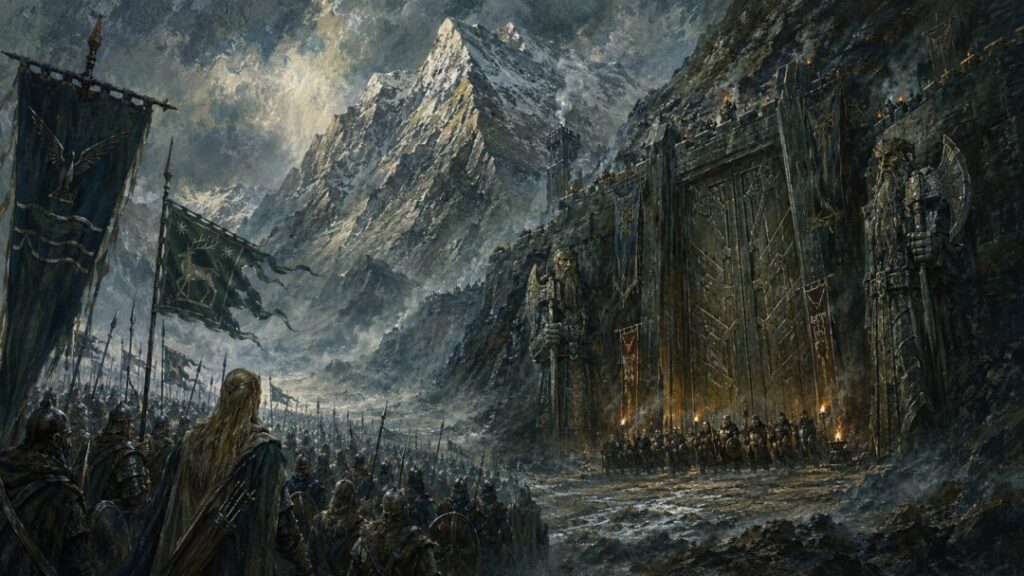
The gates are shut. Claims from outside are refused. The needs of the Lake-men, whose town Smaug has destroyed, are pushed aside. Even Bard’s role in killing the dragon does not move Thorin toward generosity. Instead, the treasure becomes something to defend before it becomes something to use.
This is one of the darkest things treasure does in Middle-earth.
It promises restoration, but it produces isolation.
It promises security, but it creates fear.
It promises kingship, but it turns the king into a watchman of locked doors.
Thorin came to the Mountain to reclaim a kingdom.
For a time, the hoard nearly makes him less than a king.
It makes him a guard.
Bilbo Breaks the Logic of the Hoard
Bilbo’s choice with the Arkenstone is one of the boldest moral acts in The Hobbit.
He is not physically powerful. He cannot command armies. He cannot force Thorin, Bard, or the Elvenking to make peace.
But he can do one thing the hoard cannot understand.
He can give up treasure.
This is why Bilbo matters so much in the final conflict. He does not simply steal the Arkenstone for himself. He uses it to interrupt the logic of possession. In a story where nearly everyone is gathering around the Mountain with claims, weapons, hunger, fear, or pride, Bilbo chooses loss.
He gives away the one thing that might have made him rich beyond imagining.
And he does it because lives matter more than ownership.
That does not mean Bilbo’s action is simple or painless. He knows Thorin may condemn him. He knows the Dwarves may see him as a traitor. His choice is morally dangerous, not socially safe.
But it reveals the difference between treasure and wisdom.
Treasure asks, “What can I keep?”
Wisdom asks, “What must I risk to prevent ruin?”
Thorin’s Repentance Matters Because It Comes Late
Thorin does not remain trapped forever.
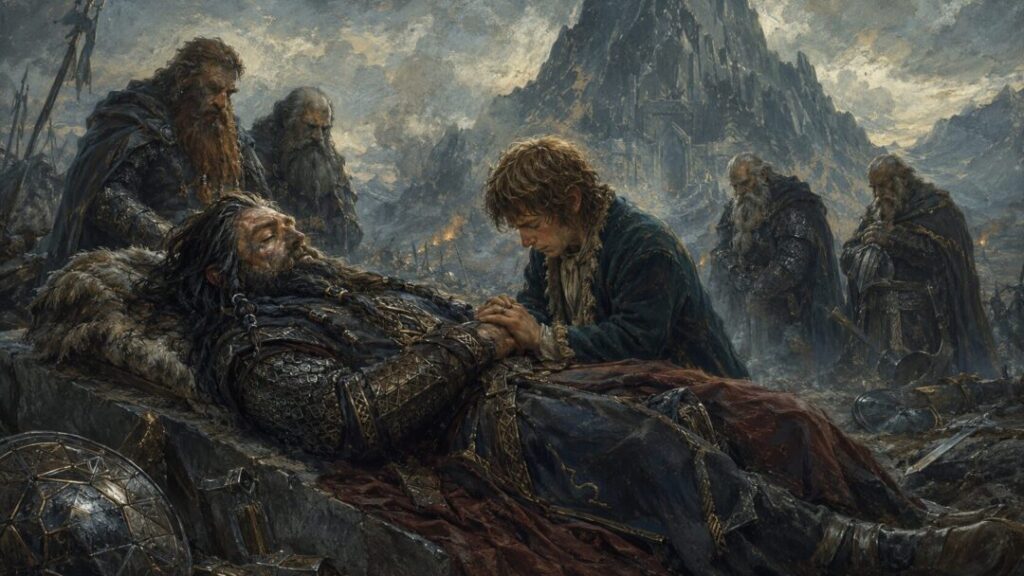
After the Battle of Five Armies, as he lies dying, he speaks to Bilbo with clarity. He asks forgiveness. He recognizes that food, cheer, and song are worth more than hoarded gold.
This moment is not a small correction.
It is the reversal of the hoard’s entire logic.
The treasure had taught Thorin to see Bilbo as a thief. At the end, he sees him again as a friend. The treasure had made generosity look like weakness. At the end, Thorin understands that simple joys are greater than possession.
But the tragedy is that this wisdom comes after the cost has already been paid.
The armies have gathered. Blood has been shed. Thorin’s nephews, Fíli and Kíli, die defending him. Thorin himself is mortally wounded. The restored King under the Mountain does not live to enjoy the kingdom he reclaimed.
That is why his ending is so moving.
It is not a neat escape from greed.
It is repentance inside ruin.
Thorin is restored inwardly, but not spared outwardly. The story allows him mercy, but it does not pretend that his choices had no consequences.
The Master Shows the Same Disease Without the Nobility
Thorin is not the only figure connected with dragon-sickness.
Near the end of The Hobbit, the old Master of Lake-town receives gold meant for the help of his people. Instead, he takes much of it and flees. The book says he falls under dragon-sickness and dies in the Waste, abandoned.
This parallel is important.
The Master’s case is less noble than Thorin’s. He has no deep ancestral claim to the hoard. He is not reclaiming a lost homeland. His greed appears more nakedly selfish.
Yet the disease is recognizably the same.
Gold meant to rebuild becomes gold hoarded for the self. Wealth that should serve a wounded community becomes a burden carried into desolation.
The Master’s end shows the final logic of hoarded treasure.
He leaves people behind.
He takes what he cannot truly use.
He dies with gold that cannot save him.
Thorin’s story is tragic because a great figure is nearly consumed.
The Master’s story is bleak because nothing great remains at all.
Treasure Is Not Evil in Itself
It would be too simple to say that all treasure is evil in Middle-earth.
The texts do not say that.
Dwarves are makers of great beauty. Jewels, metalwork, crafted things, and hidden halls can be signs of skill, memory, and love of created form. The problem is not beauty. It is not craft. It is not even inheritance.
The problem is possession without generosity.
Treasure becomes dangerous when it ceases to belong within a living web of duties: kinship, hospitality, justice, pity, and the needs of others. When gold is cut off from those duties, it begins to imitate the dragon. It sits. It gleams. It demands guarding. It makes every outsider look like a thief.
That is why Thorin’s madness reveals more than personal weakness.
It reveals what treasure can do when it becomes the center of the moral world.
It does not merely make someone want more.
It changes what they think they are allowed to ignore.
What Thorin’s Fall Really Reveals
Thorin’s fall is not powerful because it says, “Greed is bad.”
That lesson is true, but too small.
The deeper warning is that greed often arrives wearing the face of justice.
Thorin can tell himself that he is defending his people’s treasure. He can tell himself that others are trying to take what Smaug stole first. He can tell himself that the Arkenstone is beyond price because it belongs to his house.
And part of that is true.
But the truth becomes corrupted when it no longer leaves room for mercy.
That is the frightening thing about the hoard. It does not erase Thorin’s past. It imprisons him inside it. It takes his grief, his royal claim, his memory of exile, and his longing for restoration, then turns them into a wall.
By the end, Thorin sees beyond that wall.
He dies reconciled with Bilbo, no longer speaking as a hoarder, but as someone who finally understands what the treasure almost destroyed.
His last wisdom is not that gold has no value.
It is that gold is a terrible master.
And in Middle-earth, the most dangerous treasure is not the treasure that looks stolen.
It is the treasure that gives you just enough reason to believe you are right to keep it at any cost.
Sources & Notes
- J.R.R. Tolkien, The Hobbit, Chapter 12, ‘Inside Information’ — Smaug’s solitary brooding over stolen treasure establishes the dragon-hoard model of possession that shadows Erebor after his death.
- J.R.R. Tolkien, The Hobbit, Chapter 13, ‘Not at Home’ — Bilbo’s finding of the Arkenstone and the narrator’s warning about gold long brooded over by a dragon support the article’s reading of dragon-sickness.
- J.R.R. Tolkien, The Hobbit, Chapter 15, ‘The Gathering of the Clouds’ — Thorin barricades the Mountain, refuses Bard’s claim, and fixes on the Arkenstone as the heart of his inheritance.
- J.R.R. Tolkien, The Hobbit, Chapter 16, ‘A Thief in the Night’ — Bilbo gives up the Arkenstone to Bard and the Elvenking as a risky attempt to prevent war rather than hoard treasure.
- J.R.R. Tolkien, The Hobbit, Chapter 18, ‘The Return Journey’ — Thorin’s deathbed reconciliation with Bilbo and the Master’s later dragon-sickness show both repentance and the ruinous end of hoarded gold.