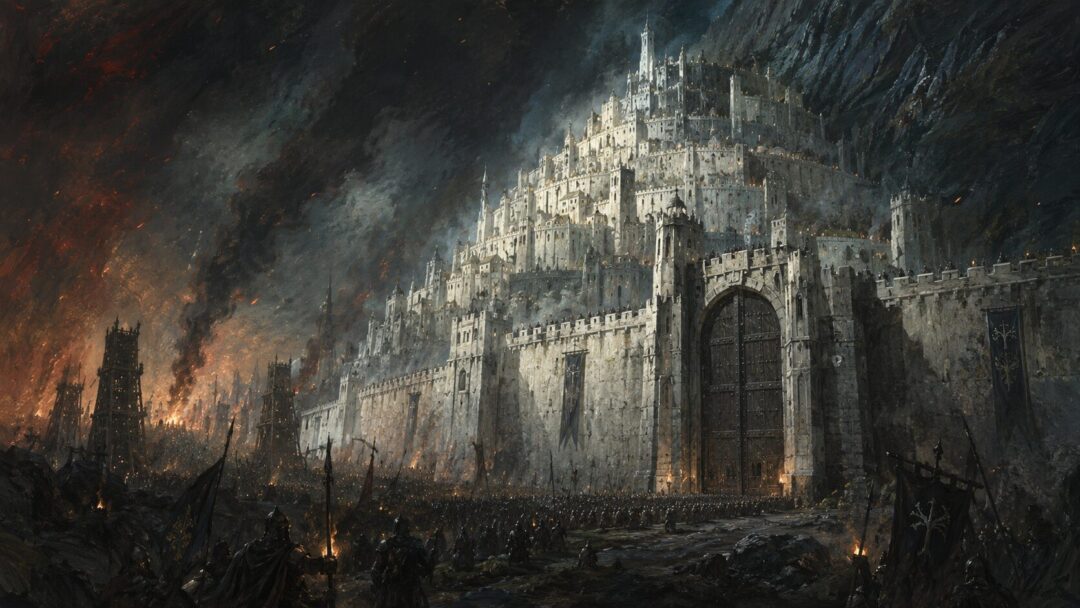
Most readers remember the breaking of the Gate of Minas Tirith as a moment of overwhelming force.
Grond is brought forward. The drums roll. The great ram strikes. The doors burst apart. The Lord of the Nazgûl rides in beneath the arch where no enemy has ever passed.
That reading is true.
But it is not complete.
The Witch-king does not simply break the Gate so Mordor can enter Gondor. The deeper logic of the scene is that Gondor has to be made to feel broken before he enters. The physical breach matters because the spiritual breach has already begun.
The Gate falls last.
Fear comes first.
The Gate Was More Than a Door
The Great Gate of Minas Tirith was not an ordinary entrance.
It stood at the eastern point of the outer wall, the first opening into the lowest circle of the City. It was made with iron and steel, guarded by towers and bastions, and positioned where the roads of the Pelennor came together before the White City.
That made it militarily important.
But its symbolic importance was even greater.
Minas Tirith was not merely a fortress. By the end of the Third Age, it had become the visible heart of Gondor. Osgiliath had fallen from its old glory. Minas Ithil had become Minas Morgul. The line of kings had failed. The Stewards ruled in waiting.
So the Gate of Minas Tirith became more than a defensive structure.
It was the threshold of survival.
As long as the Gate stood, Gondor could still imagine itself unconquered. Mordor could burn the fields, break the outer works, and fill the sky with terror, but the City itself remained sealed.
That is why the text emphasizes the horror of the Witch-king entering beneath an arch “that no enemy ever yet had passed.” The moment is not only tactical. It is historical.
Something that had never happened before is finally happening.
The Siege Was Already a War Against Courage
The Witch-king’s assault on Minas Tirith does not begin with Grond.
It begins with dread.
The Nazgûl are not presented as ordinary commanders. Their power works through fear, despair, and spiritual oppression. The Black Breath is one expression of that power, and the presence of the Ringwraiths repeatedly causes terror among living beings.
This matters because the defence of Minas Tirith is not collapsing only under physical pressure.
It is collapsing inward.
Faramir returns wounded. The defenders have been harried from the outer walls of the Pelennor. The enemy throws fire and terror against the City. Denethor, already strained by grief, pride, and the use of the palantír, moves toward despair instead of endurance.
The texts do not say that the Witch-king personally controls Denethor’s choices at this moment. That would go too far.
But the siege as a whole is clearly designed to destroy hope.
Sauron’s war is never only about numbers. It is also about making resistance seem meaningless. Mordor does not merely want Gondor defeated. It wants Gondor to believe defeat is the truth.
That is why the Witch-king is the perfect captain for this assault.
He is not just a warrior.
He is a weapon of despair.
Grond Is a Physical Ram With a Mythic Name
Then Grond appears.
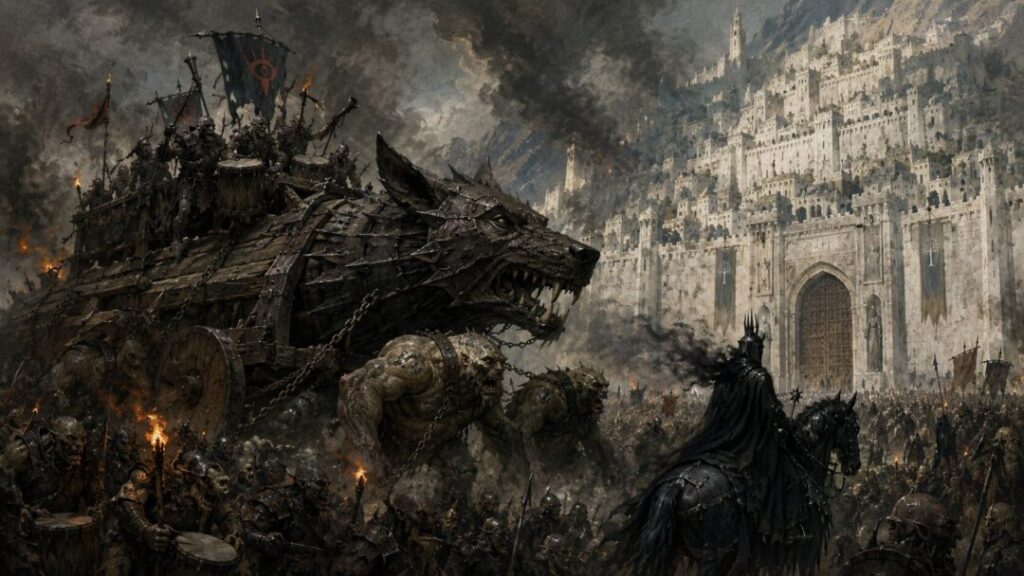
The name itself carries weight. In the older legends of Middle-earth, Grond was the Hammer of the Underworld, the great weapon of Morgoth. The battering ram at Minas Tirith is named after it, and that name is not accidental in effect.
It makes the assault feel older than the War of the Ring.
Mordor is not simply bringing a siege engine. It is bringing a memory of ancient ruin to the Gate of the last great city of Gondor.
The ram is described as vast, wolf-headed, and forged for destruction. It is brought forward under the command of the Witch-king, and when it strikes the Gate, the blow is not merely mechanical. The Lord of the Nazgûl cries out in a forgotten tongue, using words of power and terror.
The crucial phrase is that those words are meant to rend both heart and stone.
Not stone only.
Heart and stone.
The Gate is being broken in two places at once.
The doors are shattered outwardly. The courage of the defenders is shattered inwardly.
Why the Witch-king Had to Be There
This is why the Witch-king’s presence at the Gate matters.
A lesser captain could have ordered a ram forward. Orcs and trolls could have battered at the doors. Siege towers could have pressed against the walls. Mordor had enough bodies to spend.
But the Witch-king’s role is not simply to supervise.
He turns the breach into a revelation.
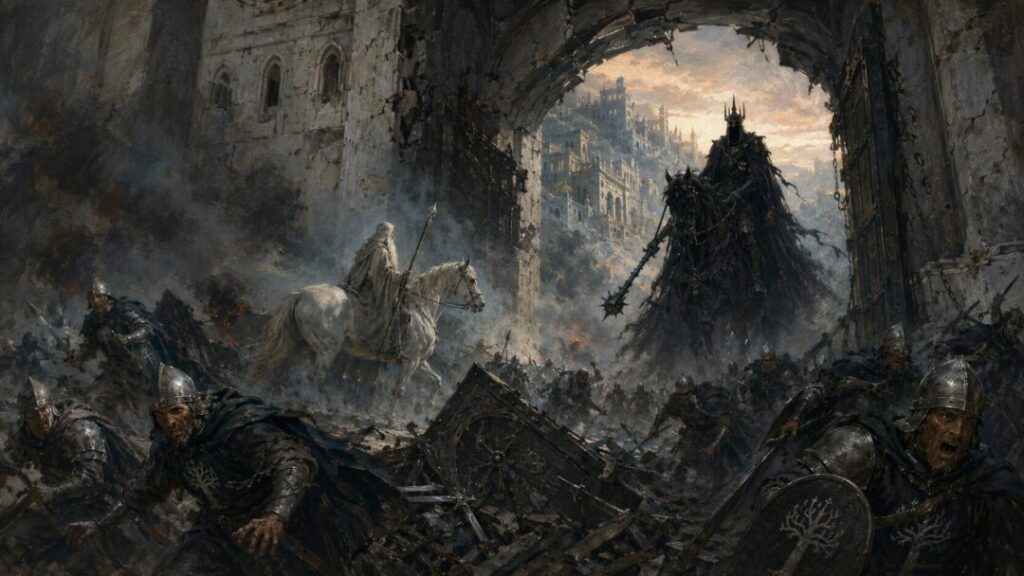
When he enters, he appears as a great black shape against the fires behind him. He wears a crown, yet there is no visible head beneath it. He is kingly and empty at once. He is authority without life, command without a human face.
That image is essential.
The Witch-king enters not as a soldier slipping through a gap, but as a dark answer to Gondor’s long vacancy.
Gondor has no king.
Now a crowned shadow rides through its broken Gate.
This does not mean the Witch-king has a lawful claim to Gondor. He does not. The point is symbolic, not legal. He appears as a mockery of kingship at the very threshold of the kingless city.
The old realm has waited for the return of the king.
Instead, at the darkest hour, a dead king comes through the Gate.
The City Breaks Before the Wall Does
When the Witch-king rides in, the text says all flee before his face except one.
That is one of the most important details in the scene.
The Gate has fallen, but the first visible result is not a flood of battle inside the City. It is flight. The defenders cannot stand before him. His victory, at that instant, is not measured in ground captured but in courage emptied.
This is the deepest reason Gondor had to be broken before he entered.
If men were still steady, the breach would remain a battle.
But if they were already overcome by dread, the breach becomes an ending.
The Witch-king wants his entrance to feel inevitable. He wants the fall of the Gate to prove what Sauron has been whispering through the whole war: that resistance is only delay, that hope is ignorance, that the West is already defeated.
And for one terrible moment, it seems to work.
The Gate is down.
The Steward is lost in despair.
The defenders scatter.
The Lord of the Nazgûl rides in.
Only Gandalf remains.
Gandalf Is the Line the Witch-king Did Not Break
Gandalf’s presence changes the meaning of the scene.
He does not rebuild the Gate. He does not summon an army. He does not answer terror with terror.
He simply remains.
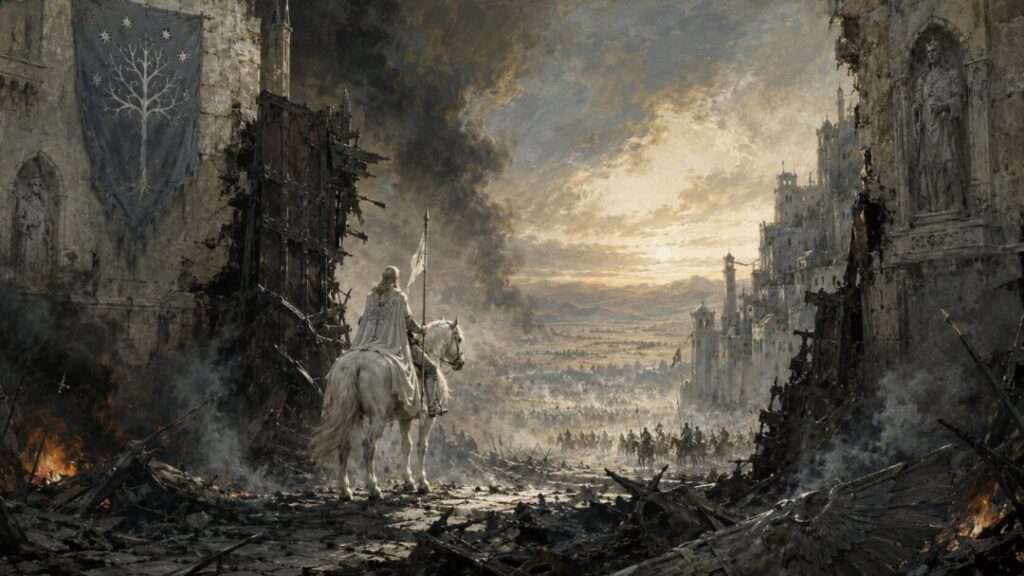
That is why the confrontation matters so much. Gandalf is not guarding an intact fortress. He is standing in the breach after the symbol of Gondor’s security has already been destroyed.
His resistance is no longer based on walls.
It is based on refusal.
“You cannot enter here” is powerful because, physically, the Witch-king already has. The Gate is broken. The arch has been crossed. The old defence has failed.
So Gandalf’s words cannot mean merely, “You cannot pass through this doorway.”
They mean something deeper.
You cannot claim this place.
You cannot make despair the final truth.
You cannot turn this broken Gate into the death of Gondor.
That is the real contest.
Not stone against sorcery.
Hope against annihilation.
Why the Witch-king Turns Away
Then the scene refuses to become the duel many readers expect.
A cock crows somewhere in the City. Dawn is coming above the darkness. Then the horns of Rohan sound from far away.
The Witch-king turns away.
This is not because he has suddenly become weak. The text does not say Gandalf defeats him there. It also does not show the Witch-king retreating in fear from Gandalf. The confrontation is interrupted before the trial of strength happens.
That restraint is important.
The Witch-king is still the commander of Sauron’s assault. When Rohan arrives, the battle outside the City changes instantly. He must answer the new threat. The Rohirrim have broken into the enemy’s design, and Théoden’s charge transforms the siege into open battle.
So the Witch-king leaves the Gate not because the moment was meaningless, but because the meaning has changed.
His entrance was supposed to be the sign that Gondor’s hope had ended.
Rohan’s horns answer that sign.
The City is not alone.
The story does not allow despair to finish its sentence.
The Gate Falls, But Gondor Does Not
This is the key to the whole scene.
The Witch-king succeeds in breaking the Gate.
He does not succeed in breaking Gondor.
That difference is everything.
Mordor can shatter iron. It can burn fields. It can fill the air with dread. It can drive wise men toward despair and make brave soldiers flee. It can even send a crowned shadow beneath the arch where no enemy has ever passed.
But it cannot make the fall of the Gate mean what it wants it to mean.
Because Gandalf remains.
Because Rohan comes.
Because dawn arrives.
Because hope in Middle-earth is often smallest at the moment it becomes decisive.
The Witch-king broke the Gate before entering because his true purpose was not simply access. It was interpretation. He wanted the broken doors to tell Gondor that the story was over.
But the story was not over.
The Gate of Minas Tirith fell.
The will of Gondor bent.
But it did not break.
And that is why the Witch-king’s most terrifying entrance becomes, almost immediately, the beginning of his own end.
Sources & Notes
- J.R.R. Tolkien, The Lord of the Rings, Book V, Chapter 4, ‘The Siege of Gondor’ — the breaking of the Gate by Grond, the Witch-king’s words of power, and Gandalf alone before him are the article’s central evidence.
- J.R.R. Tolkien, The Lord of the Rings, Book V, Chapter 1, ‘Minas Tirith’ — the city’s seven walls, iron gate, Stewardship, and kingless throne explain why the Gate carries more than tactical importance.
- J.R.R. Tolkien, The Lord of the Rings, Book V, Chapter 5, ‘The Ride of the Rohirrim’ — the cockcrow, dawn, and the horns of Rohan interrupt the Witch-king’s moment of apparent triumph.
- J.R.R. Tolkien, The Lord of the Rings, Book V, Chapter 8, ‘The Houses of Healing’ — the Black Breath and the Nazgûl’s terror show how Mordor’s assault works on courage and hope as well as bodies.
- J.R.R. Tolkien, The Silmarillion, Chapter 18, ‘Of the Ruin of Beleriand and the Fall of Fingolfin’ — Morgoth’s hammer Grond gives the ram at Minas Tirith its older mythic shadow of ruin.