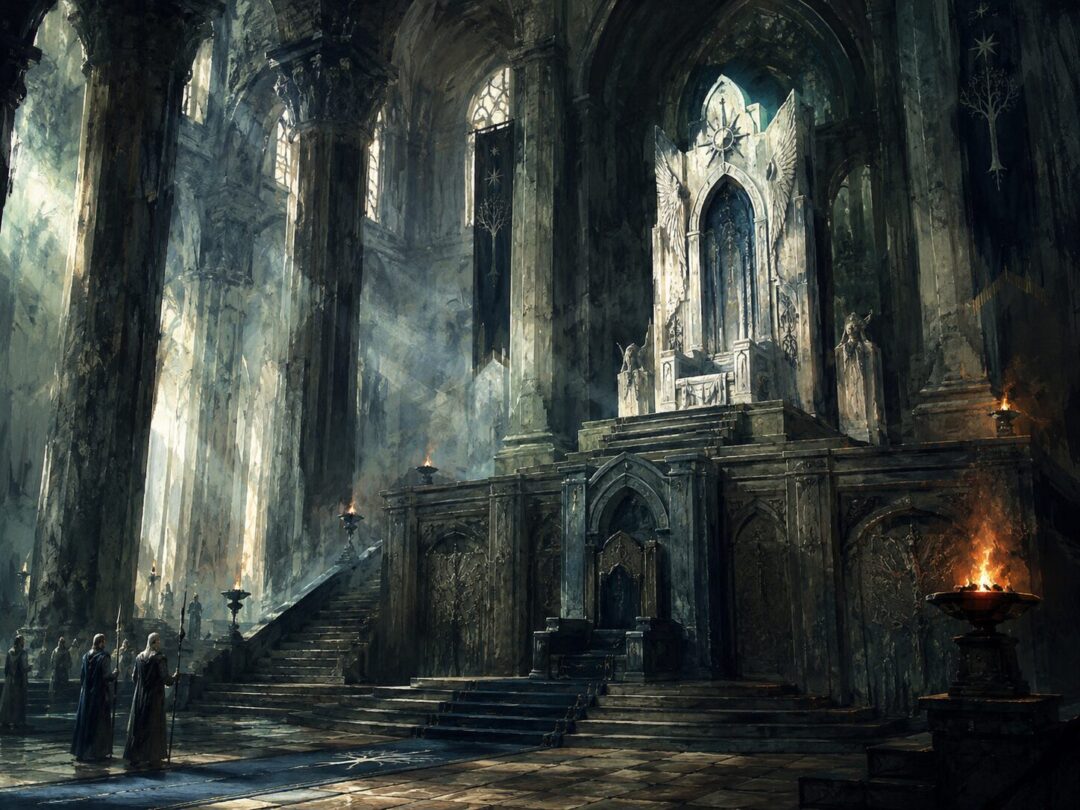
Most readers think Gondor’s empty throne is a symbol of hope.
It is.
But that is not all it is.
The high throne in Minas Tirith stands empty because Gondor has no king. The Stewards rule beneath it, not upon it. They govern, command armies, receive messengers, defend the realm, and carry the burden of leadership through the long decline of the Third Age.
Yet they do all of this from a lower seat.
That detail matters.
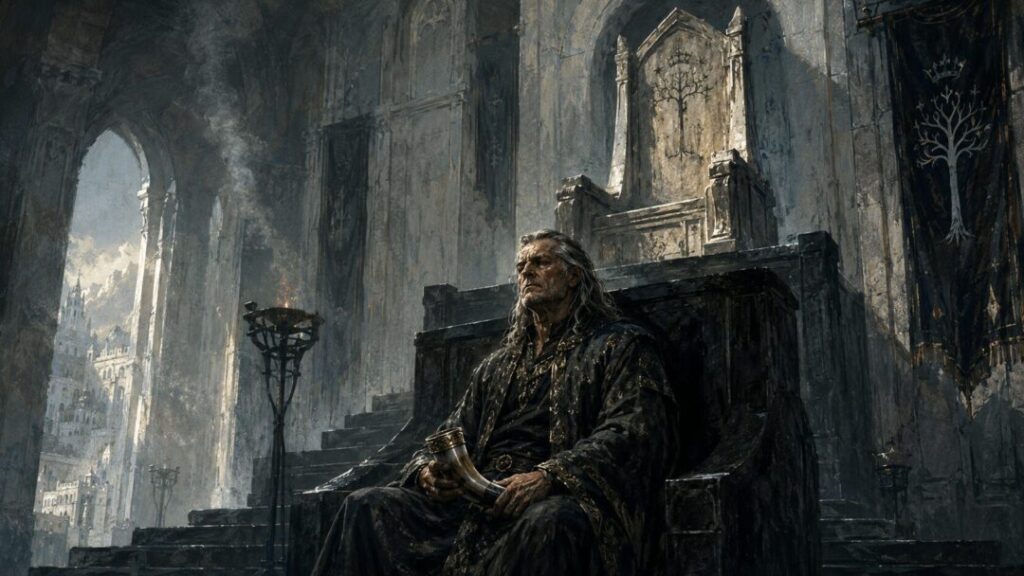
In the Tower Hall, Denethor does not sit where a king would sit. He sits on a black stone chair below the throne, at the foot of the steps. Above him remains the high seat of the Kings of Gondor, unused but not forgotten.
At first glance, this looks like humility.
The Steward does not claim what is not his. The office remembers its limit. The throne remains waiting for the rightful king.
But in Gondor, waiting has lasted almost a thousand years.
And when a people wait that long, even faithfulness can begin to harden into something else.
The Throne Was Not Empty by Accident
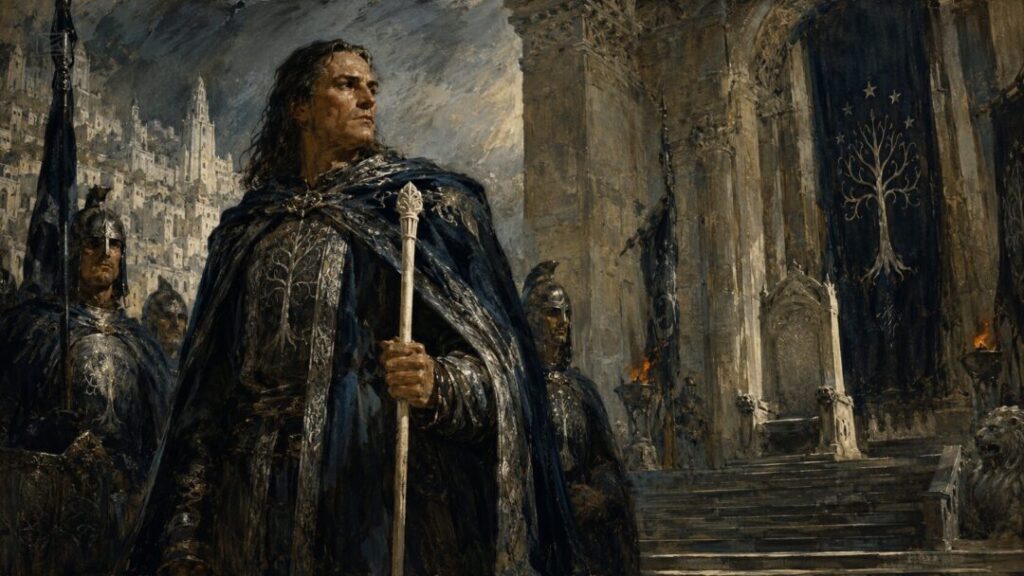
Gondor’s empty throne begins with the disappearance of King Eärnur.
Eärnur was the last King of Gondor before the return of Aragorn. He had no heir. After being challenged by the Witch-king, he rode to Minas Morgul and never returned. The texts do not show his death directly, but Gondor never saw him again.
This created a dangerous problem.
The king was gone.
There was no clear successor.
The kingdom still had to be ruled.
So Mardil, the Steward, governed in the King’s name. He did not become king. He did not found a new royal house. He became the first of the Ruling Stewards, holding Gondor until the King should return or a rightful claimant should be accepted.
That distinction is crucial.
The Stewardship was not originally a rebellion against kingship. It was a refusal to pretend that the problem had been solved.
The empty throne said something very clear:
The King is absent, but the kingship has not been abolished.
That is a powerful act of restraint.
A weaker man might have taken the crown. A more ambitious line might have renamed itself royal. But the Stewards did not do that. They preserved the old order even while exercising nearly all the practical authority of kings.
The throne remained empty because Gondor still knew the difference between guarding a thing and owning it.
Waiting Can Begin as Wisdom
In the beginning, Gondor’s waiting makes sense.
The kingdom cannot collapse simply because its king has vanished. Armies must be commanded. Borders must be defended. Minas Tirith must endure against Mordor. The line of rule must continue somehow.
The Stewards provide that continuity.
They are not parasites on the throne. They are caretakers of a realm under pressure. Without them, Gondor might not have survived long enough for any king to return at all.
This is why the empty throne should not be read as foolish from the start.
It is not merely political paralysis.
It is not cowardice.
It is not empty nostalgia.
It is an act of memory.
Gondor remembers that it is a kingdom. It remembers that the crown is not simply a prize for whoever has power. It remembers that lawful authority is not the same thing as possession.
The Steward can rule.
But he cannot become the thing he serves.
That is the beauty of the office.
It is also the danger.
Because the longer the arrangement lasts, the harder it becomes to imagine an ending to it.
When a Temporary Office Becomes Permanent
The Stewards were meant to preserve Gondor until the return of the King.
But “until” is a dangerous word when centuries pass.
One generation can live with temporary duty. Twenty-five generations can turn temporary duty into inheritance, identity, and pride.
By the time of Denethor, the Stewardship is no longer a short emergency measure. It is the only form of rule Gondor has known for many lifetimes. Fathers have handed the white rod to sons. Sons have grown up beneath the empty throne. The whole political imagination of Minas Tirith has been shaped by absence.
This does not mean the Stewards secretly became kings.
They did not.
That is part of what makes the situation so tragic. Gondor keeps the symbol of waiting. It keeps the empty throne. It keeps the language of Stewardship. It keeps the memory of the King.
But the living expectation has weakened.
Gandalf’s words to Denethor expose this tension. When Denethor says that the rule of Gondor is his “unless the king should come again,” Gandalf repeats the phrase back to him. Then he says it is Denethor’s task to keep some kingdom still against that event, though few now look to see it.
That is the wound.
The Steward’s office exists for a return that almost no one expects.
The form remains.
The hope has become remote.
And once hope becomes remote enough, the return of what was promised can feel less like restoration than disruption.
Denethor’s Problem Is Not Simple Ambition
It is easy to read Denethor as a man who simply wants power.
That is partly true, but it is not enough.
Denethor is proud. He is severe. He does not want to bow to Aragorn. He calls Aragorn the last of a ragged house long deprived of lordship and dignity. Even if Aragorn’s claim were proved, Denethor says he would not step down to become the chamberlain of an upstart.
Those words are harsh, and they reveal a terrible pride.
But Denethor’s resistance is not merely personal jealousy. It is rooted in Gondor’s long historical memory.
Aragorn comes from the line of Isildur, not from the direct line of Anárion that ruled Gondor. Long before the War of the Ring, Gondor had already rejected a northern claim when Arvedui of Arthedain sought the crown after the death of Ondoher and his sons. Gondor chose Eärnil instead.
That earlier rejection matters because it shows that Aragorn’s return is not simple in Gondorian political memory.
To the reader, Aragorn is the rightful king.
To Denethor, he is also the heir of a claim Gondor once refused.
The texts do not ask us to agree with Denethor. But they do show why his refusal has roots deeper than vanity.
He has inherited a realm that has survived for centuries without a king. He has spent his life defending Gondor. His sons have gone to war for it. Boromir has died. Faramir has been nearly lost. Mordor is at the gate.
And now, at the end, the thing the Stewardship was supposedly waiting for appears.
Denethor cannot receive it.
That is the tragedy of waiting too long.
The Empty Throne Preserves Humility—and Tempts Pride
The empty throne is meant to humble the Steward.
Every time the Steward sits below it, the arrangement says: you are not the highest authority here. You rule in trust. You hold what must one day be surrendered.
But symbols do not work automatically.
A man can sit beneath an empty throne and still become proud. He can speak the words “unless the king should come again” and still inwardly resist the possibility. He can preserve the shape of humility while losing the spirit of it.
This is why Denethor’s seat in the Tower Hall is so powerful.
He does not sit on the throne.
But he rules like a man who cannot imagine yielding.
The empty throne above him has not disappeared. Gondor has not formally denied the King. Yet the space between the Steward’s chair and the King’s throne has become filled with centuries of habit, grief, suspicion, and possessiveness.
The throne is empty.
But Denethor’s heart is not waiting.
That is the deeper warning.
Waiting is not the same thing as readiness.
Gondor Was Faithful, but Also Wounded
It would be too simple to say that Gondor failed because it waited.
Gondor’s waiting also saved it.
The Stewards kept the realm alive. They guarded the borders of the West. They held Minas Tirith against the Shadow. They maintained enough order and strength that Aragorn had a kingdom to return to.
Without the Stewards, the throne might not have been waiting at all.
It might have been buried beneath ruin.
So the empty throne carries two truths at once.
It shows loyalty.
It also shows damage.
Gondor has preserved the idea of the King, but the long absence has changed the kingdom. The city is still magnificent, but it is also diminished. The White Tree in the Court of the Fountain is dead. The line of kings has failed. The ruling house of the Stewards is exhausted by war, loss, and the pressure of Mordor.
The empty throne is not the only sign of this decline, but it gathers the meaning of it into one image.
Something rightful is missing.
Something noble has endured.
Something in the waiting has grown perilously thin.
Faramir Understands What Denethor Cannot
The contrast between Denethor and Faramir is essential.
Faramir is also a Steward of Gondor. He is Denethor’s heir. If anyone has reason to inherit the long pride of the office, it is him.
But Faramir can do what Denethor cannot.
He can surrender.
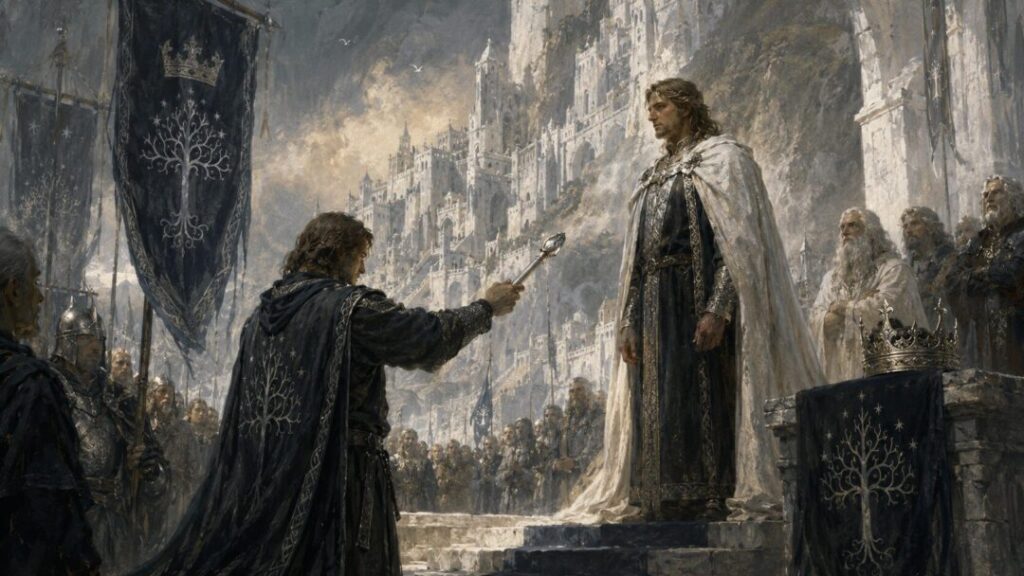
At Aragorn’s coronation, Faramir brings the white rod of the Steward and offers to give up his office. This is not humiliation. It is the fulfillment of what the office was always meant to be.
The Steward keeps the kingdom until the King returns.
Then he gives it back.
That moment reveals the true meaning of Stewardship. It was never supposed to end in self-preservation. It was supposed to end in recognition.
Faramir’s greatness is not that he clings to power.
It is that he knows when the waiting is over.
And Aragorn’s response matters too. He does not abolish Faramir. He confirms him in honor, making him Prince of Ithilien and preserving the Stewardship under the renewed kingship.
The true King does not erase faithful service.
He puts it back in its proper order.
The Return of the King Is Also the End of an Excuse
When Aragorn comes to Minas Tirith, he does not simply fill an empty chair.
He ends a story Gondor has been telling itself for centuries.
That is why the return is both joyful and dangerous. It brings healing, but it also demands surrender. It proves that the old words were not decorative. “Until the King returns” was never meant to be a phrase carved into tradition and safely forgotten.
It was a condition.
And conditions eventually come due.
For Denethor, this is unbearable. If the King returns, then the Steward must become what he always claimed to be: temporary. Limited. Accountable to a higher authority.
For Faramir, it is liberation.
The burden passes into the right hands. The long waiting ends. The dead symbol becomes living again.
This is why the empty throne is so haunting.
It does not only ask whether Gondor can endure absence.
It asks whether Gondor can survive fulfillment.
What the Empty Throne Really Says
Gondor’s empty throne is one of the most powerful political and spiritual images in The Lord of the Rings.
It says that rightful authority matters.
It says that memory matters.
It says that power held in trust is different from power possessed.
But it also warns that waiting can deform the soul.
A promise can be preserved outwardly while being doubted inwardly. A duty can begin in humility and end in possessiveness. A kingdom can guard an empty throne so long that the actual return of the King feels like a threat.
This is the tragedy of Denethor.
He is not wrong to love Gondor.
He is not wrong to defend it.
He is not wrong to understand the weight of his office.
But he cannot release what was never truly his.
Faramir can.
And that is why the Stewardship is redeemed through him.
The empty throne does not condemn Gondor. It reveals Gondor. It shows both the nobility that kept the realm alive and the danger that came from waiting too long.
For centuries, the throne said:
The King has not yet returned.
But when Aragorn finally comes, it says something else.
It says that every form of waiting is tested not by how long it lasts, but by what happens when the thing waited for finally arrives.
Sources & Notes
- J.R.R. Tolkien, The Lord of the Rings, Book V, Chapter 1, ‘Minas Tirith’ — Denethor’s black chair below the unused throne gives the article its central image: the Steward rules, but not from the king’s seat.
- J.R.R. Tolkien, The Lord of the Rings, Appendix A, ‘Gondor and the Heirs of Anárion’ — Eärnur’s ride to Minas Morgul, his lack of an heir, and Mardil’s beginning of the Ruling Stewards explain why the throne stood empty.
- J.R.R. Tolkien, The Lord of the Rings, Book V, Chapter 4, ‘The Siege of Gondor’ — Denethor’s exchange with Gandalf over ruling Gondor ‘unless the king should come again’ captures how formal waiting can become inward resistance.
- J.R.R. Tolkien, The Lord of the Rings, Appendix A, ‘The North-kingdom and the Dúnedain’ — Arvedui’s rejected claim and Gondor’s choice of Eärnil give historical context for Denethor’s suspicion of a northern claimant.
- J.R.R. Tolkien, The Lord of the Rings, Book VI, Chapter 5, ‘The Steward and the King’ — Faramir’s surrender of the white rod and Aragorn’s confirmation of his honour show the Stewardship fulfilled rather than erased.