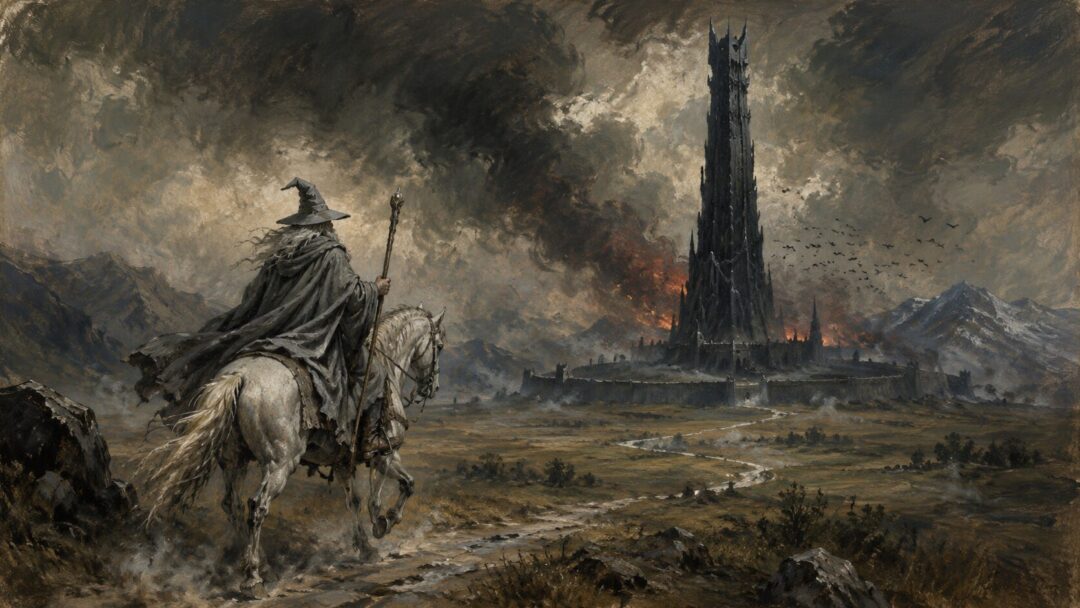
Everyone asks why Gandalf went to Saruman if Saruman was already dangerous.
But that may be the wrong question.
The more unsettling question is this:
Why did Gandalf already feel something was wrong before he could prove anything?
Because in The Lord of the Rings, Gandalf does not treat Saruman’s betrayal as something he had known all along. He is shocked by what he finds at Isengard. He does not arrive with certainty. He does not come as an accuser. He comes because Radagast has delivered a message, because the Nazgûl are abroad, because the Ring is in peril, and because Saruman is still, outwardly, the head of the White Council.
Yet earlier, Gandalf admits something strange.
He had considered consulting Saruman about Bilbo’s ring, but “something” had held him back.
That small hesitation opens a much deeper story.
Gandalf feared Saruman before he had proof because Saruman had already become the kind of person who might fall. Not openly. Not obviously. Not in a way that could be brought before the Council as a charge.
But in a way Gandalf could feel.
A pattern had formed.
And by the time Gandalf reached Orthanc, that pattern had become a prison.
Saruman Was Not Just Another Wizard
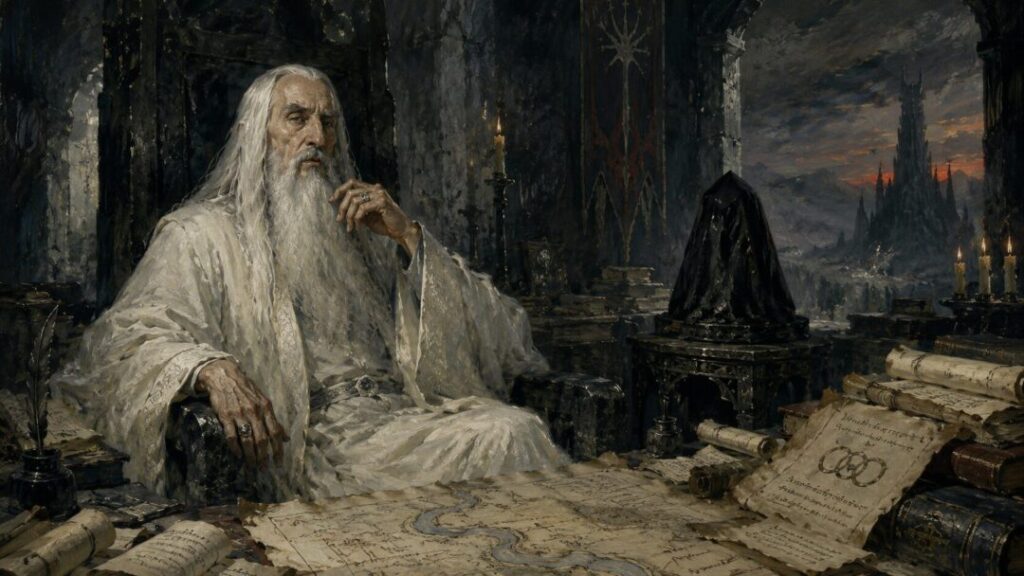
To understand Gandalf’s unease, we have to begin with Saruman’s position.
Saruman was not merely powerful. He was the chief of the Istari and the head of the White Council. He was especially learned in the lore of the Rings. When questions about Sauron, Dol Guldur, and the One Ring arose, Saruman’s voice carried enormous weight.
That matters because Gandalf was not dealing with an obvious enemy.
Saruman was not a Black Rider. He was not a servant of Mordor marching under an open banner. He was one of the Wise. He knew the history of the Rings. He understood the Enemy’s devices. He possessed authority, learning, and reputation.
This made his danger harder to name.
If a lesser person had spoken carelessly about the Ring, suspicion would have come quickly. But Saruman’s confidence looked like expertise. His delay looked like prudence. His certainty looked like wisdom.
That is why Gandalf’s fear could not yet become proof.
Saruman was surrounded by the appearance of legitimacy.
And appearances are one of the most dangerous things in Middle-earth.
The First Warning Was Delay
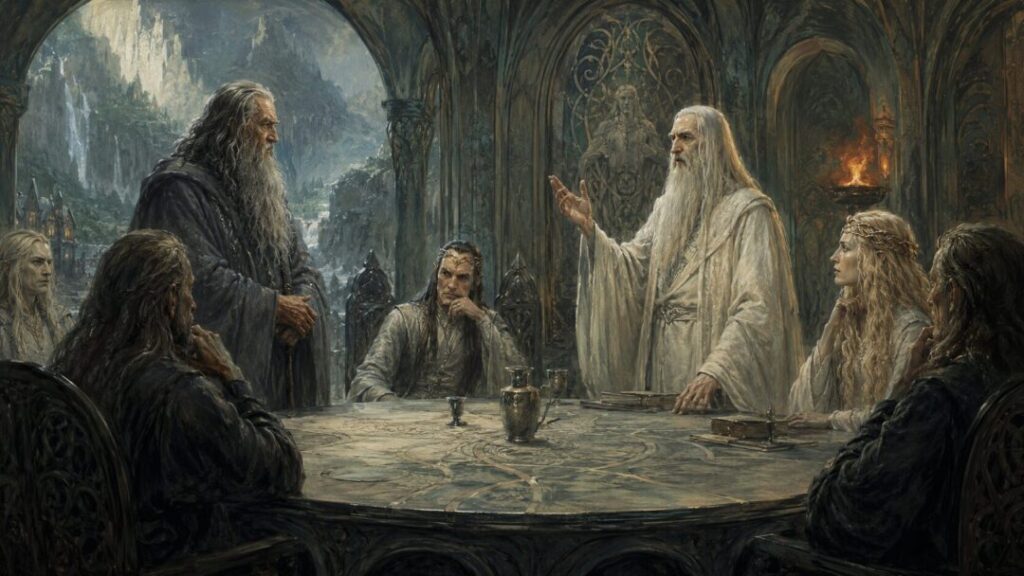
Long before Gandalf was imprisoned at Orthanc, the White Council had faced the question of Dol Guldur.
Gandalf discovered that the dark power there was Sauron returned. He urged action. Saruman overruled him.
At the time, this could be read as caution. Perhaps Saruman believed open assault was unwise. Perhaps he thought the Council should not move too soon. On the surface, delay did not prove treachery.
But the later history makes that delay look much darker.
The appendices reveal that Saruman had begun to desire the One Ring and had searched near the Gladden Fields. When he later agreed to the assault on Dol Guldur, it was not simply because Gandalf had finally convinced him. The texts indicate that Saruman had learned Sauron’s servants were also searching near the Anduin, and he became afraid that Sauron might find the Ring first.
This is crucial.
Saruman’s outward position could still be explained as strategy. But underneath, another motive was at work.
He was not only opposing Sauron.
He was competing with him.
That is not the same thing.
And Gandalf, even without knowing the full truth, had reason to sense danger in Saruman’s long, cold confidence about the Ring.
Saruman’s Ring-Lore Became a Trap
Saruman’s knowledge was real.
That is part of the tragedy.
He was not a fool dabbling in things beyond his understanding. He was deeply learned. He had studied the Rings, their history, and their making. He knew more about them than almost anyone left in Middle-earth.
But knowledge in Tolkien’s world is never morally neutral when it becomes detached from humility.
Saruman’s study of the Rings did not preserve him from temptation. It drew him closer to it. The more he understood power, the more he seems to have imagined that power could be managed, redirected, or used.
This is where Gandalf and Saruman quietly divide.
Gandalf also studies the Ring. He also searches for answers. He also handles dangerous knowledge. But Gandalf’s instinct is restraint. He refuses the Ring when Frodo offers it to him. He understands that the desire to use it for good would still become domination.
Saruman’s instinct moves the other way.
He begins to think like a strategist of power. He imagines orders, systems, devices, control. By the time Gandalf confronts him, Saruman does not merely speak of resisting Sauron. He speaks of joining with the new Power, guiding it, managing it, perhaps eventually supplanting it.
That is the voice of someone who has mistaken knowledge for mastery.
And Gandalf had known Saruman long enough to fear where that path could lead.
“Something Held Me Back”
Gandalf’s hesitation about consulting Saruman is one of the most important details in the whole question.
He does not say he had evidence.
He does not say he knew Saruman was false.
He does not say he had uncovered spies or discovered the Palantír.
He says, in effect, that something restrained him.
This is not proof. It is discernment.
Gandalf had seen enough of the Ring’s effect to be afraid. Bilbo’s long life, his possessiveness, his strange difficulty in giving the Ring up, and the shadow of Gollum’s story all pressed upon him. Yet instead of immediately placing the matter before Saruman, the greatest authority in Ring-lore, Gandalf holds back.
Why?
The texts do not give a single explicit explanation. So we should be careful.
But they do give us the pieces.
Saruman had shown unusual certainty about the Ring’s fate. He had dismissed fears that it would be found. He had resisted action when Gandalf urged it. He had made himself the master of Ring-lore. And, as later events reveal, he had private designs of his own.
Gandalf may not have known the secret.
But he felt the shape of it.
That is often how wisdom works in Middle-earth. It does not always arrive as complete information. Sometimes it appears as reluctance, warning, pity, or an unwillingness to trust a path that seems outwardly reasonable.
Gandalf did not have proof.
But he had learned not to ignore the moral atmosphere around power.
Why He Still Went to Isengard
This makes Gandalf’s ride to Isengard more tragic.
If he had unease about Saruman, why go?
Because the situation had changed.
The Nine were moving. Frodo was in danger. Radagast had brought word that Saruman wanted Gandalf to come. Saruman was still officially the chief of their order and a figure of immense knowledge. Gandalf did not yet know that the message itself would lead him into a trap.
This is important because it keeps the story from becoming too simple.
Gandalf was not foolish.
He was trapped between caution and necessity.
If Saruman was still faithful, his counsel could be vital. If he had information about the movements of the Enemy, Gandalf needed to hear it. And if the danger to the Ring was immediate, delay could doom everything.
So Gandalf went.
Not because all his doubts vanished.
But because he did not yet possess the kind of certainty that would justify treating Saruman as an enemy.
This is one of the most painful parts of the scene. Evil does not always announce itself early enough for the good to act cleanly. Sometimes the Wise must move while still uncertain.
At Orthanc, that uncertainty closes around Gandalf like stone.
The Palantír Revealed the Fall Already Underway
When Saruman reveals his knowledge and his designs, Gandalf begins to understand the scale of the betrayal.
The Palantír of Orthanc becomes central here.
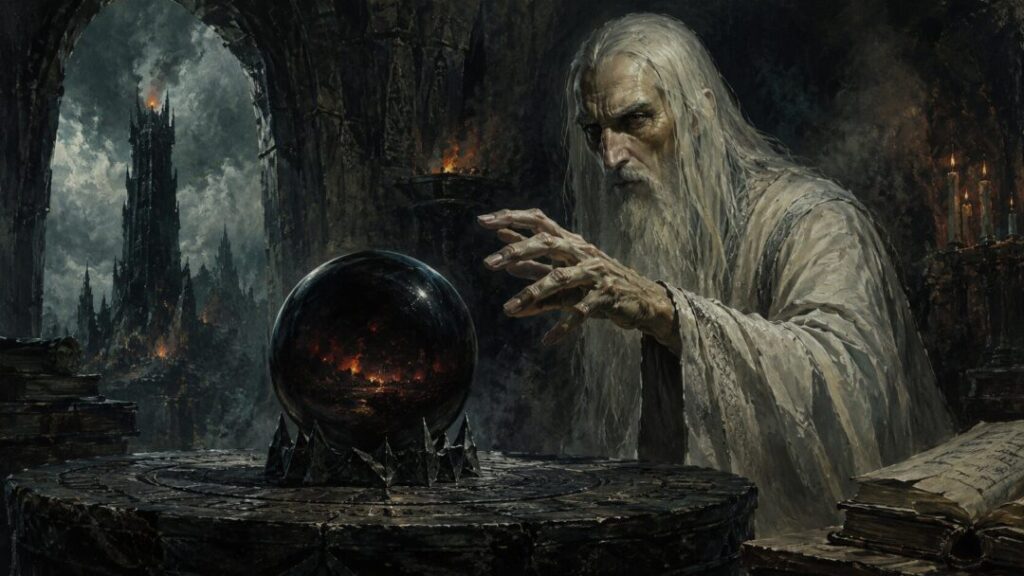
The Orthanc-stone was one of the seeing-stones brought to Middle-earth by the Faithful from Númenor. Saruman had access to it in Orthanc, and through its use he became ensnared by Sauron. The exact inner stages of that ensnaring are not laid out moment by moment, so we should not pretend to know precisely when Saruman passed each point of no return.
But the broad truth is clear.
Saruman looked through a tool of vision and met a will greater and darker than his own.
The irony is devastating.
Saruman wanted knowledge. He wanted sight. He wanted to see far, to calculate, to anticipate, perhaps to outplay both Sauron and the Wise.
Instead, his seeing became exposure.
The one who thought he could survey the board became visible to the Enemy.
That is why the Palantír is not just a magical object in this story. It is a symbol of Saruman’s error. He believes that to see is to control. But in Middle-earth, the desire to dominate through vision can itself become a form of captivity.
By the time Gandalf arrives, Saruman is no longer merely tempted by the idea of power.
He has begun speaking its language.
Saruman Did Not Simply Serve Sauron
One of the most important lore distinctions is that Saruman’s betrayal is not simple loyalty to Sauron.
He does not become a humble servant.
His ambition is more complicated and more dangerous. He appears to believe that the old alliances are doomed, that Sauron’s rise is inevitable, and that the Wise should adapt themselves to the new order. But beneath that, he desires the Ring for himself.
That means Saruman’s treason has two faces.
Outwardly, he counsels accommodation with power.
Inwardly, he wants to possess power.
This is why Gandalf’s fear before proof makes sense. Saruman’s danger was not that he had always secretly loved Sauron. The deeper danger was that he had come to resemble Sauron in the very act of studying him.
He wanted order.
He wanted command.
He wanted the ability to shape events by superior will.
These are not the desires of someone merely frightened by Mordor. They are the desires of someone already moving toward domination.
And the Ring was made for domination.
Saruman did not need to wear it to begin thinking in its terms.
Gandalf Feared What Saruman Might Become
So why did Gandalf fear Saruman before he had proof?
Not because he knew every fact.
Not because he had already solved the treason.
Not because Saruman’s fall was obvious to everyone.
Gandalf feared him because Saruman’s wisdom had begun to bend toward possession. His knowledge had become secretive. His caution had become delay. His authority had become self-regard. His study of the Enemy had become fascination with the Enemy’s methods.
That is a very different kind of fear.
It is not the fear of an enemy already unmasked.
It is the fear of watching greatness turn inward.
Saruman was powerful enough to do immense good. That made his corruption more dangerous, not less. A fallen fool can do harm. A fallen wise man can build an argument for harm and make it sound necessary.
This is exactly what Saruman does at Orthanc.
He does not begin by raging. He reasons. He persuades. He offers inevitability. He wraps surrender in the language of wisdom. He presents domination as realism.
And Gandalf recognizes it for what it is.
Orthanc Was the Proof, Not the Beginning
The trap at Orthanc is often remembered as the moment Gandalf discovers Saruman’s treachery.
That is true.
But it was not the beginning of the danger.
The beginning lay further back, in choices that could still be defended, explained, or hidden. A delayed attack. A private search. A false confidence about the Ring. A deepening obsession with lore that should have produced humility but instead fed pride.
By the time Saruman openly declares himself, the roots have been growing for a long time.
That is what makes the scene so powerful.
Gandalf is not simply betrayed by a colleague.
He is confronted by the final result of a corruption he had sensed but could not prove.
And this may explain why his earlier hesitation matters so much. Gandalf’s “something” was not irrational. It was the quiet perception that Saruman’s relationship to power had changed.
He could not yet name the treason.
But he could feel the direction.
The Deeper Warning
Saruman’s fall is one of Middle-earth’s clearest warnings about the corruption of wisdom.
Evil does not only tempt the cruel.
It tempts the intelligent, the capable, the disciplined, the visionary. It tempts those who believe they can handle dangerous things because they understand them better than others do.
Saruman did not fall because he knew too little.
He fell because knowledge without humility became appetite.
Gandalf feared him before he had proof because Gandalf understood something Saruman had forgotten: power is not made safe by expertise. The Ring cannot be studied into obedience. Sauron’s methods cannot be borrowed without cost. The desire to use domination for a supposedly greater end is already a step toward the Enemy.
That is why Orthanc changes when we see the warning signs.
The scene is not merely about Gandalf walking into a trap.
It is about the moment a hidden moral collapse becomes visible.
Saruman had not yet conquered anything.
But he had already surrendered the most important battle.
He had begun to believe that mastery was wisdom.
And Gandalf, before he could prove it, had already felt the shadow of that belief.
Sources & Notes
- J.R.R. Tolkien, The Lord of the Rings, Book I, Chapter 2, "The Shadow of the Past" — Gandalf says he had thought of consulting Saruman about Bilbo's ring, but that "something always held me back."
- J.R.R. Tolkien, The Lord of the Rings, Book II, Chapter 2, "The Council of Elrond" — Gandalf recounts Radagast's message, his ride to Isengard, and Saruman's open arguments for power, rule, and alliance with Mordor.
- J.R.R. Tolkien, The Lord of the Rings, Appendix B, "The Tale of Years" — the White Council debates Dol Guldur; Saruman first counsels delay, then later agrees to action when Sauron's servants search near the Gladden Fields.
- J.R.R. Tolkien, Unfinished Tales, "The Istari" — Saruman is presented as chief of the order and especially concerned with Ring-lore, giving context for Gandalf's difficulty in treating him as an obvious enemy.
- J.R.R. Tolkien, The Lord of the Rings, Book III, Chapter 11, "The Palantír" — Gandalf explains how Saruman's use of the Orthanc-stone exposed him to Sauron and deepened his fall through pride and calculation.