Most readers remember Galadriel’s meeting with Frodo as a moment of kindness.
The weary Ring-bearer reaches Lórien. The Lady of the Golden Wood receives him. He is given rest, counsel, and later a light to carry into the darkness. On the surface, it feels like one of the gentlest pauses in the entire Quest.
But Lórien is not merely a place of comfort.
It is a place of exposure.
By the time Frodo arrives there, he has already endured terror far beyond the quiet life of the Shire. He has fled the Black Riders. He has been wounded on Weathertop. He has crossed into the hidden world of the Wise. He has seen Moria, heard drums in the deep, and watched Gandalf fall into shadow.
He is not the same hobbit who left Bag End.
And Galadriel sees that.
Yet what she sees is not only bravery. It is not only innocence. It is not even simply that Frodo is the Ring-bearer.
She sees that Frodo has become something far more dangerous to everyone around him.
He has become a living test.
Galadriel Does Not Meet the Fellowship Gently
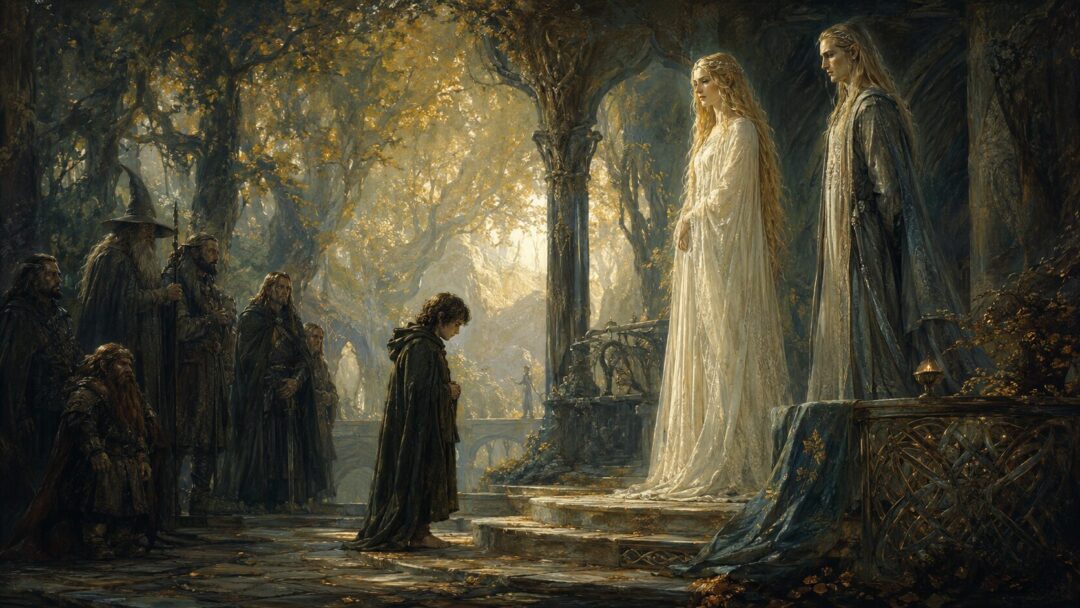
When the Fellowship first stands before Galadriel and Celeborn, the scene is beautiful, but it is not soft.
Galadriel does not merely welcome them. She looks at them.
The text makes it clear that her gaze goes deeper than ordinary sight. The members of the Company feel as if their hearts have been searched. Each of them seems to be offered a choice in thought: to continue on the hard road, or to turn aside toward something they greatly desire.
This is one of the most important details in the Lórien chapters.
Galadriel is not casually reading faces. She is revealing the inner tension of the Quest. Everyone who has come this far carries fear, longing, ambition, grief, or hidden doubt. The Ring may be Frodo’s burden, but the war against it is not his alone.
Every member of the Company must decide what kind of person he will become in its shadow.
Boromir is especially disturbed afterward. That matters, because Boromir’s later fall does not appear from nowhere. Lórien does not create his temptation, but it helps reveal the pressure already growing inside him.
Frodo is standing in the center of that pressure.
He is small, quiet, and physically weaker than nearly everyone around him. Yet the thing he carries draws out the truth of others. Near him, hidden desires become harder to hide.
This is the first thing Galadriel sees.
Frodo is not just carrying danger.
He is carrying revelation.
The Ring Makes the Mighty More Dangerous
This is why Galadriel’s understanding of Frodo is so different from a simple admiration of courage.
Many people can admire Frodo. Aragorn honors him. Gandalf loves and guides him. Sam serves him with extraordinary loyalty. Elrond entrusts him with the Quest after the Council. All of that matters.
But Galadriel sees him from another angle.
She is one of the greatest of the Eldar still remaining in Middle-earth. She bears Nenya, one of the Three Rings of the Elves. Her realm exists in a state of beauty and preservation that is deeply tied to Elvish power and memory. She has resisted Sauron for long ages.
So when Frodo comes before her, she is not simply looking down at a brave little hobbit.
She is looking at the one person in Middle-earth who now carries the object that could destroy everything she has guarded.
And worse, the same object could offer her a terrible path to preserve it.
That is the danger.
The Ring does not tempt everyone in the same way. It works through the desires already present in the heart. For the cruel, it offers domination. For the fearful, safety. For the noble, it may offer the power to do good by force.
This is why the Wise fear it.
Not because they are weak.
Because they are strong.
The stronger the will, the greater the ruin if that will is bent toward mastery.
Frodo Offers Her the Ring
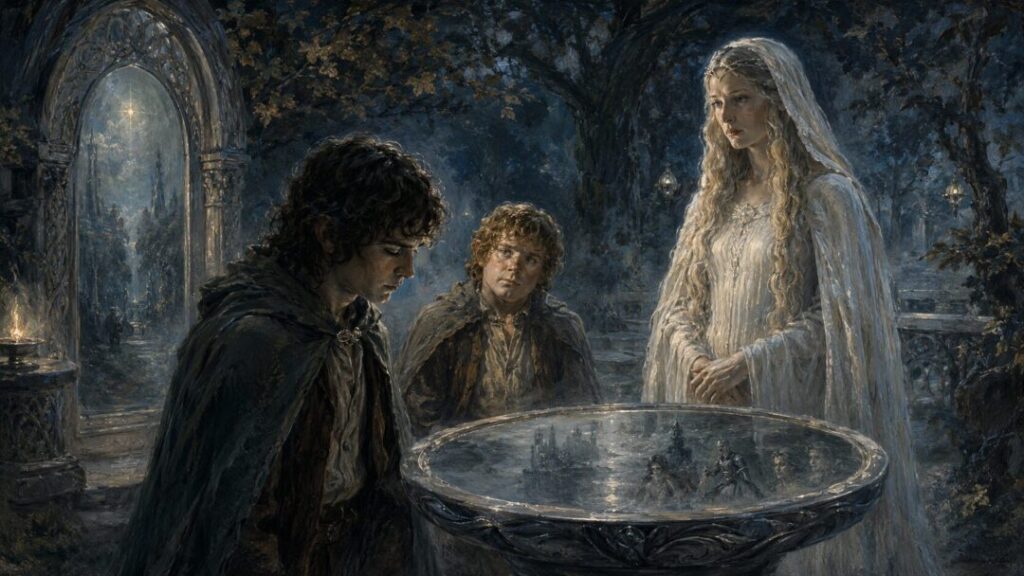
The most revealing moment comes beside the Mirror.
Frodo sees more than he expected. He sees visions of things that may be, things that are, and things that might come to pass. He sees the Eye searching. He becomes aware that Galadriel also bears a Ring.
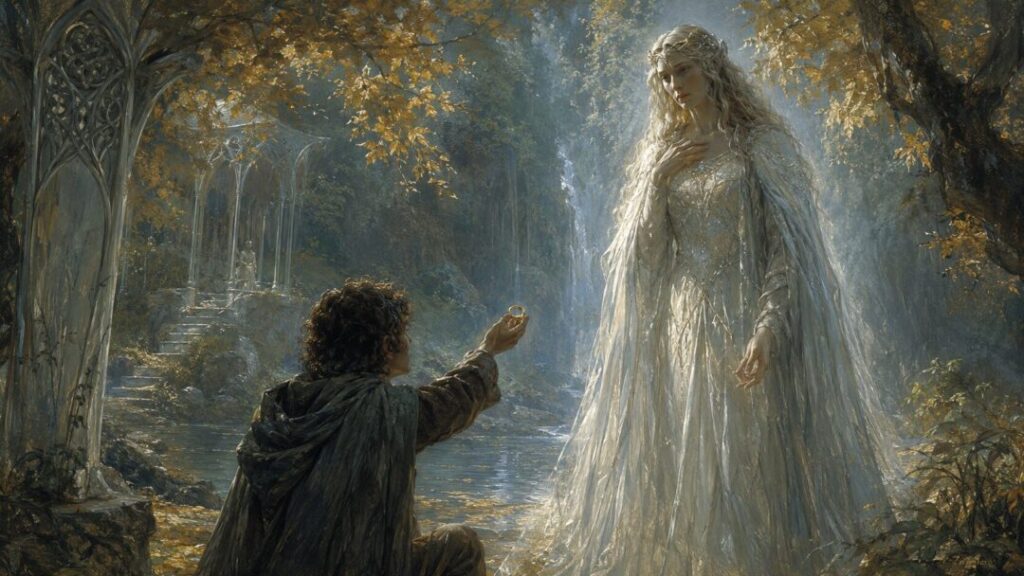
Then he does something astonishing.
He offers her the One Ring.
This is not presented as a calculated political act. Frodo is not trying to corrupt her. He is not scheming. He is overwhelmed, frightened, and painfully aware that the burden is beyond him. In that moment, giving the Ring to Galadriel may seem to him like wisdom.
After all, she is ancient, powerful, and beautiful. She opposes Sauron. She understands more than he does. If anyone could use the Ring against the Dark Lord, surely it would be someone like her.
But that is exactly the trap.
The easy answer is that Galadriel is tempted because she wants power.
The deeper issue is that she is tempted because the Ring can dress power in noble clothing.
She does not deny the desire. She says plainly that her heart has greatly desired what Frodo offers. That honesty is crucial. Galadriel’s greatness is not shown by pretending temptation is beneath her.
It is shown by facing it fully.
In Frodo’s offer, she sees the shape of the thing she might become. Not merely a rescuer. Not merely a queen. Something beautiful, terrible, and dominating. A ruler who would replace Sauron, but still rule through the logic of the Ring.
Then the moment passes.
She refuses.
“I pass the test,” she says.
And that line changes the entire scene.
Frodo Was Not the Only One Being Tested
This is the hidden reversal of Lórien.
At first, it appears that Frodo has come to Galadriel to be examined.
In one sense, he has. She sees his mind. She recognizes the burden he carries. She warns him against trying to use the Ring’s power. She gives him counsel.
But Frodo also becomes the occasion of Galadriel’s own test.
This is what many readers miss.
The Ring-bearer is not merely a student before a teacher. He is not simply a child in the presence of ancient wisdom. By carrying the Ring into Lórien, Frodo brings Galadriel to the very question that defines her future.
Will she remain herself without seizing the power to preserve what she loves?
Or will she become something else in the name of saving it?
Her answer is one of renunciation.
She will diminish. She will go into the West. She will remain Galadriel.
That statement is not defeat in the ordinary sense. It is a refusal to become great by the Ring’s standard. It is the acceptance of loss rather than domination.
And Frodo is the one who brings that choice into the open.
Not because he is mighty.
Because he is entrusted with something that makes all false strength reveal itself.
What Galadriel Understands About Frodo’s Smallness
Frodo’s smallness is not an accident in the story.
He is not a king. He is not a warrior. He does not command armies. He does not possess ancient knowledge. Even among hobbits, he is not physically imposing.
This is precisely why the Quest can take the shape it does.
The Ring is a weapon of mastery. It belongs to the logic of domination, possession, and control. Those who imagine they can wield it for great purposes are already in danger of thinking in its terms.
Frodo does not defeat the Ring by being more powerful than it.
He bears it.
That distinction matters.
Galadriel seems to understand that Frodo’s role is not to conquer the Ring in a contest of strength. No one can safely do that. His role is to carry it further than power, wisdom, and strategy alone could take it.
This does not make Frodo immune. The texts never suggest that. In fact, they show the opposite. The Ring works on him. It grows heavier. It wounds him inwardly. At the Cracks of Doom, he is unable to cast it away by voluntary strength.
But this does not make his journey meaningless.
It reveals the terrible scale of what he endured.
Galadriel sees the beginning of that cost before many others fully understand it.
The Gift She Gives Him Is Not Random
When Galadriel gives gifts to the Company, each gift carries meaning.
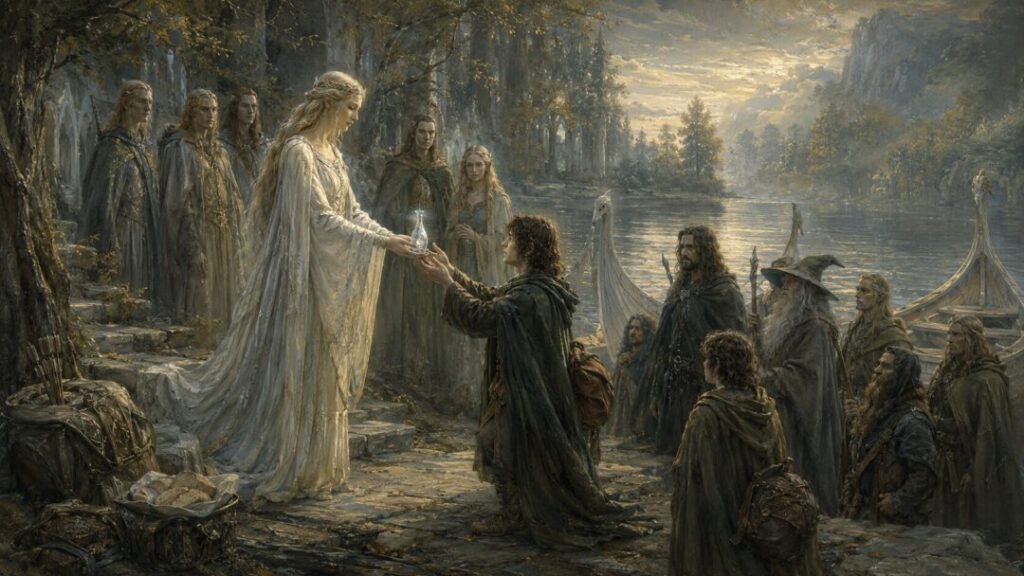
To Frodo, she gives the Phial containing the light of Eärendil’s star, caught in the water of her fountain. She tells him it will be a light in dark places, when all other lights go out.
This gift is not a weapon in the ordinary sense.
It does not make Frodo stronger in battle. It does not give him authority. It does not let him command the Ring. It does not turn him into a hero of the kind sung about in war.
It gives him light.
That is exactly what he will need.
The Phial later becomes crucial in Shelob’s Lair, one of the darkest passages of the Quest. Frodo and Sam are not facing a battlefield there. They are moving through suffocation, terror, webs, and ancient hunger. The gift Galadriel gives is suited not to conquest, but to endurance.
This suggests something important about what she saw.
She did not look at Frodo and imagine him winning by force.
She saw a bearer who would have to keep going when strength failed, when hope thinned, and when the path narrowed into darkness.
So she gave him something that answered the kind of darkness he would actually face.
Not domination.
Illumination.
Galadriel Sees the Wound Before the Ending
There is another layer, though it must be stated carefully.
The text does not say that Galadriel foresees every detail of Frodo’s later suffering. It does not tell us that she knows exactly what will happen at Cirith Ungol, Mount Doom, or the Grey Havens.
But the Lórien chapters do show that she understands the spiritual nature of his burden.
She knows the Ring is not merely a dangerous object. She knows it reaches into desire, fear, and will. She knows that bearing it is not the same as carrying a heavy stone. It is a pressure upon the self.
That makes her gift and her behavior toward Frodo more poignant.
Others may still hope that if the Quest succeeds, the world can simply be restored. Sauron will fall. The Shire will be safe. The King will return. The Shadow will pass.
All of that is true.
But Frodo will not be restored so easily.
Later, after the Ring is destroyed, this becomes painfully clear. Frodo returns to the Shire, but he cannot fully return to the life that was taken from him. His wounds remain. His burden has changed him too deeply.
The later explanation is not that Frodo goes West to become immortal. Mortals do not become immortal by sailing. He is allowed to pass over Sea for healing, if healing can be found before he dies.
That ending feels like a distant echo of Lórien.
Galadriel gave him light for a darkness he had not yet entered.
The West later offers him rest for wounds Middle-earth cannot wholly cure.
What Others Missed
So what did Galadriel see in Frodo that others missed?
Not merely that he was brave.
Not merely that he was innocent.
Not merely that he was important.
She saw that his smallness was the very shape of the Quest’s wisdom. She saw that the Ring would expose the hearts of the mighty. She saw that Frodo’s burden would not only threaten him, but reveal the truth of everyone who came near it.
In his presence, Boromir’s desire becomes clearer.
Sam’s loyalty is tested.
Galadriel’s own ancient temptation rises and is refused.
Even the reader is tested, because Frodo does not look like the kind of figure who should matter this much.
But he does.
He matters because Middle-earth is not saved by a will strong enough to master evil. It is saved through pity, endurance, mercy, renunciation, and grace.
Frodo stands at the center of that pattern.
Galadriel recognizes it before the Quest reaches its darkest places.
The Mirror Was Never Just About Seeing the Future
The Mirror of Galadriel is often remembered for its visions.
But the deeper mirror in Lórien is Frodo himself.
Through him, the hidden things are reflected.
The Wise see the danger of their own greatness. The Company sees the cost of continuing. Galadriel sees the temptation to preserve beauty by force. Frodo sees enough to understand that he is moving through a war of wills far greater than he imagined.
And still, he goes on.
That is why Galadriel’s understanding of him matters so much.
She does not mistake him for a conqueror.
She does not treat him as a future king.
She does not arm him as if the final victory will come through strength.
She gives him light, because the road ahead will become almost lightless.
And perhaps that is the clearest answer.
What Galadriel saw in Frodo was not the certainty of victory.
It was the terrible holiness of a burden carried by someone too small to master it, yet faithful enough to bear it further than the great could safely go.
That is why the scene in Lórien is not just a pause before the Quest continues.
It is the moment the story quietly reveals what kind of victory Middle-earth actually needs.
Not power taking power from evil.
Not a greater throne replacing a darker one.
But the refusal to become the thing one fights.
And in that moment, before the darkness of Mordor, Galadriel sees the truth standing in front of her:
a small hobbit, holding the fate of the world, and already paying the price.
Sources & Notes
- J.R.R. Tolkien, The Lord of the Rings, Book II, Chapter 7, ‘The Mirror of Galadriel’ — Galadriel’s searching gaze, Frodo’s offer of the Ring, and her refusal make Lórien the key textual basis for seeing Frodo as a test of others.
- J.R.R. Tolkien, The Lord of the Rings, Book I, Chapter 2, ‘The Shadow of the Past’ — Gandalf explains the Ring’s pull, Bilbo’s pity, and Frodo’s appointed burden, grounding the hidden moral weight Galadriel later perceives.
- J.R.R. Tolkien, The Lord of the Rings, Book II, Chapter 2, ‘The Council of Elrond’ — Frodo freely accepts the errand when the great and wise cannot safely claim the Ring, distinguishing his courage from rank or power.
- J.R.R. Tolkien, The Lord of the Rings, Book VI, Chapter 9, ‘The Grey Havens’ — Frodo’s lasting wound after the Quest confirms the depth of the burden that Galadriel’s insight foreshadows in Lórien.
- J.R.R. Tolkien, The Letters of J.R.R. Tolkien, Letter 246 — Tolkien’s discussion of Frodo’s failure, mercy, and limits helps frame Frodo as spiritually burdened rather than simply triumphant.