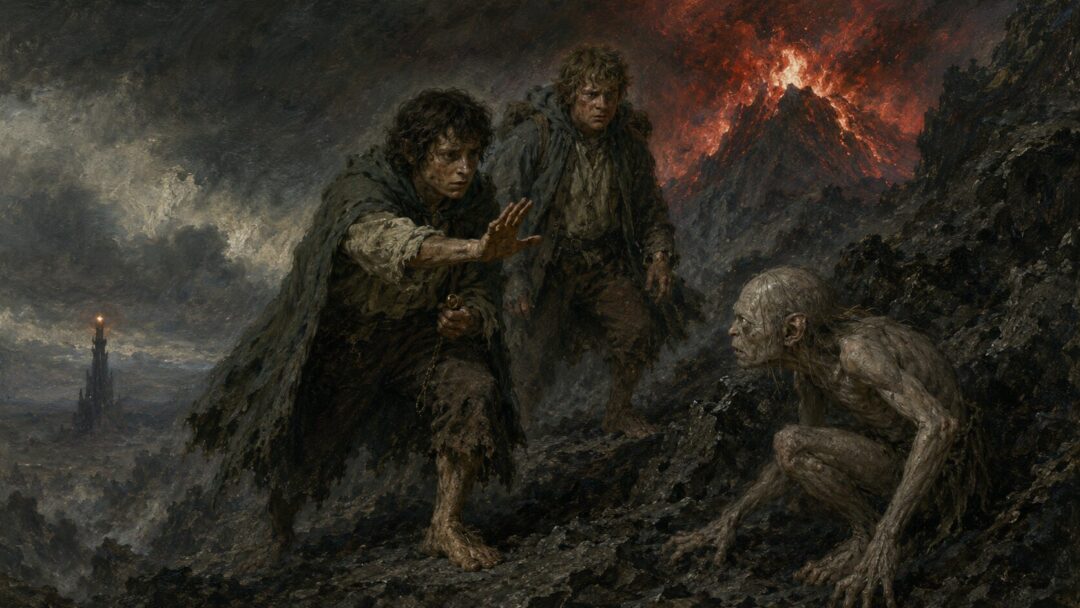
At first glance, the Ring wins at Mount Doom.
That is the uncomfortable truth at the center of the ending.
Frodo does reach the Crack of Doom. He does stand in the one place where the Ring can be destroyed. He does carry the burden farther than any reasonable hope could demand.
And then he cannot give it up.
The moment is not softened. It is not rewritten into a clean act of heroic will. Frodo says he will not do what he came to do. He claims the Ring for himself and puts it on.
For a heartbeat, the Ring has achieved exactly what it was made to achieve.
It has mastered its bearer.
But that victory lasts only a moment.
And the reason is one of the strangest and most powerful pieces of moral design in all of Middle-earth.
The Ring Wins the Contest of Will
The first thing to admit is that Frodo does not voluntarily destroy the Ring.
That matters.
The story does not pretend that the final victory comes because Frodo finds one last hidden reserve of strength and casts the Ring away. The truth is harsher and, in many ways, more merciful.
At the end, the pressure is too great.
Frodo is exhausted, starved, wounded, and spiritually worn down. He has carried the Ring through Mordor itself, closer and closer to the place where its power is most completely tied to the world. Inside the Sammath Naur, at the very heart of its making, the burden reaches its height.
This is why the scene is so devastating.
Frodo has not been secretly weak all along. He has spent everything. The texts do not treat his collapse as ordinary greed. They present it as the final breaking-point of a bearer who has endured beyond natural strength.
So yes, in that narrow sense, the Ring wins.
It finds the limit of Frodo’s will.
It presses until even he cannot surrender it.
Why This Is Not a Simple Failure
This is where many readings of the scene go wrong.
If the question is, “Why didn’t Frodo simply throw it in?” the answer is that by that moment “simply” no longer exists.
The Ring is not just an object Frodo is holding. It is a power made by Sauron, bound to domination, and designed to master desire. It works by taking what is already in a person and bending it toward possession.
Boromir imagines using it as a weapon.
Gollum worships it as his Precious.
Sam, for a brief time, sees visions of himself setting the world right through power and command.
Frodo’s temptation at the end is not identical to theirs, but the pattern is the same. The Ring does not need him to become Sauron. It only needs him to say one thing:
Mine.
That is why the final claim is so terrible. It is the smallest possible word for the largest possible surrender.
The Ring Reveals Itself
But the Ring’s victory creates its own danger.
The whole quest depends on secrecy. Sauron fears enemies who might wield the Ring against him, but he does not imagine that someone would try to destroy it. That blind spot is essential. The Wise cannot overcome him by strength, so they move by a road he does not understand.
For most of the journey, the Ring is hidden.
At Mount Doom, that changes.
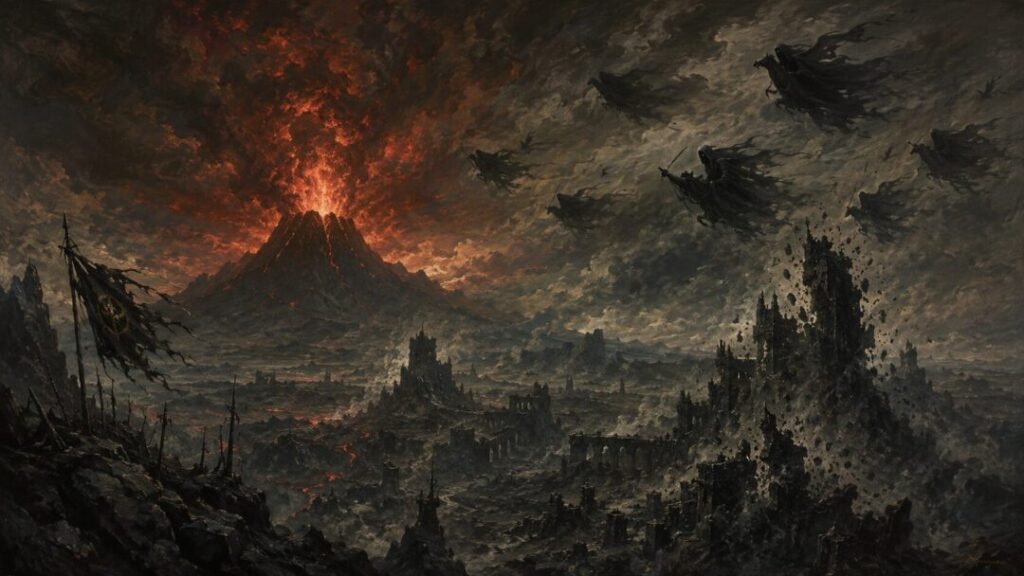
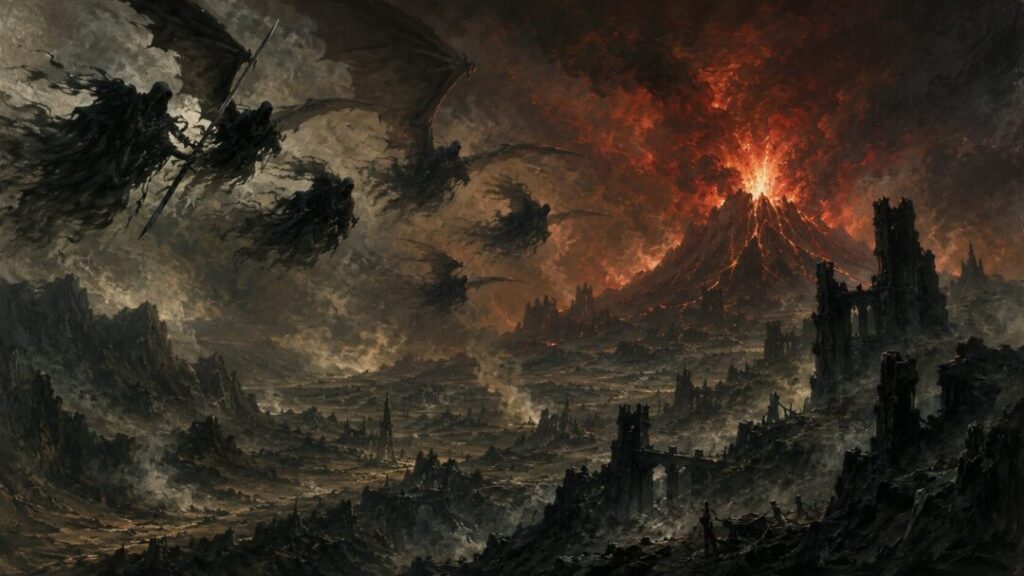
When Frodo claims it and puts it on, the concealment is broken. Sauron becomes aware of him. The remaining Nazgûl are sent racing toward the Mountain, but the discovery comes too late.
This is the first reason the Ring’s victory lasts only a moment.
By conquering Frodo at the Fire, it announces itself at the one place where it is most vulnerable.
The Ring wins the bearer, but it loses the hidden road.
It brings Sauron’s attention to the truth only when the truth can no longer be prevented.
Gollum Is Not an Accident
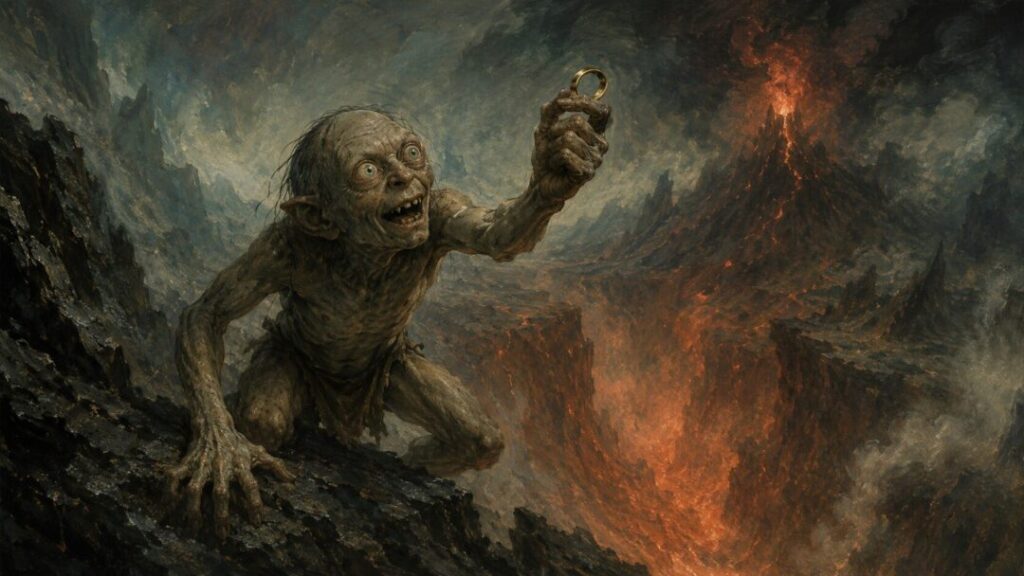
Then Gollum enters the scene.
This can look like chance. Frodo fails, Gollum attacks, the Ring is bitten from Frodo’s hand, and Gollum falls into the fire. If read too quickly, the ending may seem almost arbitrary.
But the story has been preparing for this for a very long time.
Gollum is alive because Bilbo once pitied him.
He is alive because Frodo later refused to kill him.
He is alive because Sam, even after hating and distrusting him, does not strike him down on the slopes of Mount Doom.
None of these choices make practical sense in a simple military reading of the story. Gollum is treacherous. He is dangerous. He betrays Frodo to Shelob. He follows the Ring with a hunger that nothing can heal.
And yet his life is repeatedly spared.
That mercy does not make him good.
It does not erase what he has done.
But it leaves him present at the only moment when his obsession can become part of the Ring’s undoing.
The Ring Cannot Understand Mercy
This is the deeper irony.
The Ring is made for mastery. It operates in the world of possession, domination, fear, and desire. It knows how to magnify the will to own. It knows how to turn pity into weakness, courage into pride, and wisdom into control.
What it cannot use is mercy in the same way.
Mercy does not defeat the Ring by overpowering it. Bilbo’s pity does not destroy Sauron in the tunnels under the Misty Mountains. Frodo’s pity does not instantly redeem Gollum. Sam’s restraint does not suddenly make the path safe.
At the time, each act looks incomplete.
Even foolish.
But together they create the one condition the Ring cannot master: Gollum is still there.
The Ring can corrupt Gollum’s desire. It can make him pursue it beyond reason. It can hollow him out until almost nothing remains but hunger.
But it cannot prevent the earlier mercies that allowed him to survive.
And at the end, those mercies return in a form no one could have controlled.
Gollum’s Triumph Is the Ring’s Defeat
Gollum’s final moment is also a victory.
For him, it is complete.
He has recovered the Precious. He has taken back the thing around which his ruined life has turned for centuries. In that instant, he is not thinking of Sauron, Frodo, the West, the Shire, or the fate of the world.
He has what he wants.
That is what makes the scene so chilling.
The Ring’s power over desire reaches its most concentrated form in Gollum’s joy. He does not renounce it. He does not choose to destroy it. He does not become wise at the last second.
He celebrates.
And in that celebration, he falls.
The texts do not require us to turn Gollum’s fall into a conscious sacrifice. That would soften the horror too much. His death is not presented as a clean redemption scene. It is the final collision of obsession, warning, mercy, and doom.
He gets the Ring.
And because he gets it there, at the edge of the Fire, the Ring is destroyed.
Frodo’s Warning and the Shape of Doom
There is another detail that makes the ending feel less accidental.
Before the final moment, Frodo warns Gollum that if he touches him again, he will be cast into the Fire of Doom. This should be handled carefully. The text does not turn Frodo into a wizard pronouncing a mechanical spell. Nor does it explain the fall as a simple curse operating like a rule.
But the warning matters.
It gives the final scene a sense of moral shape. Gollum has sworn by the Precious. He has broken faith. He has attacked again. He has pursued possession until he is blind to every edge around him.
So when he falls, the moment feels like more than a slip.
It feels like the story’s hidden pattern closing.
Not because Gollum freely destroys the Ring.
Not because Frodo physically casts it away.
But because all the choices made before the Fire have gathered there.
The Ring’s Victory Was Too Narrow
The Ring wins in the smallest possible way.
It wins Frodo’s final act of will.
But by then, the whole world has been arranged around that moment.
Sam has carried Frodo far enough.
The armies of the West have drawn Sauron’s gaze outward.
Gollum has been spared long enough to arrive.
The Ring has been brought to the only place where it can perish.
This is why its triumph cannot last.
It conquers the final inch of Frodo’s will, but not the road that brought Frodo there. It masters the bearer, but not the mercy that preserved Gollum. It reveals itself to Sauron, but too late for Sauron to reclaim it.
The Ring wins one soul’s last resistance.
It loses the entire design surrounding that resistance.
Victory Without Boasting
This is also why the ending feels so unlike ordinary fantasy victory.
No one stands above the Fire and defeats evil by superior strength. Frodo does not become untouchable. Sam does not strike the perfect blow. Gollum does not fully repent. Even Sauron is not beaten in a duel.
Instead, the Ring is destroyed through a chain of weakness, endurance, pity, obsession, and providence.
That is not an accident of plotting.
It is the point.
The Ring belongs to the logic of power. It assumes that the strongest will, the fiercest desire, or the greatest claim must prevail. And at the Crack of Doom, that logic seems to be proven true.
Frodo cannot give it up.
Gollum cannot stop wanting it.
Sauron is still strong enough to send terror racing through the sky.
And yet the final answer comes from something power has never understood properly.
Mercy has been moving through the story long before Mount Doom.
Quietly.
Imperfectly.
At times almost invisibly.
By the time the Ring wins, mercy has already placed the last piece on the board.
Why the Moment Matters
The Ring’s final victory lasts only a moment because evil can win the act and still lose the story.
That is the strange hope of Mount Doom.
Frodo is not honored because he was limitless. He is honored because he went as far as he could, until there was nothing left. His collapse does not erase the road. It reveals how terrible the burden truly was.
Gollum is not spared because he is harmless. He is spared because pity sees more than usefulness, even when the result cannot be known.
And the Ring is not destroyed because anyone masters it.
It is destroyed because, at the end, its own logic turns inward.
It creates hunger.
It creates possession.
It creates the cry of “mine.”
Then the creature most consumed by that cry takes it back at the only place where taking it means losing it forever.
For one breath, the Ring wins.
Then all the mercy it could not understand catches up with it.
Sources & Notes
- J.R.R. Tolkien, The Lord of the Rings, Book VI, Chapter 3, “Mount Doom” — shows Frodo claiming the Ring at the Fire, Sauron suddenly perceiving him, and Gollum’s seizure and fall destroying the Ring.
- J.R.R. Tolkien, Letter 246 — Tolkien’s own commentary says Frodo had spent all his will and strength, and that the Quest was saved through pity, mercy, and Gollum’s presence rather than a simple last act of will.
- J.R.R. Tolkien, The Lord of the Rings, Book I, Chapter 2, “The Shadow of the Past” — Gandalf explains Bilbo’s pity for Gollum and suggests Gollum may still have some part to play before the end.
- J.R.R. Tolkien, The Lord of the Rings, Book IV, Chapter 1, “The Taming of Sméagol” — Frodo spares and masters Gollum with pity and the oath by the Precious, setting up the moral chain that reaches Mount Doom.
- J.R.R. Tolkien, The Lord of the Rings, Book VI, Chapter 1, “The Tower of Cirith Ungol” — Sam’s brief bearing of the Ring shows how it magnifies desire into visions of command even in a humble and resistant heart.